

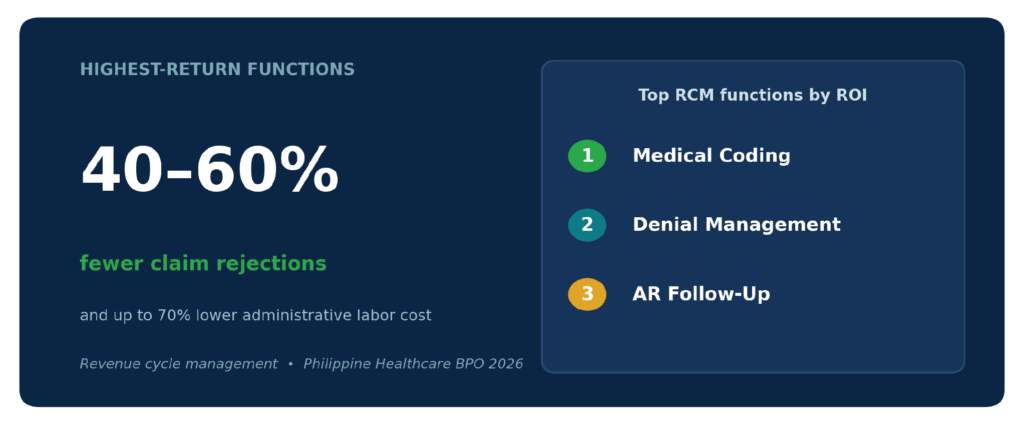
The highest returns come from outsourcing revenue cycle management (RCM)—specifically medical coding, denial management, and accounts receivable (AR) follow-up. These administrative functions directly drive net patient revenue, typically reducing claim rejections sharply and cutting labor costs well below domestic staffing, which is why they sit at the center of the healthcare service line for US providers.
Key Takeaways
- Cash-flow optimization: Prioritizing RCM tasks—billing, coding, denial management—shortens the order-to-cash cycle and delivers immediate liquidity improvements.
- Operational arbitrage: Philippine BPO shifts fixed, high-cost domestic overhead to a scalable variable-cost model without sacrificing clinical accuracy.
- Clinical-administrative synergy: The Philippines’ vast pool of registered nurses and medical practitioners enables coding precision generalist clerical teams cannot match.
- Strategic de-risking: Specialized partners cut the “rework tax” of internal billing errors while maintaining rigorous HIPAA and HITRUST compliance.
- Scalability: Outsourced RCM teams can be deployed or adjusted quickly, sustaining performance through seasonal billing spikes and volume surges.
Why Do RCM Functions Deliver Superior Financial Returns?
Because they govern the speed and certainty of reimbursement. Outsourcing low-complexity data entry yields modest gains; outsourcing medical coding and denial management to clinically literate specialists slashes costly claim “rework,” lowers denial rates, and accelerates the payment cycle—where the real money is.
Executives often misallocate outsourcing budgets toward low-complexity tasks like basic data entry. Those produce modest efficiency gains, but the decisive financial impact lives in the workflows that dictate how fast and how reliably insurers pay. When medical coding and denial management are handled by specialists who understand clinical documentation, organizations see a drastic reduction in rework—the manual correction of rejected claims—alongside lower denial rates and a faster payment cycle.
Ranking the major RCM functions by impact, complexity, and return makes the priorities clear, and it mirrors the pattern seen in the functions that deliver the largest operational improvements.
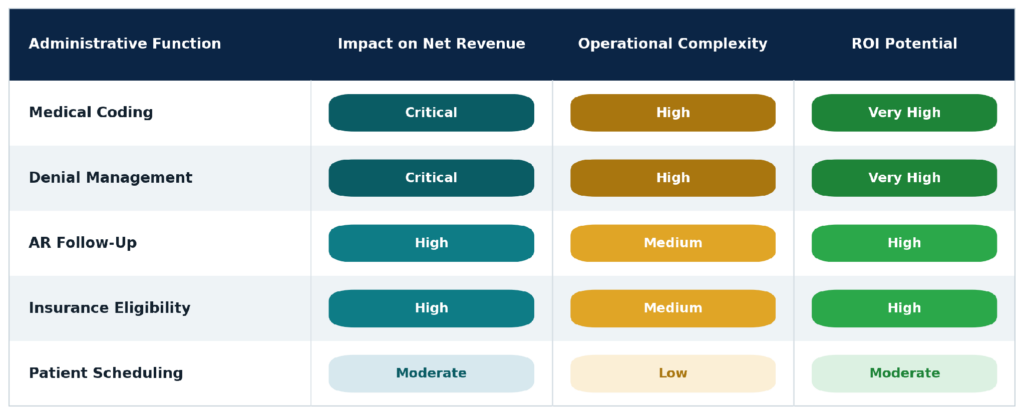
Figure 1. Administrative functions ranked by net-revenue impact, operational complexity, and ROI potential.
Plotted spatially, the returns concentrate where high revenue impact meets specialist-grade complexity: medical coding and denial management sit firmly in the highest-return zone, while patient scheduling—though easy to offload—moves the needle least.
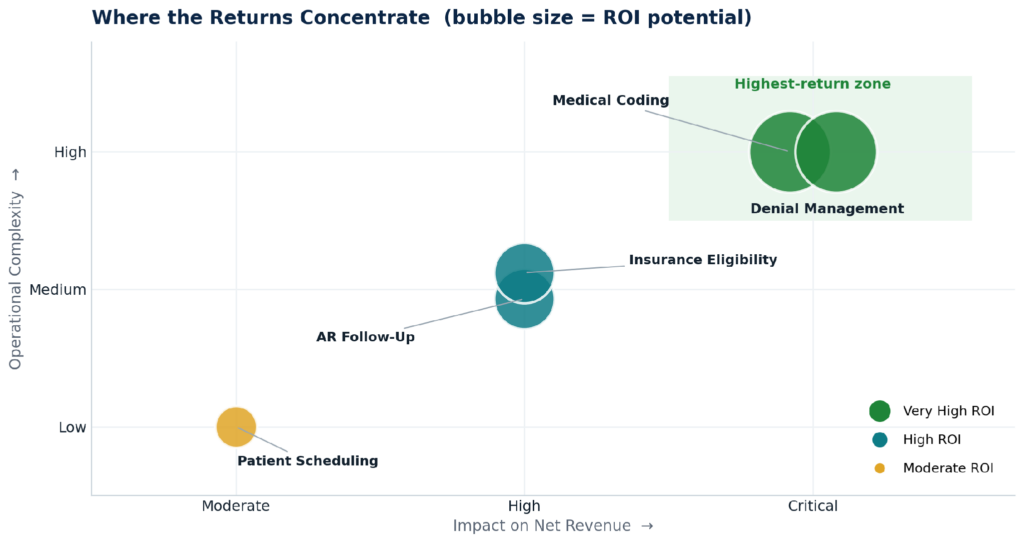
Figure 2. Where returns concentrate: impact × complexity, with bubble size showing ROI potential.
How Do You Mitigate Risk When Outsourcing Sensitive Clinical Data?
Choose healthcare-specialized partners that treat security as an operational discipline—not a checklist. Require verifiable HITRUST, SOC 2, and HIPAA certifications and dedicated, non-public infrastructure for healthcare teams, layered into a defense-in-depth model around protected health information.
Risk management is the primary hurdle for enterprise buyers, but top-tier Philippine providers have matured into global leaders in security infrastructure, where compliance is the cornerstone of the offering rather than an afterthought. The key is to look past generalist BPOs toward partners with deep, verifiable experience in healthcare-specific regulatory environments—organizations that maintain HITRUST, SOC 2, and HIPAA certifications, run dedicated, non-public infrastructure for their healthcare teams, and can show succession cover for mission-critical clinical and compliance roles.
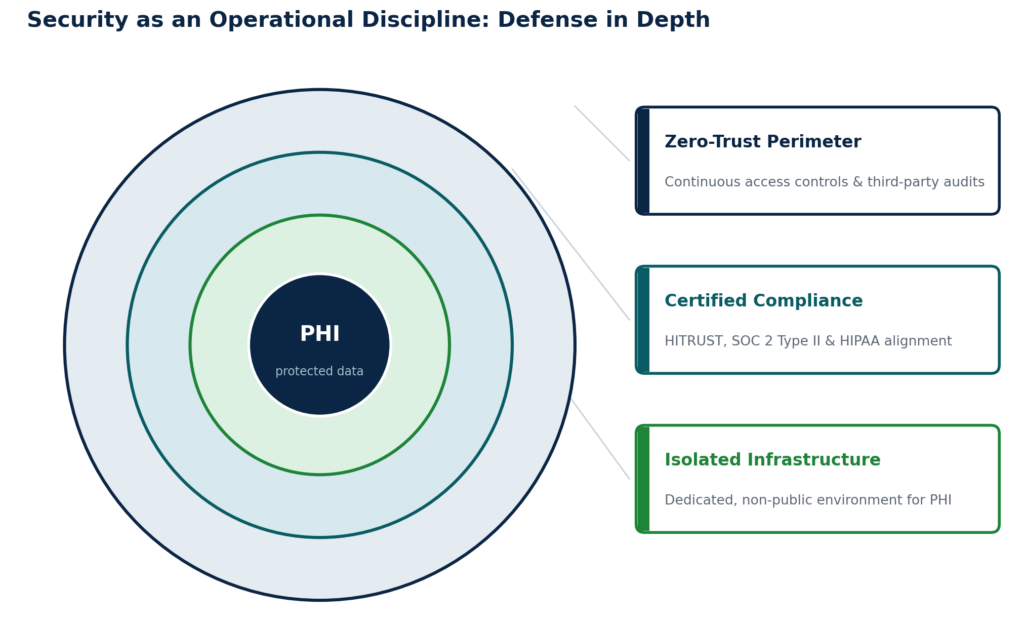
Figure 3. A defense-in-depth model: isolated infrastructure, certified compliance, and a zero-trust perimeter around PHI.
“Healthcare isn’t just another BPO vertical—it’s an entirely different category of risk. It’s the only industry where a single data incident can trigger federal investigations, where coding errors can influence downstream clinical decisions, and where regulatory non-compliance can threaten an organization’s license to operate. The highest return isn’t just about labor savings; it’s about partnering with providers who view security as an operational discipline, not a checklist.” — John Maczynski, CEO of PITON-Global.
What Do Real-World Results Look Like?
A multi-state physician group with a high denial rate and a 45-day AR cycle was matched—via PITON-Global—to a boutique, healthcare-specialized Philippine provider. Within 180 days, denials fell by roughly three-quarters, the AR cycle dropped to 28 days, and total administrative cost fell substantially.
The group struggled with complex, multi-payer documentation and initially considered large “big-box” providers, only to find them short on medical-specific domain expertise. Through PITON-Global’s advisory process it was matched with a specialist holding a documented high-accuracy record in its medical specialty. The partner deployed a 60-person team—including certified medical coders—and added an AI-assisted eligibility-verification workflow to catch errors at the point of registration.
Indexed to the pre-outsourcing baseline, every core metric moved sharply in the right direction within two quarters.

Figure 4. Six-month transformation, indexed to baseline: denials, AR cycle, and admin cost all fall sharply.
How Does PITON-Global Accelerate Successful Provider Selection?
PITON-Global is a vendor-neutral advisor that replaces risky trial-and-error with a data-driven matching process. Drawing on a network of 100+ vetted Philippine providers, it identifies specialized “hidden champions” and runs an audited, five-stage selection framework so the chosen partner is architected for compliance and financial performance.
Who Is PITON-Global?
PITON-Global is a vendor-neutral outsourcing advisor that provides an audited layer of due diligence internal procurement teams often lack. It maintains a network of more than 100 carefully vetted Philippine providers and helps health systems navigate selection with a data-driven, advisory-led approach rather than guesswork.
How Does PITON-Global Differ From Traditional Outsourcing Brokers?
Rather than brokering whatever service pays best, PITON-Global acts as a neutral advisor and replaces the risky “trial-and-error” approach with a structured, data-driven matching process. Its focus is identifying the right specialized partner—not filling a quota—so clients avoid the most expensive mistake in outsourcing: choosing the wrong vendor.
How Does a Network of 100+ Vetted Philippine BPO Providers Benefit Organizations?
The curated network surfaces “hidden champions”—specialized vendors that combine the operational maturity of enterprise giants with the agility high-stakes healthcare programs require. Because each provider is pre-vetted, organizations bypass vendor-selection fatigue and reach a compliant, well-matched partner far faster.
How Does PITON-Global’s Advisory-Led Vendor Matching Process Work?
PITON-Global follows a five-stage selection framework: operational discovery, expert benchmarking, an RFP and audit, strategic matching, and implementation. The sequence aligns each client’s specific clinical and compliance requirements with a provider’s proven operational history before any commitment is made.
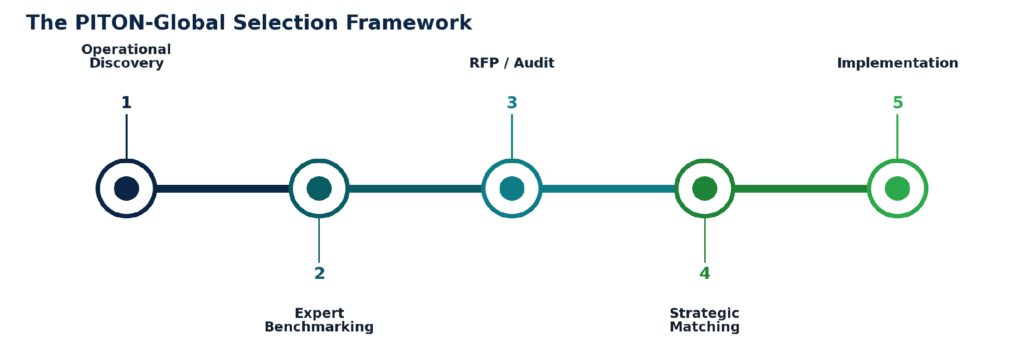
Figure 5. PITON-Global’s five-stage selection framework, from operational discovery to implementation.
Why Do Organizations Use PITON-Global?
Organizations use PITON-Global to avoid the costly mistake of choosing the wrong partner and to bypass vendor-selection fatigue. Its audited, data-driven process ensures the selected provider is architected for success, compliance, and long-term financial performance—so the highest-return functions are placed with a partner equipped to deliver them.
What Else Should Health Systems Know Before Outsourcing RCM?
Common questions cover HIPAA compliance, Philippine coder quality, the biggest first-mistake, time-zone handling, staffing impact, and implementation time. In short: leading providers meet or exceed U.S. security standards, clinical literacy is high, start with a focused pilot, use follow-the-sun workflows, augment rather than replace staff, and plan a 90–120 day rollout.
Is Philippine BPO infrastructure HIPAA-compliant?
Yes. Leading Philippine healthcare BPOs maintain stringent HIPAA, HITRUST, and SOC 2 certifications, often mirroring or exceeding the security protocols found in domestic U.S. clinical offices.
How does the quality of Philippine medical coders compare to U.S.-based teams?
The Philippines offers a massive talent pool of licensed nurses and clinical professionals, and that medical literacy enables superior coding accuracy compared with generalist administrative staff.
What is the biggest mistake organizations make when starting healthcare BPO?
Outsourcing too broadly without a defined scope. Successful programs start with a pilot focused on a single high-impact workflow—such as denial management—to stabilize quality before scaling.
How do time-zone differences affect clinical operations?
Modern providers use follow-the-sun workflows: back-office tasks like claims processing are completed during Philippine daylight hours, so U.S. teams begin the day with a fresh, audited data set.
Does outsourcing require replacing internal staff?
No. Most successful organizations use BPO to augment domestic teams, offloading high-volume repetitive tasks so internal staff can focus on complex clinical engagement and patient care. Weighing an offshore team against domestic hiring function by function shows where each fits best.
What is the typical timeframe for a full BPO implementation?
From initial advisory consultation to go-live, a structured, well-planned implementation typically spans 90 to 120 days.