PARALEGAL SUPPORT OUTSOURCING SERVICES PHILIPPINES

Paralegal support that keeps every matter moving.

Manila-based paralegal-support teams — attorney-supervised case preparation, document drafting, court-filing prep, deposition summaries and case-file management, so your attorneys spend their time practicing law, under SOC 2, ISO 27001 and GDPR controls.

Manila, Cebu & Davao delivery SOC 2 / ISO 27001 / GDPR Attorney-supervised
CASE-PREP INDEX LIVE
Filing accuracy
99%
Task turnaround
24hr
request to delivery
Cost per matter
55%
vs onshore staff
PARALEGAL SUPPORT A missed filing deadline or a sloppy exhibit puts the matter at risk. We shortlist attorney-supervised teams that keep every case organized and on schedule. Benchmark your case prep
SYSTEMS & STANDARDS
RelativityClioNetDocumentsiManageDocketingAttorney-supervisedGDPRSOC 2
01THE ESSENTIALS

What paralegal support outsourcing is.

THE ESSENTIALSLAST UPDATED · JUNE 2026

Paralegal support outsourcing is the delegation of paralegal work — case intake and organization, document drafting, court-filing prep, deposition and records summaries, and case-file management — to attorney-supervised teams, run under SOC 2 and GDPR controls to accuracy, turnaround and cost-per-matter targets, so attorneys spend their time practicing law.

What is it?Paralegal support sourced from the Philippines — case prep, document drafting, filing prep, deposition summaries and case-file management, on an attorney-supervised workflow.
Primary KPI99% filing accuracy · 24-hour task turnaround · −55% cost per matter.
Who is this for?Law firms, corporate legal departments and litigation teams that want reliable case-prep and filing support without burning associate hours or expanding headcount.
Why PITON-Global?Vendor-neutral sourcing of the top 1% of Manila paralegal teams — vetted on attorney supervision, filing accuracy and SOC 2/GDPR compliance.
Evidence of successEngagement PS-088: task turnaround cut from 5 days to 24 hours · 99% court-filing accuracy, 98% on-time, zero missed statutory deadlines since cutover · verified Q2 2026.
02PARALEGAL METRICS

Paralegal metrics that survive a partner’s scrutiny.

Court-filing accuracy, task turnaround, on-time delivery and cost per matter from PITON-Global-vetted Manila paralegal teams, against the in-house and generic-offshore baseline — figures a partner can defend in a review.

METRICPITON-GLOBAL-VETTEDBASELINEWHY IT MATTERS
Court-filing accuracy99%~90%Filings accepted without rework
Task turnaround time24 hr~5 daysMatters move faster
On-time delivery rate98%~70%Usable as delivered
Cost per matter−55%onshore loadedArbitrage that funds supervision
Deadline-miss reductionZeromissed, since cutoverDual-docketed statutory deadlines (PS-088)
Work-product acceptance rate97%~75%Less manual touch
Cost vs in-house−65%in-house baseArbitrage without quality loss
Source: PITON-Global paralegal-support operating data, 2025–2026 engagements · baseline = in-house & generic-offshore averages
03THE MATTER-PREP WORKFLOW · INTERACTIVE

Every matter, organized and on the calendar.

A dropped deadline or a missing exhibit can cost the case. Disciplined paralegal support keeps every matter moving under attorney supervision. Expand each step to see how the team runs it.

FIGURE 1 · THE MATTER-PREP WORKFLOW, INTAKE TO REVIEW
STEP 01Case Intake & OrganizationMatter set up
New matters opened and organized — pleadings index, key dates calendared, and the case file structured so nothing is lost as the matter grows.
STEP 02Document DraftingTemplates & QA
Routine documents — pleadings, discovery requests, correspondence — drafted from firm templates and attorney instructions, then QA-checked.
STEP 03Court-Filing PrepRules-checked
Filings assembled to court formatting rules, exhibits compiled and tabbed, and deadlines verified — so the e-filing goes through the first time.
STEP 04Deposition & RecordsSummarized
Deposition transcripts and records summarized into attorney-usable digests, with key testimony and citations flagged.
STEP 05Attorney ReviewSupervised sign-off
A supervising attorney reviews every work product before it reaches the client or the court — paralegal work, never unauthorized practice.
STEP 06Matter Closeout & ArchiveRetention-ready
Closed matters are indexed, final documents filed to the DMS, and records retained or purged to your retention schedule — a clean, auditable close that keeps the matter file court-ready long after it settles.
The paralegal matter-prep workflow runs in six steps: case intake and organization, document drafting from templates, court-filing prep against formatting rules, deposition and records summarization, supervising-attorney review, and matter closeout. Because every work product is attorney-reviewed before it reaches a client or court, PITON-Global-sourced paralegal teams sustain 99% court-filing accuracy and 98% on-time delivery on a 24-hour task turnaround.
THE DEADLINE THAT CANNOT DEPEND ON ONE PERSON NOTICING

Zero missed statutory deadlines isn’t vigilance. It’s redundant docketing, rule-computed dates, and a calendar that requires two people to be wrong before anything slips.

A missed court deadline is the category’s terminal failure — the malpractice claim, the default judgment, the client letter nobody wants to write. The malpractice carrier’s real question isn’t “are you careful”; it’s “who checks the checker?” This is the answer.

EVERY DATE IS COMPUTED, NEVER COPIED

Deadlines are calculated from the triggering event under the governing rules (jurisdiction, court, case type — service method and holiday tables included), not transcribed from someone’s reading of an order — because a copied date inherits its source’s error, and a computed date can be re-derived by the person checking it. The computation is shown: trigger date, rule cited, arithmetic visible — so review means re-performing, not trusting.

DUAL-DOCKETING, INDEPENDENT

Every critical date is entered twice, by two people, from the source document — and the system diffs the entries. A mismatch is a catch, not an embarrassment; the metric celebrates them (mismatches caught pre-calendar, reported monthly), because the docket that never disagrees with itself is the docket nobody’s actually double-entering. The reconciler is never the recorder, and here the second recorder never sees the first entry.

THE ESCALATION LADDER OWNS THE SILENCE

Alerts escalate (30/14/7/3/1 days) to named owners until acknowledged with the responsive task attached — a deadline acknowledged without its filing in motion is a countdown wearing a checkmark. Unacknowledged alerts climb to the supervising attorney, then the relationship lead — because the failure mode isn’t the un-alerted deadline; it’s the alerted one everyone assumed someone else had.

THE WEEKLY DOCKET RECONCILIATION

The calendar re-tied to source weekly: new orders swept for triggering events, court-docket feeds diffed against the internal calendar, closed matters archived off the alert path — the cadence that keeps “zero missed” a system property instead of a lucky streak.

THE MALPRACTICE CARRIER’S QUESTIONWho checks the checker? A vendor whose answer is “our people are very careful” has given you their loss-run preview.
04RULES-CHECKED MEANS CHECKED AGAINST TODAY’S RULES

Page limits, fonts, exhibit formats, e-filing specs — versioned per court, per judge, updated on a maintenance cycle. Because the rule that changed last month is the rejection you get tomorrow.

Filing rules aren’t one rulebook; they’re thousands — federal, state, local, judge-specific standing orders — and they change. A filing rejected on last year’s formatting rule is a clock risk wearing a font size.

The rules library, versioned per venue.
Federal, state, and local rules plus judge-specific standing orders maintained as versioned checklists per court — formatting, page limits, certificate requirements, exhibit conventions, e-filing technical specs — with change monitoring on the venues your matters live in, and every checklist stamped with its verification date. A filing preps against the venue’s current checklist, and the checklist’s currency is itself QA’d.
The e-filing rejection protocol.
Rejections happen even to clean shops; what matters is the clock. Every e-filing submission is monitored to acceptance, not to submission — a rejection triggers same-shift correction and refiling with the deadline math re-run (was the original filing timely under the relation-back rules? escalated to counsel with the analysis, never assumed) — and rejection reasons feed the venue checklist, so the same rejection never happens twice. Submitted is not filed; accepted is filed — and the desk that logs off at “submitted” is gambling with your clock.
STAFFED FOR TRIAL BEFORE THE PRETRIAL ORDER LANDS

Trial is the paralegal function’s mass event — six weeks against a court calendar that doesn’t move, its workload discovered nightly.

The trial bench activates at the pretrial-conference milestone: exhibit management (numbered, objections-tracked, the version the courtroom sees matching the version the binder holds), designation support on the deposition record, witness binders built to the examining attorney’s spec, and overnight turnaround through trial weeks — the daily transcript summarized, the next day’s binder adjusted, ready when counsel arrives. The follow-the-sun advantage at its most literal: trial days end at 5; our shift starts at 6.

THE LAST JOB IS THE NEXT TEAM’S FIRST ASSETPost-trial, the record is closed to appeal-ready standard — because the trial team’s last job is the appellate team’s first asset.
05THE PHILIPPINE PARALEGAL BENCH

Why firms run paralegal support from the Philippines.

The country produces legal talent at a scale few can match — a deep, compliance-trained, English-fluent talent base with the rigor to support attorneys while protecting attorney productivity, at a fraction of onshore cost.

A deep legal-support talent pool
Tens of thousands of law and paralegal graduates, many bar-qualified, a year — enough to staff true paralegal benches, not just data clerks.
Common-law & legal-writing fluency
Common-law training and legal-writing skill, so the work needs oversight, not rework, when it reaches your attorneys.
Controls discipline
A conscientious, detail-first culture that makes accurate drafting and second-pair-of-eyes QA natural.
Round-the-clock contact windows
Follow-the-sun coverage means case prep runs overnight, so filings and drafts are ready when your attorneys log on — your team arrives to progress that already moved forward.
Cost advantage
60–70% lower fully-loaded cost than onshore paralegals — arbitrage that funds supervision and senior review.
Security & SOC posture
SOC 2 and ISO 27001-aligned facilities with access control built for sensitive client and matter data, so privileged case data is protected.
If deadlines keep slipping, the problem is not effort — it is the absence of a disciplined cadence.
06INSIDE THE CADENCE

How reliable, on-time paralegal work is engineered.

Reliability is engineered into the workflow, not hoped for after a missed deadline. The discipline below is what separates a managed paralegal operation from a basic staffing desk.

1
Organized-from-intake cadence
Matters are organized from intake, not after they pile up, so most tasks turn around from a near-final position.
2
Docket-driven cadence
Every matter’s critical path runs from its computed dates, so the work is sequenced by the court’s clock, not the queue’s.
3
Attorney-grade controls
Compliant workflows, attorney QA on every work product and a complete audit trail keep filings court-ready.
4
Docket & deadline tooling
Case-management automation flags filing-rule issues and enforces attorney sign-off, so exceptions surface early, not at the deadline.
5
Supervising-attorney review
A supervising attorney signs off on filings and complex work product, so what reaches your attorneys needs review, not redo.
6
Deadline-integrity discipline
Disciplined docketing and QA protect the matter, avoid missed deadlines and keep filings clean.
07THE MATH OF RELIABLE SUPPORT

Where the 7.2× return comes from work done right the first time.

From four streams a per-hour rate ignores: malpractice exposure retired, attorney hours returned to billable work, filing-rework eliminated, and labor arbitrage. A deadline hit cleanly is worth far more than a scramble the night before.

Malpractice Exposure Retired (the missed-deadline claim, sized)
$1.7M – $3.0M
Attorney Hours Returned to Billable Work
$1.4M – $2.5M
Filing-Rework Eliminated (rejection-and-refile cost)
$0.7M – $1.4M
Trial-Support Surge Value & Labor Arbitrage
$0.8M – $1.5M
TOTAL ANNUAL NET BENEFIT60-FTE PARALEGAL OPERATION
$4.3M – $8.0M
6.7×
Documented return
CLIENT STORY · ENGAGEMENT PS-088 · LITIGATION BOUTIQUE

How a litigation boutique cut task turnaround from 5 days to 24 hours.

Attorneys were buried in case prep and filings, deadlines were tracked in someone’s head, and exhibits went missing the week of a hearing.

24 hr
task
turnaround
99%
filing
accuracy
-55%
cost per
matter
THE CHALLENGE

A fast-growing litigation boutique had a two-attorney team buried in case prep, drafting and filings. Task turnaround stretched to five days, deadlines lived in scattered notes, and exhibits went missing the week of a hearing.

WHAT WE SOURCED

We sourced an attorney-supervised Manila paralegal team working in the firm’s case-management tools — opening and organizing matters, drafting pleadings and discovery, prepping court filings, summarizing depositions, and keeping a clean docket with proactive deadline alerts.

THE OUTCOME

Task turnaround dropped from five days to 24 hours, court-filing accuracy reached 99%, and the attorneys got court-ready work that needed review, not rework — while cost per matter fell 55%. The attorneys moved from paperwork to the work that needs them.

“Filings go out on time, prepped to our standard, and we haven’t missed a deadline since. My attorneys finally practice law, not paperwork.”

— Managing Partner · litigation boutique
08HOW WE ENGAGE

From first call to filing — a path you control.

You never hand over your matters and hope. Sourcing and vetting are ours; the decision on who runs your matters stays entirely with you — vendor-neutral throughout. Every stage has an owner, a timeline and an exit.

01Week 1
Discovery & scoping
We map your case-prep workflow, your systems and current accuracy and turnaround baseline — and agree the accuracy and turnaround metrics your engagement will be judged on. No cost, no obligation.
02Week 1–2
Competitive vendor RFP
From 110+ vetted providers we invite 6–10 highly-qualified, paralegal-specialist firms into a competitive RFP on your matter types and volume — each presenting real turnaround, accuracy and compliance track records.
03Week 2–3
Vetting & due diligence
You see each team’s SOC 2/ISO 27001 posture, paralegal training, QA model, attrition data, references and security certifications. You interview them. You choose. We stay neutral.
04Week 3–7
Paid pilot
Start on a ring-fenced book — a single line of business or region, a fixed term, success criteria agreed up front. Performance is proven on your own matters before you scale.
05Week 7–10
Onboarding & integration
Systems access, compliance scripting, case-management protocols and a shared style guide are stood up under a documented runbook, with a named transition lead owning the ramp.
06Ongoing
Governance & QbR
A weekly operating review on court-filing accuracy, task turnaround and on-time delivery, plus a quarterly business review — with a clear escalation path and a named relationship owner accountable for outcomes.
09WHAT IT COSTS

Three ways to pay — priced to the outcome you want.

No opaque “call us” pricing. Paralegal-support engagements run on one of three commercial models. Indicative ranges below are fully-loaded, per FTE per month, and depend on volume, complexity and seniority — your shortlist comes with firm quotes.

MODEL 01
Dedicated FTE
$1,400–$2,600 /FTE/mo
A ring-fenced paralegal or team working only your matters. Best when you want control, your own process and predictable cost.
Predictable monthly cost
You own strategy & scripts
Easiest to scale up or down
MODEL 02 · MOST COMMON
Per-matter
$40–$300 /matter
You pay per matter or task. Rate varies with complexity — complex, multi-party matters sit higher. Aligns the team to output, not hours.
Pay only per matter or task
Fully output-aligned
Ideal for variable / overflow volume
MODEL 03
Managed outcome
Base + bonus on SLA
A lower platform fee plus a performance bonus tied to filing accuracy and turnaround and strict SLAs. The partner owns the target, not just the seats.
Partner owns the outcome
Penalties for missed SLA
Best for steady, high-volume matters
The net result, under any model: 50–70% below onshore cost to serve. The structure gets matched to your caseload — and the economics go on paper before any commitment.
10HOW WE DE-RISK IT

Each worry law firms raise about outsourced case work — addressed head-on.

Entrusting privileged case files and client data offshore is a risk that deserves engineering, not assurances. Here is exactly how each one is contained — in writing, not just the pitch.

Data security & confidentiality
THE RISKA data breach or leaked client matter data
How it’s contained — Facilities certified to SOC 2 Type II and ISO 27001, encrypted access, endpoints kept clean of client data, VDI locked down, breach liability in the MSA. Your security team audits before go-live.
Confidentiality & privilege risk
THE RISKA privileged or confidential disclosure
How it’s contained — Attorney-supervised workflows, 100% audit logging, QA on every work product, conflict-of-interest screening, and an attorney-review SLA. Court-ready is the standard, and it is measured.
Continuity & attrition
THE RISKThe team churns and filing quality drops
How it’s contained — Named backup specialists, cross-trained benches, documented runbooks, and attrition reported to you monthly. Knowledge lives in the playbook, not one person’s head.
Quality drift
THE RISKPerformance fades after the honeymoon
How it’s contained — SLAs with teeth: filing-accuracy, turnaround and on-time-delivery floors with financial penalties for misses, reviewed weekly. Drift shows up on the dashboard before it shows up in your cash.
Hidden cost
THE RISKThe invoice creeps past the quote
How it’s contained — Fully-loaded pricing agreed up front, no surprise pass-throughs, and a single rate card. The model you signed is the model you pay.
Lock-in
THE RISKStuck with a partner that underperforms
How it’s contained — 30-day exit for cause, your data and call records returned in full, and a documented hand-back plan. You are never trapped in an underperforming book.
Prove it on a ring-fenced book first. Every engagement can start as a paid pilot on a single matter or practice area, with success criteria agreed up front. You scale only after case-prep quality is proven on your own matters. Scope a pilot
11WHY THE PHILIPPINES — HONESTLY

The Philippines for paralegal support — and where it isn’t the answer.

Neutral on vendors and geography alike, we can give you the comparison straight. The Philippines wins on procedural accuracy, docket discipline and common-law familiarity for US/UK/AU clients — but not for every scenario.

FACTORPHILIPPINESINDIASOUTH AFRICA
Common-law & procedural familiarityStrongest — US/UK-aligned trainingStrong, more variableExcellent — strong for UK courts
Filing & docket accuracyExcellent — rigorous, detail-drivenGoodExcellent — Western-aligned
Cost per FTELowLowestHigher
UK / EMEA time-zone fitLimitedLimitedBest — same-day GMT overlap
Scale of talent poolLargestLargestSmaller, faster-growing
Common-law fluency & attention to detailDeep, provenDeep, provenGrowing
Our honest take: choose the Philippines for English-language paralegal support and case prep where common-law fluency and attorney supervision protect the quality of every matter. Choose South Africa for UK/EMEA-hours books needing same-day GMT overlap; choose India when rock-bottom cost outranks voice nuance. We will tell you when the Philippines is the wrong call.
12RADICAL TRANSPARENCY

We run the docket and prep the filings. Filing decisions, court appearances, and the practice of law stay with counsel — and the deadline calendar is jointly owned, in writing.

01
The docket is co-owned, and the SOW says whose calendar governs.
We maintain, compute, and reconcile; your firm designates the calendar of record and the attorney accountable per matter — because a deadline system with ambiguous ownership is a malpractice deposition waiting for its exhibit. Dual-docketing (Section 1) spans both sides where your firm runs its own calendar: ours diffs against yours, and the mismatches route daily.
02
The UPL architecture is inherited whole.
Paralegal work runs under attorney supervision and direction; no legal advice, no court appearances, no signing pleadings; the supervising attorney reviews per the rules of the jurisdictions we support. Full architecture at Legal Process — cross-linked, never retold. The sub-wing’s border map: LP- litigation operations · LR- research · CT- contracts · PS- matter support and docketing.
03
Filing authority is counsel’s, mechanically enforced.
Nothing files without the supervising attorney’s sign-off in the workflow; the e-filing credentials and the decision to file stay on your side of the line.
04
Privilege runs at privilege-grade — and calibration caps per pod.
Matter walls, VDI, audit trails, conflicts screening. And venue diversity and matter complexity cap the span; trial surges ride the trial bench (Section 3), never a stretched steady-state team.
A shortlist that includes “no” is the only kind worth having.
13PRICING TOPOGRAPHY · ROLE VIEW

Indicative 2026 rates — because a trial binder is not a discovery log.

CORE ROLERATE (USD/HR)OPERATIONAL PROFILETIER
Paralegal (routine)$9–$13Drafting from templates, matter organization, indexing.T
Docketing specialist$10–$14Date computation, dual-entry, the weekly reconciliation (Section 1).R
Filing-prep specialist$10–$15Venue-checklist prep, e-filing to acceptance (Section 2).R
Discovery support paralegal$10–$15Responses logged, productions organized, privilege-log support.R
Deposition summarizer$11–$16Digests to counsel’s format, designation support.R
Trial-prep specialist$14–$20The trial bench: exhibits, binders, overnight transcript turnaround — the six weeks that decide the matter (Section 3).NO GENERIC
EQUIVALENT
Docketing / deadline-integrity lead$13–$19The zero-missed keeper: the computation standard, the dual-entry diff, the escalation ladder, the malpractice-carrier answer (Section 1).NO GENERIC
EQUIVALENT
QA / rules-currency analyst$10–$15Checklist verification, rejection-pattern analysis, sampling.QUALITY
Program lead$13–$19Pod governance, counsel liaison, on-time-delivery ownership.LEADERSHIP

The two premium rows have no commodity equivalent because a staffing desk supplies neither: trial week gets whoever’s free and the docket gets one careful person and a prayer. Rates confirmed per engagement against practice mix, venues, and volume — composing with the per-matter model above.

Price my matter support against the deadline standard
14WHO WE SERVE

Four kinds of matter, supported four different ways.

01Litigation boutiques & firms

The flagship’s home: 24-hour turnaround, no deadline missed since. PS-088 is this matter, measured.

02Corporate legal departments

The standing matter-support function: intake, organization, outside-counsel coordination, the docket run at department scale.

03Trial practices

The C-tier at full intensity: the trial bench, overnight transcripts, the appeal-ready record.

04IP, regulatory & deadline-dense practices

Where the calendar IS the practice: prosecution deadlines, statutory clocks, the computation discipline at its strictest.

THE DOCKET FILE · ENGAGEMENT PS-061 · DOCKET AUDIT ONLY

Docket audit only — 120 active matters, every critical date re-computed from the rules and re-tied to the court record. The question a malpractice carrier would love you to ask first: is the calendar actually right?

CLIENT ENTITY

Litigation boutique, live docketing retained, 120 matters / 2,300 calendared dates in scope. Identity withheld under NDA.

PRE-DEPLOYMENT BASELINE

The calendar had grown the way calendars do: entered by whoever opened the matter, computed by whoever’s rule-memory was handy, migrated once between systems (a migration everyone assumed went fine), and trusted daily by attorneys who had no practical way to re-derive any date on it. The near-misses told the real story: the response deadline caught three days out by an opposing counsel’s courtesy email, the hearing that appeared on the court’s docket feed but not the firm’s, the statute-of-limitations date nobody could say who computed. A calendar everyone relies on and no one can re-derive isn’t a system; it’s a shared assumption with sanctions exposure.

THE INTERVENTION

A blind re-computation — live docketing untouched. Every critical date in scope re-derived from source: the triggering document pulled, the governing rule applied (Section 1’s computation standard as the rubric), service-method and holiday math re-run, and the result diffed against the calendar — plus a court-record reconciliation: the venue’s own docket pulled per matter and diffed against the internal calendar, because the court’s calendar is the one that sanctions you. Findings taxonomized: computation errors (wrong rule, wrong trigger, wrong arithmetic — each with days-of-error quantified), orphan dates (on the court’s docket, absent from the firm’s — the hearing nobody was preparing for), phantom dates (on the firm’s calendar, unsupported by any source), and ownerless deadlines (dates with no accountable attorney — now with sanctions attached).

6 WEEKS, MEASURED
METRICAS TRUSTEDAS AUDITEDWHAT IT WAS
Dates re-derivable from sourceassumed all94.6%The calendar, tested
Computation errors found (days off)0 known23, up to 11 daysDeadlines that were quietly wrong
Orphan dates (court knew, firm didn’t)0 known17The hearings nobody was prepping
Phantom & ownerless datesnot categories88 / 41No source, no owner
STRATEGIC INSIGHT

The flagship makes the docket reliable going forward; PS-061 tests the one every current matter already stands on — and it gives the audit family its twentieth member, joining the phantom-control set (the unversioned policy, the phantom reconciliation, the parentless number — now the unsourced date) with the family’s highest personal stakes: every other member’s findings cost money; this one’s cost licenses. The third row is the coldest finding — the court knew and the firm didn’t — and the close is the family tell at malpractice grade: ask your docketing team to re-derive five dates from source, right now, rules cited. The pause before the answer is the answer — and this time the carrier is listening too.

16PARALEGAL TAXONOMY · COMPLEXITY TIER

How do we tier the paralegal function?

Each paralegal task carries a different complexity and skill profile. These are the working tiers — with examples — that govern how the work is staffed and reviewed.

TRoutine Tasks
High-volume drafting and docketing; protocol-driven with QA.
EXAMPLE
Pleadings indexing, discovery logs, standard filings from templates.
Protocol-driven
RFiling & Discovery
Court-filing prep and discovery support; checked against filing rules.
EXAMPLE
E-filings assembled, exhibits compiled, discovery responses logged.
Rules-checked
CComplex & Litigation
Trial prep and complex matters; supervising-attorney review.
EXAMPLE
Trial binders, deposition digests, complex case-file management.
Senior reviewer sign-off
AMatter Analytics
Docket, turnaround and accuracy analytics once the workflow runs clean.
EXAMPLE
Docket dashboards, deadline reporting, turnaround-time analysis.
Decision-ready
17FROM THE PARTNERS

The case-prep bar we set — straight from the principals.

John Maczynski

“A GC does not buy cheaper paralegals — they buy faster turnaround, deadlines hit and attorney-grade work product, and accuracy that holds up on review. They buy work done right the first time, and a team they can keep. We vet for both.”

John Maczynski · CEO, PITON-Global · 40-Year Global BPO Veteran
Ralf Ellspermann

“Ask a paralegal provider for their court-filing accuracy rate, not just turnaround. The difference is whether a deadline ever surprises you.”
Ralf Ellspermann · CSO, PITON-Global · 25-Year Philippine BPO Veteran
Give your attorneys case prep they trust and deadlines they can see — not a backlog they dread. Get the paralegal shortlist
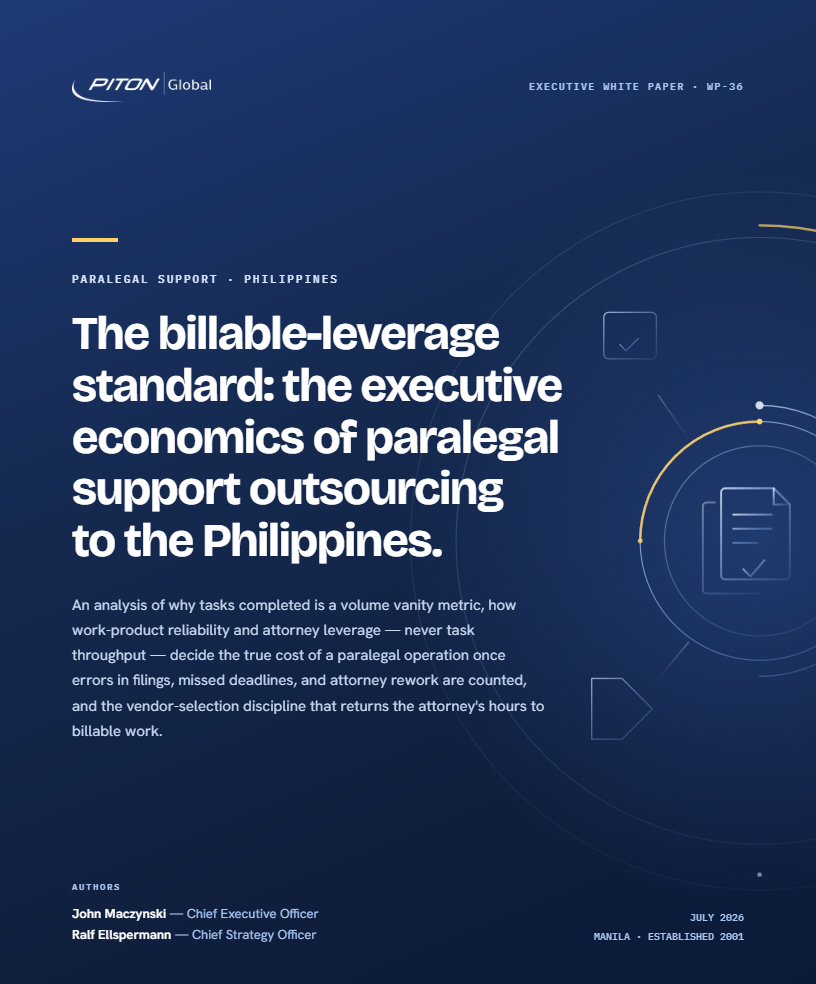
WP-36 Paralegal Support Outsourcing white paper cover
PDF · 14 PAGES
18WHITE PAPER WP-36 · PARALEGAL SUPPORT · JULY 2026

The billable-leverage standard: the economics of paralegal support outsourcing.

Why tasks completed is a volume vanity metric, how work-product reliability and attorney leverage — never task throughput — decide the true cost of a paralegal operation once errors in filings, missed deadlines and attorney rework are counted, and the vendor-selection discipline that returns the attorney’s hours to billable work. Volume 51 of PITON-Global’s Executive White Paper Series, by John Maczynski and Ralf Ellspermann.

● 14 pages● 12-min read● Maczynski & Ellspermann
The volume mirage: tasks completed versus reliable work product.
The paralegal contract: get it right, meet the deadline, free the attorney.
Case study: a 48-seat paralegal-support operation re-based on work-product reliability — 6.3× first-year ROI.
Read the white paper (PDF) Free · no gate · published July 2026
PARALEGAL SUPPORT · PHILIPPINES

Tell us your matter volume and turnaround. We’ll name the teams that can deliver.

Share your matter volume, practice areas and turnaround baseline. We return a vendor-neutral shortlist of compliance-led Philippine paralegal teams that have proven the numbers on this page — at no cost to you.

Run the RFP
Vendor-neutral · no cost to you · 24-hour response guarantee, docket-integrity audit sampling estimate included · prepared and presented by John Maczynski, CEO
19ANSWERED BY OUR PRINCIPALS

What legal leaders ask before outsourcing paralegal support.

In-depth answers to the questions that decide a paralegal-support engagement — from the principals who run them.

How do you keep work product accurate and privilege-safe?+
Attorney review and QA apply to every work product, validated against the matter file and filing rules before it goes out. That keeps every filing clean and privilege-safe, so speed never comes at the cost of filing accuracy or a compliance finding.— Ralf Ellspermann, CSO
What does outsourcing paralegal support save us?+
Typically 50 to 70 percent on cost per matter versus onshore paralegals, plus far faster turnaround. The deeper benefit is fewer errors, faster filings and your attorneys freed to practice law while we run the disciplined, high-volume case-prep work.— John Maczynski, CEO
Will you work inside our case-management and DMS systems?+
Yes. Teams work natively in Clio, NetDocuments, iManage and your case-management systems, drafting and docketing directly — with full audit trails, rather than parallel spreadsheets. Your system of record stays the single source of truth behind every matter and filing.— John Maczynski, CEO
How do you protect client and matter data?+
Work executes in SOC 2 and ISO 27001-aligned environments: role-controlled PII access, masking where needed, no local storage, complete audit trails. All interactions log automatically, and client and matter data stays inside the secured environment.— Ralf Ellspermann, CSO
Will you actually speed up our case-prep turnaround?+
Yes. Attorney-supervised drafting, docketing and filing prep typically cut task turnaround and lift on-time delivery sharply within a quarter. A documented prevention strategy keeps quality high over time. Working the right matters at the right time means fewer errors and faster, cleaner throughput.— Ralf Ellspermann, CSO
How do you handle compliance and controls?+
Through attorney-supervised workflows, full audit logging, QA on every work product, documented escalation workflows and SOC 2 controls applied consistently. The result is work-product integrity that satisfies your compliance team and gives you a clean, examinable record behind every matter.— John Maczynski, CEO
What paralegal work can you take on?+
Case intake and organization, document drafting, court-filing prep, deposition and records summaries, plus case-file management, docketing and complex-litigation support. Your team keeps oversight and the client relationship; we run the consistent daily work that keeps every matter accurate and on time.— John Maczynski, CEO
Which matters should we place first?+
Start with high-volume routine tasks — drafting, docketing and standard filings, where turnaround compounds fastest — then extend to discovery support and filing prep, and finally to trial prep and complex-litigation support. Complex work follows once the workflow, compliance controls and QA are proven on the early-stage work.— Ralf Ellspermann, CSO
How quickly can a paralegal team be live?+
About three to seven weeks, often starting with a paid pilot on a ring-fenced matter set. No work goes live until scripts, compliance controls and QA are signed off. You see proven case-prep quality on a defined set of matters before the engagement scales across your full caseload.— John Maczynski, CEO
How is performance measured?+
Against court-filing accuracy, task turnaround, on-time delivery and cost per matter, in a live dashboard with weekly reviews. We never report raw task counts — a missed deadline puts the matter at risk, not throughput. We deliberately never reward raw output: activity without accuracy, or speed that creates errors, defeats the purpose.— Ralf Ellspermann, CSO
Authorship, Review & Benchmark Verification
Authored by:
Ralf Ellspermann
Ralf Ellspermann
Chief Strategy Officer of PITON-Global
Two Decades Building and Advising Award-Winning Philippine BPO Operations

Ralf vets paralegal floors on filing accuracy and docket discipline across the Philippine vendor pool.

View full bio  →
Verified by:
John Maczynski
John Maczynski
CEO of PITON-Global
Former Global EVP of the World’s Largest Contact Center · Four Decades of Outsourcing Experience

John reviews the matter economics and commercial terms behind each paralegal-support program on this page.

View full bio  →
Last Reviewed & VerifiedJuly 11, 2026

Re-audited as privilege-protection and SOC 2 obligations evolve. Every benchmark on this page is held to PITON-Global’s internal vetting standard.

Inquire Now