MANUFACTURING BPO OUTSOURCING PHILIPPINES

A wrong order or a late part stops a production line.

Order management, dealer and distributor support, technical product help, warranty and parts — delivered by Philippine specialists who keep order-to-cash accurate and parts flowing, because in manufacturing a support error is a stopped line, not a lost ticket.

Manila, Cebu & Davao deliverySOC 1 / ISO 9001-awareAudit-grade order accuracy
ORDER-TO-CASH · CYCLE TIMEQ2 2026
Order accuracy · at fulfillment
99.8%
Parts-order fill rate
97%
Cost per order
66%
Downtime is the real expense. Find the support that keeps the line moving.Get matched
PLATFORMS & STANDARDS
SAPOracleSalesforce MfgEpicorInforDynamics 365 SCMPlexQADSiemens OpcenterRockwell FactoryTalkPTC WindchillKinaxisISO 9001SOC 1
22Vetted Manufacturing
BPO Partners
Order, dealer and aftermarket teams measured on accuracy, not volume.
64MMillion Orders & Parts
Processed / Year
Order-to-cash, warranty and spare-parts across product lines.
8Audit-Grade
Delivery Hubs
SOC-aligned operations with maker-checker order controls.
DOWNTIME IS THE REAL COST · 2026

In manufacturing, a mishandled order or a stalled parts request doesn’t cost you a ticket — it idles a customer’s line, threatens an SLA penalty and risks the account. Support here is a revenue and relationship function, judged on accuracy and speed, not handle time.

01MATCHED TO YOUR PRODUCT AND YOUR ORDER MIX

Your lines and your customers’ lines decide which engine runs hottest.

These are the four manufacturing profiles we build for most often — each with its own error surface, each served by the same line-critical, maker-checked operation.

01Industrial & heavy equipment
MF-084 was here · 64M orders and parts · errors idling customer lines

The full line-critical stack — both engines, the trap-tested controls, the parts desk.

Anchors to: The O2C Engine · MF-084
02Electronics & high-tech
High-volume, high-SKU, RMA-dense

Order accuracy at component granularity, returns operations, and the compliance documentation electronics customers audit hardest.

Anchors to: The Quality File
03Automotive suppliers & components
Where the customer’s line is an OEM’s line and the penalty clause proves it

JIT-grade order discipline, ASN accuracy, and the warranty coordination our Automotive operation runs from the OEM side — cross-linked.

Anchors to: The Risk Matrix
04Consumer goods & process
Distributor networks, promotional order surges

Distributor coordination, promotional order surges, and the O2C velocity that keeps working capital out of the billing cycle.

Anchors to: The P2P Engine
02THE ORDER-TO-CASH ENGINE

Five steps from PO to paid — click where yours leaks.

Each stage has its own failure mode — an error compounds downstream into a stopped line or an unpaid invoice. Select a stage to see the work, the control, and the metric that governs it.

DEFINITION

Order-to-cash operations run the full cycle — order entry, validation, fulfillment coordination, invoicing and dispute resolution — under maker-checker controls, measured by order accuracy and cycle time, not tickets closed.

01
Order Entry
WHAT WE RUN
Orders captured from EDI, portal, email and phone and entered into the ERP cleanly and fast.
CONTROL
A second specialist verifies every order against the PO before it is released — maker-checker from the first keystroke.
GOVERNING METRIC
99.8%
order entry accuracy
02
Validation
WHAT WE RUN
Pricing, availability, credit and configuration checked so an order cannot advance with a hidden error.
CONTROL
Automated rules plus human review catch part-number, quantity and credit-hold issues before fulfillment.
GOVERNING METRIC
<2%
orders needing rework
03
Fulfillment
WHAT WE RUN
Fulfillment coordinated with the warehouse and carriers, with parts expedited when stock is short.
CONTROL
Stockouts trigger expedite and substitution workflows, not a log entry — keeping the fill rate high.
GOVERNING METRIC
97%
Parts-order fill rate
04
Invoicing
WHAT WE RUN
Accurate invoices raised against the shipped order, matched to the PO and terms.
CONTROL
Three-way match against order and receipt eliminates the billing errors that delay payment.
GOVERNING METRIC
99.6%
invoice accuracy
05
Dispute / Cash
WHAT WE RUN
Disputes resolved and cash applied quickly, closing the loop on order-to-cash.
CONTROL
Root-caused dispute resolution and clean cash application compress the cycle and release working capital.
GOVERNING METRIC
−8d
order-to-cash cycle
John Maczynski
CEO · OPERATIONS AUTHORITY

“In manufacturing, customer support and the P&L are the same conversation. A keying error on an order doesn’t annoy a customer — it stops their line and puts your contract on the table. That is why accuracy, not handle time, is the only metric that matters here.”

John Maczynski · CEO, PITON-Global · 40-Year Global BPO Veteran
03TRANSACTIONAL VS. LINE-CRITICAL

A ticket desk vs. an order operation that protects the line.

Seven dimensions, read as risk vs. protection — what a generic desk exposes versus what a line-critical operation safeguards.

Order Accuracy
Best-effort entry
Maker-checker, 99.8%
Parts Delays
Logged, escalated late
Pre-empted & expedited
Warranty
Slow, error-prone
Accurate & fast
Dealers
Ticket queue
Named-rep coordination
Controls
Ad-hoc
SOC-aligned, audit-ready
Metric
Handle time
Order accuracy & cycle
Coverage
Business-hours
24/7 follow-the-sun
04THE P2P ENGINE

The line is fed from two directions. This page ran one. Now it runs both.

Order-to-cash protects the customer’s line; purchase-to-pay protects yours. A line-down event is just as often the inbound slip — the late delivery, the lapsed cert, the supplier exception nobody chased — as the outbound keying error. The same maker-checker discipline, pointed inbound.

THE HALF THIS PAGE DIDN’T RUN
Supplier onboarding & compliance tracking

Supplier setup with documentation verified at the door — certs, insurance, quality agreements — and tracked to expiry, so the lapsed ISO cert is a renewal notice, not an audit finding. The supplier file that’s current is the one that survives your customer’s auditor too.

PO processing & procurement support

Purchase orders processed under the same second-pair-of-eyes rule as sales orders — quantities, part numbers, and terms verified against the requisition before release — plus inventory and demand-signal support that keeps the buyers buying instead of keying.

Supplier-exception resolution

The delivery that slips, the ASN that doesn’t match, the quality hold on inbound — chased proactively, with the same expediting reflex the parts desk runs outbound. A supplier slip logged and waited on has already reached your schedule; a slip chased at the first signal is a recovery plan.

The through-line: one discipline, two engines — the order verified before it ships, the part chased before it’s late. The line doesn’t care which direction the failure came from; neither should the desk.

05THE QUALITY FILE

“Audit-grade” is an adjective until the quality records are in scope. Now they are.

Quality-record management, compliance documentation, and QMS support aligned to ISO 9001 — CAPA documentation kept current, certificates of conformance issued clean, and the document trail your auditor (and your customer’s auditor) walks without a scramble. The maker-checker culture that holds order accuracy at 99.8% is a documentation culture by construction; pointing it at the quality file is the same discipline with a different binder.

06THE RISK MATRIX

Four ways a manufacturer bleeds — two directions, one file, one perimeter.

A keying desk runs none of the four — which is why its errors reach the line three weeks later.

RISK VECTORWHERE THE COST LANDSCONTAINMENT ON A LINE-CRITICAL OPERATION
Order error → line-down THE WEDGEThe wrong part shipped by the thousand — a customer’s idle line, an SLA penalty, a contract in reviewThe core wedge: maker-checker on every order, 99.8% accuracy, the error caught before release (the O2C engine)
Supplier slip → schedule breakThe late delivery, the mismatched ASN, the lapsed cert — your own line starved from the inbound sideThe P2P engine: exception chasing at first signal, compliance tracked to expiry, PO maker-checker (The P2P Engine)
Quality-record failureThe CAPA that wasn’t documented, the CoC that doesn’t reconcile — an audit finding wearing a filing errorQMS-aligned record management, the quality file kept walk-through ready (The Quality File)
ERP & supplier-data exposureOrder books, BOMs, and supplier terms outside the perimeterZero-Trust VDI, ERP-native work with zero local residency, every touch logged

The through-line: the first two rows are the two engines; the third is the file both engines feed; the fourth is the perimeter around all of it. A keying desk runs none of the four — which is why its errors reach the line three weeks later.

07THE MATH OF A LINE KEPT RUNNING

Where does the 6.4× return come from when orders are right the first time?

From four streams a per-order rate ignores: error & rework avoidance, downtime penalties prevented, faster cash and labor arbitrage. The cheapest order is the one processed right the first time — and the line it keeps running.

Order Error & Rework Avoided
$1.3M – $2.6M
Line-Down Penalties Prevented
$1.1M – $2.2M
Faster Order-to-Cash
$0.9M – $1.8M
Order-Ops Labor Arbitrage
$0.9M – $1.8M
TOTAL ANNUAL NET BENEFIT · 75-SEAT ORDER-OPS OPERATION
$4.2M – $8.4M
6.4×
Documented return · MF-084
01
Order Accuracy — Primary Driver
An industrial equipment maker cut order errors 79% with maker-checker entry — eliminating the wrong-part shipments that had been idling customer lines and triggering penalties. Annual error cost avoided: $2.3M.
02
Parts — Line Protected
Proactive parts expediting lifted fill rate to 97%, keeping customer production lines fed and protecting the service contracts attached to them.
03
Cash — Cycle Compressed
Clean invoicing and faster dispute resolution cut order-to-cash by 8 days, releasing working capital trapped in billing friction.
ENTITY PROOF · Q4 2025–Q2 2026
79%
Order errors eliminated
An industrial equipment maker processing 64M orders & parts a year moved order ops to PITON-Global. Total 12-month net benefit: $6.7M against a $1.05M engagement cost — a 6.4× return.
64M orders/yr · Manila, Cebu & Davao · 99.8% accuracy
THE ORDER FILE · ENGAGEMENT MF-084Verified Q2 2026 · Manila, Cebu & Davao
CLIENT ENTITY
Industrial equipment maker processing 64M orders & parts a year.
PRE-DEPLOYMENT BASELINE
Order errors idling customer lines, slow parts and a 12-day order-to-cash cycle.
THE INTERVENTION
A maker-checker order operation across Manila, Cebu & Davao — O2C and parts on SAP + Salesforce.
THE ORDER BOOK, MEASURED
up to 99.8%
Order accuracy · MF-084
under maker-checker
−79%
Order errors
line-down avoided
97%
Parts fill rate · MF-084
lifted from 84%
−8d
Order-to-cash
cash released
6.4×total engagement return
$6.5M net benefit on $980K program
Reviewed by John Maczynski (CEO) &
Ralf Ellspermann (CSO) · Q2 2026
FOR THE VP OF OPERATIONSHow many of your order errors became a customer’s line-down call last quarter?See the order-ops shortlist
⚠ The line-down-penalties stream ($1.1M–$2.2M) is modeled exposure — the idle line that didn’t happen, a counterfactual, not a booked figure. The MF-084 return is anchored on the booked streams (error/rework avoided, faster O2C, arbitrage); penalty exposure is confirmed against your order volume, error history, and SLA terms on the scoping call.
08THE ENTRY POINT · COMPANION ENGAGEMENT

One desk, one number — a parts-expediting-only deployment, measured.

MF-084 proves both engines. This is the floor — on the single number a VP of Operations already watches weekly: a parts-expediting-only engagement, order entry and O2C left in-house.

THE ORDER FILE · ENGAGEMENT MF-091Single-desk · Parts-expediting only
CLIENT ENTITY
Equipment / components maker — order entry and O2C retained in-house. Identity withheld under NDA, as is standard in manufacturing.
PRE-DEPLOYMENT BASELINE
Order entry was adequate; the parts desk was the leak. Stockouts were logged and waited on, substitutions required an engineer’s chase, and the fill rate sat at 84% — every miss a customer’s maintenance window blown or a line fed late, with the service contracts on those lines quietly at risk. No order-entry crisis; an expediting absence.
THE INTERVENTION
A single-desk deployment — parts expediting only. Stockout signals wired to an expedite-and-substitute workflow on the client’s SAP stack: alternate sourcing chased at first signal, approved substitutions offered per the client’s engineering rules, and aging-order escalation with named owners. Order entry, invoicing, and warranty stayed in-house.
NINETY DAYS, MEASURED — ILLUSTRATIVE, REPLACE WITH VERIFIED ENGAGEMENT DATA BEFORE PUBLICATION
84% → 97%
Parts fill rate · target
the line fed, the window kept
logged → X hrs
Expedite cycle time
the stockout answered, not archived
X → X /qtr
Line-down events (parts)
the call that stopped coming
STRATEGIC INSIGHT

MF-084 proves both engines; MF-091 proves the entry point — on the single number a VP of Operations already watches. A manufacturer doesn’t need a full order-ops transformation to stop starving its customers’ lines: one desk, wired to act at the stockout signal instead of logging it, moved the fill rate thirteen points in a quarter with the order book untouched. A desk that logs a stockout and waits has already failed; this one stopped waiting.

Verified by Ralf Ellspermann (CSO) · Reviewed by John Maczynski (CEO) · Q2 2026
09PER ORDER VS. PER LINE KEPT RUNNING

Here is the cost per order. Now here is what the wrong part costs.

Every RFP compares cost-per-order, so we publish the seat math. Then we price the line — because an order keyed cheap and keyed wrong isn’t a saving; it’s a customer’s idle production line with your contract attached.

Distinct from the O2C Engine above: that shows the flow — this prices what keying it right the first time is worth.
THE SEAT LENS · FULLY LOADED, ANNUAL, PER MANUFACTURING-OPS FTE
DELIVERY MODELCOST / FTE / YREFFECTIVE HOURLY · 1,920 HRS
US onshore order-ops team≈ $58,000≈ $30/hr
PH keying desk (legacy)≈ $23,000≈ $11.50/hr
PITON-Global-vetted · line-critical, maker-checked≈ $18,000≈ $9.25/hr
COST SIMULATOR · CHOOSE A DELIVERY MODEL
Onshore
PH keying desk
PITON-Global 2026
Order-ops team size75 seats
30default 75 · MF-084150
Selected model
Annual operational expense
Annual labor saving vs. onshore
What the per-order rate never shows
THE LINE-KEPT-RUNNING PIVOT · THE PANEL A PER-ORDER RATE CAN’T RENDER

The seat lens prices the keystroke; the line prices the outcome. The keying desk is cheap per order and catastrophic per error: the wrong part ships by the thousand, the stockout gets a log entry instead of an expedite, and three weeks later the customer’s line is down with your contract in review. Price the line and the four streams a per-order rate ignores — error and rework avoided ($1.3M–$2.6M), line-down penalties prevented ($1.1M–$2.2M), faster order-to-cash ($0.9M–$1.8M), and labor arbitrage ($0.9M–$1.8M) — stack to a $4.2M–$8.4M annual net benefit.

That is how MF-084’s $1.05M program returned $6.7M (6.4×): order errors down 79% under maker-checker, parts fill from 84% to 97%, and eight days of cash released from the O2C cycle. The cheapest order is the one processed right the first time — and the line it keeps running.

Illustrative projection at standard order mix; per-order savings run ~66% vs. onshore. The line-down-penalties stream is modeled exposure — the idle line that didn’t happen, not a booked figure — confirmed against your order volume, error history, and SLA terms on the scoping call.
Get my line-kept-running model
10PRICING TOPOGRAPHY

Indicative 2026 rates — the control roles shown apart from the keying seat.

Keying an order has a market rate; the second pair of eyes that stops the wrong part shipping by the thousand, and the specialist who expedites instead of logs, do not — those are the roles the line depends on.

CORE ROLERATE (USD)OPERATIONAL PROFILETIER
Order-entry specialist$8–$12EDI/portal/phone capture into the ERPVOLUME
Customer / dealer support agent$8–$12Status, dealer & distributor coordinationSUPPORT
Supplier / vendor coordinator$9–$13Onboarding, compliance tracking, exception chaseP2P
Procurement / PO analyst$10–$15PO processing, inventory & demand supportP2P
Warranty / RMA specialist$10–$14Claims, returns, technical product supportAFTERMARKET
Quality / compliance documenter$9–$14QMS records, CAPA docs, CoC issuanceQUALITY
Maker-checker order verifier
— no generic equivalent
$10–$14The second pair of eyes on every order and PO before release — the same control that passes the audit on our Business Services ledger, here protecting a lineCONTROL
Parts-expediting specialist
— no generic equivalent
$11–$15Owns the fill rate — stockouts trigger expedites and substitutions, not log entriesEXPEDITE
Team lead / order commander$13–$20Accuracy/fill/O2C governance, client reportingLEADERSHIP

The two premium rows have no generic equivalent because both are measured on numbers a keying desk doesn’t track: the accuracy rate under independent verification and the fill rate under proactive expediting. A quote at the keying band for either is the tell. Rates confirmed per engagement against order volume and product mix.

Price my order ops against the line-critical standard
118-WEEK ORDER-OPS STAND-UP

An audit-grade order operation live in 8 weeks — controls proven before cutover.

A gated stand-up. No order is processed live until maker-checker controls are signed off and a parallel run reconciles clean against your ERP.

01
Wk 1–2
ERP & Process Mapping
Connect SAP/Oracle, map order-to-cash and parts workflows, design maker-checker controls, baseline accuracy audit.
02
Wk 3–4
Team & Controls Build
Recruit and train order specialists, configure validation rules, dealer playbooks and warranty workflows.
03
Wk 5–6
Parallel Run
Shadow live orders, daily reconciliation against the ERP, accuracy validated to 99.8% target before handover.
04
Wk 7–8
Cutover & Govern
Phased volume ramp, live accuracy/fill-rate/O2C dashboard, monthly business reviews — PITON-Global Audit-Grade certification.
12THE LINE-DOWN TEST · WHAT TO TRAP

Before a vendor touches an order, can they prove it won’t stop a line?

Three controls separate an order operation that protects production from a desk that just keys orders — and each is demonstrable before you sign. In manufacturing, the cost of getting one wrong is a customer’s idle line.

01
Maker-Checker on Every Order
Order entry without a second set of eyes ships wrong parts and quantities. A real operation runs maker-checker review on every order, so an error is caught before it idles a line.
VERIFY: Ask for the order-accuracy rate under maker-checker
02
Parts Expediting, Not Logging
A desk that logs a stockout and waits has already failed. The operations worth hiring proactively expedite and substitute parts to keep the fill rate high and the line fed.
VERIFY: Ask for the parts fill rate and expedite workflow
03
ERP-Native, Not Email
Order ops run from email and spreadsheets drift out of sync with the ERP. A line-critical operation works natively in SAP or Oracle with a clean, auditable trail.
VERIFY: Confirm native ERP working, not re-keying
THE LINE-CRITICAL ARCHITECTUREhow each risk is designed out
Maker-Checker Controls
Every order is entered and independently verified before release, holding accuracy at 99.8% and catching errors before they ship.
Proactive Parts Expediting
Stockouts trigger expedite and substitution workflows, not a log entry, keeping the fill rate high and customer lines fed.
ERP-Native Operations
Specialists work directly in SAP and Oracle with a complete audit trail, so the order book and the ERP never drift apart.
Ralf Ellspermann
CSO · ORDER OPERATIONS

“Give a prospective partner a hundred test orders with deliberate traps — wrong part numbers, quantity mismatches, credit holds. A maker-checker operation catches nearly all of them before release. A keying desk ships them, and three weeks later your customer’s line is down and your contract is in review.”

Ralf Ellspermann · CSO, PITON-Global · 25-Year Philippine BPO Veteran
13RADICAL TRANSPARENCY · CONTINUED

Where the line-critical desk doesn’t fit — and what stays on your side of the wall.

A shortlist that includes “no” is the only kind worth having. Three engagements we turn down — and why the refusal is the point.

01
Production, engineering, and credit policy never transfer.

Scheduling, BOM decisions, engineering changes, and credit-hold rules are yours; our discipline is running the order book and the supplier file to your rules, with the trail that proves every release matched them. A vendor making credit calls or overriding holds offshore is exercising financial authority it wasn’t granted — the verification is ours, the verdict is yours.

02
If keying volume is the brief, cheaper desks exist — and the trap test explains the difference.

The line-critical model only pays off measured on accuracy, fill rate, and cycle time. If the mandate is transactions per hour with best-effort entry, a keying desk is cheaper — and the trap test above shows exactly what it ships: the deliberate traps, released, arriving at your customer’s dock three weeks before the line-down call.

03
No ERP access, no deployment.

Maker-checker at order speed requires being native in your SAP/Oracle stack under Zero-Trust VDI — the order, the PO, and the inventory position on one screen, with order-book and supplier data at zero local residency. Work run from email and spreadsheets drifts from the ERP by construction — the exact failure the audit names.

FOR MANUFACTURING & OPERATIONS LEADERS

An order error you can’t see is a customer’s line you’re about to stop.

Tell us where order-to-cash strains — entry errors, parts delays, warranty backlogs — and we’ll hand you 6–10 vetted providers built for manufacturing, each one proven on a maker-checker order test before it reaches your shortlist.

Get my manufacturing shortlist
Vendor-neutral · no cost to you · prepared and presented by John Maczynski, CEO
Our 24-Hour Response Guarantee — a reply within 24 hours, trap-test pre-screen included.
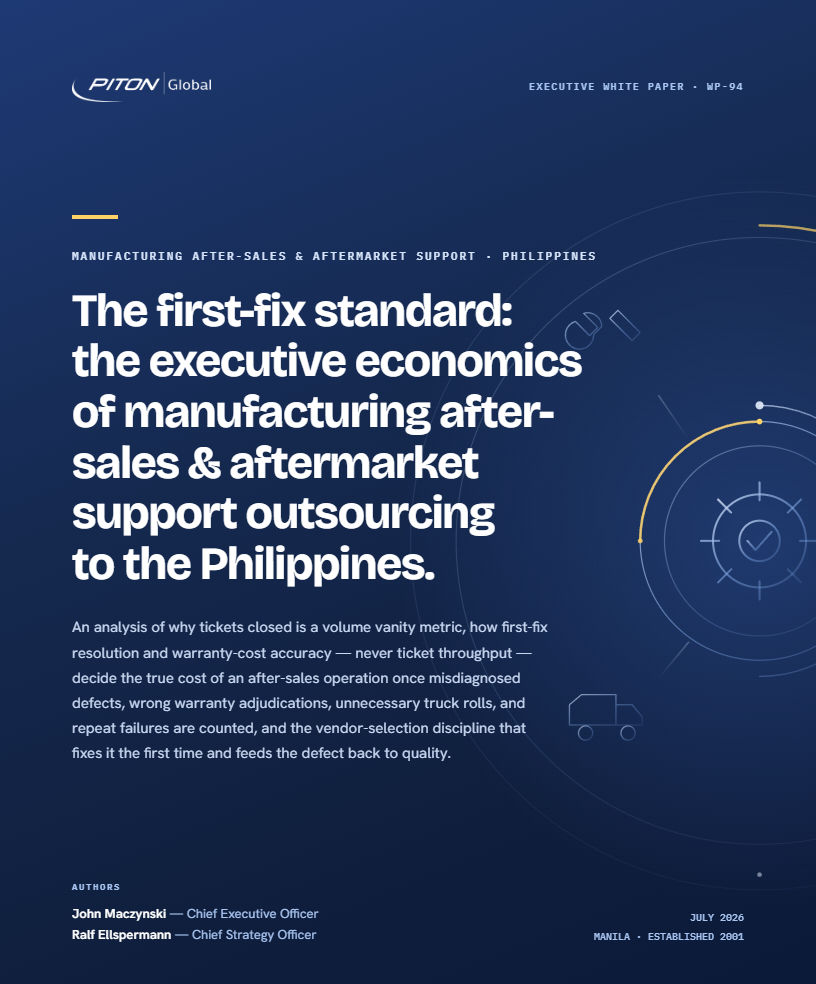
WP-94 Manufacturing After-Sales & Aftermarket Support white paper cover
PDF · 11 PAGES
14WHITE PAPER WP-94 · MANUFACTURING · JULY 2026

The first-fix standard: the economics of manufacturing after-sales & aftermarket support outsourcing.

Why tickets closed is a volume vanity metric, how first-fix resolution and warranty-cost accuracy — never ticket throughput — decide the true cost of an after-sales operation once misdiagnosed defects, wrong warranty adjudications, unnecessary truck rolls and repeat failures are counted, and the vendor-selection discipline that fixes it the first time and feeds the defect back to quality. Volume 87 of PITON-Global’s Executive White Paper Series, by John Maczynski and Ralf Ellspermann.

11 pages9-min readEllspermann & Maczynski
IN THESE PAGES
The volume mirage: tickets closed versus first-fix resolutions.
The support contract: diagnose it right, adjudicate warranty clean, feed defects to quality.
Case study MF-087: an 85-seat after-sales operation re-based on first-fix — 6.3× first-year ROI.
Read the white paper (PDF) Free · no gate · published July 2026
15ANSWERED BY OUR PRINCIPALS

What manufacturing leaders ask before they outsource.

In-depth answers to the questions that decide a manufacturing BPO engagement — from the principals who run them.

What manufacturing work can you take on?+
Order management, dealer and distributor support, technical product help, and warranty and parts processing. One coordinated team keeps order-to-cash accurate and parts flowing, so a support issue never becomes a stopped line for your customer.— John Maczynski, CEO
How do you keep orders accurate?+
Maker-checker controls validate every order before it advances, holding accuracy near 99.8 percent. A second reviewer catches the part-number and quantity errors that otherwise ship as wrong parts and idle a customer’s production line.— Ralf Ellspermann, CSO
What does outsourcing manufacturing support save us?+
Typically 50 to 70 percent on cost per order versus onshore, with faster order-to-cash. The deeper benefit is fewer errors and delays, which protect SLAs and the customer relationships that depend on parts arriving right and on time.— John Maczynski, CEO
Can you scale with production cycles?+
Yes. We flex capacity across launches, seasons and demand swings, so orders and parts requests never back up. The same maker-checker controls apply at every scale, protecting accuracy when volume is highest.— Ralf Ellspermann, CSO
Will you work in our ERP?+
Yes. Specialists work natively in SAP, Oracle and your systems, with a complete audit trail, rather than maintaining parallel spreadsheets. Your system of record and the delivery side stay aligned, with clean lineage preserved behind each order.— John Maczynski, CEO
How do you handle parts and warranty?+
Through proactive expediting and structured warranty workflows that keep the fill rate high and lines fed. Stockouts trigger expedite and substitution paths, not a log entry, so customer production stays supplied rather than stalled.— Ralf Ellspermann, CSO
How do you protect order data?+
All work runs in ISO 27001-aligned, access-controlled environments with no local storage and full audit trails. Access is scoped per role, every action is logged, and sensitive order data never leaves the secured environment.— Ralf Ellspermann, CSO
Which functions should we outsource first?+
Start with order management and parts processing, where accuracy and speed protect customer production fastest. Dealer support and warranty follow once the controls, ERP integration and quality bar are proven.— John Maczynski, CEO
How quickly can a team be live?+
About eight weeks, through a gated stand-up. Live order processing waits for control sign-off and a parallel run that reconciles cleanly against your systems. You see proven accuracy before real volume flows.— John Maczynski, CEO
How is performance measured?+
Against order accuracy, fill rate and cycle time, in a live dashboard with monthly reviews. We deliberately never report raw volume — orders processed fast but wrong stop a customer’s line, which is the cost that actually matters.— Ralf Ellspermann, CSO
Authorship, Review & Benchmark Verification
Authored by:
Ralf Ellspermann
Ralf Ellspermann
Chief Strategy Officer of PITON-Global
Two Decades Building and Advising Award-Winning Philippine BPO Operations

Ralf audits order-desk, supply-chain-admin and aftermarket-support floors across the Philippine vendor landscape.

View full bio  →
Verified by:
John Maczynski
John Maczynski
CEO of PITON-Global
Former Global EVP of the World’s Largest Contact Center · Four Decades of Outsourcing Experience

John reviews the EDI-fluency and commercial terms behind each manufacturing program, keeping benchmarks grounded.

View full bio  →
Last Reviewed & VerifiedJuly 12, 2026

Re-audited as ISO 9001-aware quality and SOC 2 obligations evolve. Every benchmark on this page is held to PITON-Global’s internal vetting standard.

Segments We Serve
OEMsIndustrial EquipmentElectronicsAutomotive SuppliersHeavy MachineryConsumer GoodsIndustrial ComponentsProcess ManufacturingAftermarket PartsDealer Networks
Inquire Now