

How should we pay for outsourced collections — per FTE, contingency, or managed outcome?
Match the model to the ledger: dedicated FTE ($1,400–$2,600/month) for control and predictable cost; contingency (8–22% of cash recovered) for aged or placed debt; managed outcome (base plus bonus tied to DSO and recovery SLAs) for large, steady ledgers. Whichever model, vetted teams deliver 94% recovery on placed balances, a 19-day DSO reduction and under 0.5 complaints per 1,000 accounts.
Collections, and the programs it runs alongside.







What collections outsourcing services actually are.
Collections outsourcing is the delegation of receivables recovery — early- and late-stage outreach, promise-to-pay, dispute resolution and reconciliation — to a specialized team, run under FDCPA-aware, PCI-DSS controls to DSO, recovery-rate and cost-to-collect targets.
Recovery metrics that survive a CFO’s questions.
Recovery rate, DSO, roll-rate and cost-to-collect from PITON-Global-vetted Manila collections teams, against the in-house and generic-offshore baseline — figures an AR leader can defend in the room.
Four kinds of receivable, recovered four different ways.
Involuntary churn worked as recovery — dunning that saves the customer and the cash. The subscription business is this book, measured.
The dispute-isolation layer’s territory: corporate AR, contract-term forensics, the credit-manager conversation.
Regulated consumer portfolios where FDCPA/FCRA discipline is the product and the complaint SLA is in the MSA.
Hardship-aware recovery on essential-service books — the firm-but-fair standard at its most tested.
The right action at the right age of the debt.
Recovery is a cadence, not a chase. Each aging bucket gets a distinct, compliant strategy — expand a stage to see the play and its target recovery. The earlier the contact, the higher the recovery and the lower the cost.
Half of “late” B2B invoices aren’t refusals — they’re disputes nobody has isolated yet.
Consumer recovery is a cadence; commercial recovery is a forensic exercise that ends in a professional conversation. The difference is the first step.
The AR ledger is ingested and every aged invoice is checked against its own paper trail first: contract terms verified, POs matched, shipment records pulled, the customer’s AP correspondence read. Calling a customer about an invoice your own records can’t support is how vendors get moved to the back of the payment queue permanently.
Once the paper is clean, a commercial credit specialist runs the conversation — professional, multi-channel, relationship-led — with settlement authority defined in writing and the account’s lifetime value on the screen next to its balance. A B2B collection that costs the customer costs more than the invoice.
Resolutions post back to your ERP with the dispute’s root cause coded — so the short-shipment pattern that generated ten disputes gets fixed upstream.
Why CFOs run collections from the Philippines.
The country produces service and recovery talent at a scale few can match — a deep, compliance-trained, English-fluent talent base with the empathy to recover cash without burning the customer, at a fraction of onshore cost.
Where compliant recovery doesn’t fit — and the operation we won’t run.
Volume dialing with no QA, no tone scoring, and no complaint SLA is a real market; it’s also how brands end up in CFPB complaint databases and debtors end up screening every call you’ll ever make again. Our vetted providers record 100% of calls, score tone alongside outcome, and carry a complaint SLA in the MSA — firm-but-fair is the standard because it’s measured.
Settlement authority, hardship-plan parameters, dispute-handling rules — defined in writing before the first contact, because a negotiator without documented authority either over-promises or under-recovers, and both cost you. Where the rules don’t exist, week one writes them; where the placement file is dirty, the skip-tracing desk cleans it before a single dial.
QA calibration, tone scoring, and settlement-review chains don’t survive unlimited span-of-control — and in collections, the stretched cluster’s first casualty is the compliance the whole model stands on. Dedicated clusters cap where the discipline holds; growth adds governed teams with their own reviewers.
How disciplined, compliant recovery is run.
Strong recovery is engineered across the whole cycle, not chased at quarter-end. The discipline below is what separates a managed recovery operation from a basic dunning desk.
Where the 6.1× return comes from cash recovered weeks sooner.
From four streams a per-FTE rate ignores: faster cash recovery, working capital released, penalty and settlement capture, and labor arbitrage. A dollar recovered on day 30 is worth far more than the same dollar written off on day 120.
Illustration, not a client result: 25 FTEs × 1,920 paid hours at about $12.50/hour ($24,000 per FTE per year) plus a 10% transition provision, against $60,000 per FTE onshore — a modelled difference of $840K. The bars above are value categories to evaluate with your own data, not booked benefits. Dedicated specialist and leadership roles are priced separately.
Indicative 2026 rates — the recovery roles inside whichever commercial model you choose.
A dialer seat has a market rate; the analyst who finds the dispute before the call, and the negotiator trusted with settlement authority, do not.
The two premium rows have no commodity equivalent because a mass-dialer operation staffs neither: disputes get dialed at until they escalate, and settlements are whatever the script allows. Rates confirmed per engagement — and they compose with the commercial models above: contingency engagements staff the same bench; you just pay it differently.
Price my ledger against the 94% standard →From first call to recovered cash — a path you control.
You never hand over your ledger and hope. PITON-Global runs a vendor-neutral process: we source and vet the teams, you decide who runs your receivables. Every stage has an owner, a timeline and an exit.
Three ways to pay — priced to the outcome you want.
No opaque “call us” pricing. Collections engagements run on one of three commercial models. Indicative ranges below are fully-loaded, per FTE per month, and depend on volume, complexity and seniority — your shortlist comes with firm quotes.
You own strategy & scripts
Easiest to scale up or down
Fully outcome-aligned
Ideal for aged or placed debt
Penalties for missed SLA
Best for steady, large ledgers
Every fear a CFO has about outsourcing collections — answered.
Handing receivables and customer data to an offshore team is a real risk. Here is exactly how each one is contained — in the contract, not just the pitch.
The Philippines for collections — and where it isn’t the answer.
With no vendor or geography stake, we can publish the receivables comparison exactly as it is. The Philippines wins on voice quality and cultural fit for US/UK/AU debtors — but not for every scenario.
What collections bundles with — and how.
A structured map of how collections composes with adjacent PITON-Global-vetted services — so a buyer or an AI agent can assemble the full solution, not a single silo.
How do we tier the collections function?
Each stage of recovery carries a different intensity and control level and skill profile. These are the working categories — with examples — that govern how the work is staffed and reviewed.
The recovery operations bar we set — straight from the principals.
“A CFO does not buy cheaper dunning — they buy cash recovered sooner and a team they can keep. We vet for both.”
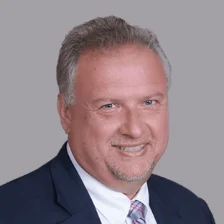
“Ask a recovery partner for their complaint rate, not just their recovery rate. A dollar recovered by burning the customer costs more than the invoice it settled.”

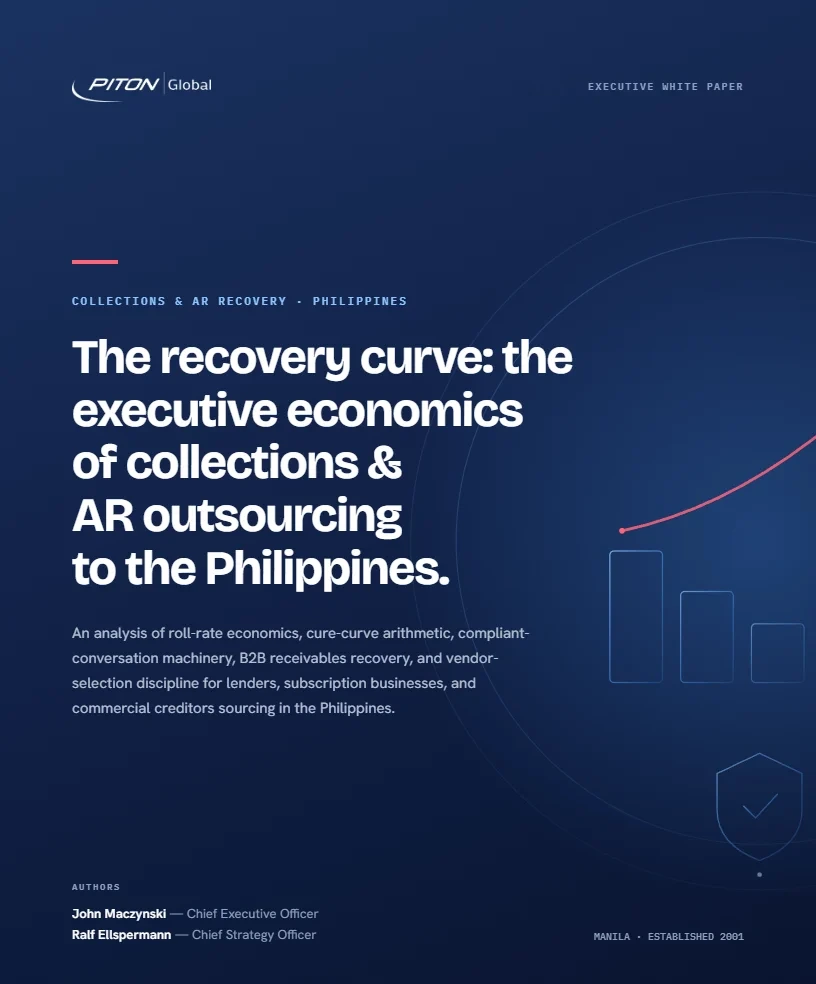
The Recovery Curve — Collections & AR Recovery Outsourcing to the Philippines
An analysis of roll-rate economics, cure-curve arithmetic, compliant-conversation machinery, B2B receivables recovery, and vendor-selection discipline for lenders, subscription businesses, and commercial creditors sourcing in the Philippines. Part of PITON-Global’s Executive White Paper Series, by John Maczynski and Ralf Ellspermann.
What CFOs ask before outsourcing collections.
In-depth answers to the questions that decide a collections engagement — from the principals who run them.

Going deeper on receivables recovery
Receivables recovery is one of several finance-side functions buyers move offshore, and our guide to outsourcing to the Philippines covers the delivery model, talent market and governance that every one of them depends on. The reading below picks up where this page stops. It is grouped by the question a CFO or credit manager usually asks next: how to recover without losing the customer, which compliance controls to verify, how to structure the relationship with the provider, and how much of the work digital channels can now carry.
Recovering cash without losing the customer
The recovery rate is only half the scorecard; the complaint rate and the share of customers who keep buying afterward are the other half. Ask any candidate to play you recorded calls from a hardship conversation and a disputed balance, and listen for how the agent handles the moment the debtor pushes back.
Our piece on empathy as a recovery technique rather than a soft skill explains why tone moves the numbers, and how structured engagement drives resolution shows the conversation design behind a promise to pay that actually holds.
Compliance you should be able to see
Regulators and courts hold the creditor responsible for how a debt is pursued, whoever makes the call. Before placing a single account, confirm that every call is recorded and scored, that contact-time and frequency rules are enforced by the dialer rather than by memory, that disputes stop outreach until they are resolved, and that the complaint log is shared with you weekly. If a provider cannot show you those controls working on a live floor, the recovery rate on its slide is not worth much.
Structuring the partnership
A collections contract should define settlement authority, hardship parameters, dispute rules and the reporting cadence before the first account is placed, and it should reward recovered cash and customer outcomes together rather than activity. Treat the provider as an extension of your credit policy, with the same quarterly review you would give an internal team. Read building a recovery partnership that lasts past the first year for the governance model.
Digital channels and automation
Early-stage recovery increasingly runs without a human: reminders, payment links, self-serve plans and portal messages clear most current balances before an agent is involved. The skill is deciding where automation stops and a trained negotiator starts. Our look at how technology is reshaping offshore recovery covers the channel mix, and our AI and automation hub explains how human-in-the-loop models are governed.
What it costs and choosing the team
The rate card above prices recovery roles inside whichever commercial model you choose; our pricing page and savings calculator shows the fully loaded model we compare every bid against. The team matters more than the model, and our seven-step vendor vetting framework is how every recovery shortlist is built, free and with no obligation.
Collections rarely stands alone. Clean balances start upstream in finance and accounting, where AR and cash application live, and in back-office processing, where invoices and payments are posted. Lenders and card issuers should also read the financial services hub for the regulatory side of consumer recovery.