UTILITIES BPO OUTSOURCING PHILIPPINES

Blue-sky days are easy. The storm is the SLA.

Billing and meter-to-cash, outage and emergency response, field dispatch and collections — delivered by Philippine specialists who hold your regulator-reported answer times through a storm-driven call surge, and triage the safety calls first.

Manila, Cebu & Davao deliveryPUC / regulatory SLA-alignedSafety-call triageNERC-CIP-mappedNIST SP 800-207 Zero-Trust
SERVICE LEVEL · ANSWER TIME STORM
SLA target peak held
PREOUTAGE HITSRECOVERED
Storm surge held
9×
Cost to serve
60%
The storm is the SLA. Find the desk that holds when every line lights up at once.Get matched
PLATFORMS & STANDARDS
SAP IS-U Oracle CC&B Salesforce ServiceMax Oracle Utilities OMS Itron IBM Maximo ESRI ArcGIS Genesys Schneider EcoStruxure Landis+Gyr GE Vernova GridOS PUC SLAs SOC 2 Type II
16Vetted Utility-Ops
BPO Partners
Billing, outage and dispatch teams built to hold SLA through a storm.
25MMillion Ratepayer
Contacts / Year
Billing, outage and field-service across electric, gas and water.
8Storm-Ready
Delivery Hubs
Emergency surge capacity drawn from eight cities, on call.
THE REGULATOR IS COUNTING · 2026

For a utility, the call center is not a cost line — it is a regulated obligation with a stopwatch. Miss your answer-time standard during an outage and you face penalties, intervenor scrutiny and a rate-case headwind. The desks that protect utilities staff for the storm, not the average day.

01MATCHED TO YOUR TERRITORY AND YOUR STORM PROFILE

Your service type and your regulator decide which clock runs hottest.

These are the four utility profiles we build for most often — each on its own stopwatch, each served by the same SLA-grade operation.

01Electric & power
UT-052 was here · 3.2M meters · a fixed roster missing the standard every season

The full SLA-grade stack — elastic bench, triage, pre-cycle gate, CIP-mapped perimeter.

Anchors to: The Storm Curve · UT-052
02Water & wastewater
Main breaks and boil-water notices run on the same stopwatch

Event surge, safety-notice handling, and meter-read validation for municipal and investor-owned systems.

Anchors to: The Risk Matrix
03Gas & energy retail
Where the safety call is the whole job

Leak-call triage at maximum drill standard, switching and onboarding support, and billing operations at retail volume.

Anchors to: Life-Safety Triage
04Waste & environmental services
The same discipline at collection-calendar rhythm

Route exceptions, service scheduling, and billing support — the SLA-grade operation on a weekly cadence.

Anchors to: The Reporting Desk
02THE STORM CURVE

Drag the storm — does your answer time hold the line?

An outage multiplies call volume in minutes, and your SLA does not move with the weather. Push the storm intensity and watch what a fixed in-house roster does to your regulator-reported answer time — versus an elastic emergency bench. Same weather, different SLA: travel’s storm interrupts the journey, ours interrupts the service — one elasticity argument, two regulators.

STORM INTENSITY · CALL VOLUME 4.0×
1× · blue sky5× · heat wave9× · major storm
EMERGENCY BENCH · AGENTS STAFFED40 total · +0 surge
PITON-GLOBAL · elastic bench
15s answer
CSAT 4.7/5
FIXED in-house roster
15s answer
CSAT 4.7/5
Below 4.0×, both models hold — the gap opens as volume climbs.
John Maczynski
CEO · OPERATIONS AUTHORITY

“A utility call center is judged on the worst day of the year, by a regulator with a spreadsheet. Staffing for the average is not a cost decision — it is a compliance decision you have already lost the moment the storm hits. The elastic bench is the whole point.”

John Maczynski · CEO, PITON-Global · 40-Year Global BPO Veteran
03FIXED VS. SLA-GRADE

A fixed roster vs. an SLA-grade utility operation.

Seven dimensions that decide whether you meet your regulator’s standard — or explain why you didn’t.

Surge Response
Buckles at the storm
Pre-trained emergency bench
SLA held
Safety Calls
In the same queue
Triaged & prioritised
Lives protected
Regulatory SLA
Missed & penalised
Met & reported
Rate-case protected
Field Dispatch
Slow, manual
Optimised scheduling
Trucks rolled fast
Billing
Error-prone
Meter-to-cash accurate
Disputes down
Collections
Aggressive
Compliant arrangements
Recovery, not complaints
Coverage
Business-hours
24/7 storm-ready
Always answering
FOR THE VP OF CUSTOMER OPERATIONS
When the storm hits, does your answer time meet the regulator’s standard?
A 45-minute scoping call maps your outage and billing load — then points you to the operations that hold the SLA.
John Maczynski
John Maczynski
CEO, PITON-Global
+1 402 598-8740
Book the scoping call
04THE SECOND SPREADSHEET

The storm tests the bench. The security audit tests everything else.

A utility’s regulator has two spreadsheets: the answer-time report and the critical-infrastructure audit. A desk that holds the SLA through a 9× surge but can’t clear a CIP review hasn’t protected the utility — it’s moved the finding from customer operations to security.

THE GAP THAT ENDS THE RFP EARLY
NERC-CIP-mapped controls

Where the engagement touches bulk-electric-system-adjacent data, controls are mapped to NERC-CIP: personnel risk assessment and training on CIP-touching roles, access management with revocation discipline, and information-protection controls on every system the desk reaches. The utility’s compliance team gets the mapping document, not a marketing assurance.

NIST SP 800-207 Zero-Trust

Non-persistent VDI, biometric MFA, continuous verification, least-privilege RBAC — the architecture the federal standard actually describes, not a VPN with a new name. No customer data, meter data, or OMS access rests on local hardware, ever.

The perimeter, logged

Every CIS, OMS, and AMI touch is logged for audit-readiness — because when the CIP auditor and the PUC examiner both ask for records, the desk that held the storm should be able to hand over both files without a scramble.

The through-line: the elastic bench wins the storm day; the CIP mapping wins the procurement review that decides whether the bench is ever hired.

05BEFORE THE CYCLE CLOSES

The disputed bill is a meter read nobody validated — catch it upstream.

AMI and MDM data validation runs before the billing cycle closes: machine-flagged read anomalies (the impossible spike, the stuck meter, the estimate that never reconciled) reviewed by a human analyst while they’re still exceptions, not invoices. The bill that goes out right is the dispute that never calls in, the adjustment that never books, and the complaint that never reaches the regulator’s inbox — the same gate-placement rule as everywhere money moves: validation before the money does. Meter-to-cash leakage isn’t a billing problem; it’s a timing problem, and the fix is a gate.

06THE TELEMETRY LAYER
The elastic bench answers the surge. The telemetry shrinks it.

OMS and grid-telemetry integration lets the desk see the outage before the calls describe it — proactive notification to affected zones, accurate ETRs from crew data instead of guesses, and status deflection that keeps the queue for the calls that need a human. The bench absorbs the 9×; the telemetry makes it a 6×.

07THE REPORTING DESK
Tariff, renewable-compliance, and ESG reporting — the regulator’s third spreadsheet.

Centralized tariff administration, renewable-program compliance support, and ESG disclosure operations in validated repositories — the reporting obligations that grow every rate case, staffed as a discipline instead of absorbed as overtime.

08THE RISK MATRIX

Four ways a utility bleeds — three the regulator counts, one it times.

A utility’s risk isn’t one surface; it’s four, and each answers to the regulator differently — three it counts, one it holds a stopwatch on.

RISK VECTORWHERE THE COST LANDSCONTAINMENT ON AN SLA-GRADE OPERATION
Missed-SLA penalty THE WEDGEThe answer-time standard breached in a storm — penalties, intervenor scrutiny, rate-case headwind · the regulator times this oneThe core wedge: weather-triggered elastic bench, drilled at 9×, activated ahead of the front — the SLA held on the day it’s measured
Safety-call mishandlingThe gas-leak call behind a billing query — a life-safety event wearing a queue positionLife-safety triage to the front, instantly, on trained emergency protocols — your procedures, executed in seconds (see Boundaries)
Meter-to-cash leakageMisreads billed, disputes credited, revenue adjusted away a cycle at a timeThe pre-cycle gate: AMI/MDM anomaly validation before the bill issues (Before the Cycle Closes)
Critical-infrastructure exposureCIS/OMS/grid-adjacent data outside the perimeter — a CIP finding, or worseNERC-CIP-mapped controls, NIST 800-207 Zero-Trust, non-persistent VDI, every touch logged (The Second Spreadsheet)

The through-line: the first row is timed, the second is triaged, the third is gated, the fourth is audited — four clocks, one operation. The storm curve shows the first; the other three are why the desk survives the years between storms. It’s the regulated-operations doctrine our crypto-compliance, aviation, and iGaming desks share — the regulator asks for the record, and here, times it.

09THE MATH OF A HELD SLA

Where does the 6.4× return come from when the SLA holds through the storm?

From four streams a per-call rate ignores: regulatory penalties avoided, idle-capacity removed, collections recovered and dispatch optimised. The most expensive call is the one that goes unanswered during an outage — because a regulator is counting it.

Regulatory Penalties Avoided
$1.7M – $3.6M
Idle-Capacity Cost Removed
$1.1M – $2.2M
Collections Recovery
$0.9M – $1.8M
Field-Dispatch Optimization
$0.8M – $1.6M
TOTAL ANNUAL NET BENEFIT · BASELINE-70, STORM-630 UTILITY DESK
$4.5M – $9.2M
6.4×
Documented return
01
Penalties Avoided — Primary Driver
An electric utility held its answer-time SLA through three major storms by surging from 70 to 630 agents in hours — avoiding regulatory penalties and the rate-case damage a missed standard invites. Penalty exposure avoided: $2.9M.
02
Idle Cost — Removed
Carrying a lean blue-sky baseline and surging only for events cut annual cost to serve 36% versus a roster sized for the storm year-round.
03
Collections — Recovered
Compliant payment-arrangement handling lifted recovery while cutting the complaints that aggressive collections drive into the regulator inbox.
ENTITY PROOF · Q4 2025–Q2 2026
9×
Storm surge absorbed, SLA held
An electric utility serving 3.2M meters moved customer operations to PITON-Global. Total 12-month net benefit: $6.0M against a $940K engagement cost — a 6.4× return.
3.2M meters · Manila, Cebu & Davao · SLA held through 3 storms
THE STORM FILE · ENGAGEMENT UT-052Verified Q2 2026 · Manila, Cebu & Davao
CLIENT ENTITY
Investor-owned electric utility serving 3.2M meters.
PRE-DEPLOYMENT BASELINE
A fixed roster that missed answer-time SLAs every storm season, drawing penalties and intervenor scrutiny.
THE INTERVENTION
An SLA-grade utility operation across Manila, Cebu & Davao — outage, billing and dispatch on Oracle CC&B + Genesys.
THE SEASON, MEASURED
up to
Storm surge held · UT-052
SLA maintained across three storms
$2.9M
Penalties avoided
no SLA breach
−36%
Cost to serve
lean baseline
100%
Safety-call triage · UT-052
every emergency call to the front · verified across the engagement
6.4×total engagement return
$6.0M net benefit on $940K program
Reviewed by John Maczynski (CEO) &
Ralf Ellspermann (CSO) · Q2 2026
⚠ The regulatory-penalties-avoided stream ($1.7M–$3.6M; $2.9M in UT-052) is modeled exposure — the SLA breach that didn’t happen, a counterfactual, not a booked figure. The 6.4× return is anchored on the booked streams (idle-capacity removed, collections, dispatch); penalty exposure is confirmed against your service territory, SLA history, and storm profile on the scoping call.
10THE ENTRY POINT · COMPANION ENGAGEMENT

One gate, no storm required — a meter-to-cash-only deployment, measured.

UT-052 proves the full storm-season operation. This is the floor — and it needs no storm: a meter-to-cash-only engagement, outage and care left in-house, on the cycle that runs twelve times a year whether or not the weather turns.

THE STORM FILE · ENGAGEMENT UT-059Single-gate · Meter-to-cash only
CLIENT ENTITY
Municipal / investor-owned utility — outage and care operations retained in-house. Identity withheld under NDA, as is standard in regulated utilities.
PRE-DEPLOYMENT BASELINE
The storm season was managed; the billing cycle was the leak. Read anomalies — stuck meters, estimate chains, impossible spikes — surfaced after invoicing, as disputes, adjustments booked each quarter, and a complaint line the regulator reads. No outage crisis; a validation absence, billed monthly.
THE INTERVENTION
A single-gate deployment — meter-to-cash validation only. AMI/MDM anomaly review on the client’s Oracle CC&B + Itron stack, machine-flagged exceptions human-reviewed before the cycle closes, and a reconciliation log finance can audit. Care, outage, and dispatch stayed in-house; scope held to one gate.
NINETY DAYS, MEASURED · ILLUSTRATIVE — REPLACE WITH VERIFIED ENGAGEMENT DATA BEFORE PUBLICATION
X → X /mo
Billing disputes
the bad read caught as an exception, not an invoice
$X → $X /qtr
Adjustments & credits
revenue kept, not clawed back
X → X /qtr
Complaints to the regulator
the inbox the rate case reads, quieter
STRATEGIC INSIGHT

UT-052 proves the storm-season operation; UT-059 proves the entry point — on the cycle that runs twelve times a year whether or not the weather turns. A utility doesn’t need a storm to start: one gate, placed before the bill issues, converted a monthly leak into a monthly log, in a quarter, with the storm bench untouched. The regulator counts the storm day once a season — and the billing complaints every month in between.

Verified by Ralf Ellspermann (CSO) · Reviewed by John Maczynski (CEO) · Q2 2026
11PER CALL VS. PER STANDARD HELD

Here is the cost per call. Now here is what the unanswered one costs.

Every RFP compares cost-per-call, so we publish the seat math. Then we price the stopwatch — because an unanswered call on a blue-sky day is a service miss, and the same call in a storm is a compliance event with a docket number.

Distinct from the Storm Curve above: that shows the surge — this prices what holding the standard through it is worth.
THE SEAT LENS · FULLY LOADED, ANNUAL, PER UTILITY-SUPPORT FTE
DELIVERY MODELCOST / FTE / YREFFECTIVE HOURLY · 1,920 HRS
US onshore utility desk≈ $65,000≈ $34/hr
PH fixed-roster vendor (legacy)≈ $25,000≈ $13/hr
PITON-Global-vetted · SLA-grade, storm-drilled≈ $19,000 blended≈ $10/hr
COST SIMULATOR · 70-FTE BASELINE UTILITY DESK
Onshore fixed
PH fixed roster
PITON-Global elastic
Baseline desk size70 FTE
30default 70 · UT-052120
Model shape ·
Annual operational expense
Annual saving vs. onshore fixed
What the per-call rate never shows
THE HELD-SLA PIVOT · THE PANEL A PER-CALL RATE CAN’T RENDER

The seat lens prices the agent; the stopwatch prices the operation. The fixed roster is cheap per call and existential per storm: the busy signal is a compliance event, the trapped gas-leak call is worse, and the penalty is only the invoice — the rate-case damage is the balance. Price the standard and the four streams a per-call rate ignores — regulatory penalties avoided ($1.7M–$3.6M), idle-capacity cost removed ($1.1M–$2.2M), collections recovery ($0.9M–$1.8M), and dispatch optimization ($0.8M–$1.6M) — stack to a $4.5M–$9.2M annual net benefit.

That is how UT-052’s $940K program returned $6.0M (6.4×): 70 surged to 630 in hours, the SLA held through three storms, and cost to serve down 36% against a roster sized for the storm year-round. The most expensive call is the one that goes unanswered during an outage — because a regulator is counting it.

Illustrative projection at standard contact mix. The penalties-avoided stream is modeled exposure — the breach that didn’t happen, not a booked figure — confirmed against your service territory, SLA history, and storm profile on the scoping call.
Get my held-SLA model
12PRICING TOPOGRAPHY

Indicative 2026 rates — the storm roles shown apart from the blue-sky seat.

Blue-sky billing support has a market rate; the agent who routes a gas-leak call in seconds and the bench that appears ahead of the front do not — those are drilled capabilities with a regulator’s stopwatch on them.

CORE ROLERATE (USD)OPERATIONAL PROFILETIER
Customer service rep$8–$12Billing, move-in/out, account servicingVOLUME
Billing / dispute analyst$9–$13Investigation, adjustments, dispute handlingBILLING
Meter-to-cash analyst$10–$14AMI/MDM validation, read exceptions — the pre-cycle gateGATE
Field-dispatch coordinator$9–$13Crew scheduling, work orders, OMS coordinationFIELD
Collections specialist (compliant)$9–$13Payment arrangements, recovery without the complaintCOLLECTIONS
ESG / regulatory analyst$11–$16Tariff, renewable compliance, disclosure supportREPORTING
Life-safety triage specialist
— no generic equivalent
$12–$16Emergency-call identification and routing in seconds, on your protocols — drilled before a live queueTRIAGE
Weather-triggered surge agent
— no generic equivalent
$10–$14 · activation-pricedCross-trained, drilled at 9×, activated by the forecast — the bench that holds the standardSURGE
Team lead / storm commander$14–$20ASA/SLA governance, storm-shift command, regulator reportingLEADERSHIP

The two premium rows have no generic equivalent because both are proven in a drill, not promised in a proposal — the triage specialist routes a simulated gas-leak call before touching a real one, and the surge bench holds a simulated 9× before a storm names it. Rates confirmed per engagement against territory and storm profile.

Price my desk against the storm-drill standard
138-WEEK STORM-READY STAND-UP

A regulator-grade utility operation in 8 weeks — surge-drilled before storm season.

A gated stand-up. No team takes live volume until it clears a simulated major-storm surge against your real outage and emergency playbooks.

01
Wk 1–2
CIS & Outage Onboarding
Connect billing/CIS and OMS, map emergency and outage scripts, design IVR overflow, baseline ASA & complaint audit.
02
Wk 3–4
Hiring & Safety Training
Recruit care & dispatch agents, train on gas-leak/emergency protocols, billing accuracy and field-coordination playbooks.
03
Wk 5–7
Storm Simulation & Shadow
Shadow live volume, run a simulated 9× storm surge, hold ASA under target, prove emergency-call prioritisation.
04
Wk 8
Cutover & Governance
Phased ramp, live ASA/SLA/complaint dashboard, weather-triggered surge plan, PITON-Global SLA-Grade certification.
14THE STORM-READINESS AUDIT · WHAT TO TEST

When the next major storm hits, will your support meet the standard the regulator measures you against?

Three capabilities decide whether a utility holds its service level in an emergency — and each can be stress-tested before you sign. A vendor’s calm-day metrics tell you nothing about the day that actually counts.

01
A Bench That Surges
An outage multiplies call volume in minutes. Only a pre-trained, weather-triggered surge bench keeps answer times within the regulator’s standard; a fixed roster posts a busy signal on your worst day.
TEST IT: Run a simulated major-storm surge
02
Emergency-Call Prioritisation
A gas-leak call cannot wait behind a billing query. The operations that protect utilities triage life-safety calls to the front instantly, with trained emergency handling — not a single flat queue.
TEST IT: Audit how emergency calls are prioritised
03
Field-Crew Coordination
A call center that cannot see the field is just taking messages. Real utility support coordinates with crews and the OMS, giving customers accurate restoration ETAs instead of guesses that erode trust.
TEST IT: Verify the OMS and field-dispatch integration
THE SLA-GRADE ARCHITECTUREhow each failure mode is designed out
Weather-Triggered Surge Bench
A cross-trained surge bench is drilled against simulated storm loads and activated by weather triggers, so capacity scales ahead of the outage instead of collapsing into a busy signal.
Life-Safety Prioritisation
Emergency and gas-leak calls are triaged to the front of the queue with trained handling, so a life-safety call is never stuck behind a billing question.
OMS-Integrated Coordination
Agents work from the outage-management system and coordinate with field crews, giving customers accurate restoration ETAs and proactive updates that hold trust through an outage.
Ralf Ellspermann
CSO · UTILITY OPERATIONS

“Do not buy a utility desk on its average-day numbers. Simulate the storm: nine times the volume, a gas-leak call in the queue, a regulator watching the answer time. The partners worth hiring hold the line and route the emergency in seconds; the rest post a busy signal and a fine. The drill tells you which you are buying.”

Ralf Ellspermann · CSO, PITON-Global · 25-Year Philippine BPO Veteran
15RADICAL TRANSPARENCY · CONTINUED

Where the SLA-grade desk doesn’t fit — and what never transfers.

A shortlist that includes “no” is the only kind worth having. Three engagements we turn down — and why the refusal is the point.

01
Safety protocols and grid control never transfer — we execute your emergency procedures, in seconds, exactly as written.

Gas-leak scripts, downed-wire protocols, escalation trees, and dispatch authority are yours; our discipline is drilling them until routing is reflexive and the trail proves it. A vendor improvising emergency handling isn’t a support desk — it’s a casualty report waiting for a date. The stopwatch is the regulator’s; the protocol is yours; the drill is ours.

02
If blue-sky staffing is the brief, a fixed roster is cheaper — and the first storm will bill the difference.

The elastic model only pays off when the standard is measured on the worst day. If your territory genuinely never sees event surges, a fixed vendor is adequate — but the page above shows what “sized to average” posts when the weather disagrees: a busy signal, a trapped emergency call, and a fine.

03
No CIS/OMS access, no deployment.

Held SLAs and honest ETRs require being inside your CC&B/OMS/Genesys stack under Zero-Trust VDI — the account, the outage map, and the crew status on one screen, with customer and grid data at zero local residency under the CIP mapping. Without it, we’d be taking messages about a grid we can’t see — the exact failure the audit names.

READY FOR THE NEXT STORM?

The utility operations that hold the line.

These are the operations that passed a simulated storm surge alongside the complete Seven-Step Vendor Audit — a weather-triggered surge bench, life-safety prioritisation and OMS-integrated coordination demonstrated, not described. What reaches you is a short list of SLA-grade names that earned it.

See the utilities shortlist
Peer-reviewed by John Maczynski, CEO · April 2026
Our 24-Hour Response Guarantee — a reply within 24 hours, storm-simulation and CIP pre-screen included.
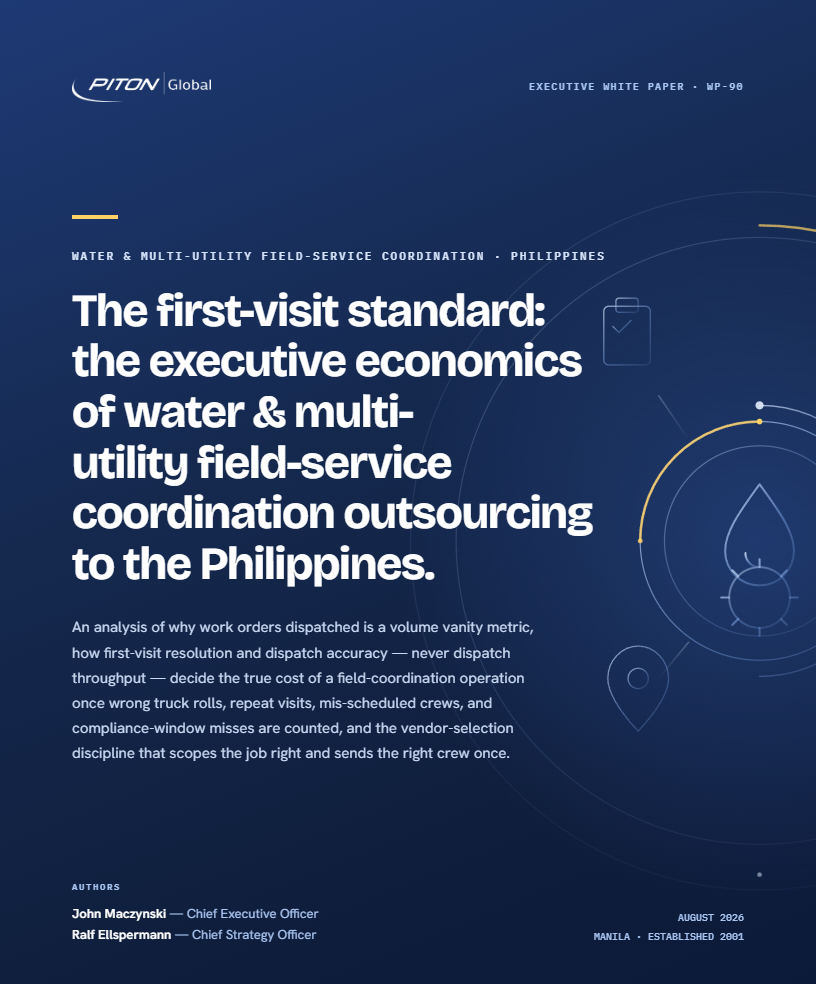
16WHITE PAPER WP-90 · WATER & MULTI-UTILITY · AUGUST 2026

The first-visit standard: the economics of water & multi-utility field-service coordination outsourcing.

Why work orders dispatched is a volume vanity metric, how first-visit resolution and dispatch accuracy — never dispatch throughput — decide the true cost of a field-coordination operation once wrong truck rolls, repeat visits, mis-scheduled crews and compliance-window misses are counted, and the vendor-selection discipline that scopes the job right and sends the right crew once. Volume 95 of PITON-Global’s Executive White Paper Series, by John Maczynski and Ralf Ellspermann.

14 pages 9-min read Maczynski & Ellspermann
IN THESE PAGES
The volume mirage: work orders dispatched versus jobs closed first visit.
The coordination contract: scope it right, dispatch it accurately, close it compliant.
Case study UT-095: an 80-seat utility field-coordination rebuild re-based on first-visit resolution — 6.3× first-year ROI.
Read the white paper (PDF) Free · no gate · published August 2026
17ANSWERED BY OUR PRINCIPALS

The questions utility leaders ask before they outsource.

In-depth answers to the questions that decide a utilities support engagement — from the principals who run them.

What utility functions can be outsourced?+
Customer care and billing support, metering and usage queries, move-in and move-out, 24/7 outage and emergency reporting, payments and collections, and program enrollment. The full customer lifecycle around the meter, delivered by safety-trained specialists so your field and engineering teams focus on the grid itself.— John Maczynski, CEO
How do you handle outage and emergency calls?+
Through safety-call protocols, priority routing and 24/7 coverage that escalate gas-leak and emergency reports instantly while keeping customers informed on restoration. These are the calls where speed and accuracy matter most, so they are staffed, scripted and drilled specifically rather than handled like routine billing contacts.— Ralf Ellspermann, CSO
What does utility outsourcing save?+
Typically 50–60% on cost per contact versus in-house, with stronger coverage and faster resolution. The larger gain is trust: cleaner bills, faster outage information and compassionate collections reduce complaints and regulator attention, protecting the customer relationship that a utility’s licence ultimately depends on.— John Maczynski, CEO
Can you scale for storms and demand peaks?+
Yes. We forecast and surge-staff for storms, heat waves and outage events, so the emergency line and safety calls stay answered when volume spikes tenfold. Capacity is planned before the event, which means customers reach a person during exactly the moments that define their confidence in the utility.— Ralf Ellspermann, CSO
How do you keep billing accurate and compliant?+
Billing QA, read validation and regulated-dispute handling hold accuracy high and resolve issues correctly under the rules. Errors that erode trust and draw complaints are caught before they reach the customer, and disputes are handled to regulatory standards, so accuracy and compliance hold together rather than trading off.— John Maczynski, CEO
Will you work in our CIS and systems?+
Yes. Specialists work natively in your customer-information, billing and outage systems with a complete audit trail, rather than toggling between disconnected tools. You keep one source of truth, and we staff into your environment, so accounts, bills and outage records stay accurate, traceable and where your teams expect them.— Ralf Ellspermann, CSO
Will support feel on-brand and empathetic?+
Yes. Teams are trained to your tone, safety standards and customer-care philosophy under calibrated QA, so interactions feel like your utility. Empathy and correctness are scored on every contact, because in energy and water a cold or wrong answer can leave a vulnerable customer without power, heat or water.— John Maczynski, CEO
How do you protect customer data?+
Operations run in ISO 27001-aligned, access-controlled environments with no local storage and audited controls. Customer and payment data stays inside the secure environment, access is role-based and time-limited, and every action is logged, so data protection holds as the team and customer base scale.— Ralf Ellspermann, CSO
How is utility support measured?+
On resolution and billing accuracy, outage-line uptime, customer satisfaction and collections-cycle time, surfaced in a live dashboard with regular reviews. We govern to service and safety outcomes rather than raw call counts, so the metrics reflect whether customers are actually being served well, not merely processed quickly.— John Maczynski, CEO
How fast can a utility team go live?+
About eight weeks, on a gated stand-up. No customer is handled live until safety-call protocols and QA are signed off and a parallel run matches your bar. The schedule proves accuracy and safety before cutover, so customers meet a capable, storm-ready team from day one rather than during a crisis.— Ralf Ellspermann, CSO
Authorship, Review & Benchmark Verification
Authored by:
Ralf Ellspermann
Ralf Ellspermann
Chief Strategy Officer of PITON-Global
Two Decades Building and Advising Award-Winning Philippine BPO Operations

Ralf vets billing, outage-surge and field-dispatch support floors across Philippine vendors serving utilities.

View full bio  →
Verified by:
John Maczynski
John Maczynski
CEO of PITON-Global
Former Global EVP of the World’s Largest Contact Center · Four Decades of Outsourcing Experience

John reviews the storm-surge readiness and commercial terms behind each utilities program, keeping benchmarks grounded.

View full bio  →
Last Reviewed & VerifiedJuly 3, 2026

Re-audited as NERC-aware reliability and SOC 2 Type II obligations evolve. Every benchmark on this page is held to PITON-Global’s internal vetting standard.

Segments We Serve
Electric UtilitiesGas UtilitiesWater UtilitiesEnergy RetailersRenewablesBilling & Meter-to-CashOutage ResponseField DispatchCollectionsProgram Enrollment
error: Content is protected !!
Inquire Now