INSURANCE BACK-OFFICE & CX OUTSOURCING SERVICES PHILIPPINES

Insurance operations that keep policyholders loyal and the book clean.

Manila-based policyholder-service and insurance back-office teams — servicing, policy administration, endorsements, renewals and FNOL intake by insurance-trained specialists, under SOC 2, ISO 27001 and NAIC-aligned controls.

Manila, Cebu & Davao delivery SOC 2 / ISO 27001 / NAIC Insurance-literate teams
SERVICE QUALITY INDEX LIVE
Policyholder CSAT
93%
Servicing turnaround
24hr
request to resolution
Cost to serve
55%
vs onshore staff
POLICYHOLDER CX A slow endorsement or a wrong policy edit is a lost renewal. We shortlist insurance teams that service policyholders fast and keep the book clean. Benchmark your servicing
SYSTEMS & STANDARDS
GuidewireDuck CreekMajescoVertaforeApplied EpicOneShieldInsuritySapiensEIS GroupSalesforce FSCNAICACORDSOC 2GDPR
01THE ESSENTIALS

What insurance back-office & CX outsourcing is.

THE ESSENTIALSLAST UPDATED · JUNE 2026

Insurance back-office & CX outsourcing is the delegation of policyholder-facing and administrative operations — servicing and support, policy administration, endorsements, renewals, billing and FNOL intake — to insurance-trained teams, run under SOC 2 and NAIC-aligned controls to CSAT, turnaround and cost-to-serve targets.

What is it?Insurance-literate operations sourced from the Philippines — from policyholder servicing and endorsements to renewals, billing and FNOL intake, on a compliance-governed workflow.
Primary KPI93% policyholder CSAT · 24-hour servicing turnaround · −55% cost to serve.
Who is this for?Carriers, MGAs, brokers and insurtechs that need scalable, compliant policyholder service and back-office operations without expanding onshore headcount.
Why PITON-Global?Vendor-neutral sourcing of the top 1% of Manila insurance teams — vetted on CSAT, accuracy and SOC 2/NAIC-aligned compliance.
Evidence of successEngagement IB-066: policyholder CSAT lifted from 80% to 93% at 24-hour servicing turnaround · verified Q2 2026.
02SERVICING METRICS

Servicing metrics that survive a COO and a DOI review.

Policyholder CSAT, servicing turnaround, transaction accuracy and cost to serve from PITON-Global-vetted Manila insurance teams, against the in-house and generic-offshore baseline — 93% policyholder CSAT at 24-hour servicing turnaround across 2025–26 vetted engagements (IB-066: 80→93%) — figures an operations leader can defend in the room.

METRICPITON-GLOBAL-VETTEDBASELINEWHY IT MATTERS
Policyholder CSAT93%~80%Renewals protected
Servicing turnaround24 hr~3 daysFaster service, happier insureds
Transaction accuracy99.4%~96%Clean book, fewer E&O risks
NIGO rate (not-in-good-order)6%~18–25%The work done once
First-contact resolution82%~62%Resolved in one touch, renewed at term
Renewal retention+6 ptsbaseMore policies retained
Endorsement accuracy99.5%~92%Fewer policy errors
Cost vs in-house−65%in-house baseArbitrage without quality loss
Source: PITON-Global insurance operating data, 2025–2026 engagements · baseline = in-house & generic-offshore insurance averages
03WHO WE SERVE

Four kinds of book, serviced four different ways.

01P&C carriers

The regional carrier whose service stopped being the reason policies lapsed. IB-066 is this book, measured.

02Brokers, MGAs & agencies

The COI lane: certificate volume processed at speed, carrier-submission administration, the servicing back-office that scales with the book.

03Life & health-adjacent lines

Admin-only servicing under the right controls: beneficiary changes, policy updates, non-clinical coordination — HITRUST-aligned where health data touches.

04Insurtech & digital platforms

Platform-ops support: policy-lifecycle administration, ticket handling, the data validation that keeps a digital book clean at growth speed.

04THE POLICY LIFECYCLE · INTERACTIVE

Loyalty is earned at every touchpoint — not just at the claim.

A policyholder relationship is a chain of moments, and one bad one loses the renewal. Each stage of the lifecycle needs its own service standard. Representative lifecycle from audited engagements; your lines and book profile set the stage weights. Expand a stage to see how PITON-Global-sourced teams run it.

FIGURE 1 · THE POLICY LIFECYCLE, ONBOARDING TO CLAIM
STAGE 01New Business & OnboardingQuote-to-bind support
Application data entry, quote support and clean policy issuance — the first impression that sets the tone for the whole relationship.
STAGE 02Policyholder ServicingMulti-channel support
Inbound and outbound support across phone, email and chat for coverage questions, billing and account changes — measured on CSAT and first-contact resolution.
STAGE 03Endorsements & ChangesMid-term accuracy
Mid-term policy changes processed accurately to underwriting rules, so coverage and premium stay correct and E&O exposure stays low.
STAGE 04Billing & RenewalsRetention-driven
Premium billing, reminders and proactive renewal outreach — the retention work that protects the book before it lapses.
STAGE 05FNOL & Claims IntakeCompassionate, fast
First-notice-of-loss captured quickly and accurately with empathy, routed clean to claims — because the claim moment is when loyalty is won or lost.
The insurance policy lifecycle runs in five service stages: new-business onboarding, policyholder servicing, endorsements and mid-term changes, billing and renewals, and FNOL/claims intake. Because every touchpoint is a retention moment, PITON-Global-sourced insurance teams sustain a 93% policyholder CSAT and 82% first-contact resolution on a 24-hour servicing turnaround.
05THE PHILIPPINE INSURANCE BENCH

Why carriers run servicing from the Philippines.

The country produces insurance-trained talent at a scale few can match — a deep, compliance-trained, English-fluent talent base with the insurance literacy to service policyholders and protect retention, at a fraction of onshore cost.

A deep insurance-admin talent pool
Tens of thousands of insurance, finance and customer-service graduates a year — enough to staff true insurance-admin benches, not just data clerks.
Compliance & negotiation fluency
Training in policy admin, underwriting rules and licensing, so the work needs oversight, not rework, when it reaches your in-house team.
Controls discipline
A conscientious, customer-first culture that makes compliant, firm-but-fair outreach and second-pair-of-eyes QA natural.
Round-the-clock contact windows
Follow-the-sun coverage means servicing and back-office run overnight across US time zones — your team arrives to progress that already moved forward.
Cost to serve
50–70% lower fully-loaded cost than onshore insurance staff — arbitrage that funds compliance and senior review.
Security & SOC posture
SOC 2 and ISO 27001-aligned facilities with access control built for sensitive policyholder data — access controlled, logged, and audited.
THE NIGO DISCIPLINE · NOT-IN-GOOD-ORDER, MEASURED

Every not-in-good-order file is the same work done twice — and a policyholder waiting while it is.

An application missing a signature page, an endorsement request without the effective date, a loss run that doesn’t match the submission — each one bounces back up the chain, re-touches three desks, and adds days to a turnaround the policyholder experiences as your service. NIGO is where servicing cost actually hides, and it’s measurable.

MEASURED AT INTAKE

Every submission, endorsement, and change request is checked against a completeness standard on arrival — the NIGO catch happening at the front door, where fixing it costs a same-day callback instead of a week-long bounce.

REPORTED AS A RATE

The NIGO rate goes on the scoreboard, trended monthly, and broken down by source: which agents, which forms, which product lines generate the incomplete files — because a NIGO pattern is an upstream fix waiting to be named.

PRICED HONESTLY

A vendor quoting per-transaction without a NIGO standard is quoting the first touch and billing you the rework. Our per-transaction model prices the completed transaction — in good order, first pass — the only unit a clean book is built from.

THE THROUGH-LINEOne word proves insurance literacy in the meeting where vendors get chosen — and it’s the metric your COO already runs on.
06STAFFED BEFORE THE SURGE

Renewal season arrives on a schedule. Catastrophes don’t. We staff for both before the queue knows it.

THE RENEWAL CURVE, PRE-BUILT

Your book’s renewal distribution is known math: policy counts by month, endorsement seasonality, the January commercial-lines wall. Volume analysis converts it into a staffing curve — trained flex benches scheduled into the peak weeks, not hired during them — so the renewal season’s first Monday looks like any other Monday on the dashboard.

THE CAT PROTOCOL, PRE-AGREED

Catastrophe surges can’t be scheduled, but the response can: a documented surge protocol with named trained backups, FNOL-intake cross-training maintained year-round, and activation SLAs in the contract — hours to stand up, not weeks. When the storm hits, your policyholders meet a staffed intake line at the worst moment of their year — the entire brand promise of insurance, kept operationally.

THE TELLAsk any insurance-ops vendor how last renewal season went. “We added people quickly” means the backlog formed first. The right answer has a date on it from the quarter before.
UNDERWRITING BACK-OFFICE · NON-DECISIONING

Underwriters keep the decision. We deliver the file that lets them make it in one sitting.

The most expensive minute in underwriting is the one spent chasing what should have been in the file: the loss runs not yet indexed, the application field that contradicts the supplement, the missing financials. Our underwriting back-office runs the non-decisioning layer: application data validated against source documents, risk information compiled — loss runs pulled, indexed, and summarized administratively; supporting documents checklisted complete, the file assembled to your underwriting standard and delivered decision-ready.

WHAT THE WORK NEVER IS
A decision.
No risk selection, no pricing input, no appetite calls — the underwriter’s judgment is the product your carrier sells, and our job is to make sure it’s spent on judging, not on document archaeology. The non-decisioning line, drawn in the SOW — same standard as the adjusting boundary: adjusters keep the call; we keep the file moving.
If your servicing backlog keeps climbing, the problem is not effort — it is the absence of a disciplined operating model.
07RADICAL TRANSPARENCY

Where an insurance-ops team fits — and the two decisions that never transfer.

01
Two authority lines, stated once, held everywhere.

Underwriting decisions stay with your underwriters (the clean file); claims determinations stay with your adjusters — our coordination desk intakes, chases documents, updates policyholders, and routes escalations, and never adjudicates a claim or selects a risk. Both lines are named in the SOW, because in insurance the vendor who blurs them isn’t ambitious — they’re an E&O claim in progress.

02
Core-platform access and carrier-approved SOPs are the prerequisite.

The team works inside your Guidewire, Duck Creek, or Applied instance against your underwriting rules and servicing standards; where the SOPs are tribal, week one documents them — and the completeness standards that power the NIGO discipline become yours, versioned, from day one.

03
Insurance judgment has a ceiling per cluster, and we hold it.

Endorsement QA, NIGO calibration, and senior review of complex changes don’t survive unlimited span-of-control. Dedicated clusters cap where the discipline holds; renewal-season surge comes from the pre-built flex benches (staffed before the surge), never from strangers in your policy-admin system.

A shortlist that includes “no” is the only kind worth having.
08INSIDE THE CADENCE

How loyalty and a clean book are engineered.

Retention is engineered across every touchpoint, not won back at renewal. The discipline below is what separates a managed insurance-servicing operation from a basic data-entry desk.

1
New-business intake cadence
New business is worked from day one of intake, not after it queues, so most policies issue from a near-final position.
2
Parallel workstream cadence
Workstreams run concurrently on a documented calendar with owners and gates, compressing the critical path.
3
Compliance-grade controls
Compliant workflows, second-pair-of-eyes QA on policy edits and a complete audit trail keep policies audit-ready.
4
Policy-edit validation tooling
Automated validation flags policy and endorsement edits and enforces sign-off, so exceptions surface early, not at audit.
5
Compliance & QA review
A senior reviewer signs off on settlements and escalations, so what reaches your in-house team needs review, not redo.
6
Retention discipline
Disciplined servicing and accurate endorsements protect retention, avoid E&O exposure and reduce policy lapses.
09THE MATH OF A RETAINED POLICYHOLDER

Where the 6.9× return comes from policyholders retained and renewals protected.

From four streams a per-FTE rate ignores: renewals protected through faster, accurate servicing; rework avoided with clean-first processing; compliance penalties prevented; and labor arbitrage. A policyholder retained at renewal is worth far more than one quietly lost to a servicing failure.

Renewal Retention Priced in Premium (+6 pts)
$1.7M – $3.0M
NIGO Rework Eliminated
$0.7M – $1.4M
E&O Exposure & Peak-Season Backlog Cost Avoided
$0.6M – $1.3M
Labor Arbitrage
$1.0M – $1.9M
TOTAL ANNUAL NET BENEFIT · 60-FTE INSURANCE OPERATIONS TEAM
$4.0M – $7.6M
6.9×
Documented return
10PRICING TOPOGRAPHY · 2026 RATE CARD

Indicative 2026 rates — the insurance roles shown apart from the seat.

CORE ROLERATE (USD/HR)OPERATIONAL PROFILETIER
Policy administration specialist$8–$12Issuance, data entry, document generation.T
Policyholder service rep$8–$12Multi-channel servicing, forms assistance.T
Endorsement specialist$10–$14Mid-term changes to underwriting rules, QA’d.R
Billing & renewals specialist$9–$13Invoicing, posting, renewal outreach, lapse prevention.R
Underwriting support specialist$10–$15Clean-file assembly, loss-run indexing (the clean file).R
Claims coordination specialist$10–$15FNOL intake, document chase, status updates (non-adjusting).R
COI processing specialist$8–$12Certificate issuance at volume, holder management.BROKER
NIGO / file-quality auditor$12–$16The completeness standard at intake and the monthly NIGO source report — the person the first-pass rate belongs to (the NIGO discipline).NO GENERIC
EQUIVALENT
Renewal-retention specialist$11–$15The +6 pts, staffed: pre-lapse outreach, at-risk flagging, the renewal that got a call instead of a notice.NO GENERIC
EQUIVALENT
QA / servicing-accuracy analyst$12–$16Policy-edit sampling, E&O-aware review.QUALITY
Team lead$14–$19Book governance, DOI-ready reporting, escalations.LEADERSHIP

The two premium rows have no commodity equivalent because a keying floor staffs neither: incomplete files bounce forever, and renewals lapse by mail. Rates confirmed per engagement against lines, platform, and book profile.

Price my book against the in-good-order standard
CLIENT STORY · ENGAGEMENT IB-066 · REGIONAL P&C CARRIER

How a regional carrier lifted policyholder CSAT to 93% and protected renewals.

Service wait times were climbing, endorsements were backlogged, and policyholders were lapsing at renewal over poor service.

93%
policyholder
CSAT
24 hr
endorsement
turnaround
-55%
cost to
serve
THE CHALLENGE

A regional P&C carrier watched service levels slip as its book grew. Hold times climbed, mid-term endorsements backlogged for days, errors crept into policy edits, and policyholders were lapsing at renewal citing poor service.

WHAT WE SOURCED

We sourced a Manila insurance team working in the carrier’s policy-admin system — staffing multi-channel servicing, processing endorsements accurately to underwriting rules within 24 hours, running renewal outreach, and QA-checking every policy change.

THE OUTCOME

Policyholder CSAT climbed to 93%, endorsement turnaround dropped to 24 hours, and renewal retention improved measurably — while cost to serve fell 55%. Service stopped being the reason policies lapsed.

“Our policyholders stopped leaving over service. Endorsements are same-day, the phones are answered, and retention is the best it has been in years.”

— VP Operations · regional P&C carrier
THE RENEWAL FILE · ENGAGEMENT IB-073 · RENEWAL SEASON ONLY

One renewal season — the same wall, met with a staffed line instead of a backlog.

CLIENT ENTITY

Regional P&C carrier, standing operations retained in-house, 38K policies renewing in the January concentration. Identity withheld under NDA.

PRE-DEPLOYMENT BASELINE

Last season, on the record: the renewal wall hit in week one, endorsement turnaround stretched from 2 days to 9, hold times tripled, 310 policies lapsed with “service” coded as the reason, and the in-house team spent February recovering from January. The season after that one was already visible on the calendar — which is the point.

THE INTERVENTION

A renewal-season-only surge team — standing operations untouched. The staffing curve built from the book’s own renewal distribution three months out: flex benches trained on the client’s platform and products in November, activated on schedule, running renewal outreach, endorsement processing to the NIGO standard, and pre-lapse retention calls on at-risk policies — then stood down on schedule when the curve descended.

ONE SEASON, MEASURED — AGAINST THE PRIOR SEASON’S OWN NUMBERS
METRICLAST SEASONTHIS SEASONDELTA
Peak endorsement turnaround9 days36 hoursThe wall, absorbed
Service-coded lapses31012Renewals that got a call, not a notice
Peak-week hold time22 min3 minThe Monday that looked like any Monday
February recovery backlog1,900 items~0The season that ended when it ended
STRATEGIC INSIGHT

The flagship proves the standing operation; IB-073 proves the surge — with the cleanest seasonal attribution available, because the baseline is the same book hitting the same wall one year earlier. The fourth row is the quiet argument: a peak handled badly doesn’t cost you January — it costs you February too. And the commercial logic closes itself: a carrier that watched one season run clean on a surge team knows exactly what the standing operation would do to the other ten months. The season is the demo; the book is the sale.

11HOW WE ENGAGE

From first call to renewals protected — a path you control.

You never hand over your policy book and hope. PITON-Global runs a vendor-neutral process: we source and vet the teams, you decide who runs your policy servicing. Every stage has an owner, a timeline and an exit.

01Week 1
Discovery & scoping
We map your servicing and back-office workflow, your policy-admin systems and current CSAT and turnaround baseline — and agree the accuracy and compliance metrics your engagement will be judged on. No cost, no obligation.
02Week 1–2
Competitive vendor RFP
From 110+ vetted providers we invite 6–10 highly-qualified, insurance-specialist firms into a competitive RFP on your product mix and book profile — each presenting real servicing, CSAT and compliance track records.
03Week 2–3
Vetting & due diligence
You see each team’s SOC 2/ISO 27001 posture, insurance training, QA model, attrition data, references and security certifications. You interview them. You choose. We stay neutral.
04Week 3–7
Paid pilot
Open on a ring-fenced scope — a single line or region, a set term, success measures agreed first. Performance is proven on your own policy book before you scale.
05Week 7–10
Onboarding & integration
Systems access, compliance scripting, policy-administration workflows and a shared playbook are stood up under a documented runbook, with a named transition lead owning the ramp.
06Ongoing
Governance & QbR
A weekly operating review on CSAT, servicing turnaround and accuracy, plus a quarterly business review — with a clear escalation path and a named relationship owner accountable for outcomes.
12WHAT IT COSTS

Three ways to pay — priced to the outcome you want.

No opaque “call us” pricing. Insurance engagements run on one of three commercial models. Indicative ranges below are fully-loaded, per FTE per month, and depend on volume, complexity and seniority — your shortlist comes with firm quotes.

MODEL 01
Dedicated FTE
$1,400–$2,600 /FTE/mo
A ring-fenced agent or team working only your policy book. Best when you want control, your own process and predictable cost.
Predictable monthly cost
You own strategy & scripts
Easiest to scale up or down
MODEL 02 · MOST COMMON
Per-Transaction / Per-Policy
Variable utilizationPriced per processed endorsement, policy issue, or FNOL intake volume.
You pay on throughput. Rate flexes with volume and complexity — complex policy books or legacy admin systems sit higher. Aligns the team to processed work, not their hours.
Pay only per processed transaction
Fully volume-aligned
Ideal for seasonal renewal and FNOL peaks
MODEL 03
Managed outcome
Base + bonus on SLA
A lower platform fee plus a performance bonus tied to CSAT and turnaround under strict performance SLAs. The partner owns the target, not just the seats.
Partner owns the outcome
Penalties for missed SLA
Best for steady, large policy books
Typical net effect: 50–70% lower cost to serve than an onshore team, whichever model you pick. We help you choose the structure that fits your policy book — and put the numbers in writing before you commit.
13HOW WE DE-RISK IT

Every fear an insurer has about outsourcing operations — answered.

Handing policyholder records and customer data to an offshore team is a real risk. Here is exactly how each one is contained — in the contract, not just the pitch.

Data security & PCI
THE RISKA data breach or leaked policyholder PII
How it’s contained — SOC 2 Type II and ISO 27001 sites, encrypted access, notes kept free of policyholder PII, locked VDI, and breach liability contracted in the MSA. Your security team audits before go-live.
Policyholder PII risk
THE RISKA breach or misdirected policyholder-data disclosure
How it’s contained — Least-privilege platform access, encrypted channels, 100% audit logging, no PII in free-text notes, and breach liability written into the MSA. Servicing accuracy carries its own control: QA scoring on endorsement and policy accuracy under an E&O-aware SLA.
Continuity & attrition
THE RISKThe team churns and servicing quality drops
How it’s contained — Named backup agents/specialists, cross-trained benches, documented runbooks, and attrition reported to you monthly. Knowledge lives in the playbook, not one person’s head.
Quality drift
THE RISKPerformance fades after the honeymoon
How it’s contained — SLAs with teeth: CSAT, turnaround and accuracy floors with financial penalties for misses, reviewed weekly. Drift shows up on the dashboard before it shows up in your cash.
Hidden cost
THE RISKThe invoice creeps past the quote
How it’s contained — Fully-loaded pricing agreed up front, no surprise pass-throughs, and a single rate card. The model you signed is the model you pay.
Lock-in
THE RISKStuck with a partner that underperforms
How it’s contained — 30-day exit for cause, your data, policy files, and completeness standards returned in full, and a documented hand-back plan. You are never trapped in an underperforming book.
Prove it on a ring-fenced book first.
Every engagement can start as a paid pilot on a single product line or region, with success criteria agreed up front. You scale only after servicing quality is proven on your own policy book.
Scope a pilot
14WHY THE PHILIPPINES — HONESTLY

The Philippines for insurance ops — and where it isn’t the answer.

We are vendor- and geography-neutral, so here is the straight comparison for insurance servicing work. The Philippines wins on voice quality and cultural fit for US/UK/AU policyholders — but not for every scenario.

FACTORPHILIPPINESINDIASOUTH AFRICA
Voice & accent (US/UK/AU)Strongest — neutral, empatheticStrong, more variableExcellent — neutral, strong for UK
Cultural rapport with policyholdersExcellent — high for de-escalationGoodExcellent — Western-aligned
Cost per FTELowLowestHigher
UK / EMEA time-zone fitLimitedLimitedBest — same-day GMT overlap
Scale of talent poolOvernight shiftsOvernight shiftsSmaller, faster-growing
Policyholder empathy & communicationDeep, provenDeep, provenGrowing
Our honest take: choose the Philippines for English-language policyholder-facing and back-office work where product literacy and rapport and calm de-escalation protect the customer relationship. Choose South Africa for UK/EMEA-hours books needing same-day GMT overlap; choose India when rock-bottom cost outranks voice nuance. We will tell you when the Philippines is the wrong call.
16INSURANCE-OPS TAXONOMY · STAGE INTENT

How do we tier the insurance function?

Each stage of the policy lifecycle carries a different intensity and control level and skill profile. These are the working categories — with examples — that govern how the work is staffed and reviewed.

TNew Business & Policy Admin
High-volume processing; automated with maker-checker.
EXAMPLE
New-business intake, policy issuance, data entry.
Target STP 80%+
REndorsements & Billing
Endorsement processing and billing support under dual control.
EXAMPLE
Endorsement processing, billing support, payment updates.
higher CSAT · 93%
CComplex endorsements & escalations
Complex endorsements and escalations; senior specialist review.
EXAMPLE
Complex endorsements, escalations, FNOL intake support.
senior reviewer sign-off
ARetention Analytics
Retention and CSAT analytics once servicing runs clean.
EXAMPLE
Churn analysis, renewal forecasting, servicing reporting.
Decision-ready
17FROM THE PARTNERS

The insurance-ops bar we set — straight from the principals.

“A carrier does not buy cheaper servicing — they buy renewals protected and a clean book, and policies serviced right the first time, and a team they can keep. We vet for both.”

John Maczynski
CEO, PITON-Global · 40-Year Global BPO Veteran

“Ask an insurance-operations partner for their policy-accuracy and QA scores, not just their day-rate. Faster servicing means nothing if it cannot survive a compliance review.”

Ralf Ellspermann
CSO, PITON-Global · 25-Year Philippine BPO Veteran
Give your operations team servicing they oversee — not a backlog they dread. Get the insurance shortlist
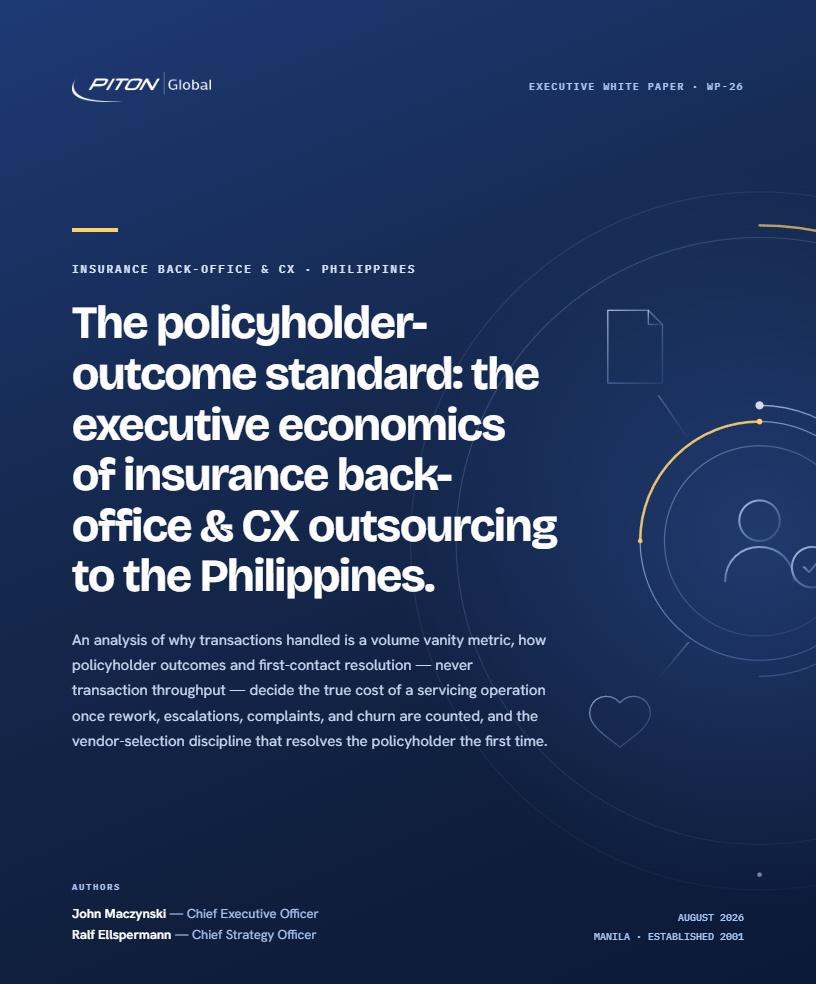
White paper cover — PITON-Global WP-26, The Policyholder-Outcome Standard: The Economics of Insurance Back-Office & CX Outsourcing
PDF · 14 PAGES
18WHITE PAPER WP-26 · INSURANCE CX · AUGUST 2026

The policyholder-outcome standard: the economics of insurance back-office & CX outsourcing.

Why transactions handled is a volume vanity metric, how policyholder outcomes and first-contact resolution — never transaction throughput — decide the true cost of a servicing operation once rework, escalations, complaints and churn are counted, and the vendor-selection discipline that resolves the policyholder the first time. Part of PITON-Global’s Executive White Paper Series, by John Maczynski and Ralf Ellspermann.

● 14 pages● 12-min read● Maczynski & Ellspermann
WHAT IT COVERS
The volume mirage: transactions handled versus policyholder outcomes resolved.
The servicing contract: service accurately, resolve on first contact, protect retention.
Case study: a 64-seat policyholder-servicing operation re-based on outcomes — 6.2× first-year ROI.
Read the white paper (PDF) Free · no gate · published August 2026
INSURANCE BACK-OFFICE & CX · PHILIPPINES

Tell us your CSAT and turnaround. We’ll name the teams that can lift them.

Share your servicing scope, systems and CSAT baseline. We return a vendor-neutral shortlist of compliance-led Philippine insurance operations teams that have proven the numbers on this page — at no cost to you.

Run the RFP
Vendor-neutral · no cost to you · 24-hour response guarantee, renewal-curve staffing model included · prepared and presented by John Maczynski, CEO
20ANSWERED BY OUR PRINCIPALS

What insurance leaders ask before outsourcing operations.

In-depth answers to the questions that decide an insurance engagement — from the principals who run them.

How do you stay compliant while servicing policyholders?+
Compliance review and QA apply to every policy change and interaction, validated against carrier rules before it goes out. That keeps claims clean and fully defensible, so the cash you collect never comes at the cost of the customer relationship or a compliance finding.— Ralf Ellspermann, CSO
What does outsourcing insurance operations save us?+
Typically 50 to 70 percent on cost to serve versus onshore staff, with higher CSAT and retention. The deeper benefit is loyal policyholders and freed capacity: your servicing team focuses on exceptions and relationships while we run the disciplined daily servicing across the policy book.— John Maczynski, CEO
Will you work inside our billing and CRM systems?+
Yes. Teams work natively in your Policy Administration Systems (PAS), CRMs, and core policy platforms (e.g., Guidewire, Duck Creek, Majesco, Vertafore, Applied Epic) — with full audit trails, rather than parallel spreadsheets. Your system of record stays the single source of truth behind every claim and note.— John Maczynski, CEO
How do you protect policyholder data (PII)?+
All work runs in SOC 2 and ISO 27001-aligned environments with PII access controlled per role, PII masked where needed, no local storage and complete audit trails. Every interaction is logged and sensitive policyholder data never leaves the secured environment.— Ralf Ellspermann, CSO
Will you actually lift our CSAT and retention?+
Yes. Multi-channel servicing trained to your products, accurate endorsements and proactive renewal outreach typically lift CSAT and retention sharply within a quarter, and a documented prevention strategy reduces servicing errors. Working the right policyholders at the right time means more renewals protected earlier and fewer customers lapsing into churn.— Ralf Ellspermann, CSO
How do you handle compliance and controls?+
Through compliant workflows, full audit logging, QA on policy edits and accuracy, documented escalation workflows and SOC 2 controls applied consistently. The result is revenue integrity that satisfies your compliance team and gives you a clean, examinable record behind every contact.— John Maczynski, CEO
What insurance servicing work can you take on?+
Policyholder servicing, policy administration, endorsements, billing, renewals and FNOL intake, plus claims support, premium billing and reconciliation posting and revenue reporting. Your team keeps oversight and the customer relationship; we run the consistent daily servicing that turns at-risk policies into protected renewals.— John Maczynski, CEO
Which accounts should we place first?+
Start with high-volume servicing and endorsements — where consistency lifts CSAT fastest — then extend to renewals and FNOL intake, where accuracy and empathy protect retention downstream. Complex endorsements and exception handling follow once the contact strategy, compliance controls and QA are proven on the early-stage work.— Ralf Ellspermann, CSO
How quickly can an insurance team be live?+
About three to seven weeks, often starting with a paid pilot on a ring-fenced book. No outreach goes live until scripts, compliance controls and QA are signed off. You see proven servicing quality on a defined book before the engagement scales across your full policy book.— John Maczynski, CEO
How is performance measured?+
Against policyholder CSAT, servicing turnaround, transaction accuracy and first-contact resolution, in a live dashboard with weekly reviews. We deliberately never report raw productivity counts — activity without accuracy, or speed that creates errors, defeats the purpose.— Ralf Ellspermann, CSO
Authorship, Review & Benchmark Verification
Authored by:
Ralf Ellspermann
Ralf Ellspermann
Chief Strategy Officer of PITON-Global
Two Decades Building and Advising Award-Winning Philippine BPO Operations

Ralf benchmarks policyholder-CX and insurance back-office floors on licensing-aware handling and service accuracy.

View full bio  →
Verified by:
John Maczynski
John Maczynski
CEO of PITON-Global
Former Global EVP of the World’s Largest Contact Center · Four Decades of Outsourcing Experience

John reviews the carrier-grade terms and compliance posture behind each insurance CX program on this page.

View full bio  →
Last Reviewed & VerifiedJune 30, 2026

Re-audited as SOC 2 Type II and state DOI obligations evolve. Every benchmark on this page is held to PITON-Global’s internal vetting standard.

error: Content is protected !!
Inquire Now