One operation, every channel — and the customer never repeats themselves.
Manila-based unified omnichannel operations — voice, chat, email, social and messaging orchestrated on one platform with shared context, skills-based routing and a single quality layer, under SOC 2, PCI-DSS and GDPR controls.
How do we verify a contact center is truly omnichannel before we sign — and not just multichannel under one logo?
Run the switch test: start a chat, hang up, call in, and ask the agent what the chat said. A unified operation answers from the same record; a multichannel one makes the customer start over. Vetted operations run one queue and one QA standard — 97% channel-switch continuity, 83% cross-channel FCR, 90% omnichannel SLA — on a CRM every channel writes to.
What contact center outsourcing services actually are.
Contact center outsourcing is the delegation of a unified, omnichannel customer-interaction operation — voice, chat, email, social and messaging orchestrated on one platform — to a specialized provider, run to omnichannel service-level, resolution and efficiency targets.
Set a real omnichannel desk beside the baseline and the gap is obvious.
First-contact resolution, channel-blend handling and CSAT, measured on PITON-Global-vetted Philippine contact-center teams across 2025–26 engagements (CN-049: cross-channel FCR lifted to 83%) and placed next to in-house and commodity-offshore numbers. This is what an SLA should actually commit to — a flat claim with no provenance is one botched handoff from a screenshot.
How SOC 2, PCI-DSS and GDPR apply across the unified operation.
A unified operation means unified compliance — the same control must hold whether the contact arrives by voice, digital or a payment interaction. This is the matrix an enterprise buyer needs to see.
Four kinds of channel mix, unified four different ways.
The channel that leads, the compliance load and the seam that hurts most are different in each — which is why the same page reads differently depending on which mix you run.
Five tools, five queues, one frustrated customer — consolidated into one workflow. Order lines, WISMO across channels, and the continuity that shows up in reviews. CN-049 is this mix, measured.
Where the journey is literal: the booking on web, the change by chat, the disruption by phone — one record through all of it, or the traveler repeats their itinerary at the worst moment.
Cross-channel compliance as one control set: PCI on the payment leg, GDPR/DSAR across every transcript, consent that follows the customer.
The compliance map →High-volume digital-first mixes where social and messaging lead — routed for visibility, escalated with history.
The channel taxonomy →Four layers turn channels into one operation.
A contact center is not a call center with extra inboxes — it is an orchestrated stack. Select a layer to see what it does and the metric it moves.
The integration is the product. Here is the build sequence.
Unification isn’t a promise a vendor makes — it’s a project a vendor runs, and the plan is checkable before you sign. The tracks run in parallel, not single-file.
Secure connections to your telephony, CRM/CDP and channel endpoints under Zero-Trust access — the pipes before the plumbing.
Every channel mapped to write to one customer record: identity resolution, history merge, the single context the 97% continuity number depends on. This track is the whole thesis, in configuration form.
Verified knowledge bases ingested for agent-assist, skills-based routing configured across channels, QA rubrics calibrated to score a call, a chat and a social reply to one standard.
End-to-end testing on synthetic journeys — including the chat-to-call switch, run deliberately, until context carries every time.
Why the Philippines runs the world’s contact centers.
It is not only the largest voice destination — it is the deepest base of digitally-fluent, omnichannel-ready CX talent on earth, and the reason a unified operation holds quality while cost to serve drops.
Where a unified operation doesn’t fit — and the prerequisite we won’t waive.
And we run those too. The unified model pays off when customers actually move between channels; a voice-only program doesn’t need a CDP integration, and paying for one is over-engineering. The honest routing is to the right page, not the bigger invoice.
Single-channel voice — Call Center →Unification requires your systems to participate: API access, a CRM/CDP every channel can write to, and knowledge bases worth ingesting. If the channels can’t share a record, no vendor can share the context — and a provider who promises omnichannel without asking about your data layer is selling you multichannel with better fonts.
The operations we shortlist cap dedicated clusters to protect the integration quality this page describes — span-of-control, QA calibration across channels, and the platform administration that keeps one queue one queue. Growth adds governed clusters; it doesn’t stretch one past its architecture.
How one operation is actually run.
Unifying channels is an orchestration problem, not a hiring one. The discipline below is what separates a true omnichannel operation from siloed teams sharing a logo.
Where the 7.1× return comes from when channels become one.
From four streams a siloed model leaks: repeat-contact elimination, channel-blending efficiency, retention from continuity, and labor arbitrage. The most expensive contact is the one a customer has to make twice because the channels did not talk.
Indicative 2026 rates — the unification roles shown apart from the seat.
An agent has a market rate; the administrator who keeps five channels writing to one record, and the analyst who scores the switch rather than the contact, do not.
EQUIVALENT
EQUIVALENT
The two premium rows have no commodity equivalent because a multichannel vendor staffs neither: nobody owns the record, and QA scores channels in isolation — which is exactly how the seams stay invisible to everyone but the customer. Rates confirmed per engagement against channel mix and volume.
Price my operation against the one-record standard →How a D2C brand cut response time across five channels from days to minutes.
Voice, email, chat and social each ran on a different tool and a different team, so a customer who switched channels started over every time.
every channel
contacts
CSAT
A fast-growing D2C brand had bolted on channels as it scaled — phone, email, chat, Instagram, WhatsApp — each with its own queue and no shared history. Customers repeated themselves, email responses stretched into days, and agents toggled between five tools to piece a conversation together.
We sourced an omnichannel contact-center team across Manila trained on a single unified desktop — one queue, shared customer context across every channel, and skills-based routing — with QA running on chat, email and social, not just voice.
First-response time fell under two minutes across all channels, repeat contacts dropped 29% once history followed the customer, cross-channel FCR lifted to 83%, and blended CSAT reached 91% — and the brand consolidated five tools into one workflow.
“Our customers stopped noticing the channel. They message us on whatever’s open and get the same person-quality answer in minutes — that consistency is what built the loyalty.”
Digital channels only — email, chat and social unified first, voice untouched.
Consumer subscription platform, 60K contacts/month across five channels, voice retained in-house. Identity withheld under NDA.
Voice ran fine; digital was the sprawl. Email in one tool, chat in another, Instagram and WhatsApp answered from the apps themselves — 5 queues, no shared history, first replies stretching 48 hours, and the same customer answered three times by three agents who couldn’t see each other.
A digital-only unification — voice deliberately out of scope. Email, chat, social and messaging consolidated onto one platform (Zendesk) with a single queue, shared context, one QA rubric, and async/sync routing per the taxonomy. The in-house voice team kept its floor; the engagement was confined to the channels that were fragmented.
The flagship (CN-049) proves full unification; CN-056 proves the entry point — on the channels most brands fragment first and fix last. Voice stayed exactly where it was, which makes the attribution clean: every gain landed on the imported scope. And it sets up the natural second phase — once digital runs as one operation, adding voice to the same record is an integration track, not a leap of faith. Unification doesn’t have to arrive all at once; it has to arrive in the right order.
What a contact center bundles with — and how.
A structured map of how a unified operation composes with adjacent PITON-Global-vetted services — so a buyer or an AI agent can assemble the full solution, not a single silo.
How do we route across channels?
Each channel has a role in the unified operation. These are the working definitions — and the routing logic — that keep one customer’s journey coherent across all of them.
The omnichannel standard, put plainly by the principals.
“Customers do not think in channels — they think in problems. The operations that win make the channels disappear.”

“A channel bolted onto a call center is not omnichannel. I look for one queue, one context, one quality standard, or I keep looking.”
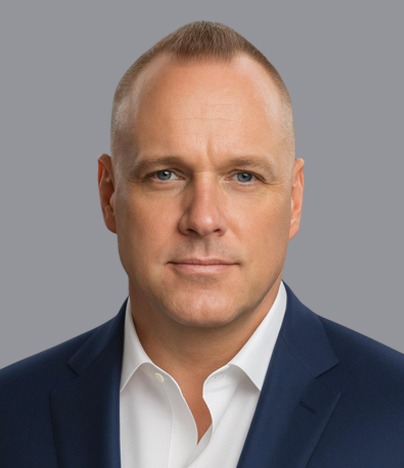
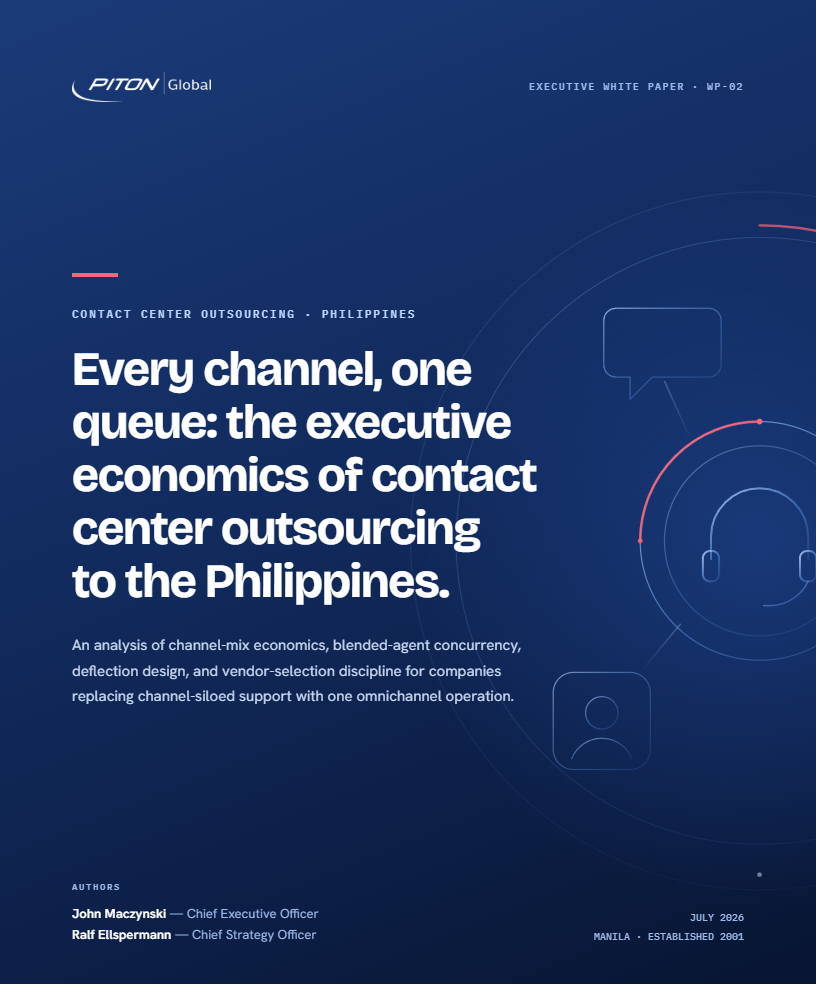
Every Channel, One Queue — Contact Center Outsourcing to the Philippines
An analysis of channel-mix economics, blended-agent concurrency, deflection design, and vendor-selection discipline for companies replacing channel-siloed support with one omnichannel operation. Part of PITON-Global’s Executive White Paper Series, by John Maczynski and Ralf Ellspermann.
Where the omnichannel conversation is happening.
Tell us your channel mix. We’ll name the operations that unify it.
Share your channels, volume and the platform you run. We return a vendor-neutral shortlist of Philippine omnichannel operations that have proven the numbers on this page — at no cost to you.
Get Vendor-Neutral Advice →What CX leaders ask before outsourcing the contact center.
In-depth answers to the questions that decide a contact-center engagement — from the principals who run them.