MEDIA & ENTERTAINMENT BPO OUTSOURCING PHILIPPINES

Launch night is when support becomes the show.

Streaming and device support, content operations, metadata and localization QA, and fan care — delivered by Philippine specialists who keep the stream up and the catalog clean when a tentpole release sends a million viewers to your help center at once.

Manila, Cebu & Davao deliveryPCI-DSS aligned15 languages
RESOLUTION DESK · LAUNCH NIGHTPREMIERE
up to99.9%
resolution-desk availability · ME-076
Surge absorbed · up to
12×
Cost vs onshore
63%
Audiences scale overnight. Your support has to scale the same hour.Find your partner
PLATFORMS & STANDARDS
ConvivaZendeskSalesforceBrightcoveJW PlayerMuxAkamaiAWS ElementalFastlyBitmovinDolby.ioSprinklrPCI-DSSSOC 2 Type II
22Vetted Media
BPO Partners
Streaming-fluent support and content-ops teams built for the spike.
29MMillion Viewer
Contacts / Year
Playback, billing and fan care across web, app and connected TV.
8Surge-Ready
Delivery Hubs
Premiere-night capacity drawn from eight cities, on demand.
THE PREMIERE IS THE TEST · 2026

A streaming service is judged in the ninety minutes a tentpole drops. Demand spikes tenfold, every playback hiccup trends, and a fan who can’t watch the finale cancels before the credits roll. Support is not a cost center that night — it is the product experience itself.

01MATCHED TO YOUR SLATE AND YOUR RELEASE RHYTHM

Your platform and your release calendar decide what the desk must prove.

These are the four media profiles we build for most often — each with its own drop rhythm, each served by the same premiere-grade operation.

01Streaming & OTT
ME-076 was here · 6M subscribers · a desk that buckled at the drop

The full media operation — premiere bench, stream-fluent resolution, the content-ops loop, and fan care.

Anchors to: The Readiness Profile · ME-076
02Studios & production
Where the risk starts before the release

Pre-release content security, metadata and localization QA, and delivery support under forensic watermarking and embargo controls.

Anchors to: Before the Drop
03Gaming & live events
The premiere that happens every night

Launch-day and live-event surge, player and fan care, and the community sentiment layer at gaming velocity.

Anchors to: The Premiere Surge Bench
04Music, sports & podcast platforms
Drop-day rhythms at catalog scale

Release-calendar surge, metadata hygiene across massive catalogs, and fan care in 15 languages.

Anchors to: The Content-Ops QA Loop
02THE READINESS PROFILE

Six dimensions decide a launch — how does your support shape up?

A media operation lives or dies across six axes at once — and a generic vendor is strong on none of them. The shape below compares a typical desk against the PITON-Global media standard; the gap is what shows up on premiere night.

STREAM UPTIMEMETADATA ACCURACYLOCALIZATION QALAUNCH SURGESUBSCRIBER SAVEFAN SENTIMENT
PITON-Global media standard Generic vendor
Stream Uptime — Premiere-night reliability, not best-effort
Metadata Accuracy — Clean titles, art and tags across the catalog
Localization QA — Subtitles and dubs checked, not auto-shipped
Launch Surge — Elastic bench that absorbs the spike
Subscriber Save — A retention motion at every cancel
Fan Sentiment — Community care that protects the brand
John Maczynski
CEO · OPERATIONS AUTHORITY

“In media, the average day is irrelevant — you are only as good as your worst ninety minutes, and those ninety minutes are watched by everyone at once. A desk that is merely fine on a Tuesday and falls over on premiere night has failed at the only test the business actually runs.”

John Maczynski · CEO, PITON-Global · 40-Year Global BPO Veteran
03GENERIC VS. MEDIA-GRADE

A help desk vs. a media operation.

The delta between a generic help desk and a PITON-Global-vetted media operation — across seven dimensions that decide your premiere-night reputation and your subscriber base.

DIMENSIONGENERIC HELP DESKPITON-GLOBAL MEDIASTRATEGIC SIGNAL
Launch SurgeBucklesElastic premiere benchStream stays up
Playback IssuesScript readsDevice & CDN-fluentReal fixes
Content OpsNot offeredMetadata & loc QAClean catalog
RetentionProcesses cancelsSave motionBase protected
Fan CareIgnoredCommunity-managedBrand defended
LanguagesEnglish-heavy15 nativeGlobal audience
CoverageBusiness-hours24/7 follow-the-sunEvery premiere
04BEFORE THE DROP

Launch night only matters if nothing leaked before it.

The premiere thesis has a precondition: the content has to reach the premiere unseen. Every specialist who touches an unreleased asset — a cut in QC, a subtitle file, a metadata record with a spoiler in the synopsis — is a potential leak vector, and a leaked finale isn’t a support incident; it’s the tentpole’s value walking out the door before the drop.

THE PRE-RELEASE PERIMETER
Non-persistent VDI — no unreleased content, art, or metadata ever rests on local hardware.
Forensic watermarking on every asset a reviewer touches — any leak is traceable to a session.
Biometric MFA & least-privilege RBAC — the localization specialist sees the subtitle file, not the library.
Embargo controls with full access logging — the studio’s security team can audit who saw what, when, down to the frame.
Why it lives with the support desk

The same operation that runs your premiere-night surge handles your pre-release content ops — metadata, localization QA, catalog prep — in the weeks before. One perimeter, one audit trail, one accountability line: the team drilled for the ninety minutes is the team locked down for the ninety days before them.

The through-line: the readiness profile gains a seventh, silent axis — content security — the one that’s only visible when it fails, and the one a studio checks first.

05THE RISK MATRIX

Four ways a platform bleeds — one before the drop, three during and after.

A platform’s risk isn’t one surface; it’s four, and they span the whole release cycle — the leak before, the surge during, the catalog and the data throughout.

RISK VECTORWHERE THE COST LANDSCONTAINMENT ON A MEDIA-GRADE OPERATION
Pre-release leakThe unreleased cut, art, or spoiler exposed — the tentpole’s value spent before the premiereForensic watermarking, non-persistent VDI, embargo controls, session-level access logging (Before the Drop)
Catalog & metadata decayWrong titles, missing art, broken subtitles — the errors that generate the tickets and bury the titleThe content-ops QA loop: metadata and localization QA upstream, recurring faults fed back — the catalog stops generating the contacts
Premiere surge collapse THE WEDGEThe 12× spike that turns the biggest night into the worst one — publicly, all at onceThe core wedge: calendar-activated surge bench, drilled at 12×, stream-fluent resolution holding flat through the drop
Viewer-data & payment exposureSubscriber PII and card data at breach risk across billing and account supportPCI-DSS controls, Zero-Trust VDI, zero local residency on viewer data — the fan cared for, the data locked down

The through-line: the moderation and policy-enforcement risks a platform also carries are a different discipline, run by teams built and wellness-supported for it — see our Trust & Safety operation. The growth desk and the safety desk: coordinated, never blurred.

FOR THE VP OF VIEWER EXPERIENCE
When the premiere spikes your queue, does CSAT survive the night?
A 30-minute scoping call maps your peak-event load — then points you to the operations that hold under it.
John Maczynski
John Maczynski
CEO, PITON-Global
+1 402 598-8740
Book the scoping call
06THE MATH OF A PREMIERE

Where does the 6.6× return come from when the stream holds and the fans stay?

From four streams a ticket count never shows: launch-churn prevented, content-ops cost cut, sentiment protected and idle capacity removed. A subscriber who watches the finale without a hitch renews; one who hits a buffering wheel cancels — and tells everyone why.

Launch-Night Churn Prevented
$1.5M – $3.1M
Content-Ops & Loc Cost Cut
$0.9M – $1.8M
Brand Sentiment Protected
$0.8M – $1.6M
Idle Capacity Removed
$0.9M – $1.8M
TOTAL ANNUAL NET BENEFIT · BASELINE-50, PREMIERE-600 MEDIA DESK
$4.1M – $8.3M
6.6×
Documented return
01
Launch Churn — Primary Driver
A streaming service cut premiere-night cancellations 44% by absorbing a 12× surge without playback-resolution times slipping — fans who would have rage-quit the finale stayed subscribed. Annual churn prevented: $2.7M.
02
Content Ops — Cost & Quality
Metadata and localization QA moved off in-house overtime to a managed team, cutting cost 34% while raising catalog accuracy — fewer wrong titles, fewer broken subtitles.
03
Sentiment — Brand Protected
Proactive fan-community care turned premiere-night complaints into managed conversations, holding social sentiment positive through three major launches.
ENTITY PROOF · Q4 2025–Q2 2026
44%
Premiere-night cancellations
A streaming platform with 6M subscribers moved support & content ops to PITON-Global. Total 12-month net benefit: $6.5M against a $990K engagement cost — a 6.6× return.
6M subscribers · Manila, Cebu & Davao · 99.9% premiere uptime
THE PREMIERE FILE · ENGAGEMENT ME-076Verified Q2 2026 · Manila, Cebu & Davao
CLIENT ENTITY
Streaming platform with 6M subscribers and a heavy original-release slate.
PRE-DEPLOYMENT BASELINE
A generic desk that buckled on premiere nights, with in-house overtime on content ops and rising launch churn.
THE INTERVENTION
A media operation across Manila, Cebu & Davao — elastic premiere bench, content QA and fan care on Conviva + Sprinklr.
THE SLATE, MEASURED
99.9%
Premiere uptime
12× surge absorbed
−44%
Launch churn
fans stayed subscribed
−34%
Content-ops cost
managed, not overtime
+0.6
Fan sentiment
net positive through launches
6.6×total engagement return
$6.5M net benefit on $990K program
Reviewed by John Maczynski (CEO) &
Ralf Ellspermann (CSO) · Q2 2026
07THE ENTRY POINT · COMPANION ENGAGEMENT

One loop, no premiere required — a content-ops-QA-only deployment, measured.

ME-076 proves the full premiere operation. This is the floor — and it proves it with no premiere required: a content-ops-QA-only engagement, viewer support and surge left in-house.

THE PREMIERE FILE · ENGAGEMENT ME-083Single-loop · Content-ops QA only
CLIENT ENTITY
OTT / catalog platform — viewer support retained in-house. Identity withheld under NDA, as is standard in streaming.
PRE-DEPLOYMENT BASELINE
Support was adequate; the catalog was generating its own tickets. Wrong titles, missing art, out-of-sync subtitles — a meaningful share of contacts traced to catalog errors, fixed downstream at support cost after a viewer found each one. Content ops ran on in-house overtime. No premiere crisis; a QA-loop absence.
THE INTERVENTION
The content-ops QA loop only — metadata accuracy, art QA, and localization QA across 15 languages on the client’s CMS, with recurring faults fed back to the catalog team. Support and surge stayed in-house; scope held to one loop.
NINETY DAYS, MEASURED — ILLUSTRATIVE, REPLACE WITH VERIFIED ENGAGEMENT DATA BEFORE PUBLICATION
X% → X%
Catalog-error contacts
the tickets never generated
−34%
Content-ops cost
target · managed, not overtime
X% → X%
Catalog accuracy (audited)
fewer wrong titles, fewer broken subs
STRATEGIC INSIGHT

ME-076 proves the full premiere operation; ME-083 proves the entry point — with no premiere required. The catalog error caught upstream is the contact that never happens: failure-demand eliminated at the source, in a quarter, with the support desk untouched. It’s the same kill-the-contact-at-the-source logic as the Bad Volume elimination on our telecom desk — there the failed activation, here the broken subtitle; both are demand you remove rather than staff. The cheapest ticket in media is the one the clean catalog never generated.

Verified by Ralf Ellspermann (CSO) · Reviewed by John Maczynski (CEO) · Q2 2026
08PER TICKET VS. PER PREMIERE

Here is the cost per seat. Now here is what a buffering wheel on the finale costs.

Every RFP compares cost-per-contact, so we publish the seat math. Then we price the ninety minutes — because a subscriber who watches the finale without a hitch renews, and one who hits a buffering wheel cancels before the credits roll, and tells everyone why.

Distinct from the Readiness Profile above: that radar scores the desk across six axes — this prices what a clean premiere is worth.
THE SEAT LENS · FULLY LOADED, ANNUAL, PER MEDIA-OPS FTE
DELIVERY MODELCOST / FTE / YREFFECTIVE HOURLY · 1,920 HRS
US onshore media desk≈ $62,000≈ $32.50/hr
PH generic help desk (legacy)≈ $25,000≈ $13.25/hr
PITON-Global-vetted · media-grade, premiere-drilled≈ $19,000 blended≈ $10/hr
COST SIMULATOR · CHOOSE A DELIVERY MODEL
Onshore fixed
PH generic
PITON-Global elastic
Baseline desk size50 FTE · premiere up to 12×
20default 50 → 600 · ME-07690
Selected model
Annual operational expense
Annual labor saving vs. onshore
What the ticket count never shows
THE PREMIERE PIVOT · THE PANEL A TICKET COUNT CAN’T RENDER

The seat lens prices the agent; the premiere prices the platform. The generic desk is cheap per contact and catastrophic per launch: the fixed roster buckles at 12×, the scripted agent apologises for the buffering wheel instead of fixing it, and the untouched catalog keeps generating the tickets. Price the ninety minutes and the four streams a ticket count omits — launch churn prevented ($1.5M–$3.1M), content-ops cost cut ($0.9M–$1.8M), sentiment protected ($0.8M–$1.6M), and idle capacity removed ($0.9M–$1.8M) — stack to a $4.1M–$8.3M annual net benefit.

That is how ME-076’s $990K program returned $6.5M (6.6×): a 12× surge absorbed at 99.9% resolution-desk availability, launch cancellations down 44%, and content ops off in-house overtime. The cheapest ticket is the one the clean catalog never generated — and the cheapest premiere is the one the fans only remember for the show.

Illustrative projection; the elastic model’s advantage is cost shape plus the loop. We confirm against your release slate, subscriber base, and current launch-churn rate.
Get my premiere model
09PRICING TOPOGRAPHY

Indicative 2026 rates — the stream-fluent roles shown apart from the script-reader.

Reading a playback script has a generic market; diagnosing a device/app/CDN failure to a real fix, and absorbing a 12× drop without resolution times slipping, do not. Those are drilled capabilities — and a quote at the help-desk band for either is the buffering-wheel-apology failure mode with a price on it.

CORE ROLERATE (USD)OPERATIONAL PROFILETIER
Viewer / fan-care agent$8–$13Playback, billing, account supportVOLUME
Media asset / metadata specialist$9–$14Ingest, tagging, catalog & art QACONTENT OPS
Localization / subtitling specialist$10–$15Subtitles, captions, dub coordination, loc QACONTENT OPS
Community / sentiment specialist$9–$14Fan-community care, launch-night sentimentFAN CARE
QA / calibration analyst$10–$14Resolution QA, catalog-accuracy calibrationVERIFICATION
Stream-fluent resolution agent
— no generic equivalent
$11–$16Device/app/CDN diagnosis to real fix — proven on live playback troubleshooting before a premiereRESOLUTION
Premiere surge agent (calendar-activated)
— no generic equivalent
$10–$14 · activation-pricedCross-trained, drilled at 12×, activated by the release slateSURGE
Team lead / premiere commander$14–$22Uptime/churn/sentiment governance, launch-shift commandLEADERSHIP

The two premium rows have no generic equivalent because fixing a stream and absorbing a drop are drilled capabilities — a script-reader can only apologise for the buffering wheel. A quote at the help-desk band for either is the tell. Rates confirmed per engagement against slate and subscriber base.

Price my desk against the premiere-drill standard
107-WEEK MEDIA-OPS STAND-UP

A premiere-ready media desk live in 7 weeks — surge-drilled before the drop.

A gated stand-up timed to your release calendar. No team takes a live premiere until it clears a 12× surge simulation against your real playbooks.

01
WEEKS 1–2
Platform & Content Onboarding
Conviva / Zendesk / CMS connectPlayback & device troubleshootingMetadata & localization specsBaseline uptime & churn audit
02
WEEKS 3–4
Hiring & Surge Build
Streaming-fluent recruitmentFan-care & sentiment trainingContent-QA certificationPremiere surge bench cross-trained
03
WEEKS 5–6
Premiere Simulation & Shadow
Shadow live viewer contacts12× surge load simulationPlayback-resolution heldSave motion & QA proven
04
WEEKS 7
Cutover & Governance
Phased volume rampLive uptime / churn / sentiment dashboardRelease-calendar surge planPITON-Global Media-Grade certification
11THE PREMIERE-NIGHT TEST · SIMULATE IT

What does a premiere-grade media desk do at peak that a generic help desk simply can’t?

Three capabilities decide whether a launch makes your platform or breaks it — and each can be stress-tested before you sign. Ask any prospective partner to prove them against a simulated premiere, not a calm-day report.

01
A Bench That Absorbs the Drop
When a tentpole drops, contacts can spike tenfold in minutes. Only a pre-trained, cross-trained surge bench keeps playback-resolution times flat; a fixed roster turns your biggest night into your worst.
STRESS-TEST IT: Run a 12× premiere surge simulation
02
Hands That Fix the Stream
A scripted agent can only apologise for a buffering wheel. A media-fluent one diagnoses device, app and CDN issues and actually resolves them — the difference between a fan who keeps watching and one who cancels.
STRESS-TEST IT: Test live playback troubleshooting depth
03
A Clean Catalog Behind the Care
Support is only half the operation. Wrong titles, missing art and broken subtitles drive contacts in the first place. A media partner runs metadata and localization QA so the catalog stops generating the tickets.
STRESS-TEST IT: Audit metadata and localization accuracy
THE MEDIA-GRADE ARCHITECTUREhow each failure mode is designed out
Premiere Surge Bench
A cross-trained surge bench is drilled against simulated 12× premiere loads and activated by your release calendar, so capacity is scaling before the drop, not after the stream is already down.
Stream-Fluent Resolution
Agents troubleshoot device, app and CDN issues to real resolution and feed recurring faults back to engineering, so playback problems get fixed instead of just apologised for.
Content-Ops QA Loop
Metadata and localization QA run alongside care, so the catalog errors that generate contacts are caught upstream — fewer wrong titles, fewer broken subtitles, fewer tickets.
THE LOOP, DEEPENED
The broken subtitle is a QA miss and a support ticket — catch it once, upstream.

Subtitling, captioning, and dubbing coordination across 15 languages, QA’d before the drop — because the mistranslated line trends, the out-of-sync caption generates the contact, and the missing dub locks a market out of the premiere. Localization QA inside the content-ops loop means the catalog error is caught where it’s cheap: before a million viewers find it simultaneously. The wrong title, the missing art, the broken subtitle — each is failure-demand the loop eliminates at the source, so the premiere bench fights the surge, not the catalog.
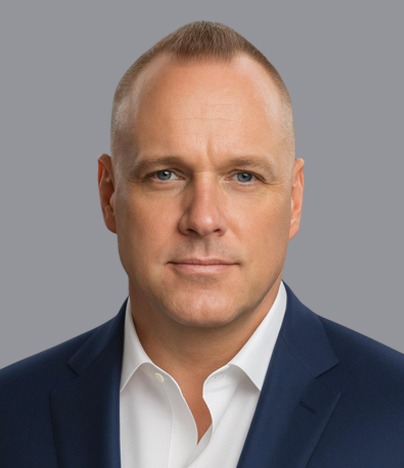
Ralf Ellspermann
CSO · MEDIA-OPS DESIGN

“Do not evaluate a media desk on a quiet afternoon. Simulate the drop: twelve times the volume, a CDN hiccup, a finale everyone is watching at once. The desks worth hiring hold their resolution times and keep the fans subscribed; the rest melt down in public. The simulation tells you which one you are buying.”

Ralf Ellspermann · CSO, PITON-Global · 25-Year Philippine BPO Veteran
12RADICAL TRANSPARENCY · CONTINUED

Where the media desk doesn’t fit — and what stays yours.

A shortlist that includes “no” is the only kind worth having. Three engagements we turn down — and why the refusal is the point.

01
You own editorial control and the release calendar — we’re drilled to it, we don’t set it.

The slate, the content decisions, the embargo dates, and the brand voice are yours; our discipline is being at 12× capacity the hour your calendar says so, with the catalog clean beneath it. A vendor that offers to shape your slate from a support desk is selling judgment it wasn’t hired for.

02
Moderation is a different discipline — and we route it to one.

Fan-community care and sentiment run here; policy enforcement, content moderation, and CIB analysis are trust & safety work, run by teams built, trained, and wellness-supported for it on our Trust & Safety operation. Where a platform needs both, they run coordinated but distinct — the fan desk and the safety desk, never blurred.

03
No platform access, no deployment.

Stream-fluent resolution requires being inside your Conviva/CMS/CDN tooling under Zero-Trust VDI — playback telemetry, device state, and account on one screen, viewer data and unreleased content at zero local residency. Without it, we’d be reading scripts at a buffering wheel — the exact failure this page audits against.

READY FOR YOUR NEXT PREMIERE?

The media desks that keep the stream up and fans subscribed.

These are the operations that passed a 12× premiere simulation alongside the complete Seven-Step Vendor Audit — a premiere surge bench, stream-fluent resolution and a content-ops QA loop demonstrated, not described. What reaches you is a short list of media-grade names that earned it.

See the media shortlist
Peer-reviewed by John Maczynski, CEO · April 2026
Our 24-Hour Response Guarantee — a reply within 24 hours, premiere-simulation pre-screen included.
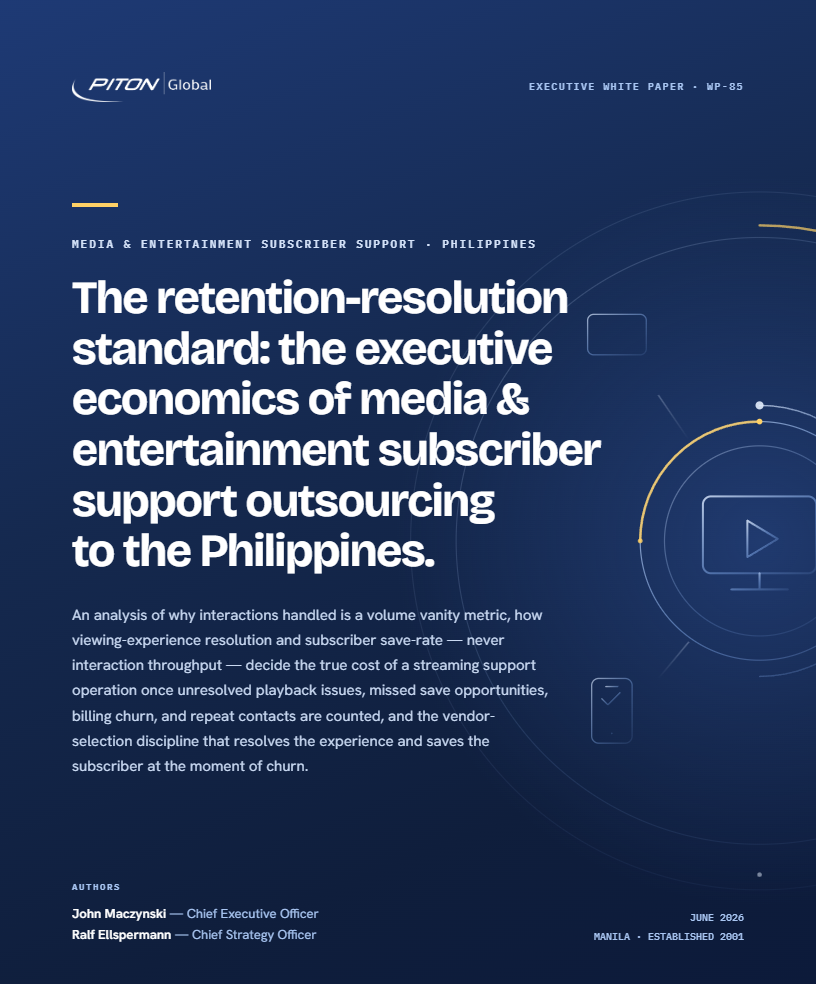
WP-85 Media & Entertainment Subscriber Support white paper cover
PDF · 11 PAGES
13WHITE PAPER WP-85 · MEDIA & ENTERTAINMENT · JUNE 2026

The retention-resolution standard: the economics of media & entertainment subscriber support outsourcing.

Why interactions handled is a volume vanity metric, how viewing-experience resolution and subscriber save-rate — never interaction throughput — decide the true cost of a streaming support operation once unresolved playback issues, missed saves, billing churn and repeat contacts are counted, and the vendor-selection discipline that resolves the experience and saves the subscriber at the moment of churn. Volume 88 of PITON-Global’s Executive White Paper Series, by John Maczynski and Ralf Ellspermann.

11 pages9-min readEllspermann & Maczynski
IN THESE PAGES
The volume mirage: interactions handled versus subscribers resolved & retained.
The support contract: resolve the experience, save the subscriber, protect the catalog.
Case study ME-088: a 110-seat streaming support operation re-based on resolution & retention — 6.4× first-year ROI.
Read the white paper (PDF) Free · no gate · published June 2026
14ANSWERED BY OUR PRINCIPALS

What media leaders ask before they outsource.

In-depth answers to the questions that decide a media & entertainment engagement — from the principals who run them.

What media and entertainment work can you take on?+
Content operations, metadata and localization support, viewer and subscriber care, moderation, and back-office across your catalog and platforms. One coordinated team keeps content flowing and audiences supported together.— John Maczynski, CEO
What does outsourcing media operations save us?+
Typically 50 to 60 percent on cost versus in-house, with faster delivery. The deeper benefit is consistent quality and throughput across content ops and viewer care, freeing your teams for creative and strategic work.— John Maczynski, CEO
Can you scale for launches and peak demand?+
Yes. We surge trained capacity for premieres, launches and seasonal peaks, so content delivery and viewer support hold when demand concentrates. The same QA controls apply throughout, protecting quality under pressure.— Ralf Ellspermann, CSO
How do you keep quality and consistency high?+
Calibrated QA and detailed guidelines apply across content ops and care, so metadata, localization and viewer support stay consistent. Standards are measured, not assumed, keeping quality uniform across titles and channels.— Ralf Ellspermann, CSO
Will you work in our systems?+
Yes. Specialists work natively in your content, MAM and support tools, with full audit trails, rather than toggling between disconnected systems. That preserves context across content and audience operations.— John Maczynski, CEO
How do you protect content and viewer data?+
All work runs in access-controlled environments with no local storage and full audit trails. Access is scoped per role, every action is logged, and sensitive content and viewer data never leaves the secured environment.— Ralf Ellspermann, CSO
Can you support global audiences and languages?+
Yes. We staff teams matched to your markets and languages, so localization and viewer care maintain quality across regions. Coverage scales with your audience footprint without you staffing each market in-house.— John Maczynski, CEO
Which functions should we outsource first?+
Start with content operations and viewer care, where volume is highest and consistency moves quality and satisfaction fastest. Localization and moderation follow once the standards and quality bar are proven.— Ralf Ellspermann, CSO
How quickly can a team be live?+
About eight weeks, through a gated stand-up. No work goes live until QA is signed off and a pilot batch or parallel run matches your bar. You see proven quality before real volume flows.— John Maczynski, CEO
How is performance measured?+
Against accuracy, turnaround and viewer satisfaction, in a live dashboard with monthly reviews. We deliberately never report raw volume — work done fast but off-standard hurts the content and the audience, not progress.— Ralf Ellspermann, CSO
Authorship, Review & Benchmark Verification
Authored by:
Ralf Ellspermann
Ralf Ellspermann
Chief Strategy Officer of PITON-Global
Two Decades Building and Advising Award-Winning Philippine BPO Operations

Ralf audits streaming-support, content-operations and fan-care floors before media benchmarks are published here.

View full bio  →
Verified by:
John Maczynski
John Maczynski
CEO of PITON-Global
Former Global EVP of the World’s Largest Contact Center · Four Decades of Outsourcing Experience

John validates the launch-surge readiness and commercial terms behind each media and entertainment program.

View full bio  →
Last Reviewed & VerifiedJune 6, 2026

Re-audited as content-security (TPN-aware) and SOC 2 obligations evolve. Every benchmark on this page is held to PITON-Global’s internal vetting standard.

Segments We Serve
Streaming / OTTStudiosMusicGamingSports MediaFan CareContent OpsMetadata QALocalizationPremiere Surge
error: Content is protected !!
Inquire Now