

Is our social-media vendor growing the community or just clearing the queue?
Ask for response time by priority tier. A flat queue buries the brand crisis behind the trivial; a community operation runs a different SLA for each — brand crisis under 5 minutes, creator escalation under 30, audience engagement under 4 hours — with every agent passing brand-voice calibration before a live mention. The social platform lifted engagement 52% and cut creator churn 40%.
Operations Partners
Handled / Year
Languages
Every growing platform hits the same wall: communities scale faster than the teams that run them. Creators need support, audiences expect replies, and conversations never stop — so response slips, engagement cools and reach quietly declines. Community operations are the competitive advantage.
Community care first, trust and safety second — what social platforms outsource, ordered by demand.









Your platform and your audience decide which tier carries the load.
These are the four community profiles we build for most often — the growth-side complement to the enforcement work on our Trust & Safety desk: the growth desk and the safety desk, coordinated, never blurred.
Full-stack community operations: tiered engagement, creator pods, and community-health analytics at platform scale.
Anchors to: The Community Dashboard · the social platform →Brand-voice-certified engagement, social care, and <5-minute crisis response across the channels your customers actually use — with the commerce cross-link to our e-commerce social operations.
Anchors to: Tier 1 · Brand Crisis →Native-tone engagement, event and launch surge coverage, and community building that reads the room in the community’s own register.
Anchors to: Tier 4 · Community Building →Community management with a brand-safety layer — and a cross-link to our Trust & Safety operations for the enforcement side.
Anchors to: The Community Ops Audit →Not every interaction is equal — how fast must each one move?
A priority-tiered workflow is what separates a thriving community from a silent one. Select a tier to see what it covers, the response SLA, who handles it, and the quality safeguard around that work.
Community operations is a model where priority-tiered engagement is paired with brand-voice governance, creator escalation paths and always-on coverage — so every mention, DM and creator request is answered to an SLA. It is measured by response time and community health, not tickets per head.
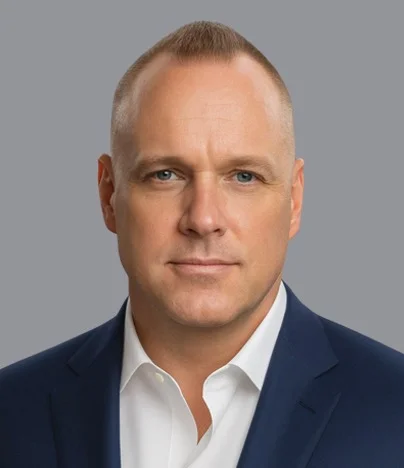
“Community is the one operation I run where every reply is the brand speaking. A team that knows your voice and answers in minutes compounds trust; one that treats social as a ticket queue quietly erodes it. We vet for teams that grow communities, not just clear them.”
A ticket-clearing vendor vs. a community operations team.
The delta between a volume-priced support vendor and the PITON-Global-vetted standard — across seven dimensions that decide your engagement, your brand reputation and the community you build.
Where does the value come from when community drives growth?
From four streams a per-interaction price ignores: engagement and reach protected, creator churn avoided, attrition cost removed and advertiser trust kept. A viral complaint left unanswered costs more than a year of the team that would have caught it.
Illustration, not a client result: 150 FTEs × 1,920 paid hours at about $8.85/hour ($17,000 per FTE per year) plus a 10% transition provision, against $58,000 per FTE onshore — a modelled difference of $5.89M. The bars above are value categories to evaluate with your own data, not booked benefits. Dedicated specialist and leadership roles are priced separately.
One pod, one cohort — a creator-support-only deployment, measured.
The flagship engagement proves the full community operation. This is the floor — and it proves it on the cohort that generates the content everything else engages with: a creator-support-only engagement, the audience-engagement desk left in-house.
Here is the cost per reply. Now here is what silence costs.
Every RFP compares cost-per-interaction, so we publish the seat math. Then we price what a per-interaction quote structurally ignores: the community that cools, the creator who leaves, and the viral complaint nobody caught — because a silent community is a shrinking one, and shrinkage never shows up on a vendor invoice.
The seat lens prices the reply; community health prices the outcome. The ticket-queue vendor is cheap per interaction and expensive per community: the flat queue buries the brand crisis behind the trivial, generic replies cool the conversations that drive reach, and creators quietly leave a platform where support is a ticket number. Price the community and the four streams a per-interaction quote ignores — engagement and reach protected ($1.6M–$3.4M), creator churn avoided ($1.2M–$2.6M), agent attrition removed ($0.8M–$1.5M), and advertiser & brand-safety trust ($0.9M–$1.8M) — stack to a $4.5M–$9.3M annual net benefit.
That is how the flagship engagement’s $1.02M operation was followed by a client-reported gross benefit of $7.1M (7.0× cost, not audited) on a 52% engagement lift and creator churn down 40%. A viral complaint left unanswered costs more than a year of the team that would have caught it. The cheapest reply is the one that keeps the conversation alive.
Indicative 2026 rates — the brand-voice roles shown apart from the queue seat.
Clearing a social queue has a generic market; a community agent certified on your voice — who sounds like the brand in twenty languages at 3am — does not. A quote at the queue-agent band for brand-voice work is the generic-script trap with a price on it: every off-tone reply is the brand speaking badly, in public, permanently.
The two premium rows have no generic equivalent because brand fluency is certified, not scripted — every agent clears a brand-voice calibration audit before a live mention — and a creator pod is a relationship desk, not a queue. It’s the same Linguistic Guardian pre-delivery discipline documented across our fintech, financial-services, and e-commerce operations since 2025, here tuned to brand voice at community scale. A quote at the queue band for either is the tell. Rates confirmed per engagement against interaction volume and language mix.
Price my team against the brand-voice standard →An always-on community operation live in 8 weeks — brand voice proven, creators supported.
A gated stand-up. No agent takes live brand-crisis work until they clear a brand-voice calibration audit and the escalation protocol is fully operational.
Social media BPO Philippines: what to inspect before you sign
Three things separate a community operation you can rely on from a ticket queue that will eventually fail you — and all three are visible on a floor walk before you sign. Ask to see them, not be told about them.

“Walk the floor before you sign. A community operation tells you everything in five minutes: are the agents trained on your brand voice and supported, or churning through an endless queue to hit a number? The healthy teams are the accurate ones. I have never seen that correlation fail.”
Where community operations don’t fit — and whose voice it always is.
A shortlist that includes “no” is the only kind worth having. Three engagements we turn down — and why the refusal is the point.
Every agent passes calibration on your tone, your escalation rules, your creator terms before touching a live mention. A vendor that improvises your voice at 3am isn’t managing your community — it’s impersonating your brand with a shift schedule. The voice standard, the crisis playbooks, and the policy calls are yours; the fluency and the always-on discipline are ours.
The community model only pays off measured in engagement, creator retention, and community health — not interactions cleared. If your social channel genuinely just needs a queue emptied, a volume vendor is cheaper and adequate, and we’ll say so. Our value is the conversation kept alive and the creator who stays; if neither is measured, you’re overpaying for warmth nobody’s tracking.
Community operations handle the conversation; content moderation, CIB analysis, and policy enforcement are trust & safety work, run by teams built, trained, and wellness-supported for it. Where your community needs both, we run them as coordinated but distinct operations — the growth desk and the safety desk, cross-linked, never blurred. (See the Trust & Safety page.)
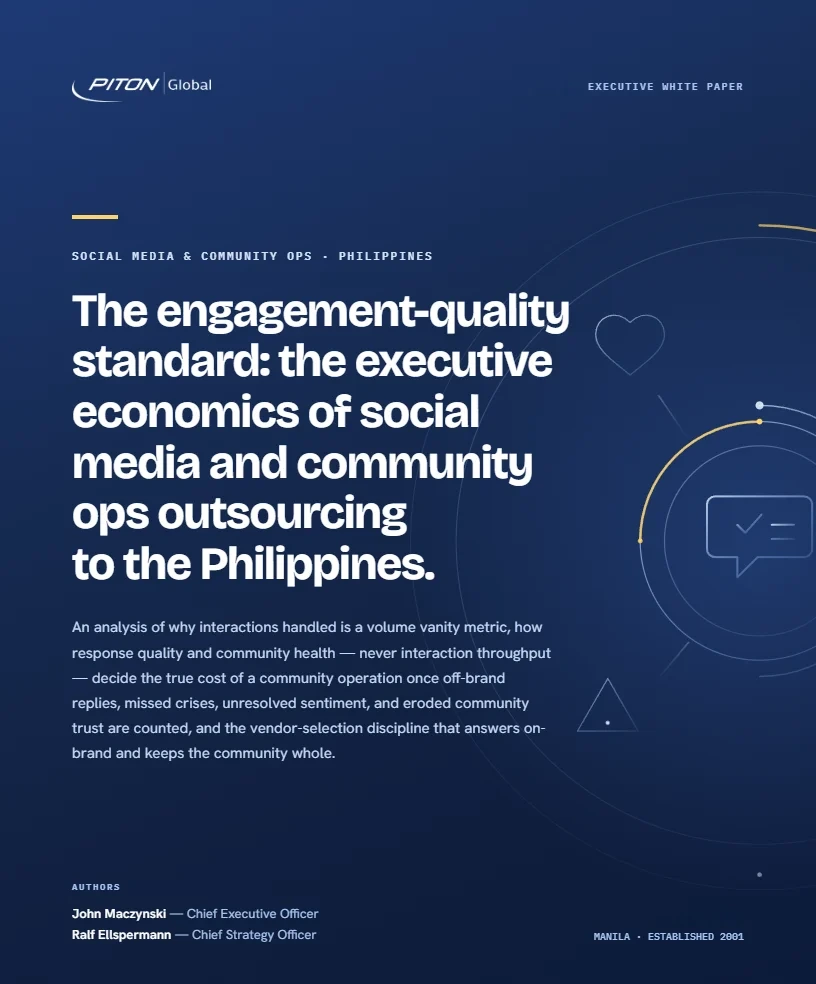
The engagement-quality standard: the economics of social media & community ops outsourcing.
Why interactions handled is a volume vanity metric, how response quality and community health — never interaction throughput — decide the true cost of a community operation once off-brand replies, missed crises, unresolved sentiment and eroded community trust are counted, and the vendor-selection discipline that answers on-brand and keeps the community whole. Part of PITON-Global’s Executive White Paper Series, by John Maczynski and Ralf Ellspermann.
What social-media leaders ask before they outsource.
In-depth answers to the questions that decide a social-media BPO engagement — from the principals who run them.

Social media operations and community management outsourcing in the Philippines: publishing, community and moderation at scale
Social media operations and community management outsourcing to the Philippines gives brands, agencies, publishers, gaming companies and creators a team for the production side of social: content scheduling and publishing across platforms, community management and engagement, comment and forum moderation, social listening and reporting, influencer and creator program coordination and the asset and copy production that keeps channels active. Social teams in-house are small and strategy-focused; the daily operational load is large and never stops.
Filipino social media teams are natively fluent in the platforms, write strong English in brand voice and already run social operations for US, UK and Australian brands through the main publishing, listening and moderation tools. Hubs in Manila, Cebu and Clark cover every time zone for always-on channels. This page covers operations and community; service conversations on social have their own page. For the wider picture, see our guides to scalable social media content operations and AI-powered social engagement.
Publishing operations and content production
Publishing coordinators manage content calendars, adapt approved content for each platform’s formats and specs, schedule posts across time zones, add captions, hashtags and alt text, and verify that posts publish correctly. Production support includes resizing and light editing of assets, caption writing in brand voice, subtitle files for video and template-based graphics.
Approval workflows keep brand and legal control: nothing publishes without sign-off where your policy requires it, and regulated industries have additional review steps. See advertising and ad operations for paid social trafficking and reporting.
Community management and engagement
Community managers reply to comments and mentions in brand voice, start and steer conversations, surface user-generated content for reposting with permission, welcome new members in groups and forums and run engagement activities such as Q&As and polls. Engagement builds reach and loyalty; silence lets communities drift.
Clear playbooks define tone, topics to engage and avoid, how to handle criticism and when to escalate to service teams or brand managers. See social media customer care for service requests that surface in social threads and social commerce support for shopping conversations.
Paid social operations and performance reporting
Organic publishing and paid campaigns run on the same channels and often the same team. Paid social operations teams build and traffic campaigns to brief, QA creative against platform specs and brand rules, monitor pacing and spend daily, pause under-performing ads under agreed rules and reconcile spend with invoices. Platform policy changes and ad rejections are handled quickly so campaigns stay live.
Reporting brings organic and paid together: reach, engagement, traffic, leads and sales by channel, campaign and content type, with commentary on what to do next rather than a wall of numbers. See advertising and ad operations for the full ad operations function.
Crisis protocols, brand safety and approvals
Social channels are where crises surface first and spread fastest. Teams work to a crisis protocol: what counts as a potential crisis, who is alerted within minutes, which scheduled posts are paused, who approves holding statements and how escalation runs through the day and night. Rehearsing the protocol matters more than writing it.
Brand safety and approvals run every day: content is checked against legal, regulatory and brand rules before publishing, claims are substantiated, disclosures for partnerships and sweepstakes are included and comments on sensitive posts are monitored closely. See content moderation for moderation at scale and social media customer care for the response side of social.
Moderation, safety and listening
Moderators review comments, posts and forum content against community guidelines and platform rules, remove spam, hate, harassment and scams, protect members from impersonation and report illegal content. Gaming and entertainment communities have high volumes and sharp tones, and moderation keeps them welcoming. Moderator wellness programs limit exposure to harmful content. See content moderation for large-scale programs.
Social listening analysts track brand mentions, competitor activity, trending topics and sentiment, flag emerging issues early and produce weekly reports that inform marketing and product decisions.
Influencer programs, reporting and choosing a partner
Influencer and creator programs need coordination: outreach, briefs, contracts and disclosures, content review for compliance with advertising rules such as FTC endorsement guidance, product shipping, performance tracking and payment reconciliation. Coordinators run these programs under your marketing leads.
Reporting ties it together: publishing performance, engagement, community growth, moderation actions, listening insights and influencer results. When you compare vendors, ask about platform tool experience, brand-voice training, moderation wellness, approval workflow discipline and reporting. Vetted mid-sized Philippine providers usually start social operations programs with 3 to 50 people and report on-time publishing, engagement response time, moderation accuracy, community growth and campaign performance. See media and entertainment and iGaming outsourcing for sector programs.
Also serving: social media operations sits in our Media & Gaming hub. Related pages: social media customer care, content moderation and advertising and ad operations.
Is our social-media vendor growing the community or just clearing the queue?
Ask for response time by priority tier. A flat queue buries the brand crisis behind the trivial; a community operation runs a different SLA for each — brand crisis under 5 minutes, creator escalation under 30, audience engagement under 4 hours — with every agent passing brand-voice calibration before a live mention. The social platform lifted engagement 52% and cut creator churn 40%.
Operations Partners
Handled / Year
Languages
Every growing platform hits the same wall: communities scale faster than the teams that run them. Creators need support, audiences expect replies, and conversations never stop — so response slips, engagement cools and reach quietly declines. Community operations are the competitive advantage.
Community care first, trust and safety second — what social platforms outsource, ordered by demand.
Your platform and your audience decide which tier carries the load.
These are the four community profiles we build for most often — the growth-side complement to the enforcement work on our Trust & Safety desk: the growth desk and the safety desk, coordinated, never blurred.
Full-stack community operations: tiered engagement, creator pods, and community-health analytics at platform scale.
Anchors to: The Community Dashboard · the social platform →Brand-voice-certified engagement, social care, and <5-minute crisis response across the channels your customers actually use — with the commerce cross-link to our e-commerce social operations.
Anchors to: Tier 1 · Brand Crisis →Native-tone engagement, event and launch surge coverage, and community building that reads the room in the community’s own register.
Anchors to: Tier 4 · Community Building →Community management with a brand-safety layer — and a cross-link to our Trust & Safety operations for the enforcement side.
Anchors to: The Community Ops Audit →Not every interaction is equal — how fast must each one move?
A priority-tiered workflow is what separates a thriving community from a silent one. Select a tier to see what it covers, the response SLA, who handles it, and the quality safeguard around that work.
Community operations is a model where priority-tiered engagement is paired with brand-voice governance, creator escalation paths and always-on coverage — so every mention, DM and creator request is answered to an SLA. It is measured by response time and community health, not tickets per head.
“Community is the one operation I run where every reply is the brand speaking. A team that knows your voice and answers in minutes compounds trust; one that treats social as a ticket queue quietly erodes it. We vet for teams that grow communities, not just clear them.”
A ticket-clearing vendor vs. a community operations team.
The delta between a volume-priced support vendor and the PITON-Global-vetted standard — across seven dimensions that decide your engagement, your brand reputation and the community you build.
Where does the value come from when community drives growth?
From four streams a per-interaction price ignores: engagement and reach protected, creator churn avoided, attrition cost removed and advertiser trust kept. A viral complaint left unanswered costs more than a year of the team that would have caught it.
Illustration, not a client result: 150 FTEs × 1,920 paid hours at about $8.85/hour ($17,000 per FTE per year) plus a 10% transition provision, against $58,000 per FTE onshore — a modelled difference of $5.89M. The bars above are value categories to evaluate with your own data, not booked benefits. Dedicated specialist and leadership roles are priced separately.
One pod, one cohort — a creator-support-only deployment, measured.
The flagship engagement proves the full community operation. This is the floor — and it proves it on the cohort that generates the content everything else engages with: a creator-support-only engagement, the audience-engagement desk left in-house.
Here is the cost per reply. Now here is what silence costs.
Every RFP compares cost-per-interaction, so we publish the seat math. Then we price what a per-interaction quote structurally ignores: the community that cools, the creator who leaves, and the viral complaint nobody caught — because a silent community is a shrinking one, and shrinkage never shows up on a vendor invoice.
The seat lens prices the reply; community health prices the outcome. The ticket-queue vendor is cheap per interaction and expensive per community: the flat queue buries the brand crisis behind the trivial, generic replies cool the conversations that drive reach, and creators quietly leave a platform where support is a ticket number. Price the community and the four streams a per-interaction quote ignores — engagement and reach protected ($1.6M–$3.4M), creator churn avoided ($1.2M–$2.6M), agent attrition removed ($0.8M–$1.5M), and advertiser & brand-safety trust ($0.9M–$1.8M) — stack to a $4.5M–$9.3M annual net benefit.
That is how the flagship engagement’s $1.02M operation was followed by a client-reported gross benefit of $7.1M (7.0× cost, not audited) on a 52% engagement lift and creator churn down 40%. A viral complaint left unanswered costs more than a year of the team that would have caught it. The cheapest reply is the one that keeps the conversation alive.
Indicative 2026 rates — the brand-voice roles shown apart from the queue seat.
Clearing a social queue has a generic market; a community agent certified on your voice — who sounds like the brand in twenty languages at 3am — does not. A quote at the queue-agent band for brand-voice work is the generic-script trap with a price on it: every off-tone reply is the brand speaking badly, in public, permanently.
The two premium rows have no generic equivalent because brand fluency is certified, not scripted — every agent clears a brand-voice calibration audit before a live mention — and a creator pod is a relationship desk, not a queue. It’s the same Linguistic Guardian pre-delivery discipline documented across our fintech, financial-services, and e-commerce operations since 2025, here tuned to brand voice at community scale. A quote at the queue band for either is the tell. Rates confirmed per engagement against interaction volume and language mix.
Price my team against the brand-voice standard →An always-on community operation live in 8 weeks — brand voice proven, creators supported.
A gated stand-up. No agent takes live brand-crisis work until they clear a brand-voice calibration audit and the escalation protocol is fully operational.
Social media BPO Philippines: what to inspect before you sign
Three things separate a community operation you can rely on from a ticket queue that will eventually fail you — and all three are visible on a floor walk before you sign. Ask to see them, not be told about them.
“Walk the floor before you sign. A community operation tells you everything in five minutes: are the agents trained on your brand voice and supported, or churning through an endless queue to hit a number? The healthy teams are the accurate ones. I have never seen that correlation fail.”
Where community operations don’t fit — and whose voice it always is.
A shortlist that includes “no” is the only kind worth having. Three engagements we turn down — and why the refusal is the point.
Every agent passes calibration on your tone, your escalation rules, your creator terms before touching a live mention. A vendor that improvises your voice at 3am isn’t managing your community — it’s impersonating your brand with a shift schedule. The voice standard, the crisis playbooks, and the policy calls are yours; the fluency and the always-on discipline are ours.
The community model only pays off measured in engagement, creator retention, and community health — not interactions cleared. If your social channel genuinely just needs a queue emptied, a volume vendor is cheaper and adequate, and we’ll say so. Our value is the conversation kept alive and the creator who stays; if neither is measured, you’re overpaying for warmth nobody’s tracking.
Community operations handle the conversation; content moderation, CIB analysis, and policy enforcement are trust & safety work, run by teams built, trained, and wellness-supported for it. Where your community needs both, we run them as coordinated but distinct operations — the growth desk and the safety desk, cross-linked, never blurred. (See the Trust & Safety page.)
The engagement-quality standard: the economics of social media & community ops outsourcing.
Why interactions handled is a volume vanity metric, how response quality and community health — never interaction throughput — decide the true cost of a community operation once off-brand replies, missed crises, unresolved sentiment and eroded community trust are counted, and the vendor-selection discipline that answers on-brand and keeps the community whole. Part of PITON-Global’s Executive White Paper Series, by John Maczynski and Ralf Ellspermann.
What social-media leaders ask before they outsource.
In-depth answers to the questions that decide a social-media BPO engagement — from the principals who run them.
Social media operations and community management outsourcing in the Philippines: publishing, community and moderation at scale
Social media operations and community management outsourcing to the Philippines gives brands, agencies, publishers, gaming companies and creators a team for the production side of social: content scheduling and publishing across platforms, community management and engagement, comment and forum moderation, social listening and reporting, influencer and creator program coordination and the asset and copy production that keeps channels active. Social teams in-house are small and strategy-focused; the daily operational load is large and never stops.
Filipino social media teams are natively fluent in the platforms, write strong English in brand voice and already run social operations for US, UK and Australian brands through the main publishing, listening and moderation tools. Hubs in Manila, Cebu and Clark cover every time zone for always-on channels. This page covers operations and community; service conversations on social have their own page. For the wider picture, see our guides to scalable social media content operations and AI-powered social engagement.
Publishing operations and content production
Publishing coordinators manage content calendars, adapt approved content for each platform’s formats and specs, schedule posts across time zones, add captions, hashtags and alt text, and verify that posts publish correctly. Production support includes resizing and light editing of assets, caption writing in brand voice, subtitle files for video and template-based graphics.
Approval workflows keep brand and legal control: nothing publishes without sign-off where your policy requires it, and regulated industries have additional review steps. See advertising and ad operations for paid social trafficking and reporting.
Community management and engagement
Community managers reply to comments and mentions in brand voice, start and steer conversations, surface user-generated content for reposting with permission, welcome new members in groups and forums and run engagement activities such as Q&As and polls. Engagement builds reach and loyalty; silence lets communities drift.
Clear playbooks define tone, topics to engage and avoid, how to handle criticism and when to escalate to service teams or brand managers. See social media customer care for service requests that surface in social threads and social commerce support for shopping conversations.
Paid social operations and performance reporting
Organic publishing and paid campaigns run on the same channels and often the same team. Paid social operations teams build and traffic campaigns to brief, QA creative against platform specs and brand rules, monitor pacing and spend daily, pause under-performing ads under agreed rules and reconcile spend with invoices. Platform policy changes and ad rejections are handled quickly so campaigns stay live.
Reporting brings organic and paid together: reach, engagement, traffic, leads and sales by channel, campaign and content type, with commentary on what to do next rather than a wall of numbers. See advertising and ad operations for the full ad operations function.
Crisis protocols, brand safety and approvals
Social channels are where crises surface first and spread fastest. Teams work to a crisis protocol: what counts as a potential crisis, who is alerted within minutes, which scheduled posts are paused, who approves holding statements and how escalation runs through the day and night. Rehearsing the protocol matters more than writing it.
Brand safety and approvals run every day: content is checked against legal, regulatory and brand rules before publishing, claims are substantiated, disclosures for partnerships and sweepstakes are included and comments on sensitive posts are monitored closely. See content moderation for moderation at scale and social media customer care for the response side of social.
Moderation, safety and listening
Moderators review comments, posts and forum content against community guidelines and platform rules, remove spam, hate, harassment and scams, protect members from impersonation and report illegal content. Gaming and entertainment communities have high volumes and sharp tones, and moderation keeps them welcoming. Moderator wellness programs limit exposure to harmful content. See content moderation for large-scale programs.
Social listening analysts track brand mentions, competitor activity, trending topics and sentiment, flag emerging issues early and produce weekly reports that inform marketing and product decisions.
Influencer programs, reporting and choosing a partner
Influencer and creator programs need coordination: outreach, briefs, contracts and disclosures, content review for compliance with advertising rules such as FTC endorsement guidance, product shipping, performance tracking and payment reconciliation. Coordinators run these programs under your marketing leads.
Reporting ties it together: publishing performance, engagement, community growth, moderation actions, listening insights and influencer results. When you compare vendors, ask about platform tool experience, brand-voice training, moderation wellness, approval workflow discipline and reporting. Vetted mid-sized Philippine providers usually start social operations programs with 3 to 50 people and report on-time publishing, engagement response time, moderation accuracy, community growth and campaign performance. See media and entertainment and iGaming outsourcing for sector programs.
Also serving: social media operations sits in our Media & Gaming hub. Related pages: social media customer care, content moderation and advertising and ad operations.