DATA LABELING OUTSOURCING SERVICES PHILIPPINES

Bad labels break every model downstream.

Image, text, audio and video annotation for AI training — delivered by Philippine-based annotators who keep your labels consistent and gold-standard, because a mislabeled dataset is a broken model at scale, not a lost ticket.

Manila, Cebu & Davao delivery SOC 2 Type II · ISO 27001-certified Validated data accuracy
DATA ACCURACY · THROUGHPUT Q2 2026
Annotation accuracy
94%
Inter-annotator agreement
94%
Labeling cost reduced
66%
Bad labels are the real expense. Find the team that keeps them clean. Get matched
PLATFORMS & STANDARDS
LabelboxCVATLabel StudioV7 / SuperAnnotateRoboflow / DataloopISO 27001SOC 2
22Vetted Data
Labeling Partners
Annotators measured on label accuracy, not throughput.
64MMillion Labels
Annotated / Year
Image, text, audio and video annotation across modalities.
8Gold-Set-QA
Delivery Hubs
ISO 27001-aligned operations with inter-annotator QA.
BAD LABELS ARE THE REAL COST · 2026

With training data, a mislabeled image or an inconsistent taxonomy doesn’t cost you a ticket — it bakes bias into the model and quietly wrecks recall. Data work here is an accuracy function, judged on validation and integrity, not keystrokes per hour.

THE GUIDELINE IS THE MODEL’S CONSTITUTION

The product isn’t labels. It’s consistent interpretation at scale — and interpretation lives in the guideline.

An ungoverned guideline is the unversioned-rulebook problem with a model attached: when the taxonomy drifts between batches, the model trains on an argument, and nobody can say which batch believed what. Versioned, adjudication-fed, deployed to every annotator within a day of ratification.

EVERY GUIDELINE IS A VERSIONED ARTIFACT

Class definitions, boundary rules, exemplars, and hard negatives — change-logged with rationale, so “what did class 7 mean in the March batches” has an answer, and a model regression traces to the guideline change that caused it. Batches stamp their guideline version — retraining decisions get provenance, not archaeology.

ADJUDICATION FEEDS THE CONSTITUTION

Edge cases route to adjudicators who rule against the written guideline — and when it can’t decide, that’s a finding, not a coin flip: the ambiguity escalates to your ML team with candidate rulings, the decision ratifies into the next version, and the same edge case never gets adjudicated twice. The annotation floor is a continuous survey of where your taxonomy is underspecified — and most vendors throw that signal away.

CALIBRATION IS CONTINUOUS, NOT ONBOARDING

Annotators qualify on the pilot set before production and stay calibrated after: per-annotator IAA and gold-set scores trended, drift caught in the metrics before the model, recalibration triggered by data — because the annotator excellent in week one and drifting in week nine is invisible to a vendor who only measures at the gate.

GUIDELINE CHANGES TRIGGER IMPACT REVIEW

A ratified change answers one question before deployment: which existing labels does this invalidate? Affected classes flagged, relabel scope quantified, your call on remediation — because silently mixing pre-change and post-change labels in one training set is the taxonomy drift the engine exists to prevent, self-inflicted.

THE BUYER’S QUESTIONAsk any annotation vendor for their guideline’s change log and the last edge case that changed it. A vendor whose guideline has no versions is running a folklore operation with a QA dashboard.
01THE BENCHMARK GETS BENCHMARKED

A stale gold set doesn’t measure quality — it measures agreement with the past. Ours is versioned with the guideline, refreshed against drift, and audited like the instrument it is.

Everything on this page benchmarks against the gold set — so the gold set is a measuring instrument, and instruments decay: guidelines evolve past old golds, distributions shift under them, and errors baked in at creation get enforced forever as “truth.”

GOLD SETS VERSION WITH THE GUIDELINE

Every guideline ratification sweeps the gold set: items whose ruling changed are re-labeled or retired, and the set’s version pins to the guideline’s — because scoring today’s annotators against yesterday’s rules punishes exactly the people who read the update.

DISTRIBUTION IS MONITORED, NOT ASSUMED

Gold composition compared against live production on a cadence: when production drifts (new domains, new edge-case frequencies, seasonal shifts), the set refreshes to match — a gold set built on last year’s distribution certifies annotators for a job that no longer exists.

GOLD ERRORS ARE FINDABLE AND FIXABLE

Items a majority of high-IAA annotators consistently “fail” are flagged for review — because when your best people keep disagreeing with the answer key, sometimes the key is wrong, and a gold error doesn’t just miscount quality; it trains the floor to reproduce the mistake. Disputed golds adjudicate like any edge case; corrections version-log like any change.

THE PRINCIPLEThe exam gets graded too. An answer key nobody re-reads doesn’t certify quality — it enforces the moment it was written, forever.
WHERE THERE’S NO RIGHT ANSWER, THERE’S STILL A WRONG PROCESS

Preference and safety labeling breaks the objective-QA model: no single right answer to benchmark, so accuracy gives way to rubric fidelity and calibrated judgment — a different discipline, not a harder version of the same one.

RUBRIC FIDELITY · CONSISTENCY OVER CORRECTNESS

Criteria decomposed and anchored with exemplars — “helpfulness” scored against a written standard, not a mood. Per-rater calibration against consensus distributions, intra-rater stability checks — the rater who ranks the same pair differently on Tuesday is the drift signal.

DISAGREEMENT AS DATA · WELFARE GOVERNED

Genuine value divergence on contested items is reported to your alignment team with the split shown, never averaged into false consensus — a 60/40 human split flattened to one label teaches the model a confidence nobody had. And rater welfare for harmful-content exposure is the wing’s wellbeing architecture, inherited — exposure budgets, rotation, support: non-negotiable, cross-linked rather than retold.

02THE DATA LIFECYCLE ENGINE

Five stages from raw to decision-ready — click where yours leaks.

Each stage carries a distinct failure mode; left alone it compounds into corrupted output and decisions built on it. Select a stage to see the work, the control, and the metric that governs it.

DEFINITION

Data-labeling operations run the full annotation lifecycle — dataset preparation and taxonomy design, annotation and labeling, QA and adjudication, gold-set validation, and delivery with feedback loops — under IAA and gold-set QA, measured by annotation accuracy and consistency, not labels per hour.

01
Prepare
02
Annotate
03
Review
04
Gold-Set
05
Deliver
01
Dataset Preparation
WHAT WE RUN
Raw images, text, audio and video ingested, de-duplicated and organized into batches, with annotation guidelines and taxonomy locked before work starts.
CONTROL
Guideline review and a labeled pilot set align every annotator before production begins.
GOVERNING METRIC
100%
guidelines calibrated
John Maczynski
CEO · AI DATA AUTHORITY

“With training data, the labels and the model are the same conversation. A mislabeled object doesn’t annoy anyone today — it surfaces months later as a biased model with poor recall. That is why annotation accuracy and consistency, not labels per hour, are the only metrics that matter here.”

John Maczynski · CEO, PITON-Global · 40-Year Global BPO Veteran
03A LABEL FARM VS. A GOLD-STANDARD TEAM

A label farm vs. a gold-standard team that protects your model.

Seven dimensions, read as risk vs. rigor — what a cheap label farm exposes versus what a gold-standard team safeguards.

Label farm
Gold-standard team
Annotation Accuracy
Unbenchmarked labels
Gold-set, 99%
Label Consistency
Drifts across annotators
Gold-set benchmarked
Edge Cases
Guessed or skipped
Adjudicated to guideline
Analysts
Offshore black box
Embedded data partner
Security
Ad-hoc
ISO 27001, audit-ready
Metric
Labels per hour
Annotation accuracy & consistency
Coverage
Business-hours
24/7 follow-the-sun
04THE MATH OF LABELS YOU CAN TRUST

Where does the 6.6× return come from when labels are right the first time?

From four streams a per-label rate ignores: better model accuracy, annotation rework avoided, faster dataset creation, and annotation labor arbitrage. The cheapest label is the one done right the first time — and the decision it keeps sound.

Model-Failure Exposure Retired (edge-case regressions traced to labels)
$1.6M – $2.9M
Relabel-Rework Elimination (the −84% × per-label cost)
$1.4M – $2.5M
Training-Cycle Compression (QA weeks the ML team keeps)
$0.7M – $1.4M
Gold-Set-Decay Cost Avoided & Labor Arbitrage
$0.6M – $1.2M
TOTAL ANNUAL NET BENEFIT100-SEAT DATA OPERATION
$4.3M – $8.0M
6.7×
Documented return
01
Annotation Accuracy — Primary Driver
A data-driven enterprise cut edge-case failures 84% with gold-set validation — eliminating the inconsistent labels that had been corrupting training sets and models. Annual rework cost avoided: $2.3M.
02
Integrity — Decisions Protected
Gold-set benchmarking held annotation accuracy at 99%, keeping training sets and models clean and protecting the decisions that ride on them.
03
Training Cycle — Compressed
Consistent labels and validated gold sets cut model-training cycles by days, getting reliable training data to researchers faster.
ENTITY PROOF · Q4 2025–Q2 2026
84%
Edge-case errors eliminated
The AV company behind DL-064 moved annotation QA to PITON-Global. Total 12-month net benefit: $1.1M against a $170K engagement cost — a 6.5× return.
40M+ labels/yr · Manila, Cebu & Davao · 99% annotation accuracy
THE INSTRUMENT FILE · ENGAGEMENT DL-064Verified Q2 2026 · Manila, Cebu & Davao
CLIENT ENTITY
AV company producing 40M+ labels a year.
PRE-DEPLOYMENT BASELINE
Inconsistent labels corrupting training, taxonomy drift and an unreliable gold set.
THE INTERVENTION
A gold-standard annotation operation across Manila, Cebu & Davao — annotation and QA on Labelbox + CVAT.
THE DATASET, MEASURED
99.2%
Annotation accuracy
gold-set QA
−84%
Edge-case errors
rework avoided
0.94
Inter-annotator agreement
up from 0.79
−5d
QA cycle
faster training
6.6×total engagement return
$1.1M net benefit on $170K program
Reviewed by John Maczynski (CEO) &
Ralf Ellspermann (CSO) · Q2 2026
CLIENT STORY · ENGAGEMENT DL-064 · AUTONOMOUS DRIVING

How an autonomous-driving company annotated 40M road-scene images — and stopped its model failing on edge cases.

A perception model kept failing on edge cases because its training labels were inconsistent across annotation vendors. Classes were confused, taxonomy drifted between batches, and the ML team had stopped trusting the labels feeding the model.

40M
images
annotated
99.2%
annotation
accuracy
5 days
faster
training
THE CHALLENGE

An autonomous-vehicle company needed 40M road-scene images annotated with boxes and segmentation. Their previous vendor’s labels were inconsistent, the model failed on edge cases, and engineers spent days auditing labels by hand instead of training models.

WHAT WE SOURCED

We sourced a validated-annotation team across Manila and Cebu running consensus labeling, gold-set benchmarking and reconciliation against source — working natively inside the company’s annotation platform with a complete audit trail, and feeding failure patterns back into the validation rules each week.

THE OUTCOME

40M road-scene images were annotated at 99.2% gold-set accuracy with 0.94 inter-annotator agreement, edge-case failures fell 84%, and model precision on rare classes jumped sharply. For the first time in years, the training set was consistent end to end — and the model’s edge-case performance finally held.

“Their labels finally matched our gold set — consistent, benchmarked, and reviewed. Our model stopped failing on edge cases, and our ML engineers got out of the annotation-QA business for good.”

— Head of ML Data, autonomous-driving company
FOR THE HEAD OF AI / ML How many model failures traced back to bad training labels last quarter?
058-WEEK ANNOTATION STAND-UP

A validated annotation operation live in 8 weeks — accuracy proven before scale.

A gated stand-up. No batch ships until gold-set validation is signed off and a parallel run reconciles clean against source.

01
Wk 1–2
Taxonomy & Guideline Mapping
Connect your annotation platform, define the taxonomy and labeling guidelines, design gold-set validation rules, baseline accuracy audit.
02
Wk 3–4
Team & Validation Build
Recruit and train annotators, configure gold-set QA, taxonomy and guidelines and enrichment workflows.
03
Wk 5–6
Parallel Run
Run a pilot dataset, daily reconciliation against the gold set, accuracy validated against the audited gold-set target before handover.
04
Wk 7–8
Cutover & Govern
Phased volume ramp, live accuracy/validation/throughput dashboard, monthly business reviews — PITON-Global Gold-Standard Annotation certification.
06RADICAL TRANSPARENCY

The taxonomy is yours, the training data is lawful, and the labels never pretend to more agreement than humans actually had.

01
Taxonomy authority is yours.
We adjudicate within the constitution (Section 1) and propose amendments from edge-case data; your ML team ratifies. A vendor silently extending your taxonomy is training your model on decisions you never made.
02
Training-data lawfulness is checked at intake.
Faces, voices, medical images, scraped corpora: consent basis, licensing, and PII handling assessed per dataset and routed to your counsel for the call — a model trained on unlawful data inherits the problem at scale.
03
Disagreement reports honestly.
Contested items ship with their splits (Section 3); consensus is earned, never manufactured.
04
Data protection at the wing’s standard — and calibration caps per pod.
Dataset-walled access, VDI, no local copies, SOC 2 Type II and ISO 27001-certified operations. Modality and taxonomy complexity cap the span; dataset surges ride pre-qualified benches under the gated-wave rule.
A shortlist that includes “no” is the only kind worth having.
07PRICING TOPOGRAPHY · ROLE VIEW

Indicative 2026 rates — the annotation bench shown apart from the seat.

CORE ROLERATE (USD/HR)OPERATIONAL PROFILETIER
Image / video annotator$6–$9Boxes, polygons, segmentation to guideline.T
Text / NLP annotator$7–$10Entity, classification, span labeling.T
Audio annotator$7–$10Transcription, diarization, event tagging.T
Senior annotator / reviewer$9–$13Second-pass review, consensus resolution.R
RLHF / preference rater$9–$14Rubric-based rating, calibrated judgment (Section 3).R
Adjudicator / guideline editor$12–$18The constitution’s clerk: edge-case rulings, guideline versions, the impact review (Section 1).NO GENERIC
EQUIVALENT
Gold-set curator$12–$18The instrument’s keeper: version sweeps, distribution monitoring, gold-error review (Section 2).NO GENERIC
EQUIVALENT
QA / IAA analyst$9–$13Per-annotator trending, drift detection, batch certification.QUALITY
Annotation program lead$13–$18Pod governance, taxonomy liaison, throughput/quality balance.LEADERSHIP

The two premium rows have no commodity equivalent because a label farm staffs neither: edge cases get guessed and the gold set was made once, by someone, probably. Rates confirmed per engagement against modality, taxonomy depth, and volume.

08WHO WE SERVE

Four kinds of training set, labeled four different ways.

01Autonomous systems & CV

The flagship’s home: 40M road scenes, edge-case failures down, the ML team out of the QA business. DL-064 is this set, measured.

02LLM & foundation-model teams

The subjective lane at scale: RLHF, preference data, safety labeling with honest disagreement.

03Medical & regulated AI

Expert-adjacent annotation with the lawfulness gate at its strictest: consent-verified data, specialist reviewers, audit-grade trails.

04Retail, document & speech AI

The production lanes: catalog tagging, document-extraction labels, speech corpora — the guideline engine at volume.

THE INSTRUMENT FILE · ENGAGEMENT DL-064 · GOLD-SET AUDIT ONLY

Gold-set audit only — 25K gold items, re-adjudicated. The question underneath every accuracy number you’ve ever reported: who labeled the labelers’ exam, and when did anyone last check it?

CLIENT ENTITY

Enterprise ML team, live annotation program retained, 25K gold items across 6 taxonomies in scope. Identity withheld under NDA.

PRE-DEPLOYMENT BASELINE

The gold set had been built the way gold sets are: assembled at launch by whoever was senior then, under guideline v1, from that quarter’s data — and then trusted, permanently, while everything it measured evolved. Three guideline versions had shipped since; the production distribution had shifted twice; and the QA regime scored every batch, annotator, and vendor against an answer key nobody had re-read. The symptoms were subtle: accuracy scores drifting down while model performance held (the golds punishing compliance with the new guideline), the “difficult” annotators who kept failing the same twelve items (the items, it would turn out, were wrong), and vendor disputes nobody could settle because both sides were right — against different versions of the truth. Every quality number was a measurement; nobody had calibrated the instrument.

THE INTERVENTION

A ring-fenced re-adjudication — the live program untouched. Every gold item re-ruled against the current guideline by a senior panel: version-orphan sweep (golds whose ruling changed under updates but were never re-labeled — the compliance-punishers, quantified), gold-error review (Section 2’s protocol run retroactively — where the best annotators consistently disagree with the key, the key goes on trial), distribution audit (gold composition vs. current production — the coverage gaps where new edge-case classes have no golds at all, meaning the QA regime is blind exactly where the model is weakest), and impact quantification: every historical batch score recomputed against the corrected set, so the program learns which quality trends were real and which were artifacts of a decaying ruler.

6 WEEKS, MEASURED
METRICAS TRUSTEDAS AUDITEDWHAT IT WAS
Gold items correct under current guidelineassumed all93.5%The answer key, graded
Version-orphans (punishing compliance)0 known3,900Golds enforcing the old constitution
Confirmed gold errors0 known1,150The exam’s wrong answers, fixed
Edge-case classes with zero gold coverageunknown17QA blind where the model is weakest
STRATEGIC INSIGHT

The audit family’s thirtieth member completes a recursion the family has circled since BP-096: the phantom-control set audited controls that reported themselves working; this audits the instrument every other control reports through — the meta-control. The second row is the cruelest finding (annotators penalized for reading the update), the fourth the most dangerous (blind spots aligned with model weakness), and the close is the family tell pointed at the mirror: ask your QA lead when the gold set was last re-adjudicated against the current guideline. If the answer is “it’s the gold set” — that’s not an answer; that’s the finding wearing a halo.

09THE GOLD-SET TEST · WHAT TO VERIFY

Before a vendor touches your data, can they prove the labels are right?

Three controls separate a gold-standard team from a label farm — and each is demonstrable before you sign. With training data, the cost of getting one wrong is a biased model and poor recall.

01
Gold-Set on Every Batch
A cheap label farm ships inconsistent labels and bad data. A real operation gold-set-benchmarks and validates every batch against the gold set, so an error is caught before it enters your systems.
VERIFY: Ask for the gold-set accuracy and inter-annotator agreement
02
Adjudication, Not Guessing
A label farm that guesses edge cases has already failed. The teams worth hiring adjudicate ambiguous items against written guidelines so labels stay consistent across millions of items.
VERIFY: Ask how they adjudicate edge cases and measure inter-annotator agreement
03
Secure & System-Native, Not Email
Data work over email and personal drives leaks and drifts. A validated annotation operation works natively in your systems on ISO 27001 infrastructure with a clean audit trail.
VERIFY: Confirm secured, system-native working, not email
LABEL-INTEGRITY ARCHITECTUREHow Each Risk Is Designed Out
Gold-Set Validation
Every critical label is reviewed against the gold set, adjudicated where needed, and independently verified before release — holding gold-set accuracy at its audited target.
Guideline Validation
Labels are validated against written annotation guidelines and the gold set, not applied blind, keeping consistency high across the dataset.
Secure, System-Native
Specialists operate within your systems on ISO 27001 infrastructure and a full audit trail — no leakage, no drift.
Ralf Ellspermann
CSO · AI DATA AUTHORITY

“Give a prospective partner a batch with deliberate errors salted in — mislabeled objects, wrong classes, ambiguous cases. A gold-standard team catches nearly all of them. A label farm labels right past them, and three months later a model fails in production and no one knows why.”

Ralf Ellspermann · CSO, PITON-Global · 25-Year Philippine BPO Veteran
FOR DATA & ANALYTICS LEADERS

A bad label you can’t see is a model defect you’re about to ship.

Tell us where your training data strains — inconsistent labels, taxonomy drift, weak edge-case handling, unreliable gold sets — and we’ll hand you 6–10 vetted annotation providers, each one proven on a gold-set accuracy test before it reaches your shortlist.

Get my annotation shortlist
Vendor-neutral · no cost to you · 24-hour response guarantee, gold-set audit sampling estimate included · prepared and presented by John Maczynski, CEO
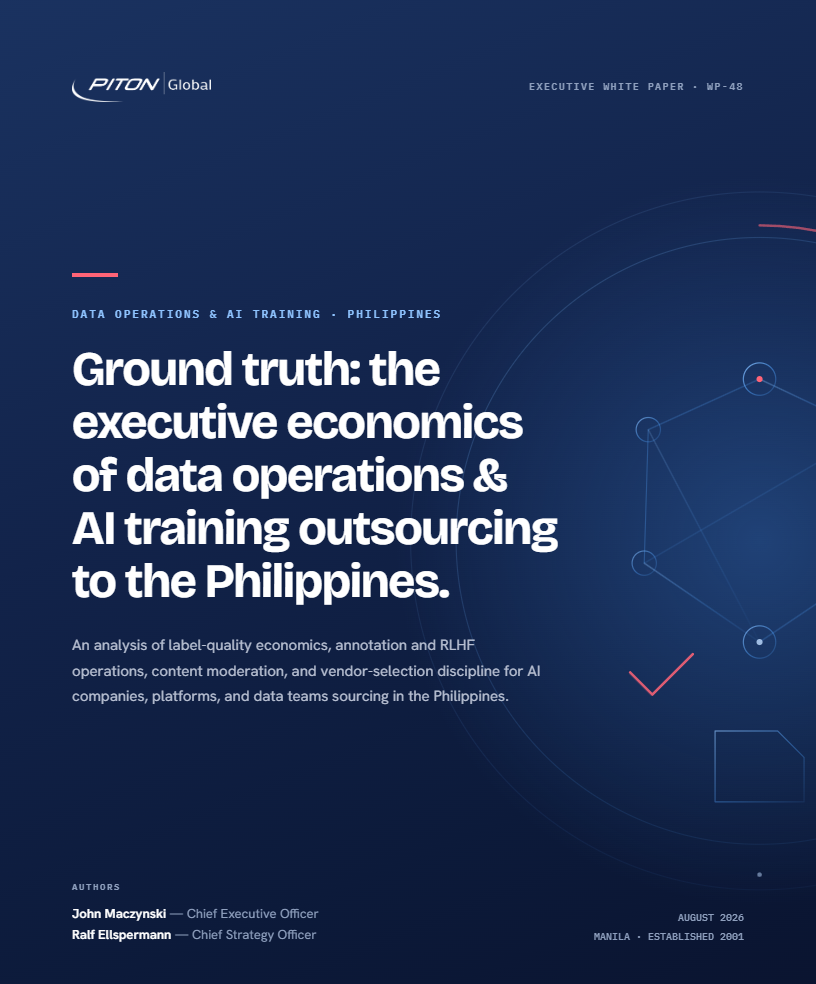
White paper cover — PITON-Global Executive White Paper WP-48
PDF · 14 PAGES
10WHITE PAPER WP-48 · DATA OPERATIONS & AI TRAINING · AUGUST 2026

Ground Truth — Data Operations & AI Training Outsourcing to the Philippines

An analysis of label-quality economics, annotation and RLHF operations, content moderation, and vendor-selection discipline for AI companies, platforms, and data teams sourcing in the Philippines. Volume 15 of PITON-Global’s 20-part Executive White Paper Series, by John Maczynski and Ralf Ellspermann.

14 pages16-min readEllspermann & Maczynski
IN THESE PAGES
The work behind the model: what moves, and why the Philippines
The quality ladder: label economics and the cost of being wrong at scale
Case study: an 80-seat AI-company program, reconstructed
Download the full report (PDF) Free · no gate · published August 2026
12ANSWERED BY OUR PRINCIPALS

What AI and ML leaders ask before they outsource data labeling.

Answers, at depth, to the questions that determine a labeling engagement — direct from the principals.

Which annotation types and modalities do you support?+
Every batch passes gold-set benchmarking plus inter-annotator agreement validation against reference data, then benchmark against the gold set. That holds annotation accuracy at 99 percent and catches mislabels, wrong classes and ambiguous cases before they reach training and quietly degrade a modeport months later.— Ralf Ellspermann, CSO
What does outsourcing data work actually save us?+
Typically 50 to 70 percent on cost per label versus onshore, with faster turnaround. The larger saving is avoided downstream damage: clean, validated data prevents the biased models, misfired predictions and bad decisions that inconsistent labels cause long after they ship.— John Maczynski, CEO
Can labeling capacity scale for a backlog, migration or seasonal spike?+
Yes. Labeling capacity flexes up for surges and back down as they pass — you fund throughput, never a standing bench. The same gold-set validation and IAA controls apply whether it is ten thousand labels or ten million.— Ralf Ellspermann, CSO
How is our data protected while you work on it?+
ISO 27001 infrastructure, access-controlled environments, zero local storage, audit trails end to end. Access is bounded to project and operator, all actions log, and nothing exits the secured environment — your data stays protected end to end.— Ralf Ellspermann, CSO
Will you work inside our systems or hand back files?+
We work natively inside your annotation tools — Labelbox, CVAT, Label Studio or your own platform — with a complete audit trail, rather than emailing spreadsheets back and forth. That keeps your data layer and ours from drifting apart and preserves a clean lineage for every label.— John Maczynski, CEO
How do you measure and maintain annotation quality?+
Anything that fails a rule is flagged for SME review and resolved against the rule set, not silently posted or guessed at. Recurring issues get designed away: failure patterns are tracked and folded back into the validation rules.— John Maczynski, CEO
Can you support RLHF and LLM preference labeling?+
The full annotation lifecycle — dataset prep and taxonomy, labeling and QA, adjudication and enrichment, gold-set validation and structuring, migration and transformation, ongoing data management, and analytics and reporting support. Both structured and unstructured inputs are handled, from forms and scans to documents, surveys and feeds.— Ralf Ellspermann, CSO
Which data work should we outsource first?+
Lead with the high-volume, rules-driven work — entry, cleansing and reconciliation — where validation delivers the clearest, fastest accuracy gains. Richer work — enrichment, transformation, analytics — follows after the foundational volume validates the rules and quality bar.— John Maczynski, CEO
How do you handle edge cases and ambiguous labels?+
No. We work natively in your existing stack and stay vendor-neutral on tooling. Assessment of your systems, data types and goals is free, the provider match follows from it, and you keep the final decision.— Ralf Ellspermann, CSO
How do you measure performance so we can trust the output?+
Against annotation accuracy, inter-annotator agreement, gold-set accuracy and throughput, surfaced in a live dashboard with monthly reviews. We deliberately never report labels per hour — raw speed without validation produces volume you cannot trust, which defeats the entire purpose.— Ralf Ellspermann, CSO
Authorship, Review & Benchmark Verification
Authored by:
Ralf Ellspermann
Ralf Ellspermann
Chief Strategy Officer of PITON-Global
Two Decades Building and Advising Award-Winning Philippine BPO Operations

Ralf audits labeling floors on inter-annotator agreement and gold-set accuracy before benchmarks are published here.

View full bio  →
Verified by:
John Maczynski
John Maczynski
CEO of PITON-Global
Former Global EVP of the World’s Largest Contact Center · Four Decades of Outsourcing Experience

John validates the per-label economics and commercial terms behind each data-labeling program.

View full bio  →
Last Reviewed & VerifiedJuly 26, 2026

Re-audited as SOC 2 and annotation-quality audit obligations evolve. Every benchmark on this page is held to PITON-Global’s internal vetting standard.

Inquire Now