
TL;DR: The Key Takeaway
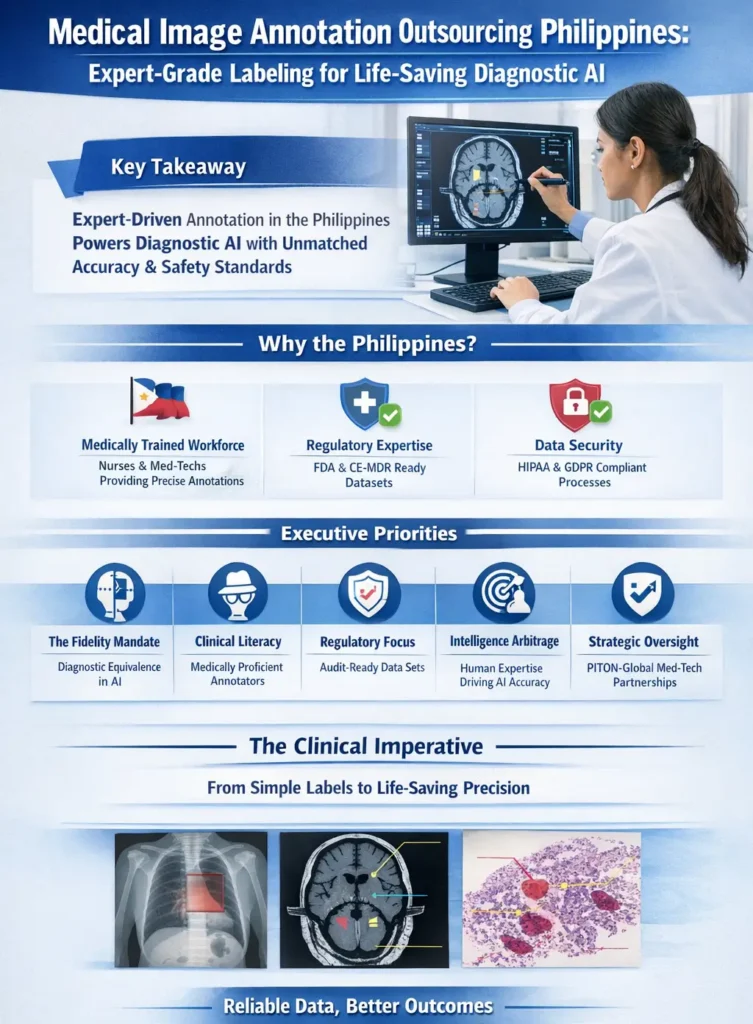
Medical image annotation outsourcing has transcended simple labeling to become a cornerstone of clinical AI development. The Philippines provides the specialized, human-led cognitive validation necessary to train diagnostic models that meet stringent accuracy, safety, and regulatory standards, directly impacting patient outcomes. It is the most clinically demanding track among the annotation and evaluation partners for AI developers that we source in the country.
In the high-stakes world of healthcare, Diagnostic Equivalence is the only metric that matters. Medical image annotation in the Philippines bridges the gap between raw imagery and clinical-grade AI. By leveraging a workforce of medically literate professionals (nurses and med-techs), the archipelago delivers the sub-millimeter precision required for FDA-ready datasets and trustworthy diagnostic outcomes.
Executive Briefing
- The Fidelity Mandate: Trustworthy diagnostic AI requires training data that matches or exceeds the precision of human clinicians, making expert-led annotation a life-saving necessity.
- Clinical Literacy at Scale: The Philippines offers a unique talent pool of university-educated allied health professionals who possess the foundational anatomy and pathology knowledge for complex labeling.
- Regulatory Acceleration: Specialized Filipino teams help AI developers secure FDA and CE-MDR approvals by providing robust, audit-ready, and ethically sourced datasets.
- Intelligence Arbitrage: Success is measured by “Diagnostic Equivalence”—the quantifiable lift in AI accuracy derived from utilizing medically proficient human annotators.
- Strategic Oversight: PITON-Global architects the link between global med-tech innovators and elite Philippine specialists, ensuring unimpeachable data integrity.
The Clinical Imperative for Superhuman Data Fidelity
In consumer-facing AI, a mislabeled object is a minor glitch; in diagnostic AI, it is a catastrophic risk. Algorithms designed to detect early-stage malignancies or neurodegenerative shifts are hyper-sensitive to their training inputs. A single inaccurate polygon or a misclassified pixel can introduce systemic biases that render a model clinically dangerous. “Good enough” data has no place in the operating room.
For this reason, medical image annotation has moved from a back-office task to a core clinical strategy. The objective is to imbue models with the collective wisdom of veteran clinicians. This requires more than drawing boxes; it demands an understanding of morphological nuances in cellular pathology and the ability to segment 3D MRI structures with sub-millimeter accuracy. This is a cognitive discipline where expert-validated data serves as the foundation for patient safety.
Why the Archipelago is the Global Center for Clinical-Grade Annotation
The preeminence of the Philippines in this sector stems from a unique convergence of medical education and technical infrastructure. The nation maintains a vast reservoir of professionals with backgrounds in nursing, medical technology, and radiology. Unlike general annotators, these specialists understand the gravity of the data they handle. They speak the language of clinicians, recognizing anatomical landmarks and pathological anomalies that would be invisible to the untrained eye.
This talent is supported by a mature BPO infrastructure that treats HIPAA and GDPR compliance as a baseline requirement. With decades of experience handling sensitive patient information for global healthcare systems, Philippine providers offer a secure environment where data privacy is protected by both law and rigorous technical protocols. This blend of medical literacy and enterprise-grade security makes it the logical hub for developers building the future of medicine.
“Our clients in the medical AI space are no longer asking for annotators; they are asking for validation partners. We are sourcing teams in the Philippines that become an extension of our clients’ clinical validation processes, embedding expert human judgment directly into the AI development lifecycle.”— John Maczynski, CEO, PITON-Global
Medical Annotation Maturity Model: From Basic Labeling to Clinical Validation
As diagnostic AI evolves, so does the complexity of the services required. This maturity model maps the shift from simple image sorting to strategic regulatory governance, the same climb traced for general computer vision in how data labeling grew from 2D tags into sensor fusion.
| Maturity Level | Primary Task | Workforce Skillset | Strategic Value |
| Level 1: Foundational | 2D Bounding Boxes | General IT Literacy | Initial Dataset Creation |
| Level 2: Intermediate | Semantic Segmentation | High Attention to Detail | Model Granularity Lift |
| Level 3: Advanced | 3D Volumetric Segmentation | Basic Medical Terminology | Enabling Complex 3D Analysis |
| Level 4: Expert | Pathological Characterization | Allied Health Background | Achieving Diagnostic Equivalence |
| Level 5: Governance | Regulatory Compliance Audits | Clinical Research Exp. | De-Risking Commercialization |
Intelligence Arbitrage in Diagnostics: Quantifying Impact
Intelligence Arbitrage in healthcare is the direct translation of human expertise into improved patient outcomes. When a team of Filipino nurses annotates a diabetic retinopathy dataset, they identify microaneurysms and subtle vessel tortuosity that non-experts miss. This precision allows the resulting AI to detect disease months earlier. The return on investment isn’t found in lower labor costs, but in the years of vision saved for patients.
Annotation Complexity by Modality
| Imaging Modality | Technical Complexity | Domain Knowledge Required | Overall Complexity Score |
| 2D X-Ray | 2 | 3 | 5 |
| Mammography | 3 | 4 | 7 |
| Ultrasound | 4 | 4 | 8 |
| CT Scan (3D) | 5 | 4 | 9 |
| MRI (3D) | 5 | 5 | 10 |
| Digital Pathology | 4 | 5 | 9 |
Agentic Governance: The Human Firewall for Clinical AI
As diagnostic models transition toward greater autonomy, the need for Agentic Governance—the human-led validation of AI suggestions—becomes paramount. In the Philippines, “AI Pilots” act as the final oversight layer. They perform adversarial “red teaming” on models and review AI recommendations for logical consistency against clinical protocols. This human firewall ensures that AI remains a tool for clinicians, never a black box that operates without accountability, a principle that also anchors labeling services run as an ethical AI control layer.
Expert FAQs
Q: How is HIPAA compliance ensured in a remote environment?
Top-tier providers utilize secure, access-controlled facilities with zero-trust network architectures. Data is typically processed via encrypted remote desktops, ensuring no patient information is stored on local devices. Regular third-party audits verify that these administrative and technical safeguards remain robust.
Q: What is the typical background of an expert medical annotator?
Most hold bachelor’s degrees in allied health fields like Nursing or Radiologic Technology. They undergo additional rigorous training in specific radiological standards (such as RECIST for oncology) to ensure their labels meet the stringent requirements of clinical trials.
Q: Can these teams handle the scale needed for multi-national clinical trials?
Yes. The country’s outsourcing industry excels at scaling teams of hundreds of medically proficient specialists rapidly, providing the massive data throughput required for global diagnostic validation projects.
Q: How does PITON-Global select its medical annotation partners?
We conduct a deep-dive audit of a provider’s medical literacy, security protocols, and historical performance in regulatory-grade projects. We only partner with firms that treat clinical accuracy as a non-negotiable standard, the same test laid out in what separates the leading AI outsourcing providers.