

The leading AI and autonomy outsourcing providers in the Philippines are separated by a high bar on every axis at once, not a high average. The bar applies across what AI labs outsource to Filipino teams, from annotation to RLHF. They show proven domain delivery, security and IP rigor, talent retention, outcome-based SLAs, and resilient scale — and the way to find them is a vendor-neutral shortlisting process that screens a 100-plus provider network against these criteria, not a vendor’s self-published ranking. This is a buyer’s framework for evaluating providers, not an endorsement of named firms.
Key Takeaways
- A high bar on every axis. Leaders clear all the criteria; a strong average with one weak axis is not leadership.
- Proven beats promised. Reference deployments and reported metrics separate operators from pitch decks.
- Retention signals capability. Low attrition is the quiet indicator of a partner that holds domain knowledge.
- Process over ranking. A vendor-neutral shortlist beats any self-published “top providers” list.
What Criteria Actually Separate the Leading Providers?
Five, evaluated together: proven domain delivery, security and IP rigor, talent depth and retention, willingness to commit to outcome-based SLAs, and resilient scale — with leaders clearing a high bar on every one rather than averaging out a weakness.
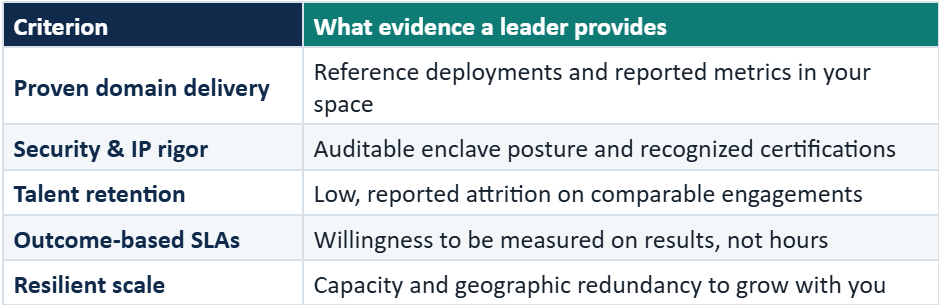
The difference between a leading provider and a competent one is consistency across criteria. The axes that matter are proven domain delivery (real deployments in your problem space, not adjacent work, such as diagnostic-grade medical image annotation for a clinical model), security and IP rigor (an auditable, enclave-based posture), talent depth and retention (the people who hold your ontology stay), willingness to be measured on outcome-based SLAs rather than hours, and resilient scale (the capacity and geographic redundancy to grow with you). A leader clears a high bar on all five. A provider that is excellent on four and weak on one is not a leader on the axis that fails — and that axis is usually where the engagement breaks.
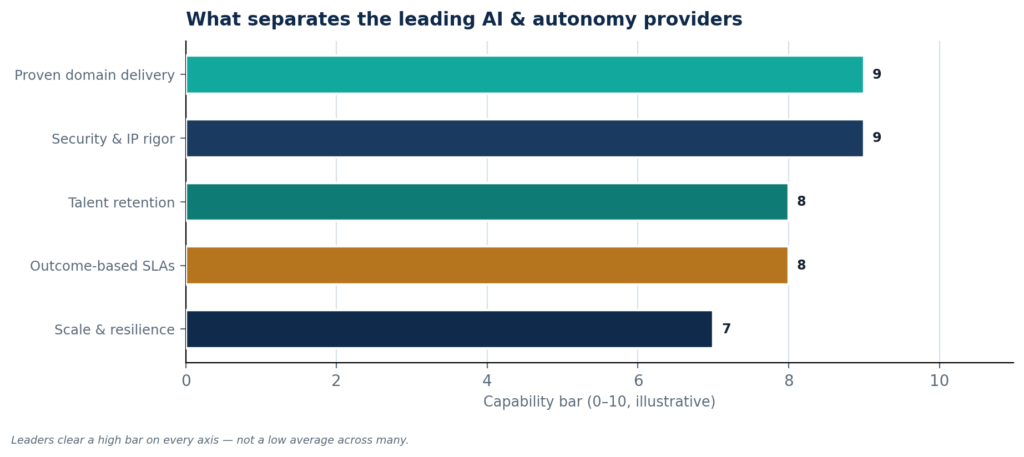
Figure 1 — Leaders clear a high bar on every axis, not a high average across many.
According to John Maczynski, CEO, PITON-Global, “Beware the provider who is a ten on price and a four on security, then sells you the average. In this work the weakest axis is the one that ends up in your incident report. The leaders are boringly strong on all of it — that consistency is the whole signal.”
Why Trust a Shortlisting Process Over a “Top Providers” List?
Because published rankings reflect marketing spend and affiliate economics, not fit to your requirement; a vendor-neutral process defines your needs first, screens the network against them, audits capability, and pilots — surfacing the right partner rather than the best-promoted one.
A self-published “best providers” list answers a different question than yours: it ranks who marketed best or paid for placement, not who fits your specific autonomy or AI workload. The reliable alternative is a process. Define the requirement precisely; screen the full provider network against the five criteria; audit the shortlisted few on security, delivery evidence, and references; then pilot before committing. That sequence surfaces the partner that fits your problem rather than the one with the largest advertising budget. It is also why a vendor-neutral advisor — one paid by the network, not by you — can run it without steering you toward a favored name.
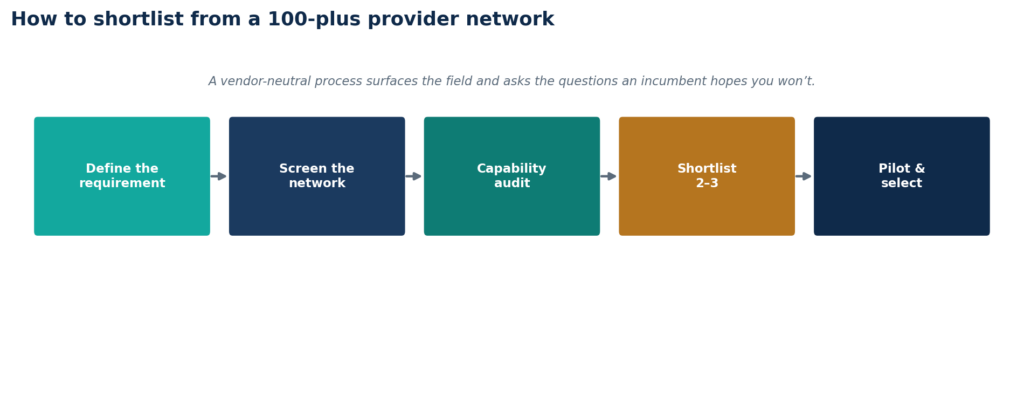
Figure 2 — A vendor-neutral process surfaces the field and asks the questions an incumbent hopes you won’t.
“The questions that separate leaders from the field are the ones incumbents hope you never ask: show me your attrition, open your enclave, name a reference doing exactly this. We ask them on the client’s behalf precisely because we have no stake in which provider wins,” said Ralf Ellspermann, CSO, PITON-Global.
How Do You Verify a Provider Actually Clears the Bar?
With evidence, not assertion: reference deployments you can check, reported quality and retention metrics, a security audit of the enclave and controls, and a scoped paid pilot measured against your own benchmark before any commitment.
Verification is where leadership claims get tested. Ask for reference deployments in your domain and actually contact them. For labeling programs, benchmark the answers against current expectations for data labeling and the zero-possession security model for labeling services. Require reported metrics — quality, accuracy, attrition — with definitions, and treat a refusal to share them as an answer. Audit the security posture rather than accepting a certification logo at face value. And run a scoped, paid pilot against your own benchmark, because performance on your data is the only proof that travels. A provider that welcomes this scrutiny is signaling the consistency that defines a leader; one that resists it is telling you which axis it would rather you not examine.
“Contact the references and ask them the hard questions yourself. A provider that fits your problem will have customers doing exactly your work; the rest will have logos,” noted John Maczynski, CEO, PITON-Global.
Frequently Asked Questions
Is This a Ranked List of the Best Providers?
No. It is a buyer’s framework for evaluating providers against five criteria — proven delivery, security and IP, retention, outcome SLAs, and resilient scale — not an endorsement of named firms or a self-published ranking.
What Single Trait Most Distinguishes a Leader?
Consistency — clearing a high bar on every criterion rather than averaging out a weak axis. The weakest axis is usually where an engagement breaks, so a leader has no weak axis to hide.
How Do You Verify a Provider’s Claims?
With evidence: checkable reference deployments, reported quality and retention metrics, a security audit of the enclave and controls, and a scoped paid pilot against your own benchmark before committing.
About PITON-Global
PITON-Global runs the vendor-neutral shortlisting process this article describes — defining the requirement, screening a network of 100-plus leading Philippine BPOs (20 of them AI-first front-runners) against the criteria, auditing capability, and supporting the pilot. Because we are paid by the provider network and never by you, we surface the right partner rather than the best-promoted one. Our leadership brings 6+ decades of combined global outsourcing experience and 25+ years in the Philippines; advisory is free and obligation-free.