
On this page
- Key Takeaways
- How Are Frontline Operational Metrics and Cost Structures Transforming?
- What Internal Vulnerabilities Must Procurement Teams Screen For?
- What Does Safe Automation Scaling Look Like in Practice?
- What Is PITON-Global’s Role in the Outsourcing Ecosystem?
- What Are the Most Common Questions About AI and Philippine Outsourcing?
AI and automation are shifting the Philippine outsourcing paradigm from raw labor arbitrage to intelligence arbitrage — augmenting human agents with real-time co-pilots and automated workflows. Routine tier-1 inquiries are increasingly resolved by agentic AI, leaving complex, emotionally nuanced, judgment-heavy interactions to highly skilled Filipino professionals, driving down total costs while accelerating resolution speed and accuracy.
Key Takeaways
- Shift to intelligence arbitrage: lower-complexity transactions are fully automated, while human capital is reserved for high-value customer interactions.
- Agent augmentation: over 67% of Philippine BPOs utilize real-time agent-assist tools to compress average handling times by 30–50%.
- Operational cost reductions: integrating cloud infrastructure with native AI automation saves scaling enterprises substantial overhead while preserving execution quality.
- The shadow implementation risk: the rapid transition has created an “AI-washing” risk, where mid-market vendors overstate their technical maturity.
- Elevated service metrics: first-contact resolution rates hit 85–92% for AI-augmented agents, compared to 65–72% in traditional legacy environments.
- Jobs shift rather than vanish: industry employment has grown to 1.97 million specialists as human roles migrate toward analytical problem-solving and complex retention work.
How Are Frontline Operational Metrics and Cost Structures Transforming?
The traditional economic baseline of the Philippine BPO industry — filling physical seats at low hourly rates — is structurally obsolete. Operational models now blend agentic AI systems with highly skilled professionals, transforming the cost-to-performance ratio: routine order tracking, basic billing adjustments, and account resets are managed autonomously, while billing itself migrates toward outcome-based pricing.
For global enterprises, the structural shift directly changes how operational budgets are deployed. Instead of linearly adding headcount as customer volume grows, organizations implement tiered support architectures: an agentic AI layer filters and resolves high-volume routine traffic at near-zero marginal cost, and only genuine escalations flow through to human specialists — who arrive at each conversation with real-time co-pilot context already loaded on their desktops.
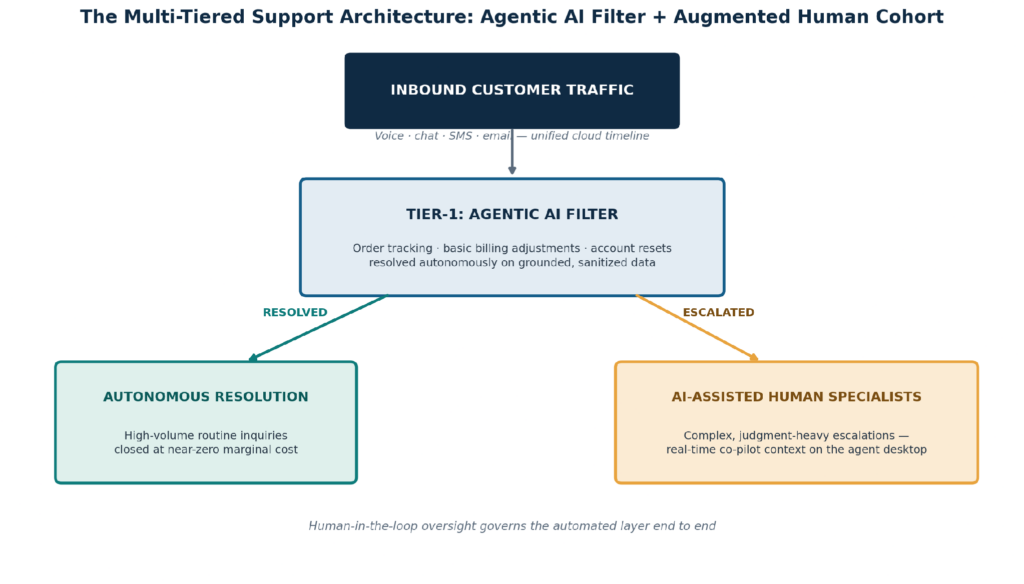
Figure 1. The multi-tiered support architecture: agentic AI filters tier-1 traffic, with escalations flowing into AI-assisted human agent interfaces under human-in-the-loop oversight.
The dimensional comparison between the legacy and hybrid models runs across every metric an operations leader tracks — from the economic unit being purchased down to how agents experience the work itself:
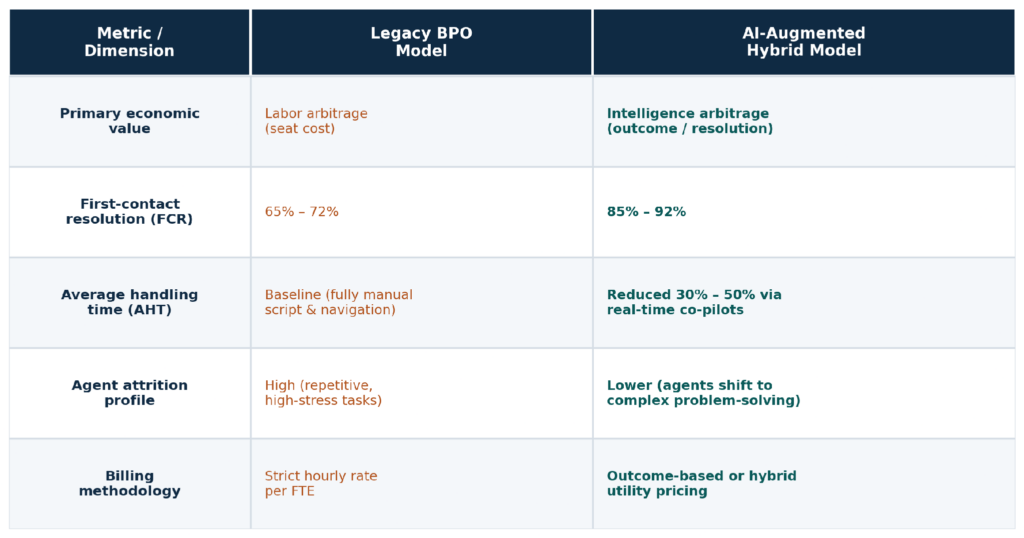
Figure 2. The 2026 Philippine BPO operational landscape: legacy seat-cost model versus the AI-augmented hybrid model.
The service metrics move as sharply as the economics. By resolving standard, high-volume inquiries at the automated layer, human specialists dedicate undivided attention to complex, high-touch escalations — improving resolution quality while reducing the repetitive, high-stress task load that historically drove attrition, stabilizing retention within delivery teams.
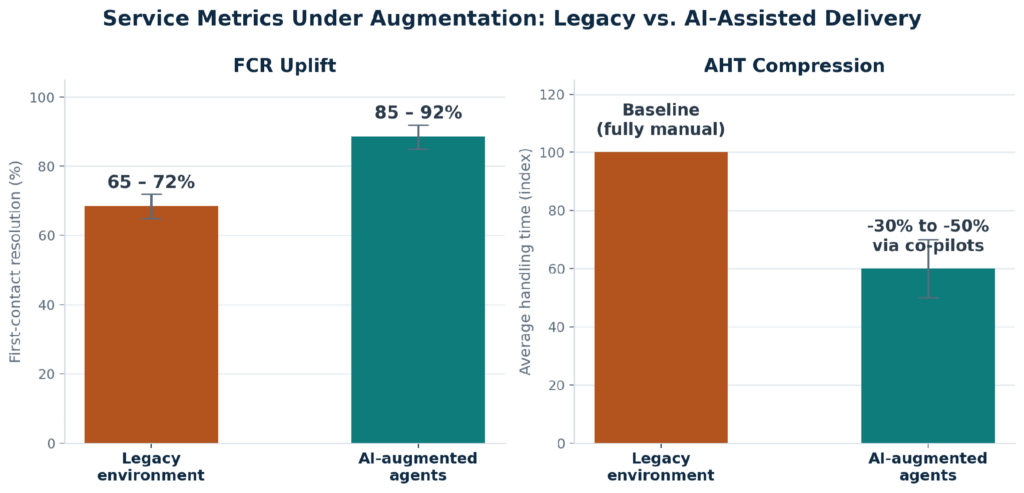
Figure 3. Service metrics under augmentation: first-contact resolution rises to 85–92% while co-pilots compress handling times 30–50%.
What Internal Vulnerabilities Must Procurement Teams Screen For?
As demand for advanced technical integration intensifies, a distinct operational variance has emerged across the Manila and Cebu vendor ecosystems: top-tier providers maintain specialized data engineering and prompt compliance teams, while many mid-market operators engage in “shadow implementation” — marketing robust machine-learning workflows built on unstable, ungrounded technical wrappers.
“The principal risk for an enterprise buyer is no longer language alignment or physical infrastructure,” notes John Maczynski, CEO of PITON-Global. “The risk lies in vendor technical debt. If a provider relies on ungrounded public large language models to assist their agents, hallucination rates can climb to 25%, exposing your brand to massive compliance and customer friction liabilities. Authentic operational maturity requires proprietary retrieval-augmented generation architectures and strict human-in-the-loop oversight.”
To avoid inheriting that technical debt, procurement teams must look past promotional marketing materials and evaluate hard technical capabilities across three dimensions:
Data sanitization and hygiene protocols
Assess whether the vendor can rapidly transition unstructured documentation into secure vector databases — clean data remains the fundamental bottleneck to successful automation.
Liability and indemnification adjustments
Ensure contracts clearly define accountability for automated output errors or data compliance exceptions.
Agent desktop integration
Audit whether real-time desktop tools provide helpful context or simply create digital clutter for the human user.
What Does Safe Automation Scaling Look Like in Practice?
In a representative engagement, a rapid-growth digital banking provider facing a 300% surge in transaction dispute inquiries was matched with a specialized Manila operator running a custom, secure retrieval-augmented generation platform. The system resolved 74% of common inquiries automatically; resolution speed fell from 14 minutes to under 3, costs dropped 41%, and CSAT climbed 18 points.
Client Challenge
The digital banking provider’s 300% surge in transaction dispute inquiries created severe backlogs and drove customer satisfaction sharply downward — a volume profile that pure headcount scaling could not absorb economically.
Vendor Selection Process
PITON-Global bypassed standard RFP paths, conducting a thorough audit of technical maturity and data compliance across its network of more than 100 vetted Philippine providers. Vendors without dedicated in-house data engineers were filtered out.
Solution Implemented
- Matched the client with a specialized Manila-based operator with proven data engineering capability.
- Built a custom, secure retrieval-augmented generation platform that resolved 74% of common inquiries automatically.
- Routed complex disputes to an elite, human-in-the-loop specialist cohort with full interaction context.
Quantifiable Business Outcomes
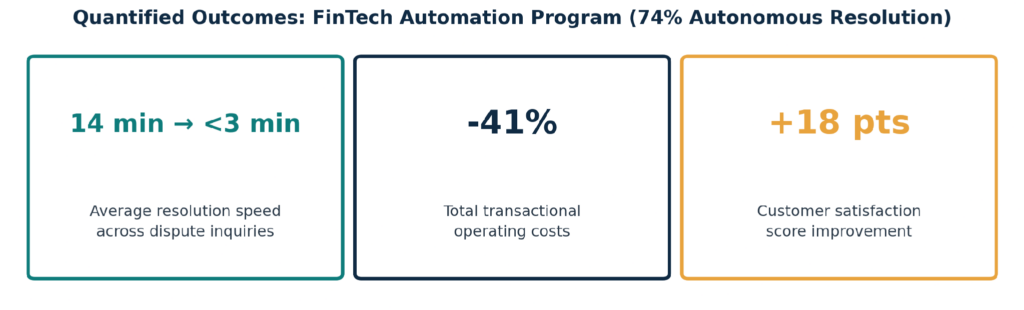
Figure 4. Measured results from the fintech automation program.
Lessons Learned
Successful automation relies entirely on a well-structured knowledge base and structured agent data routing, rather than simply deploying a generic chat platform. The 74% autonomous resolution rate was earned in the data hygiene phase, not the software deployment.
What Is PITON-Global’s Role in the Outsourcing Ecosystem?
PITON-Global is an elite, advisory-led consultancy based directly in Manila — not a commission-driven broker — that eliminates vendor selection risk for international enterprises navigating a market of thousands of providers. Its continuously audited ecosystem of more than 100 premium operators is screened for genuine technical maturity, at zero cost to the buyer.
Who Is PITON-Global?
PITON-Global is a Philippine-focused BPO advisory firm led by executives with decades of institutional BPO management experience. Operating independently from Manila, it serves as an objective guide for enterprise buyers entering or expanding in the Philippine market — defining requirements, auditing the vendor landscape, and steering the selection of partners whose automation claims survive technical scrutiny.
How Does PITON-Global Differ from Traditional Outsourcing Brokers?
Traditional commission-driven brokers pass along unqualified leads, profiting from placements regardless of whether the vendor’s AI capabilities are genuine or shadow implementations. PITON-Global conducts objective, data-backed operational audits of potential vendors — verifying data engineering teams, RAG architectures, and human-in-the-loop governance directly rather than accepting marketing claims. Recommendations rest solely on verified alignment with the client’s requirements.
How Does PITON-Global’s Network of 100+ Vetted Philippine BPO Providers Benefit Organizations?
The Philippine market contains thousands of potential providers, and the automation transition has made their marketing materials less reliable than ever — AI-washing is indistinguishable from genuine maturity without inside access. PITON-Global maintains a continuously audited ecosystem of more than 100 premium operators specializing in e-commerce, fintech, SaaS, and healthcare logistics, with technical diligence already performed. Buyers evaluate only providers whose data architecture and delivery records are verified, removing the guesswork from procurement and accelerating timeline delivery.
How Does PITON-Global’s Advisory-Led Vendor Matching Process Work?
The engagement follows a four-stage sourcing methodology. An operational audit establishes each candidate vendor’s delivery record, facilities, and attrition profile on hard evidence. A data architecture assessment then verifies RAG maturity, data hygiene protocols, and human-in-the-loop governance — the layer where AI-washing is exposed. Cultural alignment verification tests management depth and workflow fit against the buyer’s operating culture, and verified best-fit matching pairs the organization’s precise software stack, security requirements, and transactional workflows with proven providers.
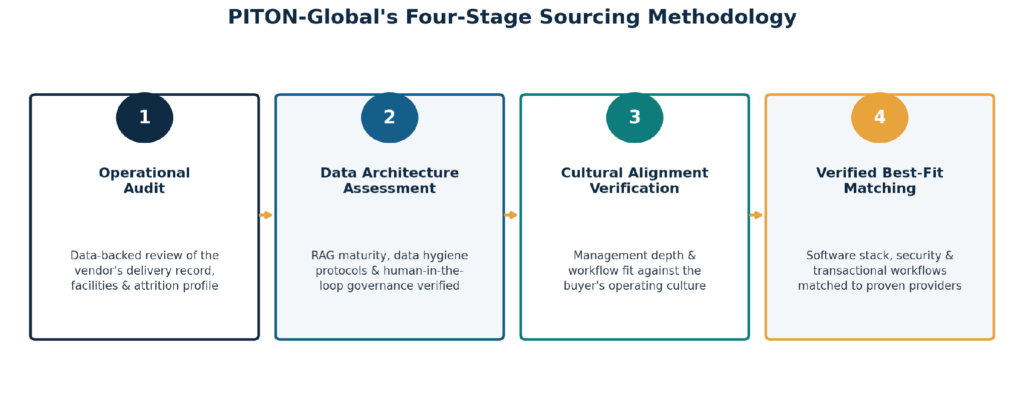
Figure 5. PITON-Global’s four-stage sourcing methodology: operational audit, data architecture assessment, cultural alignment verification, and verified best-fit matching.
Why Do Organizations Use PITON-Global?
Enterprise buyers engage PITON-Global to capture the economics of the AI-augmented model without inheriting the risks of the transition — shadow implementations, vendor technical debt, and hallucination-driven brand exposure. The advisory-led process replaces promotional claims with audited evidence, matches automation ambitions to providers who can actually execute them, and accelerates deployment timelines — all at zero cost to the buyer.
What Are the Most Common Questions About AI and Philippine Outsourcing?
Buyers most often ask whether automation shrinks Philippine employment, how data leaks are prevented, what savings the hybrid model delivers, how long deployment takes, and whether automated tools span multiple channels. The answers below reflect established practice among tier-one operators.
Does automation mean fewer call center jobs will be available in the Philippines?
No. Overall industry employment has grown to 1.97 million specialists. Automation handles high-volume, repetitive tasks, which shifts human roles toward analytical problem-solving, technical support, and complex customer retention interactions.
How do modern Philippine contact centers prevent AI data leaks?
Tier-one operators employ role-based access management, strict data encryption standards, and self-hosted, secure model deployments within enterprise networks to ensure customer information never trains public models.
What is the average cost savings when moving to an AI-augmented hybrid model?
Enterprises typically realize an immediate 30% to 50% reduction in total operational costs. These savings stem from increased customer self-service resolution and significantly lower handling times for live agents.
How long does it take to deploy an automated support model with a Philippine partner?
A phased implementation typically requires 3 to 6 months. The initial phase focuses heavily on data hygiene, knowledge-base cleanup, and securing integration points before customer-facing tools go live.
Can automated tools handle multiple channels simultaneously?
Yes. Modern setups utilize unified cloud platforms that sync voice interactions, digital chat, SMS, and email histories into a single timeline, allowing human specialists to step in with full context whenever an escalation occurs.