
CLAIMS PROCESSING OUTSOURCING SERVICES PHILIPPINES

Claims adjudicated fast, accurate, and audit-clean.

Manila-based healthcare claims-processing teams — claim intake, validation, adjudication against plan rules, and resolution, at 99.2% accuracy and a 48-hour turnaround, under HITRUST, SOC 2 and HIPAA controls.

Manila, Cebu & Davao delivery HITRUST / HIPAA / SOC 2 Plan-rule adjudication
ADJUDICATION INDEX LIVE
Adjudication accuracy
99.2%
Claim turnaround
48hr
intake to decision
Cost per claim
50%
vs onshore staff
ADJUDICATION A mis-adjudicated claim is a leakage, a re-work, or a member complaint. We shortlist claims teams that decide accurately and fast. Benchmark your claims
SYSTEMS & STANDARDS
Facets QNXT HealthEdge TriZetto HealthRules Payor GuidingCare Cotiviti Zelis Epic / Cerner HIPAA PCI-DSS SOC 2 GDPR
01THE ESSENTIALS

What healthcare claims processing outsourcing is.

THE ESSENTIALSLAST UPDATED · JUNE 2026

Healthcare claims processing outsourcing is the delegation of claim adjudication — intake and data capture, eligibility and benefit validation, adjudication against plan rules, and resolution or pend handling — to a specialized team, run under HITRUST and SOC 2 controls to accuracy, turnaround and cost-per-claim targets.

What is it?Claims adjudication sourced from the Philippines — intake, validation, plan-rule adjudication and resolution, on a HIPAA-governed 48-hour workflow.
Primary KPI99.2% adjudication accuracy · 48-hour intake-to-decision · −50% cost per claim.
Who is this for?Health plans, TPAs, self-insured employers and digital-health payers that need accurate, fast claim adjudication without scaling an in-house claims department.
Why PITON-Global?Vendor-neutral sourcing of the top 1% of Manila claims teams — vetted on adjudication accuracy and HIPAA/HITRUST compliance.
Evidence of successEngagement CP-089: the deployment behind a 95%→99.2% accuracy lift that ended state prompt-pay penalties · verified Q2 2026.
02CLAIMS METRICS

Claims metrics that survive a plan audit.

Adjudication accuracy, turnaround, auto-adjudication rate and cost per claim from PITON-Global-vetted Manila claims teams, against the in-house and generic-offshore baseline — 99.2% adjudication accuracy at 48-hour intake-to-decision across 2025–26 vetted engagements (CP-089: 95%→99.2%, state prompt-pay penalties ended).

METRICPITON-GLOBAL-VETTEDBASELINEWHY IT MATTERS
Adjudication accuracy99.2%~95%Right decision, less leakage
Claim turnaround time48 hr~6 daysMembers and providers paid faster
Auto-adjudication assist rate+28%baselineStraight-through, less manual
Cost per processed claim−50%baselineThe decision, priced sanely
Cost vs in-house−65%in-house baseArbitrage without quality loss

BUILT FOR THE PAYER SIDE — This page is healthcare claims — plan rules, pends, prompt-pay clocks. Deliberately.

Our depth is built for health plans, TPAs, and payer operations: Facets and QNXT fluency, benefit-plan adjudication, coordination of benefits, the prompt-pay statutes with teeth. Property, auto, travel, and P&C claims live in a different operating reality — FNOL intake, adjusters, subrogation — and that depth lives on our Insurance page, where the carrier-side story is told properly. One page, one operating model, no dilution.

03WHO WE SERVE

Four kinds of claims book, decided four different ways.

01

Regional health plans

The prompt-pay clock beaten, provider abrasion ended. CP-089 is this plan, measured.

The client story (CP-089) →
02

TPAs & self-insured administrators

Multi-plan adjudication under one QA standard, per-claim pricing for variable books.

The commercial models →
03

Medicare Advantage & Medicaid plans

Government-program discipline: encounter accuracy, timeliness rules, the audit posture regulators expect.

RCM →   Medical Coding →
04

Dental, vision & specialty benefits

High-volume, tight-margin lines where the auto-adjudication assist and the leakage math do the heaviest lifting.

The front door, read by machine →
THE REAL DENOMINATOR · THE LEAKAGE THESIS

Your processing budget is a rounding error next to your paid-claims file. Leakage is priced in the second number.

The per-claim rate is the number vendors compete on and the smallest number in the room. Run the honest arithmetic: a payer processing millions of claims a year pays a processing budget against them — and pays out a hundred times that in claims. A one-point accuracy slip on the paid-claims file dwarfs the entire processing budget: the duplicate that funded twice, the coordination-of-benefits miss that paid primary when secondary owed, the fee-schedule mismatch nobody caught — each one leakage you rarely recover, because recovery means clawing back from a provider who already banked it. That’s why the workflow below validates before the dollar leaves, why the QA samples every adjudicator’s decisions (not their throughput), and why our accuracy SLA is written against payment accuracy — the metric that moves the big number.

THE BUYER’S ARITHMETIC Multiply your accuracy gap by your paid-claims total, then look at the processing quote again. A vendor selling three cents off the per-claim rate while your leakage runs unmeasured has optimized the invoice you see and ignored the one you don’t.
04THE ADJUDICATION WORKFLOW · INTERACTIVE

The right decision — before the dollar leaves.

Every claim is a payment decision, and the wrong one is leakage you rarely recover. A disciplined adjudication line validates before it pays. Representative workflow from audited engagements; your plan mix sets the pend profile. Expand each step to see how the team runs it.

FIGURE 1 · THE ADJUDICATION LINE, INTAKE TO RESOLUTION
STEP 01Claim IntakeCaptured & scrubbed
Claims captured from EDI, paper and portal, normalized and scrubbed for missing data — so adjudication starts with a complete, clean record.
STEP 02Eligibility & BenefitsMember verified
Member eligibility, coverage and benefit limits verified against the plan — catching the non-covered and out-of-period claims before they are paid in error.
STEP 03AdjudicationPlan rules applied
Claims adjudicated against the benefit plan, fee schedules, authorizations and coordination-of-benefits — the decision engine that protects against leakage.
STEP 04Edits & Pend HandlingExceptions worked
Claims that hit edits or pends are worked by specialists — documentation requested, COB resolved, duplicates caught — not left to age in a queue.
STEP 05Resolution & AuditPaid, denied, QA-checked
Final pay/deny/adjust decisions issued with clear remittance, and a QA sample audited for accuracy — protecting the plan and the member.
The healthcare claims adjudication line runs in five steps: claim intake and scrubbing, eligibility and benefit validation, adjudication against plan rules and fee schedules, edit and pend handling by specialists, and final resolution with a QA audit. Because every claim is validated before payment, PITON-Global-sourced claims teams sustain 99.2% adjudication accuracy on a 48-hour intake-to-decision turnaround.
05THE PHILIPPINE CLAIMS BENCH

Why health plans run claims from the Philippines.

The country produces claims-and-insurance talent at a scale few can match — a deep, compliance-trained, English-fluent talent base with the clinical literacy to adjudicate claims accurately and communicate clearly with providers, at a fraction of onshore cost.

A deep clinical-admin talent pool
Tens of thousands of insurance, health-admin and analytics graduates a year — enough to staff true clinical-admin benches, not just data clerks.
Compliance & negotiation fluency
HIPAA training plus benefit-plan and adjudication-rule expertise, so the work needs oversight, not rework, when it reaches your AR team.
Controls discipline
A conscientious, customer-first culture that makes compliant, firm-but-fair outreach and second-pair-of-eyes QA natural.
Round-the-clock contact windows
Follow-the-sun coverage means claims are adjudicated overnight, so members and providers see decisions faster — your team arrives to progress that already moved forward.
Cost per decision
60–70% lower fully-loaded cost than onshore claims staff — arbitrage that funds compliance and senior review.
Security & SOC posture
Facilities aligned to HITRUST and SOC 2, engineered for PHI: controlled entry, comprehensive logging, regular audits.
FLAGGED BEFORE FUNDED · THE FWA DESK

Fraud caught after payment is a recovery project. Fraud caught before adjudication is a routing rule.

Every intake batch runs the FWA screen before the rules engine sees it: pattern anomalies (the provider whose billing curve bent last month, the impossible-day schedules, the unbundling signatures), member-side flags (eligibility patterns that don’t parse, the ID used in two states on one Tuesday), and known-scheme matching against the fraud-pattern library — maintained and versioned like every rules library we run. Flagged claims don’t get denied by an algorithm; they route to the FWA desk, where trained analysts review with the full file and either clear to adjudication (most do — a flag is a question, not a verdict), pend for documentation, or escalate to your SIU with the workup attached.

THE MATH ISN’T CLOSE
Post-payment recovery averages cents on the dollar; pre-payment routing costs a day.
Your special-investigations unit keeps every determination; our desk makes sure the claims worth their time reach them before the money moves.
06THE FRONT DOOR, READ BY MACHINE — AND THE MACHINE, AUDITED

Extraction at 99.8%. Auto-adjudication assist at +28%. And a bias audit on the model every month.

Because a rules engine can drift like an adjuster can.

Intake, Extracted

Unstructured attachments (itemized bills, medical records, EOBs, corrected-claim paper) run through intelligent document processing at 99.8% field accuracy — the keying bottleneck removed before the clock starts, low-confidence fields surfaced to specialists rather than guessed.

Assist, Governed

Where automation assists adjudication (the +28% straight-through lift on the scoreboard), the model itself is a controlled system: monthly bias auditing (do auto-decisions skew by provider type, geography, claim class?), override tracking (every human correction logged and trended — a rising override rate is a drifting model announcing itself), and red-team review of the automation surface. An adjudication model is an adjuster that never gets tired and never gets audited — unless you audit it. We audit it.

THE POSITION Automation clears the routine; accountable humans own the judgment — and the machine answers to the same QA the humans do.
07RADICAL TRANSPARENCY

Where an adjudication operation fits — and the integration we can’t decide without.

01
Plan rules, fee schedules, and system access are the prerequisite — an adjudicator without the rules engine is a guesser with a login. The team decides inside your Facets/QNXT/HealthEdge instance against your configured benefits; where plan documents and the configuration disagree (they will), the discrepancy routes to your named authority — we apply rules, we don’t invent them. Stale fee schedules get flagged in week one, because adjudicating against last year’s schedule is leakage with a system of record.
02
If bulk keying with no adjudication is the brief, a data-entry operation is the honest buy. Cheaper, and correctly matched. This model prices for decision accuracy, QA on judgment, and the FWA screen; buying it for keystrokes is over-engineering, and we’ll say so. Capture-grade scope — Data Entry →
03
Decision QA has a ceiling per cluster, and we hold it. Adjudicator-level sampling, pend-review calibration, and senior sign-off on complex determinations don’t survive unlimited span-of-control — and the stretched cluster’s first casualty is payment accuracy, which is the whole product. A shortlist that includes “no” is the only kind worth having.
If leakage runs unmeasured, the problem is not effort — it is a paid file nobody re-decides.
08INSIDE THE CADENCE

How accurate, fast adjudication is engineered.

Accuracy is engineered into adjudication, not corrected after a payment error. The discipline below is what separates a managed revenue-cycle operation from a basic billing desk.

1
Intake-validation discipline
Claims are validated on intake, not after they pend, so most adjudicate cleanly on the first pass.
2
Rules-engine adjudication
Claims route through the rules engine with owners and edit gates, compressing adjudication turnaround.
3
Compliance-grade controls
HIPAA-compliant workflows, accuracy QA on a sample of every adjudicator and a complete decision audit trail keep claims audit-ready.
4
Pend-management tooling
Clearinghouse automation flags claim edits and enforces sign-off, so exceptions surface early, not at audit.
5
Compliance & QA review
A senior reviewer signs off on complex adjudications and appeals, so what reaches your AR team needs review, not redo.
6
Adjudication-accuracy discipline
Disciplined validation and edits protect adjudication accuracy, avoid rework and cut claim turnaround.
09THE MATH OF AN ACCURATE DECISION

Where the 6.7× return comes from cleaner adjudication, faster.

From four streams a per-FTE rate ignores: faster decisions from faster adjudication, rework avoided, penalty and discount capture, and labor arbitrage. A dollar recovered on day 30 is worth far more than the same dollar written off on day 120.

Leakage Prevented on the Paid File
$1.6M – $2.9M
Prompt-Pay Penalties Avoided
$0.7M – $1.4M
FWA Routed Pre-Payment & Rework Eliminated
$0.8M – $1.6M
Labor Arbitrage
$1.0M – $1.9M
TOTAL ANNUAL NET BENEFIT60-FTE ADJUDICATION OPERATION
$4.1M – $7.8M
6.7×
Documented return
10PRICING TOPOGRAPHY · 2026 RATE CARD

Indicative 2026 rates — the decision roles shown apart from the seat.

CORE ROLERATE (USD/HR)OPERATIONAL PROFILETIER
Claims intake specialist$9–$13Capture, scrubbing, IDP exception handling.T
Eligibility & benefits specialist$9–$13Member verification, COB determination.T
Claims adjudicator$11–$16Plan-rule adjudication, fee-schedule application.R
Pend & edits specialist$11–$16Exception resolution, documentation chase.R
Appeals analyst$12–$17Appeal workups, determination support.C
Payment-integrity / leakage auditor$13–$18Pre-payment sampling and post-payment review against the paid file — the person the leakage number belongs to (the real denominator).NO GENERIC EQUIVALENT
Fraud-triage analyst (FWA desk)$13–$18The pre-adjudication screen and the SIU-ready workup — flagged before funded (the FWA desk).NO GENERIC EQUIVALENT
QA / decision-accuracy analyst$13–$18Adjudicator-level sampling, override trending.QUALITY
Team lead$15–$20Queue governance, prompt-pay clocks, reporting.LEADERSHIP
The two premium rows have no commodity equivalent because a keying floor staffs neither: leakage is unmeasured and fraud is the SIU’s surprise. Rates confirmed per engagement — composing with the per-claim model ($3–9, complexity-tiered).
Price my claims against the payment-accuracy standard.Get a quote
CLIENT STORY · ENGAGEMENT CP-089 · REGIONAL HEALTH PLAN

How a health plan cleared a claims backlog and hit 99.2% accuracy.

A claims backlog was breaching prompt-pay deadlines, and accuracy errors were driving member complaints and re-work.

99.2%
adjudication
accuracy
48 hr
claim
turnaround
-50%
cost per
claim
THE CHALLENGE

A regional health plan faced a claims backlog that was breaching state prompt-pay timelines. Its in-house team was stretched, adjudication accuracy had slipped below 95%, payment errors drove provider abrasion and member complaints, and interest penalties were mounting.

WHAT WE SOURCED

We sourced a Manila claims team working in the plan’s adjudication platform — scrubbing intake, validating eligibility and benefits, adjudicating against plan rules and fee schedules, working edits and pends, and auditing a QA sample of every adjudicator’s decisions.

THE OUTCOME

The backlog cleared in six weeks, adjudication accuracy reached 99.2%, and turnaround dropped to 48 hours — ending prompt-pay penalties — while cost per claim fell 50% and provider complaints subsided.

“The backlog disappeared, the penalties stopped, and our providers stopped calling about wrong payments. The accuracy is better than what we ran in-house, at half the cost.”

— VP Claims · regional health plan
THE INTEGRITY FILE · ENGAGEMENT CP-096 · POST-PAYMENT AUDIT ONLY

Post-payment audit only — your paid file, re-decided.

CLIENT ENTITY

Regional health plan, live adjudication retained in-house, 24 months of paid claims in audit scope. Identity withheld under NDA.

PRE-DEPLOYMENT BASELINE

The plan’s adjudication “ran fine” — which meant nobody had re-decided a paid claim in 6 years. Leakage was a budget-line assumption, not a measurement: duplicates, COB misses, fee-schedule mismatches, and eligibility-gap payments all presumed rare because nobody had counted. The uncomfortable question leadership finally asked: what would our own file say if we re-adjudicated it?

THE INTERVENTION

An audit-only engagement — live operations untouched. 24 months of paid claims re-adjudicated in sample-then-target passes: statistical sampling to size the leakage rate, then targeted sweeps on the patterns the sample surfaced (the duplicate signatures, the COB population, the schedule-mismatch window). Findings documented to recovery-grade, routed through the client’s provider-recovery workflow, and root-caused: every leakage class traced to the intake edit, configuration gap, or workflow miss that produced it.

10 WEEKS, MEASURED
METRICFOUNDRECOVERED / FIXEDWHAT IT WAS
Leakage rate (sampled)1.9% of paid dollarsThe assumption, replaced with a number
Recoverable overpayments$3.8M$3.1M recoveredDollars already gone, gotten back
Configuration & edit gaps3127 fixedNext year’s leakage, turned off at the source
Recovery-to-audit-cost ratio11×The audit that paid for itself before it finished
STRATEGIC INSIGHT

The flagship proves live adjudication; CP-096 proves the diagnostic — and it carries the cleanest attribution in the payer set, because the baseline is the client’s own paid file and every finding is arithmetic, not opinion. The third row is the strategic sale: recoveries are satisfying, but the configuration fixes are compounding — leakage turned off at the source, every year after.

— PITON-Global engagement archive
11HOW WE ENGAGE

From intake to adjudicated claim — a path you control.

You never hand over your claims and hope. PITON-Global runs a vendor-neutral process: we source and vet the teams, you decide who runs your adjudication. Every stage has an owner, a timeline and an exit.

01Week 1
Discovery & scoping
We map your claims workflow — volume, plan types and current accuracy and turnaround — your systems and claims baseline — and agree the metrics your engagement will be judged on. No cost, no obligation.
02Week 1–2
Competitive vendor RFP
From 110+ vetted providers we invite 6–10 highly-qualified, claims-specialist firms into a competitive RFP on your claim volume and complexity — each presenting real clean-claim, denial and compliance track records.
03Week 2–3
Vetting & due diligence
You see each team’s HIPAA/HITRUST posture, release-of-information training, QA model, attrition data, references and security certifications. You interview them. You choose. We stay neutral.
04Week 3–7
Paid pilot
Start on a ring-fenced book — a single facility or payer, a fixed term, success criteria agreed up front. Performance is proven on your own claims before you scale.
05Week 7–10
Onboarding & integration
Systems access, compliance scripting, payment flows and a shared playbook are stood up under a documented runbook, with a named transition lead owning the ramp.
06Ongoing
Governance & QbR
A weekly operating review on adjudication accuracy, turnaround and pend rates, plus a quarterly business review — with a clear escalation path and a named relationship owner accountable for outcomes.
12WHAT IT COSTS

Three ways to pay — priced to the outcome you want.

No opaque “call us” pricing. Claims engagements run on one of three commercial models. Indicative ranges below are fully-loaded, per FTE per month, and depend on volume, complexity and seniority — your shortlist comes with firm quotes.

MODEL 01
Dedicated FTE
$1,400–$2,600 /FTE/mo
A ring-fenced biller or team working only your account. Best when you want control, your own process and predictable cost.
Predictable monthly cost
You own strategy & scripts
Easiest to scale up or down
MODEL 02 · MOST COMMON
Per-claim / per-transaction
$3–$9 per claim
You pay per adjudicated claim. Rate flexes with claim type and complexity — institutional and coordination-of-benefits claims sit higher. Aligns the team to accuracy, not hours.
Pay only per processed claim
Fully outcome-aligned
Ideal for variable volume
MODEL 03
Managed outcome
Base + bonus on SLA
A lower platform fee plus a performance bonus tied to adjudication accuracy and turnaround SLAs. The partner owns the target, not just the seats.
Partner owns the outcome
Penalties for missed SLA
Best for steady, large claim volumes
Typical net effect: 50–70% lower cost to serve than an onshore team, whichever model you pick. We help you choose the structure that fits your claims operation — and put the numbers in writing before you commit.
13HOW WE DE-RISK IT

Every fear a health plan has about outsourcing adjudication — answered.

Handing patient claims and PHI to an offshore team is a real risk. Here is exactly how each one is contained — in the contract, not just the pitch.

Data security & PCI
THE RISKA HIPAA breach or leaked patient health data
How it’s contained — SOC 2 Type II and PCI-DSS facilities, encrypted access, no PHI in free-text notes, locked-down VDI, and breach liability written into the MSA. Your security team audits before go-live.
HIPAA & PHI risk
THE RISKIncorrect adjudication releasing wrong payments
How it’s contained — HIPAA-compliant workflows, 100% audit logging, dual-review QA on every adjudication decision, and a payment-accuracy SLA. Decided-right is the standard, and it is measured.
Continuity & attrition
THE RISKThe team churns and claim quality drops
How it’s contained — Named backup billers, cross-trained benches, documented runbooks, and attrition reported to you monthly. Knowledge lives in the playbook, not one person’s head.
Quality drift
THE RISKPerformance fades after the honeymoon
How it’s contained — SLAs with teeth: adjudication-accuracy, turnaround and pend-rate floors with financial penalties for misses, reviewed weekly. Drift shows up on the dashboard before it shows up in your cash.
Hidden cost
THE RISKThe invoice creeps past the quote
How it’s contained — Fully-loaded pricing agreed up front, no surprise pass-throughs, and a single rate card. The model you signed is the model you pay.
Lock-in
THE RISKStuck with a partner that underperforms
How it’s contained — 30-day exit for cause, your data, claim files, and QA scorecards returned in full, and a documented hand-back plan. You are never trapped in an underperforming book.
Prove it on a ring-fenced book first. A paid pilot on one facility or payer is the standard opening move, success criteria settled beforehand. You scale only after clean-claim performance is proven on your own claims. Scope a pilot
14WHY THE PHILIPPINES — HONESTLY

The Philippines for claims processing — and where it isn’t the answer.

We are vendor- and geography-neutral, so here is the straight comparison for claims-adjudication work. The Philippines fields a deep bench of payer-trained adjudicators at a fraction of onshore cost — but not for every scenario.

FACTORPHILIPPINESINDIASOUTH AFRICA
Voice & accent (US/UK/AU)Strongest — neutral, empatheticStrong, more variableExcellent — neutral, strong for UK
US payer-rules fluencyExcellent — plan-adjudication literate at depthGoodExcellent — Western-aligned
Cost per FTELowLowestHigher
UK / EMEA time-zone fitLimitedLimitedBest — same-day GMT overlap
Scale of talent poolOvernight shiftsOvernight shiftsSmaller, faster-growing
Payer-platform & COB fluencyDeep, provenDeep, provenGrowing
Our honest take: choose the Philippines for English-language patient-facing and revenue-cycle work where clinical literacy and rapport and calm de-escalation protect the customer relationship. Choose South Africa for UK/EMEA-hours books needing same-day GMT overlap; choose India when rock-bottom cost outranks voice nuance. We will tell you when the Philippines is the wrong call.
16ADJUDICATION TAXONOMY · STAGE INTENT

How do we tier the claims function?

Each stage of the adjudication workflow carries a different intensity, control level and skill profile. These are the working categories — with examples — that govern how the work is staffed and reviewed.

TClaim Intake
High-volume processing; automated with maker-checker.
EXAMPLE
Claim intake, eligibility and benefits verification, data validation.
Target STP 80%+
RAdjudication
Payment posting and account reconciliation under dual control.
EXAMPLE
Rules-engine adjudication, benefit determination, payment authorization.
accuracy · 99%
CPend & Appeals
Complex denials and underpayment appeals; senior analyst review.
EXAMPLE
Pend resolution, appeals handling, coordination of benefits.
senior reviewer sign-off
AClaims Analytics
Adjudication and turnaround analytics once the cycle runs clean.
EXAMPLE
Adjudication-accuracy trends, pend analysis, turnaround reporting.
Decision-ready
17FROM THE PARTNERS

The adjudication bar we set — straight from the principals.

“A health plan does not buy cheaper claims processing — it buys payment accuracy. Every basis point of adjudication error is leakage multiplied across the entire paid file. We vet for the teams that treat the decision, not the keystroke, as the product.”

John Maczynski
CEO, PITON-Global · 40-Year Global BPO Veteran

“Ask a claims partner for their adjudication-accuracy rate, not just their per-claim price. Fast throughput means nothing if the benefit decisions cannot survive an audit.”

Ralf Ellspermann
CSO, PITON-Global · 25-Year Philippine BPO Veteran
Give your team a claims engine they oversee — not a backlog they dread. Get the claims shortlist
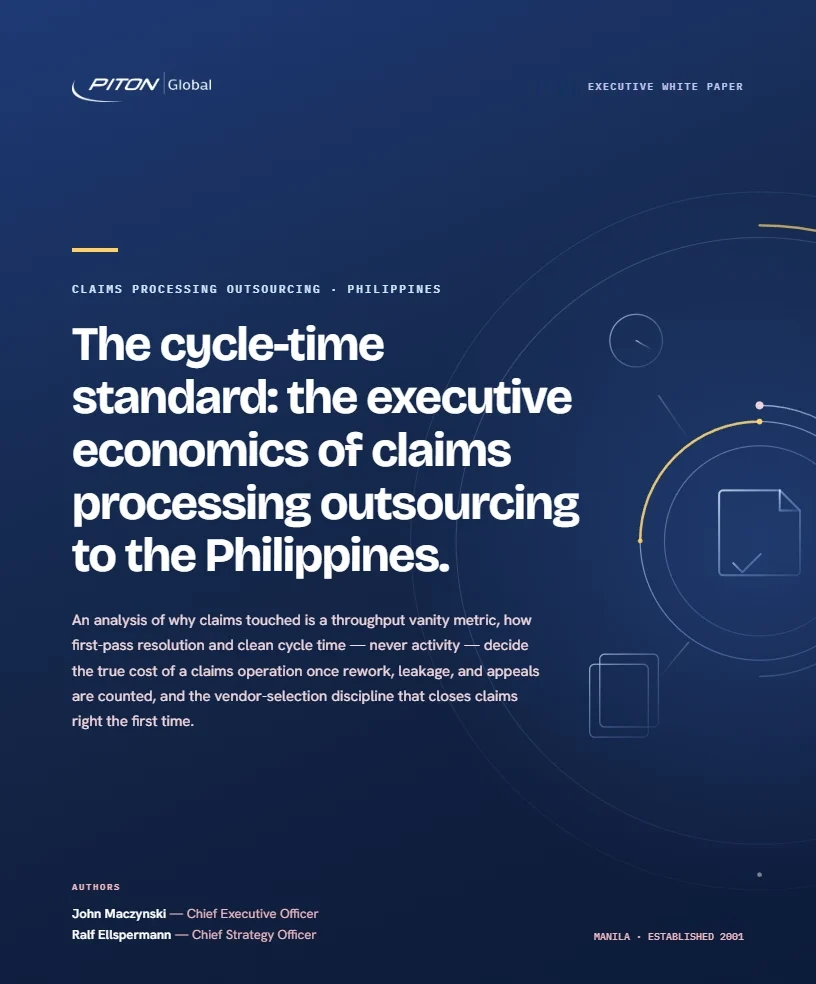
White paper cover — PITON-Global WP-25, The Cycle-Time Standard: Claims Processing Outsourcing to the Philippines
PDF · 14 PAGES
18WHITE PAPER · CLAIMS PROCESSING · 2026

The Cycle-Time Standard — Claims Processing Outsourcing to the Philippines

An analysis of why claims touched is a throughput vanity metric, how first-pass resolution and clean cycle time — never activity — decide the true cost of a claims operation once rework, leakage, and appeals are counted, and the vendor-selection discipline that closes claims right the first time. Volume 36 of PITON-Global’s Executive White Paper Series, by John Maczynski and Ralf Ellspermann.

● 14 pages● 12-min read● Maczynski & Ellspermann
WHAT IT COVERS
The throughput mirage: why claims touched flatters while first-pass resolution tells the truth.
The claims contract — the adjudication gate, first-pass resolution, and the clean close.
Case Study CP-036: a 45-seat operation re-based on first-pass resolution behind a 6.0× first-year ROI.
Read the full white paper (PDF) Free · no gate · published July 2026
CLAIMS PROCESSING · PHILIPPINES

Tell us your accuracy and turnaround. We’ll name the teams that can hit them.

Share your claims scope, volume and accuracy baseline. We return a vendor-neutral shortlist of compliance-led Philippine claims processing teams that have proven the numbers on this page — at no cost to you.

Run the RFP
Vendor-neutral · no cost to you · 24-hour response guarantee, leakage-rate sampling estimate included · prepared and presented by John Maczynski, CEO
20ANSWERED BY OUR PRINCIPALS

What claims leaders ask before outsourcing adjudication.

In-depth answers to the questions that decide a claims-processing engagement — from the principals who run them.

How do you ensure compliant and accurate claims adjudication?+
HIPAA review and claims QA apply to every claim and interaction, validated against payer rules before it goes out. That keeps claims clean and fully defensible, so the cash you collect never comes at the cost of the customer relationship or a compliance finding.— Ralf Ellspermann, CSO
What does outsourcing claims processing save us?+
Typically 50 to 70 percent on cost to collect versus onshore staff, with higher net coean-claim rates and lower denials. The deeper benefit is cash arriving sooner and freed capacity: your AR team focuses on exceptions and relationships while we run the disciplined daily adjudication work.— John Maczynski, CEO
Will you work inside our EHR and encoder?+
Yes. Teams work natively in your EHR, practice-management and claims systems — Facets, QNXT, HealthEdge, TriZetto and similar — with full audit trails, rather than parallel spreadsheets. Your system of record stays the single source of truth behind every claim and note.— John Maczynski, CEO
How do you protect patient health data (PHI)?+
Claims work stays in HITRUST and SOC 2-aligned environments — PHI access by role, card data barred from notes, local storage off, audit trails complete. Interactions log without exception, and PHI remains inside the secured environment at all times.— Ralf Ellspermann, CSO
Will you actually improve our adjudication accuracy?+
Yes. Clean intake, eligibility validation, plan-rule adjudication and accuracy QA on every adjudicator typically lift adjudication accuracy above 99% and cut turnaround sharply within a quarter. A documented prevention strategy keeps quality high over time. Working the right files at the right time means fewer errors and faster, cleaner throughput.— Ralf Ellspermann, CSO
How do you handle compliance and controls?+
HIPAA-compliant workflows, complete audit logging, claims and accuracy QA, documented escalations, and SOC 2 controls applied without exception. The result is revenue integrity that satisfies your compliance team and gives you a clean, examinable record behind every contact.— John Maczynski, CEO
What claims processing work can you take on?+
Claim intake and scrubbing, eligibility and benefit validation, adjudication, edit and pend handling, COB and resolution, plus disclosure logging, plus risk-adjustment and CDI support, patient statements and billing support, plus charge-lag follow-up and patient collections, plu support, denial management, cash posting and revenue reporting. Your team keeps oversight and the customer relationship; we run the consistent daily work that turns pending claims into accurate, paid claims.— John Maczynski, CEO
Which claim types should we outsource first?+
Start with the highest-volume, deadline-driven request types — where disciplined outreach compounds accuracy compounds, then extend to risk-adjustment and CDI — where clean submission compounds, then extend to posting and worked balances convert to cash fastest, then extend upstream accuracy compounds into faster turnaround. Complex and aged requests follow once the contact strategy, compliance controls and QA are proven on the early-stage work.— Ralf Ellspermann, CSO
How quickly can a claims processing team be live?+
About three to seven weeks, often starting with a paid pilot on a ring-fenced book. No outreach goes live until scripts, compliance controls and QA are signed off. You see proven clean-claim performance on a defined book before the engagement scales across your full claim volume.— John Maczynski, CEO
How is performance measured?+
Against adjudication accuracy, claim turnaround, auto-adjudication assist and cost per claim, in a live dashboard. We never report raw claim counts — a fast wrong decision is leakage, not throughput and cost per chart, in a live dashboard. We never report raw activity counts — a chart returned incomplete defeats the purpose, not productivity, in a live dashboard. We never report raw chart counts — speed that creates audit findings defeats the purpose, and cost per claim, in a live dashboard. We never report raw productivity counts — speed that creates errors defeats the purpose, not claims pending over 30 days, in a live dashboard. We never report raw productivity counts — activity without accurate adjudication is just motion, in a live dashboard with weekly reviews. We deliberately never report raw productivity counts — activity without clean claims, or speed that creates denials, defeats the purpose.— Ralf Ellspermann, CSO
Authorship, Review & Benchmark Verification
Authored by:
Ralf Ellspermann
Ralf Ellspermann
Chief Strategy Officer of PITON-Global
Two Decades Building and Advising Award-Winning Philippine BPO Operations

Ralf audits claims floors on adjudication accuracy and cycle-time discipline before benchmarks reach this page.

View full bio  →
Verified by:
John Maczynski
John Maczynski
CEO of PITON-Global
Former Global EVP of the World’s Largest Contact Center · Four Decades of Outsourcing Experience

John validates the throughput economics and commercial terms behind each claims-processing program.

View full bio  →
Last Reviewed & VerifiedJune 29, 2026

Re-audited as HIPAA and payer audit obligations evolve. Every benchmark on this page is held to PITON-Global’s internal vetting standard.

error: Content is protected !!
Inquire Now