Scale healthtech with clinical certainty.
HIPAA- and HITRUST-ready clinical coordination, health-data operations and back-office workflows — delivered by EHR-trained Philippine specialists who pair Agentic AI with a zero-error tolerance framework to turn administrative burden into clinical capacity.
Our healthtech vendor is HIPAA-compliant — why isn’t that enough?
Because HIPAA compliance is a training certificate, not a security architecture; the failure points are shared infrastructure, PHI persisting on workstations and password-only access — invisible in a BAA. Run the test: open a PHI record, close the session, reopen it; if the record persists, walk. HT-079 under HITRUST governance: prior-auth turnaround 68 to 19 hours, first clean HITRUST report ever.
BPO Suppliers
Innovators Served
Philippines
In 2026, healthtech leaders don’t just scale users — they scale responsibility. The Philippines has evolved into a clinical extension of the enterprise, where the focus has shifted from back-office support to Clinical Data Sovereignty and Agentic AI-driven patient safety — delivered by HITRUST-certified partners operating at 99.9% accuracy.
Your product decides which pillar carries the load first.
Patient volume scales in weeks; clinical-admin capacity scales in quarters — HT-079 was exactly this gap. Onboarding, prior-auth at sub-24 hours, and predictive navigation for virtual-care and remote-monitoring platforms.
Evidence is the product, and evidence lives in data quality. Clinical data operations, adherence outreach, and AI data-ops — labeling, validation, and model evaluation with clinical review on the edge cases your regulatory submissions depend on.
Your customers audit you the way we audit vendors. Implementation support, data abstraction, and documentation QA delivered from a HITRUST-assessed environment your enterprise deals can reference — TEFCA-aligned, FHIR-native.
Value-based contracts price your data discipline. Claims operations, coding support, and care-management workflows at the Forensic QA standard, with the audit trail your delegation agreements require.
Why is clinician administrative burden the primary patient safety risk in healthtech scaling?
In 2026 the leading cause of clinician error is not clinical knowledge failure — it is administrative cognitive overload. Documentation, chart-review backlogs and prior-auth queues consume 34–41% of licensed clinician time that should be spent on patient care. Agentic Clinical Workflows absorb that burden with zero-error tolerance.
Clinical Data Sovereignty is a healthtech outsourcing model in which Agentic AI performs documentation and abstraction autonomously while EHR-trained Philippine specialists own judgment-critical review, exception handling, and escalation under HITRUST CSF governance — with every clinical decision made by the client’s licensed clinicians — measuring success in forensic accuracy and patient safety, not ticket volume.
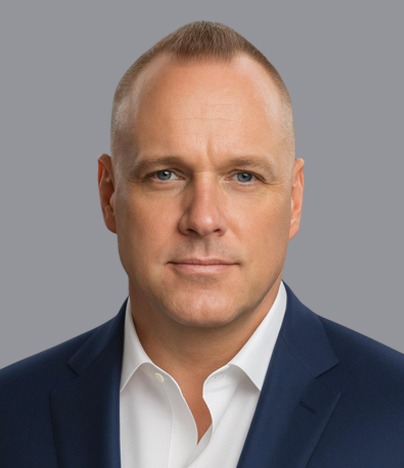
“A BPO that bolted a healthcare vertical onto its existing business is not what we put in front of a client. We vet clinical infrastructure providers that happen to operate out of Manila — organizations whose remit has already moved past back-office support into Clinical Data Sovereignty and Agentic AI-driven patient safety.”
Three interlocking pillars that define HITRUST-ready Clinical Sovereignty.
Agentic Clinical Data Operations, Regulatory Sovereignty under Zero-Trust, and Predictive Patient Engagement. Each pillar is independently auditable. Together, they define the top 1% of Philippine healthtech operations.

“In healthtech, the wrong partner doesn’t just cost you money — it costs you patient trust, regulatory standing, and potentially clinical outcomes. The HITRUST CSF certification is not a premium feature. It is the minimum architecture for any PHI-touching engagement in 2026.”
Where does the Compliance Dividend come from — and why do standard models miss 50% of its value?
The Compliance Dividend is the economic value created when healthtech outsourcing architecture eliminates regulatory exposure rather than managing it. Standard models capture labor savings but miss the three largest value drivers: violation-exposure reduction, clinician top-of-license ROI, and proactive-engagement patient LTV.
The cheapest column below cannot navigate your EHR. That is why it’s the cheapest.
Every procurement model opens with the seat comparison, so we publish it — with the column most vendors hide in a blend shown separately.
Illustrative projection at standard role mix; labor savings run 30–45% vs. an equivalent in-house build — a deliberately narrower band than commodity BPO quotes, because the clinical-literate premium is the product. A narrower saving than our healthcare RCM benchmark (60–70%) — deliberately: healthtech clinical-ops roles carry the clinical-literate premium end to end, and the dividend is built on risk elimination and clinician recovery, not seat arbitrage. We confirm exact figures against your platform, patient volumes, and payer mix.
Indicative 2026 rates — the clinical-literate premium shown in two columns, not blended into one.
The spread between the columns is the Credentialing Gap with a price on it. An EHR-certified, ICD-10/CPT-trained specialist prices 40–80% above the generic equivalent — and a quote at the generic band for a clinical role is how you buy the 71% who fail a live EHR navigation demo.
The rows with no generic equivalent are the point — those seats cannot be staffed from a communication-skills pool, which is why 71% of providers claiming healthcare capability failed the live evaluation (PITON-Global Q2 2026 healthtech audit cohort, n=100). Rates confirmed per engagement against platform and specialty mix.
Price my role mix against the credentialing standard →Legacy BPO baseline vs. PITON-Global-vetted 2026 standard.
The competitive delta across eight dimensions that determine valuation, regulatory standing and patient safety in a PHI-touching healthtech operation.
A three-layer governance stack that makes a regulatory audit a non-event.
Every clinical data interaction is processed through three sequential controls — Agentic AI orchestration, Forensic Human QA and Continuous Compliance Telemetry — before it touches the platform’s downstream systems. A live dashboard answers every assessor question in real time.
Two structural failure modes that expose healthtech orgs to regulatory and patient-safety risk.
The Credentialing Gap and the Security Illusion account for the majority of healthtech outsourcing regulatory events. Both are auditable before contract execution. Neither requires legal review to identify — only the right questions asked to the right people.
Where Clinical Data Sovereignty doesn’t fit — and the line we never cross.
The fastest way to become one of the audit statistics on this page is to force a clinical-literate, HITRUST-governed operation into work it was never built for. So before the shortlist, the disqualifiers — ours, stated plainly.
How administrative burden became a $2.1M compliance dividend.
A documented Q4 2025 engagement: a US-based telehealth platform onboarding 4,200 new patients monthly, deploying a 25-specialist Philippine clinical operations team under full HITRUST CSF governance.
$2.1M 12-month compliance dividend on $580K cost
Our previous Philippine BPO had three years of HIPAA training certificates on the wall and zero HITRUST architecture behind them. The PITON-Global audit found persistent PHI on analyst workstations, no role-based access controls, and prior-auth agents who could not interpret a payer’s medical necessity criteria. We had been exposed without knowing it. The switch was not optional after that audit.
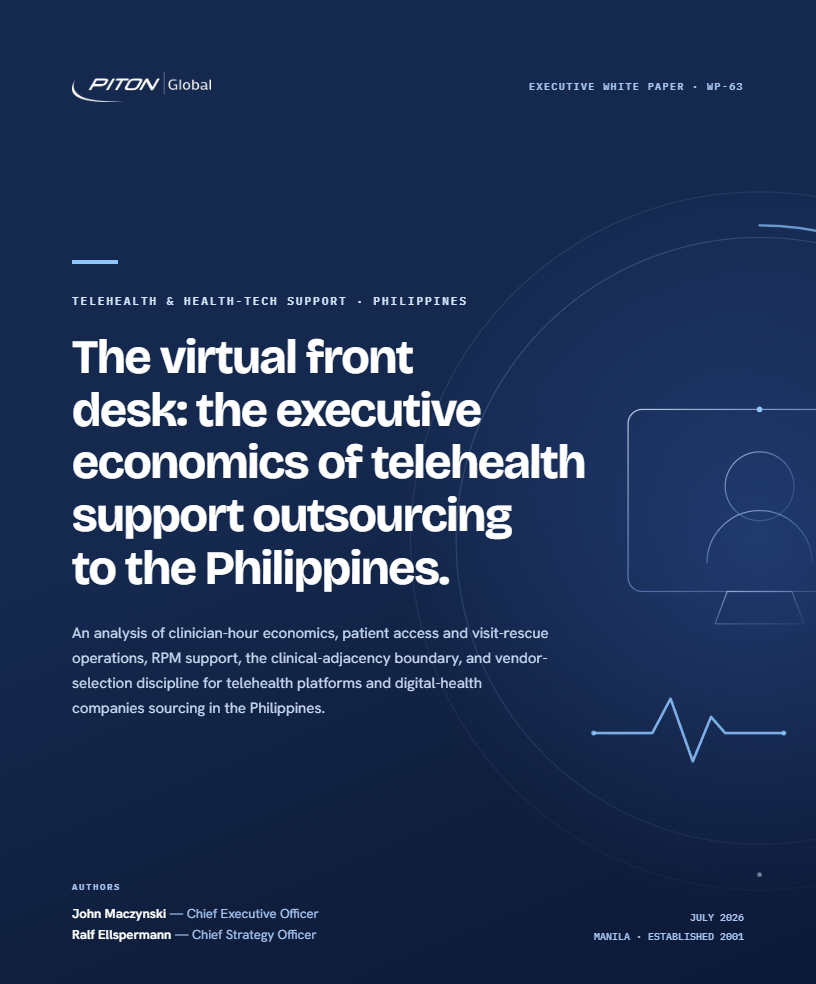
The Virtual Front Desk — Telehealth & Health-Tech Support Outsourcing to the Philippines
An analysis of clinician-hour economics, patient access and visit-rescue operations, RPM support, the clinical-adjacency boundary, and vendor-selection discipline for telehealth platforms and digital-health companies sourcing in the Philippines. Part of PITON-Global’s Executive White Paper Series, by John Maczynski and Ralf Ellspermann.
Independent coverage. Third-party validation.
What healthtech leaders ask before they outsource.
In-depth answers to the questions that decide a healthtech engagement — from the principals who run them.