LEGAL RESEARCH OUTSOURCING SERVICES PHILIPPINES

Legal research that finds the authority that wins.

Manila-based legal research teams — attorney-supervised case law and statutory research, legal memos, citation checking and Bluebooking, so your research is accurate, well-sourced and on time, under SOC 2, ISO 27001 and GDPR controls.

Manila, Cebu & Davao delivery SOC 2 / ISO 27001 / GDPR Attorney-supervised
RESEARCH INDEX LIVE
Citation accuracy (QC)
99%
Cite-check rate
60/hr
cites per researcher
Cost per memo
55%
vs onshore staff
LEGAL RESEARCH A bad citation in a brief is a credibility hit you cannot take back. We shortlist attorney-supervised teams that research fast and cite defensibly. Benchmark your research
SYSTEMS & STANDARDS
WestlawLexisNexisBloomberg LawFastcaseBluebookAttorney-supervisedGDPRSOC 2
01THE ESSENTIALS

What legal research outsourcing is.

THE ESSENTIALSLAST UPDATED · JUNE 2026

Legal research outsourcing is the delegation of legal research work — case law and statutory research, research memos, citation checking and Bluebooking, and 50-state and regulatory surveys — to attorney-supervised teams, run under SOC 2 and GDPR controls to accuracy, turnaround and cost-per-memo targets, so attorneys build arguments on solid, verified ground.

What is it?Legal research sourced from the Philippines — case law and statutory research, memos, citation checking and surveys, on an attorney-supervised workflow.
Primary KPI99% citation accuracy · 48-hour memo turnaround · −55% cost per memo.
Who is this for?Law firms, corporate legal departments and litigation teams that want thorough, well-cited research without burning associate hours or expanding headcount.
Why PITON-Global?Vendor-neutral sourcing of the top 1% of Manila legal-research teams — vetted on attorney supervision, citation accuracy and SOC 2/GDPR compliance.
Evidence of successEngagement LR-066: research memo turnaround cut from 5 days to 48 hours · 100% existence-verified citations, zero phantoms · verified Q2 2026.
02RESEARCH METRICS

Research metrics that survive a partner’s scrutiny.

Citation accuracy, memo turnaround, attorney-acceptance and cost per memo from PITON-Global-vetted Manila legal-research teams, against the in-house and generic-offshore baseline — figures a partner can defend in a review.

METRICPITON-GLOBAL-VETTEDBASELINEWHY IT MATTERS
Citation accuracy99%~90%Cites that hold up
Memo turnaround48 hr~5 daysArguments built faster
Cost per memo−55%onshore loadedDiscounts kept, penalties avoided
First-pass attorney acceptance98%~80%Answers land sooner
Cost vs in-house−65%in-house baseArbitrage without quality loss
Source: PITON-Global legal-research operating data, 2025–2026 engagements · baseline = in-house & generic-offshore averages
03THE RESEARCH WORKFLOW · INTERACTIVE

Answer the right question — with authority that holds.

Thorough research is method before it is hours. Each stage narrows to controlling authority and verifies every citation under attorney supervision. Expand each step to see how the team runs it.

FIGURE 1 · THE RESEARCH WORKFLOW, QUESTION TO MEMO
STEP 01Intake & ScopingFrame the question
The legal question, jurisdiction and sources are scoped with the requesting attorney — issues, controlling authority and deadline fixed before research begins.
STEP 02Source ResearchCase law & statutes
Researchers run primary and secondary sources — case law, statutes, regulations and treatises — across Westlaw, Lexis and Bloomberg Law, capturing every on-point authority.
STEP 03Analysis & SynthesisWeigh authority
On-point authorities are analyzed, distinguished and synthesized into a clear answer — holdings, splits of authority and the strongest line of argument, flagged for the supervising attorney.
STEP 04Memo DraftingDraft the answer
Findings are drafted into a research memo or brief section — question presented, short answer, analysis and conclusion — in your house style.
STEP 05Cite-Check & Sign-offVerify & Bluebook
Every citation is verified for accuracy and good law and Bluebooked, then a supervising attorney signs off — accurate, well-sourced and ready to file.
The legal-research workflow runs in five stages: intake and scoping with the requesting attorney, primary and secondary source research across Westlaw, Lexis and Bloomberg Law, analysis and synthesis of controlling authority, memo or brief drafting in your house style, and citation verification with Bluebooking and supervising-attorney sign-off. Because every memo is scoped before research and cite-checked before delivery, PITON-Global-sourced research teams sustain 99% citation accuracy and 48-hour memo turnaround.
EVERY AUTHORITY EXISTS. WE PROVE IT BEFORE YOU CITE IT.

The era’s defining research failure is the citation that was never real. Ours carry a verification chain — pulled, read in full, treatment-checked. No exceptions, including the cites you send us.

It is 2026. The defining legal-research failure of the era is the AI-hallucinated citation — the confident, well-formatted authority that does not exist — and the sanctions orders have names attorneys recognize. This is the anti-hallucination architecture, stated as such.

EXISTENCE VERIFICATION, 100% — THE FLOOR

Every authority in every memo is pulled directly from Westlaw, Lexis, or Bloomberg Law as a primary-source document — never accepted from a secondary source, a prior memo, or any AI tool’s output — and the pull is logged. An AI assistant may suggest; nothing is cited until a researcher has the actual opinion open. A citation that can’t be pulled doesn’t get a footnote asterisk; it gets deleted, and the deletion gets flagged — because in 2026 the confident fake is the failure mode, and the only defense is a human with the real document on screen.

READ, NOT SKIMMED — THE PROPOSITION CHECK

Existence isn’t sufficiency: the case must say what the memo says it says. Every cite is verified for its proposition — pin cites to the actual page, holdings distinguished from dicta, the quote checked against the opinion verbatim — because the second-worst research failure after the fake case is the real case cited for something it doesn’t hold.

GOOD-LAW STATUS, WITH THE TREATMENT READ

Every authority Shepardized/KeyCited before delivery — and the flags are read, not color-glanced: a yellow flag gets its citing decisions reviewed (distinguished-on-other-grounds is survivable; questioned-on-your-exact-point is not), negative treatment is characterized in the memo, and superseded statutes and amended regulations are version-checked to the date that governs your matter.

THE VERIFICATION CHAIN, DELIVERED

Every memo ships with its citation table: authority, database pull date, treatment status, proposition-check initials — the one-page exhibit that answers the question every filing attorney now silently asks: did a human verify every one of these? Ours answers in writing.

THE ERA’S OWN TELLAsk any research vendor what happens when an AI tool suggests a case their researcher can’t pull. If the answer isn’t “it dies immediately and we log the near-miss,” you’ve found where the sanctions order starts.
04THE MEMO THAT TELLS YOU YOUR ARGUMENT LOSES

Adverse authority disclosed. Thin support called thin. “We found nothing” said plainly. The most valuable memo you’ll ever buy is the one that saves you from filing.

A memo that only reports supportive authority isn’t research; it’s advocacy delivered early and discovered late. The candor rules (Rule 3.3’s duty to disclose adverse controlling authority) make this professional obligation, not style — and the vendor incentive runs the wrong way: teams paid to please report what pleases.

ADVERSE AUTHORITY IS PART OF THE ANSWER, ALWAYS

Every memo’s authority section reports both directions: controlling adverse authority flagged prominently (your Rule 3.3 disclosure duty starts with knowing it exists — and knowing it from your own memo beats learning it from opposing counsel’s response brief), unfavorable trends characterized honestly, and the circuit split reported as a split, not resolved by omission.

STRENGTH IS GRADED, NOT IMPLIED

Short answers carry confidence language with teeth: controlling and directly on point · persuasive but distinguishable · thin — analogy only · no supporting authority found — because a partner allocating argument weight off a memo deserves to know whether the ground is rock or rumor, and a memo that grades everything “supportive” has graded nothing.

“NOTHING” IS A DELIVERABLE

When the research finds no support, the memo says so, shows the search methodology that proves the absence was looked for (databases, terms, date ranges — the negative-space documentation), and, where useful, reports what the adverse landscape looks like — because the argument you don’t file costs a memo; the argument you file into controlling adverse authority costs credibility with the bench, and only one of those is refundable.

THE PRINCIPLEThe argument you don’t file costs a memo; the one you file into controlling adverse authority costs credibility with the bench — and only one of those is refundable.
05THE PHILIPPINE RESEARCH BENCH

Why firms run legal research from the Philippines.

The country produces legal talent at a scale few can match — a deep, compliance-trained, English-fluent talent base with the rigor to support attorneys without sacrificing research rigor, at a fraction of onshore cost.

A deep legal-support talent pool
A yearly pipeline of law and paralegal graduates in the tens of thousands — many bar-qualified — deep enough to build standing research benches rather than temp pools.
Compliance & negotiation fluency
Training in common-law reasoning and legal writing, so deliverables arrive needing supervision rather than redrafting.
Controls discipline
A conscientious, quality-first culture that makes attorney QA and second-pair-of-eyes citation verification natural.
Round-the-clock contact windows
Follow-the-sun coverage means research runs overnight, so memos are waiting when your attorneys log on — your team arrives to progress that already moved forward.
Cost per memo
60–70% lower fully-loaded cost than onshore associates — arbitrage that funds compliance and senior review.
Security & SOC posture
Facilities aligned to SOC 2 and ISO 27001, with access controls designed around privileged client and matter material.
When error rates keep rising, effort is rarely the issue — a disciplined operating cadence is what is missing.
06INSIDE THE CADENCE

How thorough, well-cited research is engineered.

Thoroughness is engineered into the workflow, not hoped for after a thin memo. The discipline below is what separates a managed legal-research operation from a basic search desk.

1
Scoped before researched
Every request is scoped with the attorney before research starts, so memos answer the actual question, not an adjacent one.
2
Parallel research streams
Issues run concurrently on a documented calendar with owners and deadlines, compressing time to a file-ready memo.
3
Attorney-grade controls
Compliant workflows, attorney QA on every memo and a complete audit trail keep work product audit-ready.
4
Citation-verification tooling
Automated cite-checking flags bad law and enforces attorney sign-off, so errors surface early, not in a filing.
5
Supervising-attorney review
A supervising attorney signs off on novel issues and close calls, so what reaches your team needs review, not redo.
6
Argument-integrity discipline
Disciplined research and cite-checking protect the argument and keep bad citations out of your filings.
07THE MATH OF A SOLID MEMO

Where the 7.2× return comes from work done right the first time.

From four streams a per-hour rate ignores: filing-risk exposure retired, associate hours returned to billable work, matter velocity, and labor arbitrage. An argument grounded on day 2 is worth far more than a memo that lands on day 7.

Filing-Risk Exposure Retired (the phantom-cite class, sized)
$1.6M – $2.9M
Associate Hours Returned to Billable Work
$1.4M – $2.5M
Matter-Velocity Value (5 days → 48 hours × filings unblocked)
$0.7M – $1.4M
Outside-Research Displacement & Labor Arbitrage
$0.8M – $1.5M
TOTAL ANNUAL NET BENEFIT60-FTE LEGAL-RESEARCH OPERATION
$4.3M – $8.0M
6.7×
Documented return
CLIENT STORY · ENGAGEMENT LR-066 · LITIGATION BOUTIQUE

How a litigation boutique cut memo turnaround from 5 days to 48 hours.

Associates burned nights on case law research, memo turnaround stretched to a week, and partners kept reviewing thin, under-sourced work.

48 hr
memo
turnaround
99%
citation
accuracy
-55%
cost per
memo
THE CHALLENGE

A fast-growing litigation boutique had a two-partner team buried in case law research and memo drafting. Memo turnaround stretched to five days, novel issues piled up, and partners spent nights cite-checking instead of building arguments.

WHAT WE SOURCED

We sourced an attorney-supervised Manila legal-research team working in the firm’s research tools — researching case law and statutes, drafting memos and escalating novel issues to a supervising attorney, checking and Bluebooking every citation, and packaging file-ready memos with clear short answers.

THE OUTCOME

Memo turnaround dropped from five days to 48 hours, citation accuracy reached 99%, and the partners got file-ready memos that needed review, not rework — while cost per memo fell 55%. The associates moved from rote searching to the work that needs them.

“Memos come back in 48 hours, cited to our standard, and they hold up. My associates finally build arguments instead of burning nights in the database.”

— Managing Partner · litigation boutique
08HOW WE ENGAGE

From first call to filing — a path you control.

You never hand over your matters and hope. The process stays vendor-neutral end to end: we map and vet the candidates; the decision on who runs your matters is entirely yours. Every stage has an owner, a timeline and an exit.

01Week 1
Discovery & scoping
We map your research workflow, your systems and current accuracy and turnaround baseline — and agree the accuracy and turnaround metrics your engagement will be judged on. No cost, no obligation.
02Week 1–2
Competitive vendor RFP
From 110+ vetted providers we invite 6–10 highly-qualified, research-specialist firms into a competitive RFP on your matter types and research volume — each presenting real turnaround, accuracy and compliance track records.
03Week 2–3
Vetting & due diligence
You see each team’s SOC 2/ISO 27001 posture, legal-research training, QA model, attrition data, references and security certifications. You interview them. You choose. We stay neutral.
04Week 3–7
Paid pilot
Start on a ring-fenced book — a single line of business or region, a fixed term, success criteria agreed up front. Performance is proven on your own matters before you scale.
05Week 7–10
Onboarding & integration
Systems access, compliance scripting, research protocols and a shared style guide are stood up under a documented runbook, with a named transition lead owning the ramp.
06Ongoing
Governance & QbR
A weekly operating review on citation accuracy, memo turnaround and research thoroughness, plus a quarterly business review — with a clear escalation path and a named relationship owner accountable for outcomes.
09WHAT IT COSTS

Three ways to pay — priced to the outcome you want.

No opaque “call us” pricing. Legal-research engagements run on one of three commercial models. Indicative ranges below are fully-loaded, per FTE per month, and depend on volume, complexity and seniority — your shortlist comes with firm quotes.

MODEL 01
Dedicated FTE
$1,400–$2,600 /FTE/mo
A dedicated bench assigned exclusively to your matters. Best when you want control, your own protocol and predictable cost.
Predictable monthly cost
You own strategy & scripts
Easiest to scale up or down
MODEL 02 · MOST COMMON
Per-memo
$80–$400 /memo
You pay per memo. Rate varies with research depth — multi-jurisdiction and 50-state surveys sit higher. Aligns the team to output, not hours.
Pay only per research memo
Fully output-aligned
Ideal for variable / overflow volume
MODEL 03
Managed outcome
Base + bonus on SLA
A lower platform fee plus a performance bonus tied to citation accuracy and turnaround and strict SLAs. The partner owns the target, not just the seats.
Partner owns the outcome
Penalties for missed SLA
Best for steady, high-volume matters
Whichever structure you choose, the net effect typically lands 50–70% below onshore cost to serve. We match the model to your caseload and commit the economics to paper before you sign anything.
10HOW WE DE-RISK IT

The objections law firms actually raise about outsourced case work — each one addressed.

Placing privileged files and client data with an offshore team carries genuine risk. Here is exactly how each one is contained — in writing, not just the pitch.

Data security & confidentiality
THE RISKA data breach or leaked client matter data
How it’s contained — SOC 2 Type II and ISO 27001 facilities, encrypted access, no client data retained on endpoints, locked-down VDI, and breach liability written into the MSA. Your security team audits before go-live.
Confidentiality & privilege risk
THE RISKA privileged or work-product disclosure
How it’s contained — Attorney-supervised workflows, 100% audit logging, QA on every memo, conflict-of-interest screening, and an attorney-review SLA. Disciplined citation QA is the standard, and it is measured.
Continuity & attrition
THE RISKThe team churns and research quality drops
How it’s contained — Named backup specialists, cross-trained benches, documented runbooks, and attrition reported to you monthly. Knowledge lives in the playbook, not one person’s head.
Quality drift
THE RISKPerformance fades after the honeymoon
How it’s contained — SLAs with teeth: citation-accuracy, turnaround and thoroughness floors with financial penalties for misses, reviewed weekly. Drift shows up on the dashboard before it shows up in your cash.
Fully-loaded pricing, no surprises
THE RISKHourly creep and hidden database charges
How it’s contained — Per-memo and fixed-capacity models with Westlaw/Lexis access included, scoped up front — the verification architecture (existence, proposition, treatment) is standard, never an add-on line. What you’re quoted is what you pay.
Lock-in
THE RISKStuck with a partner that underperforms
How it’s contained — 30-day exit for cause, your data and call records returned in full, and a documented hand-back plan. You are never trapped in an underperforming book.
Prove it on a ring-fenced book first. Engagements can open as a paid pilot scoped to one matter or document set, with success criteria fixed in advance. You scale only after research quality is proven on your own matters. Scope a pilot
11WHY THE PHILIPPINES — HONESTLY

Where the Philippines earns legal work — and where it isn’t the answer.

Vendor- and geography-neutral means we can publish the comparison straight, so here it is for this work. The Philippines wins on common-law legal education, research rigor and citation discipline for US/UK/AU clients — but not for every scenario.

FACTORPHILIPPINESINDIASOUTH AFRICA
Common-law legal educationStrongest — US/UK-aligned curriculaStrong, more variableExcellent — strong for UK law
Citation & Bluebook disciplineExcellent — rigorous, detail-drivenGoodExcellent — Western-aligned
Cost per FTELowLowestHigher
UK / EMEA time-zone fitLimitedLimitedBest — same-day GMT overlap
Scale of talent poolLargestLargestSmaller, faster-growing
Common-law fluency & attention to detailDeep, provenDeep, provenGrowing
Our honest take: choose the Philippines for English-language legal research where common-law fluency and attorney supervision protect the quality of every memo. Choose South Africa for UK/EMEA-hours books needing same-day GMT overlap; choose India when rock-bottom cost outranks voice nuance. We will tell you when the Philippines is the wrong call.
12RADICAL TRANSPARENCY

Research support under counsel’s direction — the carve-out from litigation stated, the UPL line inherited, the work product yours.

01
The territory, stated for both indexes.
Our Legal Process page owns litigation operations — review, eDiscovery, the matter lifecycle; this page owns the research lane as its specialist operation (the umbrella keeps the narrative; the specialist owns the depth — cross-linked both directions, retold in neither). Contract work lives at CT-. Three legal pages, two borders, all stated.
02
The UPL architecture is inherited whole.
Memos are prepared for counsel’s use, under counsel’s direction; they advise the attorney, never the client; strategic judgment and every filing decision are counsel’s alone. Full architecture on the Legal Process page — cross-linked, never retold.
03
The work product is yours, structured for the privilege argument.
Research performed at counsel’s direction for the matter, engagement papered accordingly, so the work-product doctrine has the facts it needs before anyone challenges it. Conflicts screening runs at privilege-grade — matter-level checks, ethical walls where concurrent engagements require them.
04
Calibration caps per pod.
Practice-area depth caps the span; a researcher stretched across six doctrinal areas is a generalist with a database, and the memo shows it. Appellate and deep-treatment work is supervising-attorney paired, always.
A shortlist that includes “no” is the only kind worth having.
13PRICING TOPOGRAPHY · ROLE VIEW

Indicative 2026 rates — because a 50-state survey is not a single-issue memo.

CORE ROLERATE (USD/HR)OPERATIONAL PROFILETIER
Legal researcher$10–$15Case law and statutory research, memo drafting to protocol.T
Cite-checker / Bluebook specialist$9–$14Verification-chain execution, Bluebooking, quote checks (Section 1).T
Senior researcher$13–$18Circuit splits, multi-jurisdiction issues, treatment analysis.R
Regulatory researcher$12–$17Administrative law, version-controlled reg research, agency guidance.R
50-state survey specialist$14–$20The jurisdictional matrix done right: consistent question-framing across 50 answers, version-dated, exceptions flagged — the survey that survives the second reader.NO GENERIC
EQUIVALENT
Appellate research specialist$16–$24Standard-of-review discipline, preservation analysis, the deep-treatment work briefs stand on — supervising-attorney paired (C-tier, always).NO GENERIC
EQUIVALENT
QA / verification analyst$10–$15Citation-table audits, proposition-check sampling, near-miss logging.QUALITY
Research program lead$14–$20Pod governance, counsel liaison, turnaround ownership.LEADERSHIP

The two premium rows have no commodity equivalent because a search desk staffs neither: the 50-state survey becomes 50 inconsistent paragraphs and the appellate issue gets trial-level depth. Rates confirmed per engagement against practice areas and volume — composing with the per-memo model above.

Price my research bench against the verification standard
14WHO WE SERVE

Four kinds of question, researched four different ways.

01Litigation boutiques & firms

The flagship’s home: 48-hour memos, partners building arguments again. LR-066 is this question, measured.

02Corporate legal & compliance

The standing research function: regulatory surveys, version-controlled monitoring, the 50-state matrix.

03Appellate & brief support

The C-tier lane: deep treatment analysis, preservation review, authority mapping.

04IP, regulatory & specialty

Doctrinally deep, precedent-dense practice areas where researcher specialization is the product.

THE BRIEF FILE · ENGAGEMENT LR-062 · CITATION AUDIT ONLY

Citation audit only — 45 briefs, every authority re-verified through the full chain. The question 2026 forces: are you certain every case you’ve cited exists — and still says what you said it says?

CLIENT ENTITY

AmLaw-200 firm, active litigation portfolio, 45 briefs / 1,200 citations in scope (filed and pre-filing). Identity withheld under NDA.

PRE-DEPLOYMENT BASELINE

The portfolio’s briefs had been assembled the way briefs now are: associates under deadline, research memos of mixed vintage, AI drafting tools in the workflow somewhere — nobody could say exactly where — and cite-checking done “when time allowed,” which is a schedule with a known ending. The precipitating anxiety was the era’s: a sanctions order in the news with a fake citation at its center, and a managing partner asking the question no one could answer from records: if a clerk ran our last ten filings through the databases, what would come back? Nobody knew, because verifying your own filed work feels like paying twice — right up until opposing counsel does it for free.

THE INTERVENTION

A ring-fenced re-verification — live matters untouched. Every citation in scope run through the full chain (Section 1’s architecture as the rubric): existence (pulled from primary databases — any cite that can’t be pulled escalated same-day, because a phantom in a filed brief is a candor problem with a docket number), proposition (the brief’s characterization checked against the opinion — the real case cited for the wrong holding taxonomized separately), treatment (Shepard’s/KeyCite as of today — the authority good at filing and since reversed flagged for supplemental-authority obligations), and quote fidelity (verbatim checks, ellipsis honesty). Findings triaged by remedy: pre-filing briefs corrected in draft; filed briefs with live problems routed to counsel with the remediation options mapped (errata, supplemental-authority letters, the candor-rule analysis) — found by you, it’s a correction; found by the bench, it’s a credibility event.

6 WEEKS, MEASURED
METRICFILED-IN-CONFIDENCEAUDITEDWHAT IT WAS
Citations verified through full chainassumed96.8% cleanThe portfolio, tested
Existence failures (phantom cites)0 known3The era’s failure mode, found by us first
Proposition mismatches0 known14Real cases, wrong holdings
Since-filing treatment changesuntracked31 flaggedThe supplemental-authority duties nobody watched
STRATEGIC INSIGHT

The flagship verifies before filing; LR-062 verifies what filing already exposed — and it gives the audit family its nineteenth member with the era’s own epistemics: the second row is the finding that didn’t exist as a category five years ago, and now headlines sanctions orders. The fourth row is the quieter duty (authority goes bad after filing, and the supplemental-authority obligation runs whether or not anyone’s watching the flags). The close is the family tell, sharpened by the times: ask your team when a filed brief’s citations were last re-verified. In 2026, the pause before the answer isn’t just the answer — it’s the exposure.

16RESEARCH TAXONOMY · COMPLEXITY TIER

How do we tier the research function?

Each research request carries a different complexity and skill profile. These are the working tiers — with examples — that govern how the work is staffed and reviewed.

TStandard Legal Research
Routine case law, statutes and regulations; protocol-driven with QA.
EXAMPLE
Routine case law, statutory and regulatory research.
Playbook-driven
RComplex Research
Multi-jurisdiction, circuit splits and administrative law; senior review.
EXAMPLE
Multi-jurisdiction surveys, circuit splits, administrative law.
Senior-reviewed
CStrategic Research
Appellate, constitutional and novel issues; supervising-attorney review.
EXAMPLE
Appellate briefs, constitutional questions, regulatory interpretation.
Senior reviewer sign-off
AResearch Analytics
Citation, authority and turnaround analytics once the workflow runs clean.
EXAMPLE
Authority mapping, precedent analysis, litigation-trend reporting.
Decision-ready
17FROM THE PARTNERS

The standard we hold this work to — from the principals directly.

John Maczynski

“A GC does not buy cheaper research — they buy stronger legal arguments, reliable authority and attorney-grade citation quality, and research that holds up on review. They buy work done right the first time, and a team they can keep. We vet for both.”

John Maczynski · CEO, PITON-Global · 40-Year Global BPO Veteran
Ralf Ellspermann

“Ask a research provider for their citation-accuracy rate, not just turnaround. The difference is whether an argument holds up in court.”
Ralf Ellspermann · CSO, PITON-Global · 25-Year Philippine BPO Veteran
Give your attorneys research they trust and authority they can cite — not a backlog they dread. Get the research shortlist
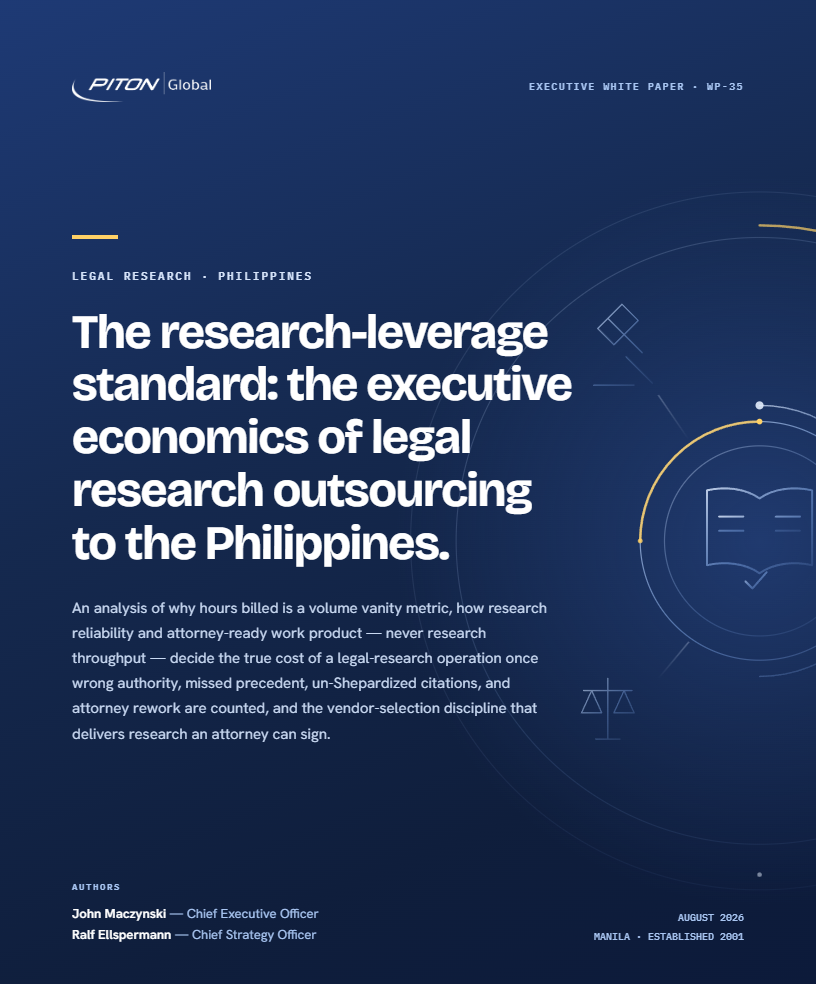
WP-35 Legal Research Outsourcing white paper cover
PDF · 14 PAGES
18WHITE PAPER WP-35 · LEGAL RESEARCH · AUGUST 2026

The research-leverage standard: the economics of legal research outsourcing.

Why hours billed is a volume vanity metric, how research reliability and attorney-ready work product — never research throughput — decide the true cost of a legal-research operation once wrong authority, missed precedent, un-Shepardized citations and attorney rework are counted, and the vendor-selection discipline that delivers research an attorney can sign. Volume 50 of PITON-Global’s Executive White Paper Series, by John Maczynski and Ralf Ellspermann.

● 14 pages● 12-min read● Maczynski & Ellspermann
The volume mirage: hours billed versus reliable, attorney-ready research.
The research contract: find the controlling authority, verify every citation, deliver attorney-ready.
Case study: a 40-seat legal-research operation re-based on research reliability — 6.4× first-year ROI.
Read the white paper (PDF) Free · no gate · published August 2026
LEGAL RESEARCH · PHILIPPINES

Tell us your research volume and turnaround. We’ll name the teams that can deliver.

Share your matter volume, practice areas and turnaround baseline. We return a vendor-neutral shortlist of attorney-supervised Philippine legal-research teams that have proven the numbers on this page — at no cost to you.

Run the RFP
Vendor-neutral · no cost to you · 24-hour response guarantee, filed-brief citation-audit sampling estimate included · prepared and presented by John Maczynski, CEO
19ANSWERED BY OUR PRINCIPALS

What legal leaders ask before outsourcing legal research.

In-depth answers to the questions that decide a legal-research engagement — from the principals who run them.

How do you keep research accurate and well-sourced?+
Attorney review and QA apply to every memo, validated against the authorities before it goes out. That keeps every work product clean and fully defensible, so speed never comes at the cost of the client relationship or a compliance finding.— Ralf Ellspermann, CSO
What does outsourcing legal research save us?+
Typically 50 to 70 percent on cost per memo versus onshore associates, plus far faster turnaround. The deeper benefit is fewer errors, faster turnaround and your team freed to focus on complex matters and analysis while we run the disciplined, high-volume work.— John Maczynski, CEO
Will you work inside our research tools and DMS?+
Yes. Teams work natively in Westlaw, LexisNexis and your document management systems, researching and tracking directly. Document repositories, capturing citation and authority data directly. Core platforms — Westlaw, LexisNexis, Bloomberg Law and similar — with full audit trails, rather than parallel spreadsheets. Every coding decision and production traces back to your system of record as the sole source of truth.— John Maczynski, CEO
How do you protect client and matter data?+
Work is confined to SOC 2 and ISO 27001-aligned environments — role-based access, masking where warranted, zero local storage, and audit trails end to end. Each interaction is logged, and privileged client and matter data remains inside the secured environment at all times.— Ralf Ellspermann, CSO
Will you actually speed up our research turnaround?+
Yes. Attorney-supervised research, citation checking and Bluebooking typically cut memo turnaround and lift research thoroughness capture sharply within a quarter. A documented prevention strategy keeps quality high over time. Working the right files at the right time means fewer errors and faster, cleaner throughput.— Ralf Ellspermann, CSO
How do you handle compliance and controls?+
Through attorney-supervised workflows, full audit logging, QA on every memo and citation, documented escalation workflows and SOC 2 controls applied consistently. The result is research integrity that satisfies your compliance team and gives you a clean, examinable record behind every contact.— John Maczynski, CEO
What research work can you take on?+
Case law and statutory research, regulatory and 50-state surveys, legal memos and brief sections, citation checking and Bluebooking, plus docket research and proactive issue alerts. Your team keeps oversight and the client relationship; we run the consistent daily research that keeps every matter accurate and on time.— John Maczynski, CEO
Which research should we place first?+
Start with high-volume routine case law and statutory research — where turnaround compounds fastest — then extend to multi-jurisdiction and administrative-law research, and finally to novel appellate and regulatory matters, where accuracy and rigor matter most. Complex research and analysis follow once the workflow, compliance controls and QA are proven on the early-stage work.— Ralf Ellspermann, CSO
How quickly can a research team be live?+
About three to seven weeks, often starting with a paid pilot on a ring-fenced book. No outreach goes live until scripts, compliance controls and QA are signed off. You see proven research quality on a defined set of matters before the engagement scales across your full caseload.— John Maczynski, CEO
How is performance measured?+
Against citation accuracy, memo turnaround, research thoroughness and cost per memo, in a live dashboard with weekly reviews. We never report raw task counts — a missed deadline or a bad citation puts the matter at risk, not throughput. We deliberately never reward raw output: activity without accuracy, or speed that creates errors, defeats the purpose.— Ralf Ellspermann, CSO
Authorship, Review & Benchmark Verification
Authored by:
Ralf Ellspermann
Ralf Ellspermann
Chief Strategy Officer of PITON-Global
Two Decades Building and Advising Award-Winning Philippine BPO Operations

Ralf benchmarks legal-research floors on citation accuracy and jurisdiction coverage before benchmarks reach this page.

View full bio  →
Verified by:
John Maczynski
John Maczynski
CEO of PITON-Global
Former Global EVP of the World’s Largest Contact Center · Four Decades of Outsourcing Experience

John validates the confidentiality posture and commercial terms behind each legal-research program.

View full bio  →
Last Reviewed & VerifiedJuly 10, 2026

Re-audited as privilege-protection and SOC 2 obligations evolve. Every benchmark on this page is held to PITON-Global’s internal vetting standard.

Inquire Now