A software question and a stranded driver — one team, both.
Connected-car and EV support, roadside assistance, dealer and aftersales operations, finance and warranty servicing — delivered by automotive-trained Philippine specialists who move from a calm infotainment fix to an urgent highway dispatch without missing a beat, 24/7.
Salesforce AutomotiveCDK GlobalDealertrackTekionReynolds & ReynoldsCox AutomotiveGeotabHERE TechnologiesHarman IgniteCerenceTwilioTelematics APIsISO 26262SOC 2 Type II
TWO MODES, ONE SHIFT
Can one outsourced desk handle a calm software walkthrough and a stranded driver at midnight on the same shift?
Most can’t — they’re strong on one mode and weak on the one that matters most, and the customer remembers the worse experience. Drill both before signing: send a connected-car question, then a simulated roadside emergency an hour later. The automotive manufacturer replaced a single-mode vendor: median roadside dispatch from 4-plus minutes to 90 seconds, connected-car first-contact resolution 91%, repurchase intent +11 points.
19Vetted Automotive BPO Partners
Connected-car, roadside and dealer-ops teams — technical and safety-fluent.
124MMillion Driver Contacts / Year
Connected-car, roadside, dealer and warranty across OEM programs.
824/7 Dispatch Delivery Hubs
Around-the-clock roadside and emergency coverage in every timezone.
TWO JOBS, ONE QUEUE · 2026
A modern vehicle generates two completely different support jobs from the same customer: a patient walk-through of a software update and a stranded-at-night emergency. A desk built for one fails the other — and the one it fails is usually the one that matters most.
SERVICES FOR OEMs, DEALERS & MOBILITY COMPANIES
The automotive outsourcing stack, from the dealer line to the drawing board — in the order OEMs and suppliers build it.
MOST OUTSOURCED IN AUTOMOTIVE
Customer service & dealer support
Customer and dealer lines are what automotive companies move offshore first.
Owner, dealer and roadside lines, connected-car and app support — 24/7, on your DMS and CRM.
Your vehicles and your programs decide which mode runs hottest.
These are the four automotive profiles we build for most often — each with its own mode balance, each served by the same dual-mode, drill-certified operation.
01Automotive OEMs
the automotive manufacturer was here · 4M connected vehicles (client-wide) · a single-mode vendor · warranty leakage
The full dual-mode stack — 90-second dispatch, 91% FCR, the pre-payout gate, the campaign bench.
The same agent, two completely different jobs — switch the mode.
Connected-car support is calm, technical and patient; roadside is urgent, scripted and safety-critical. Toggle between them to see how the desk shifts gear — the skills, the clock, and the metric that proves it.
Connected-Car & EV
Roadside Emergency
⚙
Connected-Car & EV Support
A calm, technical conversation — an OTA update that stalled, a charging session that will not start, a range estimate that looks wrong. The driver is parked, patient and wants it solved on this call.
WHAT THE AGENT NEEDS
OTA & infotainment depthEV charging & rangePatient troubleshooting
First-contact resolution
91%
Average handle time
Unhurried, thorough
CEO · OPERATIONS AUTHORITY
“Automotive support is two businesses wearing one badge. The vendor who is great at patient infotainment walk-throughs is often the one who freezes when a driver is stranded on a shoulder at midnight. We vet for providers that train and staff for both — because the customer is the same person, and they remember the worse experience.”
John Maczynski · CEO, PITON-Global · 40-Year Global BPO Veteran
FOR THE VP OF CUSTOMER EXPERIENCE
Your CSAT lives or dies on the roadside call you can’t see coming.
A 30-minute scoping call maps your connected-car and roadside load — then points you to the desks built for both.
A one-trick desk vs. a dual-mode automotive operation.
The delta between a single-mode vendor and a PITON-Global-vetted automotive operation — across seven dimensions that decide both the software fix and the safety call.
SINGLE-MODE VENDOR
Good at one job, dangerous at the other.
✕RoadsideSlow, no protocol
✕Connected-CarScripted, shallow
✕EVUnfamiliar
✕Dealer OpsDisconnected
✕WarrantyError-prone
✕RecallsReactive
✕CoverageBusiness-hours
PITON-GLOBAL AUTOMOTIVE
Fluent in both, on the same shift.
✓Roadside90s dispatch, safety-trained
✓Connected-CarDeep technical FCR
✓EVCharging & range fluent
✓Dealer OpsCoordinated aftersales
✓WarrantyAccurate & auditable
✓RecallsProactive outreach
✓Coverage24/7 follow-the-sun
THE THIRD MODE
The claim paid on a repair that never qualified — caught before the dollar leaves.
The dual-mode desk serves the driver twice: calmly on the software call, urgently on the shoulder. The third job never talks to a driver at all — it reads claims. Warranty leakage is the quiet drain: the inflated claim, the fabricated service history, the repair billed against a VIN that was never in the shop — each one paid without question by a desk that processes instead of validates.
THE GATE BEFORE THE DOLLAR
Pre-payout validation
Every claim matched against VIN, service history, and telematics record before payout — the repair that never happened fails the match, the duplicate fails the dedupe, and the coverage question is answered by the record, not the invoice. The gate-placement rule, automotive edition: validation before the money moves.
Claim-anomaly detection
Machine-flagged patterns — the dealer whose claim rate doubled, the part that fails only at one rooftop, the service history that reads like a template — reviewed by a human forensics analyst before adjudication. The AI flags; the analyst decides; the OEM’s rules govern.
Auditable adjudication trail
Every validation, flag, and decision logged — because warranty is a financial control, and the OEM’s auditors will eventually ask how claims were checked. The answer should be a log, not a shrug.
The through-line: the desk that validates before it pays turns “a measurable margin” into a measured one — pre-payout VIN and service-history matching is the mechanism behind the warranty-leakage number in the economics below, not a phrase standing in for it.
THE DESK THAT ALREADY KNOWS
The telematics were read before the driver finished dialing.
Connected vehicles announce their faults before their drivers do. The pre-call read — DTCs, charging-session logs, OTA status, range telemetry pulled as the call connects — means the agent opens with the diagnosis instead of the interrogation: the stalled update already identified, the charging fault already isolated, the common fix already queued. In calm mode it turns a 20-minute walk-through into a 6-minute confirmation; in roadside mode it tells dispatch what’s wrong with the vehicle before the unit rolls. The dual-mode desk gets faster in both modes from the same feed.
THE CAMPAIGN CLOCK
A recall doesn’t schedule itself around your roster — the bench is triggered by the announcement.
Recalls, OTA campaigns, and model launches multiply contact volume overnight, on a date the news cycle picks. The campaign bench is cross-trained on both modes, drilled on the recall script and the anxious-owner conversation, and activated by your campaign calendar — proactive outreach waves, VIN-lookup surges, and dealer-scheduling spikes absorbed without the core desk missing its 90-second standard. The surge scales with the campaign and stands down with it — capacity shaped like the event, not the average. It’s the campaign-driven member of the same elastic-bench discipline our retail, utilities, and media desks run on different clocks.
THE RISK MATRIX
Four ways a brand bleeds — two in the queue, one in the claims file, one in the pipes.
A brand’s risk isn’t one surface; it’s four, and a single-mode vendor typically runs none of the four — because each requires staffing for the job it hopes won’t happen.
RISK VECTORWHERE THE COST LANDSCONTAINMENT ON A DUAL-MODE OPERATION
AI-assisted warranty fraudInflated claims, fabricated histories, the repair that never happened — leakage booked as cost of businessPre-payout VIN/service-history validation, anomaly detection, human forensics review — the gate before the dollar (The Third Mode)
Misdiagnosis & repeat repairThe wrong first fix — a second repair, a dealer visit, and a driver quietly shopping the competitionThe pre-call telematics read plus genuine technical depth — 91% FCR because the diagnosis precedes the conversation (The Desk That Already Knows)
Roadside & recall surge collapse THE WEDGEThe stranded driver in a queue; the recall wave hitting a fixed rosterThe dual-mode drill standard plus the campaign bench — 90-second dispatch held, surge shaped to the event (The Campaign Clock)
Connected-car data exposureTelematics, location, and owner PII outside the perimeterZero-Trust VDI, least-privilege access to telematics and DMS, zero local residency, every touch logged
The through-line: the first row is a financial control, the second a technical one, the third an operational one, the fourth a security one — and a single-mode vendor typically runs none of the four, because each requires staffing for the job it hopes won’t happen.
THE MATH OF A LOYAL DRIVER
Where does the value come from when both jobs are done right?
From four streams a per-contact rate ignores: brand-loyalty retention, dealer-service capture, warranty-leakage cut and labor arbitrage. The driver you rescue at midnight buys your next car — and services it at your dealer.
Brand-Loyalty Retention
$1.5M – $3.0M
Dealer-Service Revenue Capture
$1.0M – $2.0M
Warranty-Leakage Reduction
$0.9M – $1.8M
Support Labor Arbitrage
$0.9M – $1.8M
ILLUSTRATIVE ANNUAL COST MODEL · 40 FTEs
$968K vs $2.68M onshore
64%
Modelled cost reduction
Illustration, not a client result: 40 FTEs × 1,920 paid hours at about $11.46/hour ($22,000 per FTE per year) plus a 10% transition provision, against $67,000 per FTE onshore — a modelled difference of $1.71M. The bars above are value categories to evaluate with your own data, not booked benefits. Dedicated specialist and leadership roles are priced separately.
01
Loyalty — Primary Driver
An OEM lifted repurchase intent 11 points among drivers who had a roadside rescue handled well — the moment of maximum vulnerability became the moment of maximum loyalty. Estimated lifetime value protected: $2.3M–$3.1M — imputed value (repurchase-intent lift × vehicle margin × affected cohort, validated against the OEM’s loyalty analytics), not a booked figure.
02
Dealer Service — Captured
Coordinated aftersales scheduling routed connected-car alerts into dealer service bookings, capturing maintenance revenue that used to leak to independents.
03
Warranty — Leakage Cut
Pre-payout VIN and service-history validation cut invalid and duplicate claims [X]%, closing warranty leakage of [$X]/year — the pre-payout gate (see The Third Mode), not a phrase standing in for a number. (bracketed figures from verified engagement data before publication)
CASE EXAMPLE · CLIENT-REPORTED, NOT AUDITED
+11pt
Repurchase intent after a good rescue
An OEM with 4M connected vehicles moved support to PITON-Global, with the outsourced team handling the defined in-scope queue rather than the whole population. Total 12-month net benefit: $6.3M against a $970K engagement cost (client-reported, not audited).
THE DRIVER FILE · AN AUTOMOTIVE MANUFACTURER SUPPORTING CONNECTED-VEHICLE CUSTOMERS AND A NATIONAL DEALER NETWORKVerified Q2 2026 · Manila, Cebu & Clark
CLIENT ENTITY
Global OEM with 4M connected vehicles and a national dealer network.
PRE-DEPLOYMENT BASELINE
A single-mode vendor strong on tech support but slow on roadside, with warranty leakage and dealer disconnect.
THE INTERVENTION
A dual-mode automotive operation across Manila, Cebu & Clark — connected-car, roadside and dealer ops on Salesforce Automotive + CDK.
THE FLEET, MEASURED
90s
Roadside dispatch · median, the automotive manufacturer
from 4+ minutes · across the engagement
up to 91%
Connected-car FCR · the automotive manufacturer
deep technical
+11pt
Repurchase intent
after good rescue
−62%
Cost per contact
vs onshore
6.5×client-reported return (not audited) $6.3M net benefit on $970K program
Reviewed by John Maczynski (CEO) & Ralf Ellspermann (CSO) · Q2 2026
⚠ The brand-loyalty stream is imputed value — repurchase-intent lift × vehicle margin × affected cohort, validated against the OEM’s own loyalty analytics, not a booked figure. The 6.5× return is anchored on the booked streams (dealer-service capture, warranty-leakage reduction, arbitrage); loyalty value is confirmed against your loyalty analytics on the scoping call.
THE ENTRY POINT · COMPANION ENGAGEMENT
No live program required — a warranty-audit retrofit on last quarter’s paid claims, measured.
the automotive manufacturer proves the dual-mode desk. This is the floor — provable on the client’s own history, like the freight-bill and tracker retrofits: re-auditing a past quarter’s paid claims, no live program required.
THE DRIVER FILE · COMPANION ENGAGEMENTSingle-gate · Warranty-audit retrofit
CLIENT ENTITY
OEM / dealer group — driver support retained with the incumbent. Identity withheld under NDA, as is standard in automotive.
PRE-DEPLOYMENT BASELINE
Claims were processed, not validated — paid on dealer submission with sampled review at best. Nobody could say what share of paid claims would have failed a VIN/service-history match, because nobody had run one. No support crisis; a validation absence, booked annually as cost of warranty.
THE INTERVENTION
A retrofit audit — one quarter of already-paid claims re-validated against VIN, service history, and telematics records on the client’s CDK + warranty stack: duplicate detection, history matching, anomaly patterning by dealer and part, and recovery filing on everything recoverable within dealer-agreement terms. Live support untouched; scope held to one gate, pointed backward.
NINETY DAYS, MEASURED · ILLUSTRATIVE — REPLACE WITH VERIFIED ENGAGEMENT DATA BEFORE PUBLICATION
unmeasured → X%
Paid claims failing validation
what was always in the claims file, finally counted
$0 → $X
Recovered / offset within terms
money already paid, clawed back where invalid
none → 100%
Go-forward pre-payout gate
the rubber stamp, retired at the source
STRATEGIC INSIGHT
The flagship engagement proves the dual-mode desk; the companion engagement proves the entry point — on the client’s own history, before any live program moves. The paid-claims re-audit joins the freight-bill audit, the dunning file, and the discrepancy log as the fourth proof of one argument: the money was already gone until someone checked. One gate, pointed at one past quarter, converted “a measurable margin” into a measured one — which is the whole difference between this page and a vendor that processes claims instead of validating them.
Here is the cost per contact. Now here is what the midnight rescue is worth.
Every RFP compares cost-per-contact, so we publish the seat math. Then we price the driver — because the contact on the shoulder at midnight isn’t a ticket; it’s the single highest-leverage brand moment the OEM will ever get with that customer, and it arrives unannounced.
Distinct from the Dual-Mode Desk above: that shows the two jobs — this prices what handling both well is worth.
THE SEAT LENS · FULLY LOADED, ANNUAL, PER AUTOMOTIVE-SUPPORT FTE
PITON-Global-vetted, industry-specialized mid-sized providers price below the large global BPOs on every row — and deliver better service and outcomes, because the specialists are hired for the work, not trained on it after onboarding.
COST SIMULATOR · CHOOSE A DELIVERY MODEL
Onshore
Global BPO Provider
PITON-Global 2026
Automotive desk size75 seats
30default 75 · the flagship engagement150
Selected model
PITON-Global 2026 · dual-mode, drill-certified
Annual operational expense
≈$1.27M
≈$17,000 / FTE / yr
Annual labor saving vs. onshore
≈$3.75M · ~62% per contact
≈$9/hr
What the per-contact rate never shows
Both modes drilled · pre-payout gate · campaign bench
THE LOYAL-DRIVER PIVOT · THE PANEL A PER-CONTACT RATE CAN’T RENDER
The seat lens prices the agent; the driver prices the brand. The single-mode vendor is cheap per contact and expensive per relationship: the fumbled rescue is remembered at the next purchase, the misdiagnosis becomes the dealer visit that becomes the competitor’s test drive, and the rubber-stamped claim leaks quietly forever. Price the driver and the four streams a per-contact rate ignores — brand-loyalty retention ($1.5M–$3.0M), dealer-service capture ($1.0M–$2.0M), warranty-leakage reduction ($0.9M–$1.8M), and labor arbitrage ($0.9M–$1.8M) — stack to a $4.3M–$8.6M annual net benefit.
That is how the flagship engagement’s $970K program was followed by a client-reported gross benefit of $6.3M (6.5× cost, not audited): dispatch cut from 4+ minutes to 90 seconds, 91% connected-car FCR, and repurchase intent up 11 points among rescued drivers. The moment of maximum vulnerability became the moment of maximum loyalty — and the desk that was there is the reason.
Illustrative projection at standard contact mix; per-contact savings run ~62% vs. onshore. The loyalty stream is imputed value — repurchase-intent lift × vehicle margin × affected cohort, validated against the OEM’s own loyalty analytics — confirmed on the scoping call.
Indicative 2026 rates — the drilled roles shown apart from the script-reader.
Reading a script has a market rate; dispatching a stranded driver in 90 seconds and gating a warranty payout do not — those are drilled and audited capabilities, priced as such.
CORE ROLERATE (USD)OPERATIONAL PROFILETIER
Owner-support agent$10–$16Account, billing, general owner queriesVOLUME
Connected-car / EV specialist$14–$16OTA, infotainment, charging & range — pre-call read fluentTECHNICAL
DMS / dealer-ops administrator$8–$12Scheduling, parts catalog, service historyDEALER
Aftersales / service coordinator$8–$12Alert-to-booking routing, dealer captureDEALER
Warranty analyst$10–$12Claim processing on the validated pipelineWARRANTY
Roadside-dispatch specialist — no generic equivalent$12–$14Safety-trained, sub-90-second protocol — proven on an unannounced drill before a live emergencyROADSIDE
Warranty-forensics analyst — no generic equivalent$10–$12The pre-payout gate — VIN/history validation, anomaly review, the auditable trailFORENSICS
Team lead / mode commander$12–$14Dispatch/FCR/leakage governance, OEM reportingLEADERSHIP
The two premium rows have no generic equivalent because both are proven before deployment — the dispatcher on an unannounced drill, the forensics analyst on a validation-set audit — and both protect what a per-contact rate can’t see: the driver and the payout. Rates confirmed per engagement against fleet size and program mix.
Recruit technical + emergency-capable agents, roadside safety training, EV charging & range certification, warranty playbooks.
03
Wk 5–7
Shadow & Drill
Shadow both queues, unannounced roadside-dispatch drill under 90s, connected-car FCR validated, dealer-coordination dry run.
04
Wk 8
Cutover & Govern
Phased ramp, live dispatch/FCR/warranty dashboard, recall-outreach playbook, PITON-Global Dual-Mode certification.
THE BOTH-MODES TEST · WHAT TO DRILL
Can a vendor handle a software walk-through and a roadside emergency on the same shift?
Three capabilities decide whether an automotive desk serves the whole driver or only half of them — and each can be drilled before you sign. Most vendors are strong on one mode and quietly weak on the one that matters most.
01
Real Roadside Capability
A driver stranded on a shoulder at night needs a calm, fast, safety-trained dispatch — not a tech-support script. A desk that cannot run a sub-90-second roadside protocol fails the customer at their most vulnerable moment.
DRILL IT: Run an unannounced roadside-dispatch test
02
Deep Connected-Car Fluency
Infotainment, OTA updates, EV charging and range anxiety demand genuine technical depth. A scripted agent who escalates every connected-car question turns a quick fix into a dealer visit and a frustrated owner.
DRILL IT: Test connected-car FCR on a real issue
03
Dealer & Warranty Coordination
Support that does not connect to the dealer and the warranty system leaks revenue and accuracy. A real operation routes service into dealer bookings and processes warranty claims auditably — protecting both relationship and margin.
DRILL IT: Trace a warranty claim and a dealer handoff
THE DUAL-MODE ARCHITECTUREhow each failure mode is designed out
Safety-Trained Roadside
Every agent is trained and drilled on roadside emergency protocols and a sub-90-second dispatch standard, so the safety-critical call is handled fast and calmly, every time.
Technical Connected-Car FCR
Agents carry genuine technical depth on infotainment, OTA, EV charging and range, resolving connected-car issues on first contact instead of escalating to the dealer.
Dealer-Linked Aftersales
Support is wired into the dealer and warranty systems, routing service into bookings and processing claims accurately, so revenue is captured and leakage is closed.
CSO · AUTOMOTIVE OPERATIONS
“Drill both modes before you sign. Send a connected-car question and, an hour later, a simulated roadside emergency. The desks worth hiring resolve the first on first contact and dispatch the second in under ninety seconds. The ones that ace one and fumble the other are the ones that lose you the driver when it counts.”
Where the dual-mode desk doesn’t fit — and whose rules govern each mode.
A shortlist that includes “no” is the only kind worth having. Three engagements we turn down — and why the refusal is the point.
01
Dispatch protocols and goodwill policy are yours — drilled, never improvised.
Roadside procedures, safety escalation trees, and goodwill ceilings are set by you; our discipline is executing them at 90 seconds with the trail to prove it. A vendor improvising a roadside protocol is a liability with a headset — and a vendor improvising goodwill is spending your margin one apology at a time.
02
Warranty adjudication rules are the OEM’s — we validate, you decide.
Coverage terms, denial criteria, and dealer-relations policy stay with your warranty organization; the forensics desk builds the validated file and flags the anomaly. A vendor deciding claims offshore is exercising financial authority it wasn’t granted — the gate is ours to run, the verdict is yours to own.
03
No DMS and telematics access, no deployment.
The pre-call read, the 90-second dispatch, and the pre-payout gate all require being inside your Salesforce/CDK/telematics stack under Zero-Trust VDI — the vehicle, the history, and the claim on one screen, with owner data at zero local residency. Without it, we’d be a script-reader asking the driver what the car already reported — the exact single-mode failure this page drills against.
FOR AUTOMOTIVE & MOBILITY LEADERS
A recall, a launch, a software OTA — your support volume never warns you first.
Tell us where the line is straining — connected-car tickets, roadside SLAs, dealer aftersales — and we’ll hand you 6–10 vetted desks built for automotive, each one drilled in both calm tech and roadside emergency before it reaches your shortlist.
Vendor-neutral · no cost to you · prepared and presented by John Maczynski, CEO Our 24-Hour Response Guarantee — a reply within 24 hours, dual-mode drill pre-screen included.
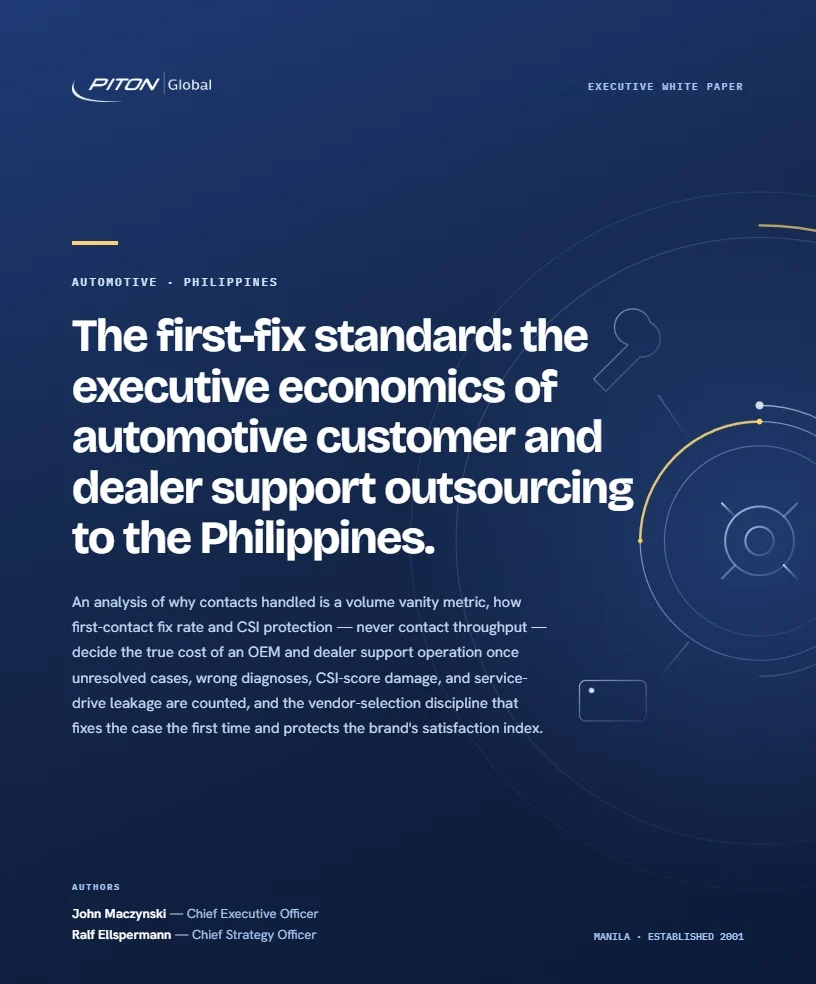
The first-fix standard: the economics of automotive customer & dealer support outsourcing.
Why contacts handled is a volume vanity metric, how first-contact fix rate and CSI protection — never contact throughput — decide the true cost of an OEM and dealer support operation once unresolved cases, wrong diagnoses, CSI-score damage and service-drive leakage are counted, and the vendor-selection discipline that fixes the case the first time. Part of PITON-Global’s Executive White Paper Series, by John Maczynski and Ralf Ellspermann.
●11 pages●Free · no gate●Maczynski & Ellspermann
IN THESE PAGES
→The volume mirage: contacts handled versus cases fixed first-contact.
→The dual-mandate contract: diagnose it right, fix it first-contact, protect the CSI.
→Case study: an 85-seat OEM/dealer support operation re-based on first-contact fix — 6.2× first-year ROI.
What automotive leaders ask before they outsource.
In-depth answers to the questions that decide an automotive BPO engagement — from the principals who run them.
What automotive work can you take on?+
Dealer and customer support, service scheduling, parts inquiries, warranty and back-office across the network. One coordinated team keeps customers and dealers supported, so service issues are resolved fast rather than scattered across functions.— John Maczynski, CEO
What does outsourcing automotive support save us?+
Typically 50 to 60 percent on cost per contact versus in-house, with stronger loyalty. The deeper benefit is faster, more consistent service and dealer support, which protects satisfaction scores and the repeat business they drive.— John Maczynski, CEO
Can you scale for campaigns and recalls?+
Yes. We surge trained capacity for promotions, launches and recall events, so customer and dealer queries are handled fast when volume spikes. The same QA controls apply through the surge, protecting quality when pressure is highest.— Ralf Ellspermann, CSO
How do you keep automotive customer support quality high?+
Calibrated QA scores every queue and feeds coaching, so resolution and CSAT hold steady across agents and shifts. Standards are measured, not assumed, keeping the experience consistent across the dealer network and direct customers.— Ralf Ellspermann, CSO
Will your automotive customer support team work in our systems?+
Yes. Specialists work natively in your DMS and CRM, with full audit trails, rather than re-keying across systems. That preserves context across service, parts and customer interactions and keeps your records and ours aligned.— John Maczynski, CEO
How do you protect customer data in automotive customer support?+
All work runs in access-controlled, audited environments with no local storage and full audit trails. Access is scoped per role, every action is logged, and sensitive customer data never leaves the secured environment.— Ralf Ellspermann, CSO
Do you offer multilingual support?+
Yes. The providers we vet staff teams matched to your markets and languages, so customers and dealers are helped in their own language with consistent quality. Coverage scales with your footprint without you hiring market by market.— John Maczynski, CEO
Which automotive customer support functions should we outsource first?+
Start with high-volume customer and service support, where consistency moves CSAT fastest. Dealer support, parts and warranty follow once the team, tooling and quality bar are proven on core queues.— Ralf Ellspermann, CSO
How quickly can an automotive customer support team be live?+
About eight weeks, through a gated stand-up. No customers are handled live until QA is signed off and a parallel run matches your bar. You see proven, on-brand quality before any real volume flows.— John Maczynski, CEO
How is automotive customer support performance measured?+
Against resolution and CSAT, in a live dashboard with monthly reviews. We deliberately never report raw volume — contacts closed fast but unresolved drive repeat visits and lost loyalty, not satisfaction.— Ralf Ellspermann, CSO
AUTOMOTIVE OUTSOURCINGSupport from first test drive to final service visit.
GOING DEEPER
Automotive outsourcing in the Philippines: support across the vehicle lifecycle
Automotive outsourcing to the Philippines gives OEMs, dealer groups, captive finance companies and mobility brands a team for the customer and back-office work around every vehicle: sales inquiries and test-drive booking, service scheduling, warranty and recall support, connected-car help, roadside coordination and dealer back-office tasks. Each touchpoint affects loyalty to the brand and to the dealer that sells and services the car.
Filipino teams already support US, UK and Australian automotive brands and dealer networks. They handle technical vehicle questions well, write and speak clear English and cover evenings and weekends, when most owners book service or ask about a purchase, from hubs in Manila, Cebu and Clark. For the wider picture, see our guides to improving automotive customer journeys and how automotive outsourcing speeds innovation.
WHERE OWNERS CONTACT THE BRAND
Sales inquiriesTest drivesService bookingWarranty and recallsConnected-car appsRoadside help
One consistent experience from showroom to service lane.
Sales, leads and test drives
Online leads go cold quickly. A dedicated lead desk responds within minutes, answers questions about models, trims and availability, books test drives and passes qualified buyers to the right dealer with notes. Leads that are not ready to buy are followed up on a schedule instead of disappearing.
Dealers and OEMs share the lead flow, so rules matter: which dealer gets which lead, how fast they must respond and what happens if they do not. The team follows those rules and reports response times by dealer.
TRACKED ON EVERY LEAD
Response timeModel and trimTest drive bookedDealer assignedFollow-up status
Service scheduling, warranty and recalls
Service is where most of the owner relationship happens. Agents book appointments in dealer management and scheduling systems, explain what the visit covers, send reminders and handle changes. For warranty questions, they check coverage and explain what is included before the owner arrives.
Recalls need careful handling. In the US, NHTSA requires manufacturers to notify owners of safety recalls, and owners must be able to get the remedy at no cost. Outreach teams contact affected owners, explain the recall in plain language and book the repair, recording every attempt.
HANDLED FOR EVERY OWNER
Service bookingCoverage checkRecall outreachRemindersVisit follow-up
Roadside assistance and accident support
When a car breaks down or is in an accident, the first call decides how the owner feels about the brand for years. Roadside desks take the call, locate the vehicle, check coverage, dispatch towing or mobile repair through your network and keep the driver updated until help arrives. For accidents, they open claims, arrange rental cars and guide the owner to an approved repair shop.
These calls need calm, clear agents who follow safety scripts first: is anyone hurt, is the car in a safe place, does the driver need emergency services. Every case is logged with times, so slow dispatches and weak providers can be found and fixed.
LOGGED ON EVERY ROADSIDE CASE
LocationCoverage checkProvider dispatchedArrival timeRental or repair arranged
Dealer network performance and reporting
OEMs often want to know how dealers handle the leads and service bookings they receive. The team can run mystery shops, follow up with owners after service visits and report response times, booking rates and satisfaction by dealer. That gives regional managers specific facts for coaching instead of general complaints.
Data from every contact, such as common questions, reasons for calling and recall response, also feeds product and marketing teams with a clear view of what owners need.
REPORTED BY DEALER
Lead response timeBooking rateService follow-upSatisfactionCommon issues
Dealer back office, finance and insurance support
Behind every vehicle sale sits a stack of paperwork and compliance: deal jackets to check, title and registration to process, lender documents to submit, product cancellations to handle and warranty and service contract claims to file. Dealer groups move this to offshore teams that work in dealer management systems to checklists, turning around deals faster and keeping compliance clean.
Finance and insurance support includes contracts-in-transit tracking, funding follow-up with lenders, aftermarket product cancellations and refunds, and audit preparation. Accurate, fast processing shortens the time between sale and funding, which matters more to dealer cash flow than almost anything else.
DEALER BACK-OFFICE TASKS
Deal jacket checksTitle and registrationFunding follow-upProduct cancellationsWarranty claim filing
Connected-car, EV and app support
Modern vehicles come with apps, subscriptions and over-the-air updates. Owners call about pairing phones, remote start, charging schedules, navigation updates and subscription renewals. Trained agents troubleshoot with your knowledge base and pass hardware issues to the dealer.
Electric vehicle owners add their own questions: charging networks, home chargers, range and battery warranties. Support teams that understand these topics reduce visits for problems that can be solved remotely.
Behind the showroom sits a lot of paperwork. Teams support deal file checks, title and registration tracking, warranty claim submissions to the OEM and parts order follow-up. For captive finance arms, they handle account servicing, payment questions and lease-end inspections and returns.
Clean back-office work speeds up funding of deals and payment of warranty claims, both of which affect dealer cash flow. See manufacturing outsourcing for supply chain and order support.
BACK-OFFICE TASKS
Deal file checksTitle and registrationWarranty claimsParts ordersLease-end returns
Choosing an automotive partner and the metrics that matter
When you compare vendors, ask about experience with dealer management systems, how they route leads between dealers, how they run recall campaigns and what share of connected-car contacts they resolve remotely. Ask to hear sample sales and service calls.
Vetted mid-sized Philippine providers usually start automotive programs with 10 to 40 people and report lead response time, appointment show rates, recall completion contacts, first-contact resolution and owner satisfaction. Rates sit within the page’s 2026 rate card above.
MEASURED EVERY MONTH
Lead response timeShow rateRecall contactsFirst-contact resolutionOwner satisfaction
A software question and a stranded driver — one team, both.
Connected-car and EV support, roadside assistance, dealer and aftersales operations, finance and warranty servicing — delivered by automotive-trained Philippine specialists who move from a calm infotainment fix to an urgent highway dispatch without missing a beat, 24/7.
Salesforce AutomotiveCDK GlobalDealertrackTekionReynolds & ReynoldsCox AutomotiveGeotabHERE TechnologiesHarman IgniteCerenceTwilioTelematics APIsISO 26262SOC 2 Type II
TWO MODES, ONE SHIFT
Can one outsourced desk handle a calm software walkthrough and a stranded driver at midnight on the same shift?
Most can’t — they’re strong on one mode and weak on the one that matters most, and the customer remembers the worse experience. Drill both before signing: send a connected-car question, then a simulated roadside emergency an hour later. The automotive manufacturer replaced a single-mode vendor: median roadside dispatch from 4-plus minutes to 90 seconds, connected-car first-contact resolution 91%, repurchase intent +11 points.
19Vetted Automotive BPO Partners
Connected-car, roadside and dealer-ops teams — technical and safety-fluent.
124MMillion Driver Contacts / Year
Connected-car, roadside, dealer and warranty across OEM programs.
824/7 Dispatch Delivery Hubs
Around-the-clock roadside and emergency coverage in every timezone.
TWO JOBS, ONE QUEUE · 2026
A modern vehicle generates two completely different support jobs from the same customer: a patient walk-through of a software update and a stranded-at-night emergency. A desk built for one fails the other — and the one it fails is usually the one that matters most.
SERVICES FOR OEMs, DEALERS & MOBILITY COMPANIES
The automotive outsourcing stack, from the dealer line to the drawing board — in the order OEMs and suppliers build it.
MOST OUTSOURCED IN AUTOMOTIVE
Customer service & dealer support
Customer and dealer lines are what automotive companies move offshore first.
Owner, dealer and roadside lines, connected-car and app support — 24/7, on your DMS and CRM.
Your vehicles and your programs decide which mode runs hottest.
These are the four automotive profiles we build for most often — each with its own mode balance, each served by the same dual-mode, drill-certified operation.
01Automotive OEMs
the automotive manufacturer was here · 4M connected vehicles (client-wide) · a single-mode vendor · warranty leakage
The full dual-mode stack — 90-second dispatch, 91% FCR, the pre-payout gate, the campaign bench.
The same agent, two completely different jobs — switch the mode.
Connected-car support is calm, technical and patient; roadside is urgent, scripted and safety-critical. Toggle between them to see how the desk shifts gear — the skills, the clock, and the metric that proves it.
Connected-Car & EV
Roadside Emergency
{{ modeIcon }}
{{ modeTitle }}
{{ modeDesc }}
WHAT THE AGENT NEEDS
{{ skill1 }}{{ skill2 }}{{ skill3 }}
{{ metricLabel }}
{{ metricValue }}
{{ metric2Label }}
{{ metric2Value }}
CEO · OPERATIONS AUTHORITY
“Automotive support is two businesses wearing one badge. The vendor who is great at patient infotainment walk-throughs is often the one who freezes when a driver is stranded on a shoulder at midnight. We vet for providers that train and staff for both — because the customer is the same person, and they remember the worse experience.”
John Maczynski · CEO, PITON-Global · 40-Year Global BPO Veteran
FOR THE VP OF CUSTOMER EXPERIENCE
Your CSAT lives or dies on the roadside call you can’t see coming.
A 30-minute scoping call maps your connected-car and roadside load — then points you to the desks built for both.
A one-trick desk vs. a dual-mode automotive operation.
The delta between a single-mode vendor and a PITON-Global-vetted automotive operation — across seven dimensions that decide both the software fix and the safety call.
SINGLE-MODE VENDOR
Good at one job, dangerous at the other.
✕RoadsideSlow, no protocol
✕Connected-CarScripted, shallow
✕EVUnfamiliar
✕Dealer OpsDisconnected
✕WarrantyError-prone
✕RecallsReactive
✕CoverageBusiness-hours
PITON-GLOBAL AUTOMOTIVE
Fluent in both, on the same shift.
✓Roadside90s dispatch, safety-trained
✓Connected-CarDeep technical FCR
✓EVCharging & range fluent
✓Dealer OpsCoordinated aftersales
✓WarrantyAccurate & auditable
✓RecallsProactive outreach
✓Coverage24/7 follow-the-sun
THE THIRD MODE
The claim paid on a repair that never qualified — caught before the dollar leaves.
The dual-mode desk serves the driver twice: calmly on the software call, urgently on the shoulder. The third job never talks to a driver at all — it reads claims. Warranty leakage is the quiet drain: the inflated claim, the fabricated service history, the repair billed against a VIN that was never in the shop — each one paid without question by a desk that processes instead of validates.
THE GATE BEFORE THE DOLLAR
Pre-payout validation
Every claim matched against VIN, service history, and telematics record before payout — the repair that never happened fails the match, the duplicate fails the dedupe, and the coverage question is answered by the record, not the invoice. The gate-placement rule, automotive edition: validation before the money moves.
Claim-anomaly detection
Machine-flagged patterns — the dealer whose claim rate doubled, the part that fails only at one rooftop, the service history that reads like a template — reviewed by a human forensics analyst before adjudication. The AI flags; the analyst decides; the OEM’s rules govern.
Auditable adjudication trail
Every validation, flag, and decision logged — because warranty is a financial control, and the OEM’s auditors will eventually ask how claims were checked. The answer should be a log, not a shrug.
The through-line: the desk that validates before it pays turns “a measurable margin” into a measured one — pre-payout VIN and service-history matching is the mechanism behind the warranty-leakage number in the economics below, not a phrase standing in for it.
THE DESK THAT ALREADY KNOWS
The telematics were read before the driver finished dialing.
Connected vehicles announce their faults before their drivers do. The pre-call read — DTCs, charging-session logs, OTA status, range telemetry pulled as the call connects — means the agent opens with the diagnosis instead of the interrogation: the stalled update already identified, the charging fault already isolated, the common fix already queued. In calm mode it turns a 20-minute walk-through into a 6-minute confirmation; in roadside mode it tells dispatch what’s wrong with the vehicle before the unit rolls. The dual-mode desk gets faster in both modes from the same feed.
THE CAMPAIGN CLOCK
A recall doesn’t schedule itself around your roster — the bench is triggered by the announcement.
Recalls, OTA campaigns, and model launches multiply contact volume overnight, on a date the news cycle picks. The campaign bench is cross-trained on both modes, drilled on the recall script and the anxious-owner conversation, and activated by your campaign calendar — proactive outreach waves, VIN-lookup surges, and dealer-scheduling spikes absorbed without the core desk missing its 90-second standard. The surge scales with the campaign and stands down with it — capacity shaped like the event, not the average. It’s the campaign-driven member of the same elastic-bench discipline our retail, utilities, and media desks run on different clocks.
THE RISK MATRIX
Four ways a brand bleeds — two in the queue, one in the claims file, one in the pipes.
A brand’s risk isn’t one surface; it’s four, and a single-mode vendor typically runs none of the four — because each requires staffing for the job it hopes won’t happen.
RISK VECTORWHERE THE COST LANDSCONTAINMENT ON A DUAL-MODE OPERATION
AI-assisted warranty fraudInflated claims, fabricated histories, the repair that never happened — leakage booked as cost of businessPre-payout VIN/service-history validation, anomaly detection, human forensics review — the gate before the dollar (The Third Mode)
Misdiagnosis & repeat repairThe wrong first fix — a second repair, a dealer visit, and a driver quietly shopping the competitionThe pre-call telematics read plus genuine technical depth — 91% FCR because the diagnosis precedes the conversation (The Desk That Already Knows)
Roadside & recall surge collapse THE WEDGEThe stranded driver in a queue; the recall wave hitting a fixed rosterThe dual-mode drill standard plus the campaign bench — 90-second dispatch held, surge shaped to the event (The Campaign Clock)
Connected-car data exposureTelematics, location, and owner PII outside the perimeterZero-Trust VDI, least-privilege access to telematics and DMS, zero local residency, every touch logged
The through-line: the first row is a financial control, the second a technical one, the third an operational one, the fourth a security one — and a single-mode vendor typically runs none of the four, because each requires staffing for the job it hopes won’t happen.
THE MATH OF A LOYAL DRIVER
Where does the value come from when both jobs are done right?
From four streams a per-contact rate ignores: brand-loyalty retention, dealer-service capture, warranty-leakage cut and labor arbitrage. The driver you rescue at midnight buys your next car — and services it at your dealer.
Brand-Loyalty Retention
$1.5M – $3.0M
Dealer-Service Revenue Capture
$1.0M – $2.0M
Warranty-Leakage Reduction
$0.9M – $1.8M
Support Labor Arbitrage
$0.9M – $1.8M
ILLUSTRATIVE ANNUAL COST MODEL · 40 FTEs
$968K vs $2.68M onshore
64%
Modelled cost reduction
Illustration, not a client result: 40 FTEs × 1,920 paid hours at about $11.46/hour ($22,000 per FTE per year) plus a 10% transition provision, against $67,000 per FTE onshore — a modelled difference of $1.71M. The bars above are value categories to evaluate with your own data, not booked benefits. Dedicated specialist and leadership roles are priced separately.
01
Loyalty — Primary Driver
An OEM lifted repurchase intent 11 points among drivers who had a roadside rescue handled well — the moment of maximum vulnerability became the moment of maximum loyalty. Estimated lifetime value protected: $2.3M–$3.1M — imputed value (repurchase-intent lift × vehicle margin × affected cohort, validated against the OEM’s loyalty analytics), not a booked figure.
02
Dealer Service — Captured
Coordinated aftersales scheduling routed connected-car alerts into dealer service bookings, capturing maintenance revenue that used to leak to independents.
03
Warranty — Leakage Cut
Pre-payout VIN and service-history validation cut invalid and duplicate claims [X]%, closing warranty leakage of [$X]/year — the pre-payout gate (see The Third Mode), not a phrase standing in for a number. (bracketed figures from verified engagement data before publication)
CASE EXAMPLE · CLIENT-REPORTED, NOT AUDITED
+11pt
Repurchase intent after a good rescue
An OEM with 4M connected vehicles moved support to PITON-Global, with the outsourced team handling the defined in-scope queue rather than the whole population. Total 12-month net benefit: $6.3M against a $970K engagement cost (client-reported, not audited).
THE DRIVER FILE · AN AUTOMOTIVE MANUFACTURER SUPPORTING CONNECTED-VEHICLE CUSTOMERS AND A NATIONAL DEALER NETWORKVerified Q2 2026 · Manila, Cebu & Clark
CLIENT ENTITY
Global OEM with 4M connected vehicles and a national dealer network.
PRE-DEPLOYMENT BASELINE
A single-mode vendor strong on tech support but slow on roadside, with warranty leakage and dealer disconnect.
THE INTERVENTION
A dual-mode automotive operation across Manila, Cebu & Clark — connected-car, roadside and dealer ops on Salesforce Automotive + CDK.
THE FLEET, MEASURED
90s
Roadside dispatch · median, the automotive manufacturer
from 4+ minutes · across the engagement
up to 91%
Connected-car FCR · the automotive manufacturer
deep technical
+11pt
Repurchase intent
after good rescue
−62%
Cost per contact
vs onshore
6.5×client-reported return (not audited) $6.3M net benefit on $970K program
Reviewed by John Maczynski (CEO) & Ralf Ellspermann (CSO) · Q2 2026
⚠ The brand-loyalty stream is imputed value — repurchase-intent lift × vehicle margin × affected cohort, validated against the OEM’s own loyalty analytics, not a booked figure. The 6.5× return is anchored on the booked streams (dealer-service capture, warranty-leakage reduction, arbitrage); loyalty value is confirmed against your loyalty analytics on the scoping call.
THE ENTRY POINT · COMPANION ENGAGEMENT
No live program required — a warranty-audit retrofit on last quarter’s paid claims, measured.
the automotive manufacturer proves the dual-mode desk. This is the floor — provable on the client’s own history, like the freight-bill and tracker retrofits: re-auditing a past quarter’s paid claims, no live program required.
THE DRIVER FILE · COMPANION ENGAGEMENTSingle-gate · Warranty-audit retrofit
CLIENT ENTITY
OEM / dealer group — driver support retained with the incumbent. Identity withheld under NDA, as is standard in automotive.
PRE-DEPLOYMENT BASELINE
Claims were processed, not validated — paid on dealer submission with sampled review at best. Nobody could say what share of paid claims would have failed a VIN/service-history match, because nobody had run one. No support crisis; a validation absence, booked annually as cost of warranty.
THE INTERVENTION
A retrofit audit — one quarter of already-paid claims re-validated against VIN, service history, and telematics records on the client’s CDK + warranty stack: duplicate detection, history matching, anomaly patterning by dealer and part, and recovery filing on everything recoverable within dealer-agreement terms. Live support untouched; scope held to one gate, pointed backward.
NINETY DAYS, MEASURED · ILLUSTRATIVE — REPLACE WITH VERIFIED ENGAGEMENT DATA BEFORE PUBLICATION
unmeasured → X%
Paid claims failing validation
what was always in the claims file, finally counted
$0 → $X
Recovered / offset within terms
money already paid, clawed back where invalid
none → 100%
Go-forward pre-payout gate
the rubber stamp, retired at the source
STRATEGIC INSIGHT
The flagship engagement proves the dual-mode desk; the companion engagement proves the entry point — on the client’s own history, before any live program moves. The paid-claims re-audit joins the freight-bill audit, the dunning file, and the discrepancy log as the fourth proof of one argument: the money was already gone until someone checked. One gate, pointed at one past quarter, converted “a measurable margin” into a measured one — which is the whole difference between this page and a vendor that processes claims instead of validating them.
Here is the cost per contact. Now here is what the midnight rescue is worth.
Every RFP compares cost-per-contact, so we publish the seat math. Then we price the driver — because the contact on the shoulder at midnight isn’t a ticket; it’s the single highest-leverage brand moment the OEM will ever get with that customer, and it arrives unannounced.
Distinct from the Dual-Mode Desk above: that shows the two jobs — this prices what handling both well is worth.
THE SEAT LENS · FULLY LOADED, ANNUAL, PER AUTOMOTIVE-SUPPORT FTE
PITON-Global-vetted, industry-specialized mid-sized providers price below the large global BPOs on every row — and deliver better service and outcomes, because the specialists are hired for the work, not trained on it after onboarding.
COST SIMULATOR · CHOOSE A DELIVERY MODEL
Onshore
Global BPO Provider
PITON-Global 2026
Automotive desk size{{ costSize }} seats
30default 75 · the flagship engagement150
Selected model
{{ costModelLbl }}
Annual operational expense
{{ costOpex }}
{{ costPerFte }}
Annual labor saving vs. onshore
{{ costSavings }}
{{ costHourly }}
What the per-contact rate never shows
{{ costHidden }}
THE LOYAL-DRIVER PIVOT · THE PANEL A PER-CONTACT RATE CAN’T RENDER
The seat lens prices the agent; the driver prices the brand. The single-mode vendor is cheap per contact and expensive per relationship: the fumbled rescue is remembered at the next purchase, the misdiagnosis becomes the dealer visit that becomes the competitor’s test drive, and the rubber-stamped claim leaks quietly forever. Price the driver and the four streams a per-contact rate ignores — brand-loyalty retention ($1.5M–$3.0M), dealer-service capture ($1.0M–$2.0M), warranty-leakage reduction ($0.9M–$1.8M), and labor arbitrage ($0.9M–$1.8M) — stack to a $4.3M–$8.6M annual net benefit.
That is how the flagship engagement’s $970K program was followed by a client-reported gross benefit of $6.3M (6.5× cost, not audited): dispatch cut from 4+ minutes to 90 seconds, 91% connected-car FCR, and repurchase intent up 11 points among rescued drivers. The moment of maximum vulnerability became the moment of maximum loyalty — and the desk that was there is the reason.
Illustrative projection at standard contact mix; per-contact savings run ~62% vs. onshore. The loyalty stream is imputed value — repurchase-intent lift × vehicle margin × affected cohort, validated against the OEM’s own loyalty analytics — confirmed on the scoping call.
Indicative 2026 rates — the drilled roles shown apart from the script-reader.
Reading a script has a market rate; dispatching a stranded driver in 90 seconds and gating a warranty payout do not — those are drilled and audited capabilities, priced as such.
CORE ROLERATE (USD)OPERATIONAL PROFILETIER
Owner-support agent$10–$16Account, billing, general owner queriesVOLUME
Connected-car / EV specialist$14–$16OTA, infotainment, charging & range — pre-call read fluentTECHNICAL
DMS / dealer-ops administrator$8–$12Scheduling, parts catalog, service historyDEALER
Aftersales / service coordinator$8–$12Alert-to-booking routing, dealer captureDEALER
Warranty analyst$10–$12Claim processing on the validated pipelineWARRANTY
Roadside-dispatch specialist — no generic equivalent$12–$14Safety-trained, sub-90-second protocol — proven on an unannounced drill before a live emergencyROADSIDE
Warranty-forensics analyst — no generic equivalent$10–$12The pre-payout gate — VIN/history validation, anomaly review, the auditable trailFORENSICS
Team lead / mode commander$12–$14Dispatch/FCR/leakage governance, OEM reportingLEADERSHIP
The two premium rows have no generic equivalent because both are proven before deployment — the dispatcher on an unannounced drill, the forensics analyst on a validation-set audit — and both protect what a per-contact rate can’t see: the driver and the payout. Rates confirmed per engagement against fleet size and program mix.
Recruit technical + emergency-capable agents, roadside safety training, EV charging & range certification, warranty playbooks.
03
Wk 5–7
Shadow & Drill
Shadow both queues, unannounced roadside-dispatch drill under 90s, connected-car FCR validated, dealer-coordination dry run.
04
Wk 8
Cutover & Govern
Phased ramp, live dispatch/FCR/warranty dashboard, recall-outreach playbook, PITON-Global Dual-Mode certification.
THE BOTH-MODES TEST · WHAT TO DRILL
Can a vendor handle a software walk-through and a roadside emergency on the same shift?
Three capabilities decide whether an automotive desk serves the whole driver or only half of them — and each can be drilled before you sign. Most vendors are strong on one mode and quietly weak on the one that matters most.
01
Real Roadside Capability
A driver stranded on a shoulder at night needs a calm, fast, safety-trained dispatch — not a tech-support script. A desk that cannot run a sub-90-second roadside protocol fails the customer at their most vulnerable moment.
DRILL IT: Run an unannounced roadside-dispatch test
02
Deep Connected-Car Fluency
Infotainment, OTA updates, EV charging and range anxiety demand genuine technical depth. A scripted agent who escalates every connected-car question turns a quick fix into a dealer visit and a frustrated owner.
DRILL IT: Test connected-car FCR on a real issue
03
Dealer & Warranty Coordination
Support that does not connect to the dealer and the warranty system leaks revenue and accuracy. A real operation routes service into dealer bookings and processes warranty claims auditably — protecting both relationship and margin.
DRILL IT: Trace a warranty claim and a dealer handoff
THE DUAL-MODE ARCHITECTUREhow each failure mode is designed out
Safety-Trained Roadside
Every agent is trained and drilled on roadside emergency protocols and a sub-90-second dispatch standard, so the safety-critical call is handled fast and calmly, every time.
Technical Connected-Car FCR
Agents carry genuine technical depth on infotainment, OTA, EV charging and range, resolving connected-car issues on first contact instead of escalating to the dealer.
Dealer-Linked Aftersales
Support is wired into the dealer and warranty systems, routing service into bookings and processing claims accurately, so revenue is captured and leakage is closed.
CSO · AUTOMOTIVE OPERATIONS
“Drill both modes before you sign. Send a connected-car question and, an hour later, a simulated roadside emergency. The desks worth hiring resolve the first on first contact and dispatch the second in under ninety seconds. The ones that ace one and fumble the other are the ones that lose you the driver when it counts.”
Where the dual-mode desk doesn’t fit — and whose rules govern each mode.
A shortlist that includes “no” is the only kind worth having. Three engagements we turn down — and why the refusal is the point.
01
Dispatch protocols and goodwill policy are yours — drilled, never improvised.
Roadside procedures, safety escalation trees, and goodwill ceilings are set by you; our discipline is executing them at 90 seconds with the trail to prove it. A vendor improvising a roadside protocol is a liability with a headset — and a vendor improvising goodwill is spending your margin one apology at a time.
02
Warranty adjudication rules are the OEM’s — we validate, you decide.
Coverage terms, denial criteria, and dealer-relations policy stay with your warranty organization; the forensics desk builds the validated file and flags the anomaly. A vendor deciding claims offshore is exercising financial authority it wasn’t granted — the gate is ours to run, the verdict is yours to own.
03
No DMS and telematics access, no deployment.
The pre-call read, the 90-second dispatch, and the pre-payout gate all require being inside your Salesforce/CDK/telematics stack under Zero-Trust VDI — the vehicle, the history, and the claim on one screen, with owner data at zero local residency. Without it, we’d be a script-reader asking the driver what the car already reported — the exact single-mode failure this page drills against.
FOR AUTOMOTIVE & MOBILITY LEADERS
A recall, a launch, a software OTA — your support volume never warns you first.
Tell us where the line is straining — connected-car tickets, roadside SLAs, dealer aftersales — and we’ll hand you 6–10 vetted desks built for automotive, each one drilled in both calm tech and roadside emergency before it reaches your shortlist.
Vendor-neutral · no cost to you · prepared and presented by John Maczynski, CEO Our 24-Hour Response Guarantee — a reply within 24 hours, dual-mode drill pre-screen included.
The first-fix standard: the economics of automotive customer & dealer support outsourcing.
Why contacts handled is a volume vanity metric, how first-contact fix rate and CSI protection — never contact throughput — decide the true cost of an OEM and dealer support operation once unresolved cases, wrong diagnoses, CSI-score damage and service-drive leakage are counted, and the vendor-selection discipline that fixes the case the first time. Part of PITON-Global’s Executive White Paper Series, by John Maczynski and Ralf Ellspermann.
●11 pages●Free · no gate●Maczynski & Ellspermann
IN THESE PAGES
→The volume mirage: contacts handled versus cases fixed first-contact.
→The dual-mandate contract: diagnose it right, fix it first-contact, protect the CSI.
→Case study: an 85-seat OEM/dealer support operation re-based on first-contact fix — 6.2× first-year ROI.
What automotive leaders ask before they outsource.
In-depth answers to the questions that decide an automotive BPO engagement — from the principals who run them.
What automotive work can you take on?+
Dealer and customer support, service scheduling, parts inquiries, warranty and back-office across the network. One coordinated team keeps customers and dealers supported, so service issues are resolved fast rather than scattered across functions.— John Maczynski, CEO
What does outsourcing automotive support save us?+
Typically 50 to 60 percent on cost per contact versus in-house, with stronger loyalty. The deeper benefit is faster, more consistent service and dealer support, which protects satisfaction scores and the repeat business they drive.— John Maczynski, CEO
Can you scale for campaigns and recalls?+
Yes. We surge trained capacity for promotions, launches and recall events, so customer and dealer queries are handled fast when volume spikes. The same QA controls apply through the surge, protecting quality when pressure is highest.— Ralf Ellspermann, CSO
How do you keep automotive customer support quality high?+
Calibrated QA scores every queue and feeds coaching, so resolution and CSAT hold steady across agents and shifts. Standards are measured, not assumed, keeping the experience consistent across the dealer network and direct customers.— Ralf Ellspermann, CSO
Will your automotive customer support team work in our systems?+
Yes. Specialists work natively in your DMS and CRM, with full audit trails, rather than re-keying across systems. That preserves context across service, parts and customer interactions and keeps your records and ours aligned.— John Maczynski, CEO
How do you protect customer data in automotive customer support?+
All work runs in access-controlled, audited environments with no local storage and full audit trails. Access is scoped per role, every action is logged, and sensitive customer data never leaves the secured environment.— Ralf Ellspermann, CSO
Do you offer multilingual support?+
Yes. The providers we vet staff teams matched to your markets and languages, so customers and dealers are helped in their own language with consistent quality. Coverage scales with your footprint without you hiring market by market.— John Maczynski, CEO
Which automotive customer support functions should we outsource first?+
Start with high-volume customer and service support, where consistency moves CSAT fastest. Dealer support, parts and warranty follow once the team, tooling and quality bar are proven on core queues.— Ralf Ellspermann, CSO
How quickly can an automotive customer support team be live?+
About eight weeks, through a gated stand-up. No customers are handled live until QA is signed off and a parallel run matches your bar. You see proven, on-brand quality before any real volume flows.— John Maczynski, CEO
How is automotive customer support performance measured?+
Against resolution and CSAT, in a live dashboard with monthly reviews. We deliberately never report raw volume — contacts closed fast but unresolved drive repeat visits and lost loyalty, not satisfaction.— Ralf Ellspermann, CSO
AUTOMOTIVE OUTSOURCINGSupport from first test drive to final service visit.
GOING DEEPER
Automotive outsourcing in the Philippines: support across the vehicle lifecycle
Automotive outsourcing to the Philippines gives OEMs, dealer groups, captive finance companies and mobility brands a team for the customer and back-office work around every vehicle: sales inquiries and test-drive booking, service scheduling, warranty and recall support, connected-car help, roadside coordination and dealer back-office tasks. Each touchpoint affects loyalty to the brand and to the dealer that sells and services the car.
Filipino teams already support US, UK and Australian automotive brands and dealer networks. They handle technical vehicle questions well, write and speak clear English and cover evenings and weekends, when most owners book service or ask about a purchase, from hubs in Manila, Cebu and Clark. For the wider picture, see our guides to improving automotive customer journeys and how automotive outsourcing speeds innovation.
WHERE OWNERS CONTACT THE BRAND
Sales inquiriesTest drivesService bookingWarranty and recallsConnected-car appsRoadside help
One consistent experience from showroom to service lane.
Sales, leads and test drives
Online leads go cold quickly. A dedicated lead desk responds within minutes, answers questions about models, trims and availability, books test drives and passes qualified buyers to the right dealer with notes. Leads that are not ready to buy are followed up on a schedule instead of disappearing.
Dealers and OEMs share the lead flow, so rules matter: which dealer gets which lead, how fast they must respond and what happens if they do not. The team follows those rules and reports response times by dealer.
TRACKED ON EVERY LEAD
Response timeModel and trimTest drive bookedDealer assignedFollow-up status
Service scheduling, warranty and recalls
Service is where most of the owner relationship happens. Agents book appointments in dealer management and scheduling systems, explain what the visit covers, send reminders and handle changes. For warranty questions, they check coverage and explain what is included before the owner arrives.
Recalls need careful handling. In the US, NHTSA requires manufacturers to notify owners of safety recalls, and owners must be able to get the remedy at no cost. Outreach teams contact affected owners, explain the recall in plain language and book the repair, recording every attempt.
HANDLED FOR EVERY OWNER
Service bookingCoverage checkRecall outreachRemindersVisit follow-up
Roadside assistance and accident support
When a car breaks down or is in an accident, the first call decides how the owner feels about the brand for years. Roadside desks take the call, locate the vehicle, check coverage, dispatch towing or mobile repair through your network and keep the driver updated until help arrives. For accidents, they open claims, arrange rental cars and guide the owner to an approved repair shop.
These calls need calm, clear agents who follow safety scripts first: is anyone hurt, is the car in a safe place, does the driver need emergency services. Every case is logged with times, so slow dispatches and weak providers can be found and fixed.
LOGGED ON EVERY ROADSIDE CASE
LocationCoverage checkProvider dispatchedArrival timeRental or repair arranged
Dealer network performance and reporting
OEMs often want to know how dealers handle the leads and service bookings they receive. The team can run mystery shops, follow up with owners after service visits and report response times, booking rates and satisfaction by dealer. That gives regional managers specific facts for coaching instead of general complaints.
Data from every contact, such as common questions, reasons for calling and recall response, also feeds product and marketing teams with a clear view of what owners need.
REPORTED BY DEALER
Lead response timeBooking rateService follow-upSatisfactionCommon issues
Dealer back office, finance and insurance support
Behind every vehicle sale sits a stack of paperwork and compliance: deal jackets to check, title and registration to process, lender documents to submit, product cancellations to handle and warranty and service contract claims to file. Dealer groups move this to offshore teams that work in dealer management systems to checklists, turning around deals faster and keeping compliance clean.
Finance and insurance support includes contracts-in-transit tracking, funding follow-up with lenders, aftermarket product cancellations and refunds, and audit preparation. Accurate, fast processing shortens the time between sale and funding, which matters more to dealer cash flow than almost anything else.
DEALER BACK-OFFICE TASKS
Deal jacket checksTitle and registrationFunding follow-upProduct cancellationsWarranty claim filing
Connected-car, EV and app support
Modern vehicles come with apps, subscriptions and over-the-air updates. Owners call about pairing phones, remote start, charging schedules, navigation updates and subscription renewals. Trained agents troubleshoot with your knowledge base and pass hardware issues to the dealer.
Electric vehicle owners add their own questions: charging networks, home chargers, range and battery warranties. Support teams that understand these topics reduce visits for problems that can be solved remotely.
Behind the showroom sits a lot of paperwork. Teams support deal file checks, title and registration tracking, warranty claim submissions to the OEM and parts order follow-up. For captive finance arms, they handle account servicing, payment questions and lease-end inspections and returns.
Clean back-office work speeds up funding of deals and payment of warranty claims, both of which affect dealer cash flow. See manufacturing outsourcing for supply chain and order support.
BACK-OFFICE TASKS
Deal file checksTitle and registrationWarranty claimsParts ordersLease-end returns
Choosing an automotive partner and the metrics that matter
When you compare vendors, ask about experience with dealer management systems, how they route leads between dealers, how they run recall campaigns and what share of connected-car contacts they resolve remotely. Ask to hear sample sales and service calls.
Vetted mid-sized Philippine providers usually start automotive programs with 10 to 40 people and report lead response time, appointment show rates, recall completion contacts, first-contact resolution and owner satisfaction. Rates sit within the page’s 2026 rate card above.
MEASURED EVERY MONTH
Lead response timeShow rateRecall contactsFirst-contact resolutionOwner satisfaction