Dirty data breaks every decision downstream.
Data entry and processing, data management, mining and enrichment, and analytics support — delivered by Philippine-based data specialists who keep your data clean, structured and decision-ready, because a data error is a wrong decision at scale, not a lost ticket.
How many customers do we actually have — and when two records disagree about one of them, who decides which fields win?
Every CAC, churn and LTV figure divides by a customer count most companies have never verified. Vetted teams split the two decisions: matching is their algorithm — deterministic and probabilistic; survivorship is your policy — field-level rules drafted with you, versioned, with merge lineage. A duplicate audit traced 38% of duplicates to one CRM import and 60,000 survivorship conflicts awaiting a policy.
Services Partners
Across Vetted Partners
Delivery Hubs
With data, a mis-keyed record or an unvalidated import doesn’t cost you a ticket — it corrupts the report, misleads the model and drives a wrong decision. Data work here is an accuracy function, judged on validation and integrity, not keystrokes per hour.
Five stages from raw to decision-ready — click where yours leaks.
Each stage has its own failure mode — an error compounds downstream into a corrupted report or a wrong decision. Select a stage to see the work, the control, and the metric that governs it.
Data operations run the full five-stage lifecycle — capture, cleanse, enrich, process and report — under double-key QA, measured by record accuracy and integrity, not keystrokes.

“With data, the records and the decision are the same conversation. A mis-keyed field doesn’t annoy anyone today — it surfaces months later as a wrong number in a board report. That is why validation and integrity, not keystrokes per hour, are the only metrics that matter here.”
A keying pool vs. a data team that protects integrity.
Seven dimensions, read as risk vs. protection — what a keying pool exposes versus what a validated-data team safeguards.
Where does the 6.6× return come from when records are right the first time?
From four streams a per-record rate ignores: re-work and re-keying avoided, bad-decision risk prevented, faster reporting, and data labor arbitrage. The cheapest record is the one keyed right the first time — and the decision it keeps sound.
$6.5M net benefit on $980K program
How a global insurer cleaned a decade of dirty data — and trusted its numbers again.
Twelve million duplicate and malformed records had accumulated across legacy systems. Reports contradicted each other, and the board had stopped trusting the numbers in front of it.
cleansed
accuracy
reporting
A multinational insurer had a decade of CRM and policy data riddled with duplicates, transpositions and malformed fields. Monthly reports disagreed with each other, analysts spent days reconciling by hand, and leadership was making decisions on data nobody fully trusted.
We sourced a validated-data team across Manila and Cebu running double-key entry, rule-based de-duplication and reconciliation against source — working natively inside the insurer’s systems with a complete audit trail, and feeding failure patterns back into the validation rules each week.
Twelve million records were cleansed to 99.9% accuracy, record errors fell 84%, and the monthly reporting cycle compressed by five days. For the first time in years, the analytics layer reconciled cleanly — and the board’s dashboards finally matched.
“We had stopped trusting our own reports. Now the numbers reconcile to the cent and our analysts are doing analysis instead of clean-up. It quietly fixed a problem that had dogged us for a decade.”
Anyone can key the clean 96%. What happens to the other 4% — the exception queue, the correction authority, the rules that learn — is what you’re actually buying.
A validation regime with no exception discipline either silently drops failures (data loss wearing a quality badge) or silently “fixes” them (fabrication wearing one). Fail-safe, never fail-silent.
Every validation failure lands in a governed exception queue with its record, its failed rule, and its source image attached — nothing dropped, nothing auto-“corrected” past its class. The queue is worked to a taxonomy: keyable-on-review (the legible-but-ambiguous scan), source-defective (flagged to the data owner with the image, never guessed at — we transcribe what the source says, we never improve it), rule-defective (the valid record a bad rule rejected), and duplicate-suspect (routed to survivorship). Exception rates and aging report weekly.
Validation rules live as maintained artifacts: each versioned with rationale, tested against known-good and known-bad sets before deployment, and change-logged — so “what was valid in March” has an answer. Exception patterns analyzed weekly; recurring failure classes become rule candidates, recurring false failures become rule fixes — the ruleset converging on your data’s actual pathology, not a generic checklist.
Double-key is a control with a price, deployed by field criticality: financial and identifier fields double-keyed always; free-text and low-consequence fields single-keyed under sampling QA — the criticality map agreed with you at design, because double-keying everything is rigor theater billed hourly, and double-keying nothing is the keying pool this page exists to replace.
Matching finds the duplicates. Survivorship decides who wins. The first is our algorithm; the second is your policy — written down, versioned, and never improvised at the merge screen.
“De-duplication” hides the hard question: when two records disagree about one customer, which fields win? That’s survivorship — a policy decision, and a vendor making it silently is writing your master-data governance without a mandate.
Deterministic matches (exact identifiers) merge by rule; probabilistic candidates (fuzzy name + address + behavior) score against tuned thresholds — auto-merge above the high bar, human review in the band, no-touch below — with thresholds per entity type and the false-merge cost stated, because merging two real customers into one is worse than keeping one as two: a false split loses efficiency; a false merge loses a customer’s history and possibly the customer.
Field-level survivorship rules (most-recent wins for contact fields, source-system precedence for identity, completeness for enrichment) drafted with you, versioned, and applied identically at every merge — with merge lineage retained: every golden record can name its parents and every merge can be unwound, because an irreversible merge is a data decision with no appeal.
Post-cleanse, the discipline that keeps it clean: match-on-entry for new records (the duplicate prevented beats the duplicate merged), periodic re-matching as data accumulates, and the duplicate-rate KPI on the standing dashboard — we make it golden once, then make “golden” permanent.
A migration is the surge family’s eleventh theater with physics all its own: the surge is scheduled, the volume is knowable — and there’s a point of no return. Cutover day converts every unfound defect into a production incident.
Profiling before promising (the source’s real pathology measured — null rates, format chaos, duplicate density — so the plan is built on the data’s actual condition, not the schema’s optimism), mapping documents versioned and signed, trial migrations reconciled to source before anyone touches production, and cutover-weekend staffing with the rollback criteria written down — because a migration without a rollback plan is a bet the whole company made without being asked.
The catch-up pattern at record scale — triaged by operational value (records feeding live processes first), processed under full exception governance (a backlog keyed fast and dirty just moves the problem into the database), and closed with the handoff to steady-state.
A validated-data operation live in 8 weeks — accuracy proven before scale.
A gated stand-up. No data posts live until double-key validation is signed off and a parallel run reconciles clean against source.
The umbrella’s boundaries — and the transcription line that governs everything under it.
Indicative 2026 rates — the data bench shown apart from the seat.
EQUIVALENT
EQUIVALENT
The two premium rows have no commodity equivalent because a keying pool staffs neither: duplicates get merged by whoever’s screen it’s on, and the rules are whatever the trainer remembered. Rates confirmed per engagement against volume, schema count, and criticality mix.
Four kinds of data debt, cleared four different ways.
The flagship’s home: the decade of dirty data, cleaned once, kept clean. DV-080 is this operation, measured.
The eleventh theater: profiled, trialed, reconciled, cut over with a rollback plan.
The golden-record lane: survivorship as policy, merge lineage as insurance.
Digitization at governed scale: insurance files, healthcare records, logistics paperwork — the capture layer that witnesses.
Duplicate audit only — 6M master records, matched and measured. The question underneath every CAC, churn, and LTV number you report: how many customers do you actually have?
B2B enterprise, live master retained, 6M records across 9 source systems in scope. Identity withheld under NDA.
The customer master said 5.2M customers, and every downstream number believed it: marketing’s dedupe-by-email missed the household with three addresses, sales’ CRM held the acquisition-era imports nobody reconciled, and the same enterprise client existed as 23 accounts because every subsidiary onboarded separately. The symptoms were classic — the customer greeted as new in week forty, the churn rate over a denominator nobody could defend, the compliance mailing that reached one person four times and another zero. Every metric divided by “customers” inherited a denominator no one had ever verified.
A ring-fenced match-and-measure — the live master untouched, nothing merged. Tiered matching (the golden-record engine, run read-only): deterministic pass on identifiers, probabilistic scoring on the remainder, results banded (certain duplicates / review-band / clean) — plus fragment analysis (the single real customer scattered across systems — reassembled on paper, quantified) and conflict mapping (the matched records that disagree on critical fields — the survivorship decisions awaiting a policy, delivered as the drafted policy’s evidence base). Deliverable: the true-count report — real-entity estimate with confidence bands, duplicate topology by source system, and the survivorship policy drafted for ratification, so the merge that follows is yours to order, not ours to improvise.
The audit family’s twenty-eighth member attacks the family’s deepest assumption yet — every prior member audited values in records; this one audits whether the records are even distinct things. The first two rows are the whole pitch (a company that doesn’t know its customer count doesn’t know its CAC, churn, or LTV — it knows ratios over a fiction), the third row routes the fix upstream (the duplicate factory closed beats the duplicates merged), and the close is the family tell at the denominator: ask your team for the customer count, then ask which dedupe logic produced it. If the second answer is “the system’s,” you’ve found the finding — because the system’s logic is exact-match on email, and your customers have more than one.
Before a vendor touches your data, can they prove the records are right?
Three controls separate a validated-data team from a keying pool — and each is demonstrable before you sign. With data, the cost of getting one wrong is a corrupted report and a wrong decision.

“Give a prospective partner a thousand records with deliberate errors salted in — transposed digits, malformed dates, duplicates. A validated-data team catches nearly all of them. A keying pool keys right past them, and three months later a board report is wrong and no one knows why.”
A bad record you can’t see is a decision you’re about to get wrong.
Tell us where your data strains — entry backlogs, dirty records, slow processing, unreliable reports — and we’ll hand you 6–10 vetted data providers, each one proven on a record-accuracy test before it reaches your shortlist.
Get my data-services shortlist →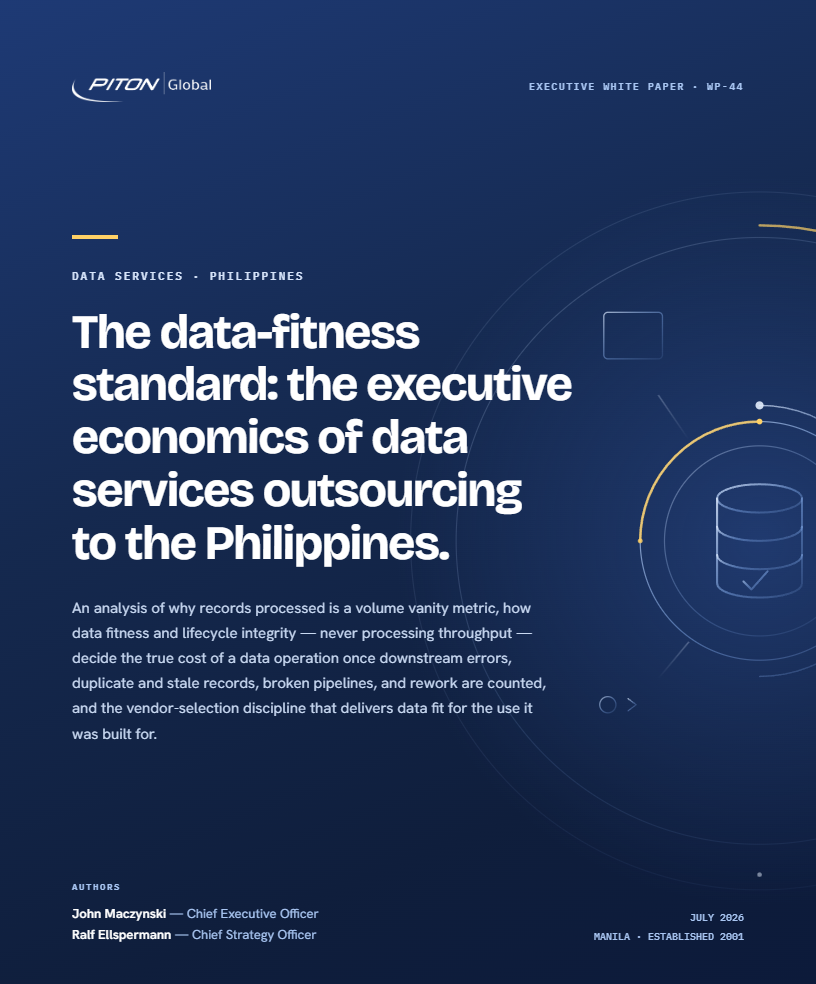
The data-fitness standard: the economics of data services outsourcing.
Why records processed is a volume vanity metric, how data fitness and lifecycle integrity — never processing throughput — decide the true cost of a data operation once downstream errors, duplicate and stale records, broken pipelines and rework are counted, and the vendor-selection discipline that delivers data fit for the use it was built for. Part of PITON-Global’s Executive White Paper Series, by John Maczynski and Ralf Ellspermann.
Where the data operations conversation is happening.
What data leaders ask before they outsource data work.
In-depth answers to the questions that decide a data services engagement — from the principals who run them.