DATA MINING & PROCESSING OUTSOURCING SERVICES PHILIPPINES

Dirty data breaks every decision downstream.

Large-scale data mining, ETL, extraction, deduplication and enrichment — delivered by Philippine-based specialists who keep your pipelines clean and structured, because a processing error is a wrong decision at scale, not a lost ticket.

Manila, Cebu & Davao delivery SOC 2 Type II · ISO 27001-certified Validated data accuracy
DATA ACCURACY · THROUGHPUT Q2 2026
ETL success, 4-monitor verified
99.9%
ETL success rate
99.9%
Pipeline incidents reduced
66%
Dirty data is the real expense. Find the team that keeps it clean. Get matched
PLATFORMS & STANDARDS
Snowflake / BigQueryApache AirflowdbtFivetran / KafkaAWS Glue / Azure Data FactoryISO 27001SOC 2
22Vetted Data
Mining Partners
Processing teams measured on data accuracy, not row count.
2B+Records
Mined / Year
Mining, ETL, extraction and enrichment across sources.
8Validated-Pipeline
Delivery Hubs
ISO 27001-aligned operations with four-monitor verification.
DIRTY DATA IS THE REAL COST · 2026

In processing work, one mis-keyed record or unvalidated import doesn’t cost you a ticket — it corrupts the report, misleads the model and drives a wrong decision. Data work here is an accuracy function, judged on pipeline reliability and validation, not rows per hour.

GREEN MEANS VERIFIED, NOT JUST FINISHED

A pipeline that fails loudly is healthy. The one that succeeds silently wrong is the incident — so every run proves itself on four axes before anyone downstream trusts it.

The category’s real killer isn’t the load that crashes — it’s the load that succeeds wrong: exit code zero, rows missing, schema shifted, freshness stale. Green dashboard, corrupted warehouse. Observability isn’t a monitoring add-on here; it’s the product.

THE FOUR MONITORS, ON EVERY PRODUCTION PIPELINE

Freshness (did the data arrive by its SLA — the as-of contract, enforced at the pipe), volume (row counts against expected bands — the load that “succeeded” with 4% of yesterday’s rows is the classic silent failure, caught in seconds), schema (structure diffed against the contract every run), and reconciliation (source-to-target counts and checksums every load — the number that left equals the number that arrived, proven). A run is green when all four pass; “the job finished” is a fact about the scheduler, not the data.

ANOMALIES PAGE BEFORE CONSUMERS NOTICE

Monitor breaches route on the escalation ladder: owner paged, downstream consumers auto-notified with the affected assets named (the freshness badge flips to stale automatically — the lie prevented at the glass), incident clocks running — because the worst version of a data incident is the one the board discovers in the numbers before engineering discovers it in the logs.

RETRIES HEAL; THEY NEVER HIDE

Auto-retry is bounded and logged as an event, never absorbed into green — a pipeline that “runs clean” because retry #3 finally worked is one flaky morning from missing its SLA, and the retry-rate trend is the early warning the uptime number papers over. Retry rate reports beside success rate, always.

THE DATA-DOWNTIME METRIC

Incidents measured the way consumers experience them: minutes of stale-or-wrong data per asset per month — because 99.9% job success with six hours of undetected staleness is a scheduler bragging while the warehouse lies.

THE BUYER’S QUESTIONAsk any pipeline vendor for their retry-rate trend and their data-downtime number. A vendor with only an uptime percentage is reporting the scheduler’s mood, not the data’s health.
01THE UPSTREAM CHANGE THAT DIDN’T ASK PERMISSION

Every source has a contract. Every run diffs against it. And a drift lands in quarantine — never in the warehouse, never in a crash.

Upstream systems change without asking. The column renamed, the type widened, the field dropped — each one either breaks the pipeline loudly (fine) or flows through silently as nulls and coercions (the corruption). The discipline is the contract.

CONTRACTS PER SOURCE, VERSIONED

Expected schema, types, nullability, and semantics documented per feed — with the upstream owner named, because a contract with no counterparty is a wish. Enforced at the producer where the org supports it, at ingestion where it doesn’t; either way, the diff runs every load.

DRIFT ROUTES TO QUARANTINE, NOT PRODUCTION

A detected change quarantines the affected load and pages the owner with the diff: additive changes (new columns) triaged fast; breaking changes (renames, type narrowing, dropped fields) held until a human who read the diff makes the mapping decision — because auto-coercing a changed column is the pipeline choosing a data meaning on its own authority. The quarantine queue reports weekly; aging drift is a supplier-relationship fact, not an engineering embarrassment.

THE DRIFT LOG FEEDS THE SOURCE MAP

Which feeds drift, how often, with what notice — the per-source reliability record that turns “the supplier changed the file again” from a recurring surprise into a managed vendor conversation.

THE PRINCIPLEFlag-and-refer at the schema layer: the pipeline detects the change and quarantines it; a human decides what it means. The warehouse never inherits a meaning nobody chose.
RERUNNABLE BY DESIGN, BECAUSE RERUNS ARE NOT EXCEPTIONS

Late-arriving data, upstream corrections, the quarantined load released — reprocessing is Tuesday, not a crisis, and the architecture assumes it.

IDEMPOTENT LOADS · DOCUMENTED WATERMARKS

Rerunning yesterday produces yesterday, once — never doubled rows, never a manual dedupe scramble (merge/upsert by design). Watermarks and partitions are a queryable fact, not a folder-name convention: what’s been processed is knowable, not guessed.

GOVERNED BACKFILLS · STATED LATE-DATA POLICY

Backfills run scoped, resource-bounded, and reconciled like any load — a backfill that swamps the production schedule is an incident you scheduled yourself. Late-data policy is stated per asset: how far back corrections flow, and when a restated number triggers the consumer notification — because silently restating last month’s figures is how dashboards stop being trusted twice.

02THE DATA LIFECYCLE ENGINE

Five stages from raw to decision-ready — click where yours leaks.

Stages fail differently, but every error rolls downstream the same way — a distorted report, then a wrong decision. Select a stage to see the work, the control, and the metric that governs it.

DEFINITION

Data engineering runs the full pipeline — source discovery and ingestion, extraction and parsing, transformation and orchestration, deduplication and enrichment, and delivery with lineage and monitoring — under source-to-target reconciliation QA, measured by extraction accuracy and pipeline reliability, not rows processed.

01
Source
02
Extract
03
Transform
04
Dedup
05
Deliver
01
Source Discovery
WHAT WE RUN
Sources profiled and mapped — APIs, databases, files, web and event streams — with schemas documented before a line of pipeline is built.
CONTROL
Source profiling and access validation confirm each feed is complete and reliable before ingestion.
GOVERNING METRIC
100%
sources profiled
John Maczynski
CEO · DATA ENGINEERING AUTHORITY

“With data, the pipeline and the decision are the same conversation. A load that silently fails doesn’t annoy anyone today — it surfaces months later as a wrong number in a board report. That is why pipeline reliability and reconciliation, not rows per hour, are the only metrics that matter here.”

John Maczynski · CEO, PITON-Global · 40-Year Global BPO Veteran
03A SCRIPT-AND-PRAY PIPELINE VS. AN ENGINEERED ONE

A brittle script vs. an engineered pipeline that never silently fails.

Seven dimensions, read as risk vs. reliability — what a brittle script exposes versus what an engineered pipeline safeguards.

Brittle script
Engineered pipeline
Pipeline Uptime
Brittle scripts
Reconciled, 99.9%
Duplicates
Left in the data
Reconciled & monitored
Enrichment
Stale, unverified
Source-validated
Analysts
Offshore black box
Embedded data partner
Security
Ad-hoc
ISO 27001, audit-ready
Metric
Rows processed per hour
Pipeline uptime & lineage
Coverage
Business-hours
24/7 follow-the-sun
04THE MATH OF PIPELINES YOU CAN TRUST

Where does the 6.6× return come from when pipelines run clean the first time?

From four streams a per-record rate ignores: manual extraction effort eliminated, ETL failures prevented, faster data availability, and data-engineering labor arbitrage. The cheapest pipeline is the one that runs clean and unattended — and the decision it keeps sound.

Manual Extraction Eliminated (the −84% × engineer loaded cost)
$1.6M – $2.9M
Silent-Failure Exposure Retired (found-in-history, priced)
$1.4M – $2.5M
Data-Downtime Reduction (stale-minutes × consumer cost)
$0.7M – $1.4M
Orphan-Compute Recovery & Labor Arbitrage
$0.6M – $1.2M
TOTAL ANNUAL NET BENEFIT100-SEAT DATA OPERATION
$4.3M – $8.0M
6.7×
Documented return
01
Pipeline Reliability — Primary Driver
A data-driven enterprise cut ETL run time 84% with automated pipelines — eliminating the manual extraction errors that had been corrupting reports and dashboards. Annual rework cost avoided: $2.3M.
02
Integrity — Decisions Protected
Automated monitoring held pipeline uptime at 99.9%, keeping reports and models clean and protecting the decisions that ride on them.
03
Reporting — Compressed
With pipelines clean and data validated, reporting cycles shorten by days and leaders get numbers they can trust faster.
ENTITY PROOF · Q4 2025–Q2 2026
84%
Load time reduced
The global retailer behind DM-062 moved its pipeline estate to PITON-Global. Total 12-month net benefit: $1.3M against a $210K engagement cost — a 6.2× return.
30M records/day · Manila, Cebu & Davao · four-monitor verified
THE PIPELINE FILE · ENGAGEMENT DM-062Verified Q2 2026 · Manila, Cebu & Davao
CLIENT ENTITY
Global retailer processing 30M records a day.
PRE-DEPLOYMENT BASELINE
A data layer no one trusted: dirty records leaking into reports and processing running slow.
THE INTERVENTION
An engineered pipeline operation across Manila, Cebu & Davao — processing and analytics on Snowflake + Power BI.
THE DATASET, MEASURED
99.9%
ETL success, 4-monitor verified
reconciled
−84%
Load time
vs. manual pipelines
99.9%
Data downtime / mo
from 91%
−5d
Reporting cycle
faster insight
6.6×total engagement return
$6.5M net benefit on $980K program
Reviewed by John Maczynski (CEO) &
Ralf Ellspermann (CSO) · Q2 2026
CLIENT STORY · ENGAGEMENT DM-062 · GLOBAL RETAILER

How a global retailer unified 40+ supplier feeds into one clean pipeline — and trusted its dashboards again.

Data lived in twelve disconnected systems with no automated pipeline feeding the warehouse across legacy systems. Reports contradicted each other, and the board had stopped trusting the numbers in front of it.

12M
records
processed daily
99.9%
pipeline
uptime
5 days
faster
reporting
THE CHALLENGE

A multinational retailer aggregated product data from 40+ supplier feeds by hand. Loads failed silently, duplicates piled up, and the warehouse was often days stale. Analysts spent additional days reconciling data by hand, while leadership made decisions on numbers nobody fully trusted.

WHAT WE SOURCED

We sourced a validated-data-engineering team across Manila and Cebu running orchestrated pipelines, source-to-target reconciliation and validation rules — working natively inside the retailer’s systems with a complete audit trail, and feeding failure patterns back into the validation rules each week.

THE OUTCOME

Automated ETL pipelines cut load time 84%, ran at 99.9% success, and the monthly reporting cycle compressed by five days. The analytics layer reconciled cleanly for the first time in years; the board dashboards, at last, matched.

“Our warehouse used to be days stale and half the loads failed overnight. Now the pipelines just run — clean, monitored, on schedule — and the data is there when the analysts arrive.”

— Head of Data & Analytics, global retailer
FOR THE HEAD OF DATA How many decisions ran on data you couldn’t fully trust last quarter?
058-WEEK DATA-PIPELINE STAND-UP

A validated data-pipeline operation live in 8 weeks — accuracy proven before scale.

A gated stand-up. No pipeline ships to production until source reconciliation is signed off and a parallel run reconciles clean against source.

01
Wk 1–2
Schema & Pipeline Mapping
Your DB/Snowflake wired in, pipelines and schemas charted, validation rules designed, a baseline accuracy audit run.
02
Wk 3–4
Team & Validation Build
Recruit and train data engineers, configure pipeline validation, orchestration and enrichment workflows.
03
Wk 5–6
Parallel Run
Pilot dataset first — reconciled daily against source — and only a validated 99.9% accuracy unlocks handover.
04
Wk 7–8
Cutover & Govern
A staged ramp, dashboards tracking accuracy, validation and throughput live, monthly business reviews — closing with Validated-Data certification.
06RADICAL TRANSPARENCY

We mine what we may, and the warehouse never becomes a second truth.

01
Mining lawfulness is checked before ingestion, per source.
External and web sources are assessed at intake — terms of service, robots directives, PII presence, licensing, lawful basis — findings routed to your counsel for the call, because “can this data lawfully be collected and used” is a legal question in a technical costume. A vendor who has never declined a source has never run the check.
02
Transformations are documented meaning-changes, never quiet fixes.
The transcription line at pipeline scale: source defects flag to owners (Section 2); the warehouse never silently diverges from its sources to look right.
03
The umbrella’s borders, on-page.
Lifecycle and MDM live at DV-; the keystroke layer at DE-; the decision layer at DA-; models at DS-. This page owns ingestion, ETL/ELT, orchestration, and pipeline reliability.
04
PII is minimized by design — and calibration caps per pod.
Masked in transit where the transformation allows, access-scoped per feed, SOC 2 Type II and ISO 27001-certified operations. Source count and orchestration complexity cap the span; migrations ride DV-’s migration protocol, cross-linked.
A shortlist that includes “no” is the only kind worth having.
07PRICING TOPOGRAPHY · ROLE VIEW

Indicative 2026 rates — the pipeline bench shown apart from the seat.

CORE ROLERATE (USD/HR)OPERATIONAL PROFILETIER
Data extraction specialist$8–$12Parsing, scraping-with-lawful-basis, document extraction.T
ETL developer$11–$16Pipeline builds in Airflow/dbt/Glue/ADF to the contract standard.R
Data integration specialist$11–$16API and warehouse integration, Fivetran/Kafka feeds.R
Dedup / enrichment specialist$9–$13Rule-based dedupe (survivorship per DV-), validated appends.R
Pipeline-reliability engineer$15–$22The observability owner: the four monitors, the retry-rate trend, the data-downtime number, the paging ladder (Section 1).NO GENERIC
EQUIVALENT
Data-contracts / schema lead$14–$20The interface’s keeper: contracts versioned per source, the quarantine queue, the drift log that manages suppliers (Section 2).NO GENERIC
EQUIVALENT
QA / reconciliation analyst$9–$14Source-to-target ties, checksum verification, backfill QA.QUALITY
Data engineering lead$14–$20Pod governance, orchestration architecture, platform liaison.LEADERSHIP

The two premium rows have no commodity equivalent because a script shop staffs neither: monitoring means “did it crash,” and schema changes are discovered by the dashboard that broke. Rates confirmed per engagement against stack, source count, and volume.

08WHO WE SERVE

Four kinds of estate, engineered four different ways.

01Retail, marketplace & supplier-feed ops

The flagship’s home: 40+ feeds unified, the warehouse fresh when analysts arrive. DM-062 is this estate, measured.

02Warehouse & lakehouse teams

The reliability lane: Snowflake/BigQuery/Databricks estates run to the four-monitor standard.

03Migrations & re-platforms

Trial loads, reconciliation, the cutover earned — DV-’s migration theater, engineering-side.

04External-data & mining programs

The lawful-basis lane: web and third-party sources vetted before the first byte moves.

THE ESTATE FILE · ENGAGEMENT DM-062 · PIPELINE AUDIT ONLY

Pipeline audit only — 220 production DAGs, audited against the four monitors. The question the scheduler’s dashboard never asks: green for whom?

CLIENT ENTITY

Enterprise data organization, live estate retained, 220 pipelines / 45 sources in scope. Identity withheld under NDA.

PRE-DEPLOYMENT BASELINE

The estate reported 99.2% job success and the analysts kept finding Tuesday’s data on Thursday. The pipelines had accreted the way estates do: built by engineers since departed, monitored by “did it exit zero,” retried until quiet, audited never — because auditing running pipelines feels like fixing what isn’t broken, right up until the definition of “broken” is examined. The dashboard measured whether jobs finished. Nobody measured whether the data arrived.

THE INTERVENTION

A ring-fenced read-only audit — the live estate untouched. Every production DAG assessed against the four-monitor standard (Section 1 as the rubric): freshness census (actual arrival vs. assumed SLAs — the pipelines “running fine” on a cadence nobody had verified in a year), silent-failure sweep (volume-band analysis run retroactively — the loads that succeeded with fractional row counts, found in the history), retry archaeology (retry rates trended — the DAGs on their third attempt daily, one flaky morning from missing everything), orphan inventory (DAGs with departed owners or no consumers — the ghost class with a cron schedule: still running, still spending, feeding nothing anyone reads), and reconciliation spot-checks on the critical paths. Deliverable: the estate health map — every DAG graded, the silent-failure history quantified, the orphans nominated for adoption or retirement, and the four monitors specced for the top 20 critical paths.

6 WEEKS, MEASURED
METRICAS DASHBOARDEDAS AUDITEDWHAT IT WAS
Pipelines meeting actual freshness SLAassumed all97.9%Green, for whom
Historical silent failures (volume-band)0 known137 loadsSucceeded wrong, undetected
DAGs running on chronic retriesinvisible41One flaky morning from the SLA
Orphan pipelines (no owner or consumer)not tracked38Cron jobs haunting the bill
STRATEGIC INSIGHT

The audit family’s twenty-ninth member joins the phantom-control set (its sixth: the exit code) with the set’s purest specimen — a control that reports success while measuring the wrong thing entirely. The second row is the retroactive proof (silent failures aren’t hypothetical; they’re in the history, findable by anyone who runs the band analysis backward), the fourth row funds the audit (orphan compute alone often covers it), and the close is the family tell at the scheduler: pull your five most critical pipelines’ retry rates for last quarter, right now. If the answer requires building the query, the monitoring was never monitoring — it was a mood ring for the scheduler.

09THE PIPELINE-RELIABILITY TEST · WHAT TO VERIFY

Before a vendor touches your data, can they prove the records are right?

Three controls separate an engineered pipeline from a brittle script — and each is demonstrable before you sign. Get one record wrong here and the price is a distorted report plus the decision made on it.

01
Reconciliation on Every Load
A brittle script silently drops rows and loads stale data. A real operation reconciles and validates every load against source, so an error is caught before it enters your systems.
VERIFY: Ask for the ETL success rate and row-count reconciliation
02
Validation, Not Guessing
A script that loads and hopes has already failed. The teams worth engaging check every record against rules and reference data, holding integrity at millions-of-records scale.
VERIFY: Request the rule set and validation-pass rate
03
Secure & System-Native, Not Email
Run data work over email and personal drives and it will leak and drift. A validated-data operation lives inside your own systems on ISO 27001 infrastructure with a clean audit trail.
VERIFY: Confirm secured, system-native working, not email
PIPELINE-RELIABILITY ARCHITECTUREHow Each Risk Is Designed Out
Source Reconciliation
Every load is row-count and checksum reconciled and independently verified, holding accuracy at 99.9% and catching errors before they enter your systems.
Rule-Based Validation
Rows are validated against business rules and reference data, not loaded blind, keeping integrity high across the dataset.
Secure, System-Native
Your systems are the workplace: ISO 27001 infrastructure, complete audit trail, and data that never drifts or escapes.
Ralf Ellspermann
CSO · DATA ENGINEERING

“Give a prospective partner a thousand records with deliberate errors salted in — dropped rows, schema drift, duplicates. An engineered pipeline catches nearly all of them. A brittle script loads right past them, and three months later a board report is wrong and no one knows why.”

Ralf Ellspermann · CSO, PITON-Global · 25-Year Philippine BPO Veteran
FOR DATA & ANALYTICS LEADERS

A bad record you can’t see is a decision you’re about to get wrong.

Tell us where your data strains — entry backlogs, dirty records, slow processing, unreliable reports — and we’ll hand you 6–10 vetted data providers, each one proven on a pipeline-reliability test before it reaches your shortlist.

Get my data-services shortlist
Vendor-neutral · no cost to you · 24-hour response guarantee, pipeline-estate audit sampling estimate included · prepared and presented by John Maczynski, CEO
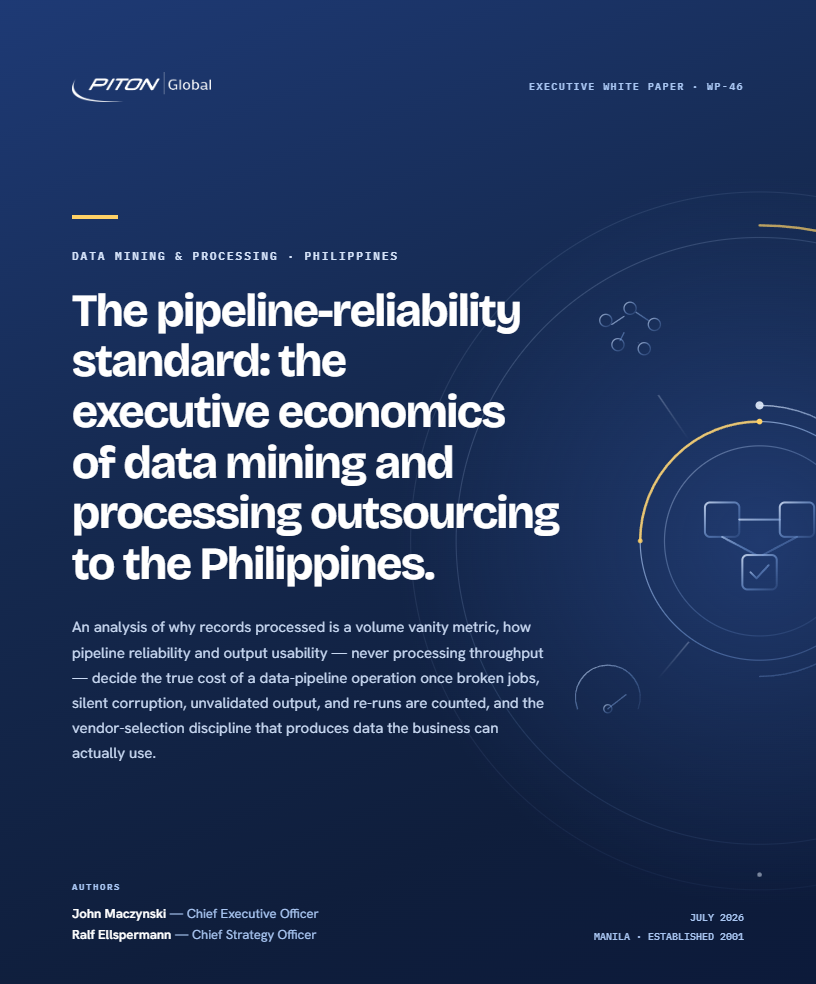
WP-46 Data Mining & Processing Outsourcing white paper cover
PDF · 14 PAGES
10WHITE PAPER WP-46 · DATA MINING & PROCESSING · JULY 2026

The pipeline-reliability standard: the economics of data mining & processing outsourcing.

Why records processed is a volume vanity metric, how pipeline reliability and output usability — never processing throughput — decide the true cost of a data-pipeline operation once broken jobs, silent corruption, unvalidated output and re-runs are counted, and the vendor-selection discipline that produces data the business can actually use. Volume 60 of PITON-Global’s Executive White Paper Series, by John Maczynski and Ralf Ellspermann.

14 pages8-min readMaczynski & Ellspermann
IN THESE PAGES
The pipeline contract — build it robust, validate the output, monitor the run — that separates a data-engineering team from a processing mill.
The records-processed-vs-reliably-processed model and why silent corruption costs more than a loud failure.
Engagement DM-060: the 44-seat data-pipeline rebuild behind a 6.4× first-year return, 99.9%+ job success, and re-runs cut by two-thirds.
Read the white paper (PDF) Open access · published July 2026
11ANSWERED BY OUR PRINCIPALS

What data leaders ask before they outsource mining and processing.

The deciding questions of a data-processing engagement, taken seriously and answered by the principals.

Which ETL and orchestration tools do you support?+
Every load passes source reconciliation plus schema validation against reference data, then reconcile against source. That holds pipeline reliability at 99.9 percent and catches dropped rows, schema drift and duplicates before they reach your warehouse and quietly distort a report months later.— Ralf Ellspermann, CSO
What does outsourcing data work actually save us?+
Typically 50 to 70 percent on cost per record processed versus onshore, with faster turnaround. Most of the saving is damage that never happens: clean data prevents the corrupted reporting, wasted campaigns and bad calls that dirty records trigger well after entry.— John Maczynski, CEO
Can processing volume scale for migrations, backlogs or seasonal spikes?+
Yes. Processing capacity rises for migrations and seasonal loads, then falls back, keeping you paying for work done rather than headcount held. The same source-reconciliation and monitoring controls apply whether it is ten thousand records or ten million.— Ralf Ellspermann, CSO
How is our data protected while you work on it?+
Operations run access-controlled on ISO 27001 infrastructure; local storage is off and audit trails are total. Project- and operator-scoped access, universal logging, and a secured environment your records never leave.— Ralf Ellspermann, CSO
Will you work inside our systems or hand back files?+
Natively in your systems — ERP, CRM, database, BI or Snowflake — under a complete audit trail, with no spreadsheet email chains. No drift opens between the data layers, and record lineage stays clean throughout.— John Maczynski, CEO
Can you build and run automated data pipelines?+
Anything that fails a rule is flagged for SME review and resolved against the rule set, not silently posted or guessed at. The validation rules learn — failure patterns are tracked and fed back so repeat data-quality issues disappear over time.— John Maczynski, CEO
Do you process structured and unstructured data?+
The full lifecycle — capture and entry, cleansing and de-duplication, enrichment and structuring, migration and transformation, ongoing data management, and analytics and reporting support. Forms, documents, scans, surveys, digital feeds — structured or unstructured, the pipeline takes them.— Ralf Ellspermann, CSO
Which data work should we outsource first?+
Begin with high-volume, rules-based work — entry, cleansing and reconciliation — where validation delivers the clearest, fastest accuracy gains. Once rules, reference data and quality prove out on the base volume, enrichment, transformation and analytics support layer on.— John Maczynski, CEO
Can you integrate directly with our data warehouse?+
No. We work natively in your existing stack and stay vendor-neutral on tooling. The assessment and the provider match cost nothing, follow from your systems, data and goals — and leave the decision with you.— Ralf Ellspermann, CSO
How do you measure performance so we can trust the output?+
Against extraction accuracy, ETL success rate, throughput and completeness, surfaced in a live dashboard with monthly reviews. We deliberately never report rows processed per hour — raw speed without validation produces volume you cannot trust, which defeats the entire purpose.— Ralf Ellspermann, CSO
Authorship, Review & Benchmark Verification
Authored by:
Ralf Ellspermann
Ralf Ellspermann
Chief Strategy Officer of PITON-Global
Two Decades Building and Advising Award-Winning Philippine BPO Operations

Ralf benchmarks data-mining floors on extraction accuracy and processing discipline.

View full bio  →
Verified by:
John Maczynski
John Maczynski
CEO of PITON-Global
Former Global EVP of the World’s Largest Contact Center · Four Decades of Outsourcing Experience

John validates the throughput economics and commercial terms behind each data-mining program on this page.

View full bio  →
Last Reviewed & VerifiedJuly 23, 2026

Re-audited as ISO 27001 obligations evolve. Every benchmark on this page is held to PITON-Global’s internal vetting standard.

Inquire Now