A booking that breaks mid-trip strands a traveler — and your brand.
Booking and reservations support, 24/7 disruption and rebooking help, loyalty and refunds, and partner coordination — delivered by Philippine specialists who keep travelers moving and bookings intact, because in travel a support failure is a stranded customer, not a lost ticket.
How do we tell whether a travel-support vendor can actually handle a mass IROPS day?
Ask how they handled their last one. A weather day isn’t 10× volume — it’s ten thousand travelers competing for the same shrinking seats, so queue position decides outcomes. “We scaled up fast” is a volume answer. An event desk shows its decay-based triage sort, pre-agreed waiver matrix and a contacts-avoided number. TT-093 cut chargebacks 71%; disruption uptime 97.2% to 99.9%.
Support Partners
Interactions / Year
Delivery Hubs
In travel, a failed booking or an unhandled cancellation doesn’t cost you a ticket — it strands a traveler, triggers a chargeback and burns hard-won loyalty. Support here is a brand and revenue function, judged on resolution and speed, not handle time.
Five stages from search to loyalty — click where yours leaks.
Each stage has its own failure mode — friction compounds downstream into an abandoned booking or a stranded traveler. Select a stage to see the work, the control, and the metric that governs it.
Trip-lifecycle support runs the full journey — shopping and booking, pre-trip changes, in-trip help, disruption and rebooking, and post-trip loyalty and refunds — under calibrated QA, measured by booking success and disruption resolution, not tickets closed.

“In travel, support and the brand are the same conversation. A failed booking or an unhandled cancellation doesn’t annoy a customer — it strands them in another city and lands on social media. That is why resolution and speed in disruption, not handle time, are the only metrics that matter here.”
A weather day isn’t 10× volume. It’s ten thousand travelers whose options are expiring while they wait in your queue.
Ordinary surge logic — forecast, staff up, hold the SLA — works when tickets are independent. A mass disruption breaks the assumption: every stranded traveler is competing for the same shrinking pool of seats, rooms, and departures, so queue position decides outcomes — the traveler answered first gets rebooked; the traveler answered fourth gets tomorrow. Volume surges are a staffing problem; mass events are a triage-under-decay problem, and the protocol is built for that physics.
Departure proximity first (the traveler whose alternative leaves in 40 minutes outranks the one with options until tonight), connection risk second (the missed leg that cascades into three more), inventory scarcity third (two remaining seats before two hundred). First-in-first-out during a mass event is fairness theater that strands people alphabetically.
Carrier IROPS feeds, weather thresholds, or your ops center’s call activate the triage sort, bring the pre-trained event bench on shift, park non-urgent queues with an honest auto-message, and switch on your waiver matrix — the pre-agreed list of what agents may do without asking (rebook fee-free within X days, hotel up to $Y, refund class Z). During an event, every escalation-for-permission is a traveler losing their seat while a manager reads email.
Affected bookings are identified from the disruption feed before the travelers even call — proactive rebooking on the clean cases, proactive notification on the rest — so a meaningful share of the event’s “volume” is resolved before it becomes contacts. The metric that proves it: contacts avoided per event, reported beside contacts handled.
Which options expired in queue, where the waiver matrix was too tight, which carrier feeds lagged — each retro feeds the next event’s protocol. The storm you can’t prevent, you can at least be readier for than last time.
The buyer’s tell: ask a travel-support vendor how they handled their last mass IROPS day. “We scaled up fast” is a volume answer. “Here’s our triage sort, our waiver matrix, and our contacts-avoided number” is an event answer — and your stranded travelers can tell the difference by whether they made the last flight out.
A ticket desk vs. a support operation that protects the trip.
Seven dimensions, read as risk vs. protection — what a generic desk exposes versus what a disruption-ready operation safeguards.
Where does the 7.3× return come from when disruptions are handled right?
From four streams a per-contact rate ignores: chargebacks and churn avoided, disruption backlog prevented, faster refunds, and labor arbitrage. The cheapest contact is the one resolved the first time — and the traveler it keeps loyal.
$7.4M net benefit on $1.02M program
A traveler in a hospital abroad. A family in a typhoon zone. The protocol was written months before the phone rang.
Travel support receives what no macro anticipates: the medical emergency abroad, the traveler in a disaster zone, the passport gone at 2 a.m. in a country whose embassy opens at 9. These arrive rarely and define the brand absolutely — because improvising duty of care is failing it.
Every specialist is trained to spot the crisis inside the contact: the “rebooking question” that’s actually a medical evacuation, the distress under the calm voice, the traveler whose safety — not itinerary — is the issue.
Crisis contacts route instantly to the duty-of-care desk — senior, opt-in, protocol-trained. The conversation held open and steady, your emergency chain notified per the SOW (your ops center, your assistance provider, your insurer — in the order you specified, at the thresholds you set), embassy and local-emergency guidance from the maintained country playbooks, and the traveler never handed off cold: the desk stays on until your protocol’s next owner has them.
Every duty-of-care event logged with timeline, actions, and notifications — the record your legal, insurance, and (in corporate travel) your client’s HR team will each need, produced as the event runs. For corporate-travel clients, this desk is the operational half of your duty-of-care obligation to traveling employees — the half your travel-risk policy assumes exists.
Ask a vendor what their agents do when a traveler says “I’m in a hospital in Bangkok.” A pause before the answer is the answer.
The traveler is on line one. The fix is at the airline, the hotel, or the bedbank — and we staff the desk that gets it.
A traveler’s fix usually lives with a supplier — the airline that must reissue, the hotel that must confirm, the bedbank whose API said yes and whose property said no. A desk that can only apologize to the traveler while emailing the supplier is half an operation.
Named contacts and escalation paths per major carrier, chain, and bedbank; the trade channels (carrier trade desks, hotelier extranets, aggregator support tiers) worked by specialists who know each one’s clock and quirks — because “we’ve emailed the property” is not a resolution, it’s a delay with a timestamp.
The booking that exists in your system and not the supplier’s (or the reverse): confirmation-mismatch triage run proactively on high-risk bookings — day-before-arrival sweeps on new-property and new-connector inventory — so the traveler discovers the problem never, instead of at the front desk at midnight.
Which properties no-show confirmations, which connectors drop modifications, which carrier desks answer in minutes vs. days — reported monthly, because your supplier-relations team can fix a pattern they can see, and our desk sees all of them.
A 24/7 disruption-ready team live in 8 weeks — playbooks proven before peak.
A gated stand-up. No traveler is handled live until disruption playbooks are signed off and a parallel run handles live volume against your booking stack.
Four travel profiles, one event-ready operation.
The full lifecycle engine, the event protocol, and the refund-cycle economics only an OTA feels at scale.
The mass-event protocol at carrier scale — reissue depth, manifest-first discipline, the waiver matrix executed at inventory speed.
Confirmation-mismatch sweeps, property-side coordination, and the supplier telemetry that turns a no-show confirmation into a fixable pattern.
The crisis desk as your travel-risk policy’s operational half, VIP handling, and program-policy enforcement.
Before a vendor touches a booking, can they prove they won’t strand a traveler?
Three controls separate a disruption-ready operation from a desk that just answers tickets — and each is demonstrable before you sign. In travel, the cost of getting one wrong is a stranded traveler and a public review.

“Give a prospective partner a hundred test cases with deliberate traps — a missed connection, a double charge, a visa question at midnight. A disruption-ready operation resolves nearly all of them at first contact. A scripted desk fumbles them, and a day later your traveler is stranded and the screenshot is trending.”
We execute your waiver policy. We never invent goodwill on your P&L.
The event matrix and its everyday equivalents — what an agent may waive, refund, or upgrade, at what thresholds, logged every time — are yours, versioned, enforced in the console. An offshore desk improvising generosity is margin leakage wearing a service smile; one improvising strictness is churn wearing a policy. Both are the same failure: authority nobody defined.
A wrong answer about a fare rule is a chargeback or a stranded traveler; fare-rule and policy accuracy get their own QA lane, sampled and scored, with the error taxonomy fed back into training weekly.
Compliant capture flows, no PAN in notes or transcripts, locked-down VDI, and the audit trail your acquirer’s review expects. On a page that touches millions of card transactions, this is architecture, not a badge.
No live travelers until the emergency chain, thresholds, and country playbooks are signed. Improvising duty of care is failing it — so we don’t start until the protocol exists.
Fare-rule QA, event-triage discipline, and duty-of-care readiness don’t survive stretched spans. Clusters cap where the discipline holds; event surges ride the pre-trained bench, never strangers in your GDS. A shortlist that includes “no” is the only kind worth having.
Indicative 2026 rates — the travel roles shown apart from the seat.
— no generic equivalent$11–$16The event bench: decay-triage, waiver-matrix execution, manifest-first bulk actionsEVENT
— no generic equivalent$12–$18The crisis lane: protocol execution, emergency-chain routing, the record the aftermath requires — opt-in, trained, protectedCRISIS
The two premium rows have no commodity equivalent because a ticket desk staffs neither: the mass event gets a longer queue and the hospital call gets a script. Rates confirmed per engagement against volumes, languages, and channel mix.
Price my support against the event standard →A disruption you can’t handle is a traveler you’re about to lose.
Tell us where traveler support strains — peak-season disruption, slow rebooking, refund backlogs — and we’ll hand you 6–10 vetted providers built for travel, each one proven on a live disruption test before it reaches your shortlist.
Get Vendor-Neutral Advice →Our 24-Hour Response Guarantee — a reply within 24 hours, event-protocol scoping estimate included.
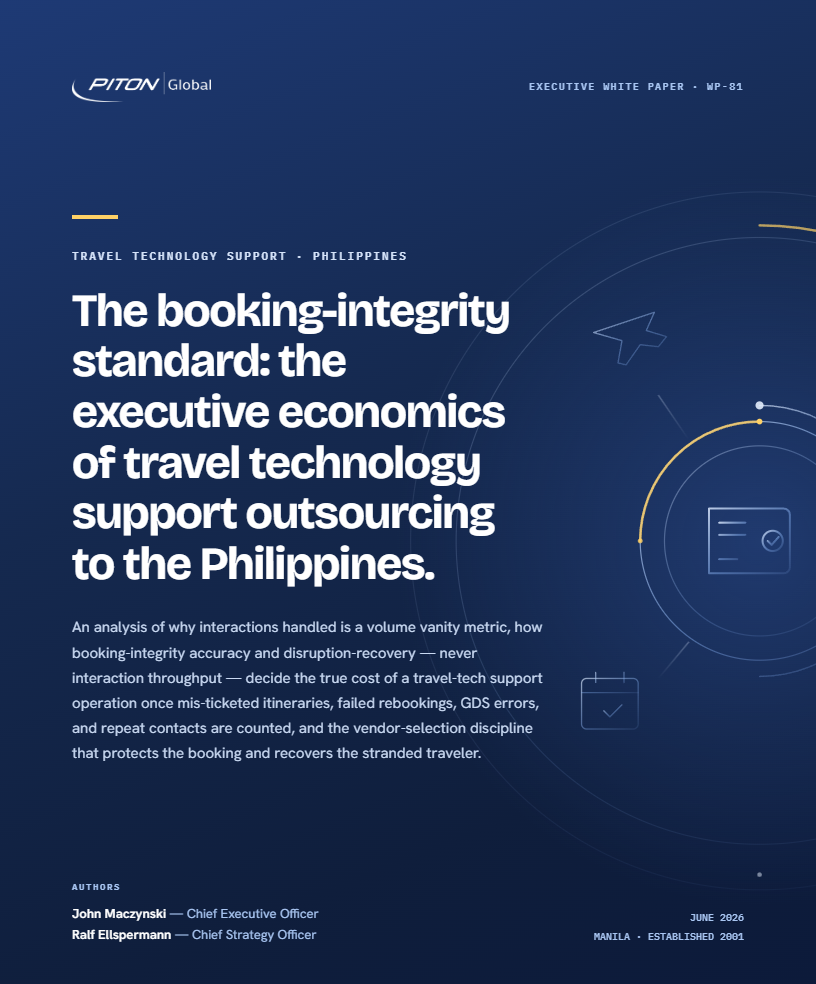
The booking-integrity standard: the economics of travel technology support outsourcing.
Why interactions handled is a volume vanity metric, how booking-integrity accuracy and disruption-recovery — never interaction throughput — decide the true cost of a travel-tech support operation once mis-ticketed itineraries, failed rebookings, GDS errors and repeat contacts are counted, and the vendor-selection discipline that protects the booking and recovers the stranded traveler. Part of PITON-Global’s Executive White Paper Series, by John Maczynski and Ralf Ellspermann.
Where the travel support conversation is happening.
What travel and CX leaders ask before they outsource.
In-depth answers to the questions that decide a travel-tech support engagement — from the principals who run them.