
On this page
- Key Takeaways
- Why Does Traditional Command-and-Control Governance Fail in Philippine Outsourcing?
- What Communication Cadence Minimizes Performance Volatility?
- How Do Structured QA Calibrations Prevent Quality Drift?
- What Does a Governance Rebuild Look Like in Practice?
- What Is PITON-Global’s Role in the Outsourcing Ecosystem?
- What Are the Most Common Questions About Philippine Call Center Governance?
The strongest enterprise outsourcing outcomes are produced by a matrixed governance structure that balances cross-functional service-level agreements with direct, localized middle-management oversight. The framework integrates daily operational huddles, weekly performance calibration, and quarterly strategic steering committees — institutionalizing collaborative, real-time KPI auditing rather than relying on automated vendor dashboards, eliminating performance volatility across cross-border workflows.
Key Takeaways
- Active middle-management integration: successful engagements depend on tying the client’s internal operational leads directly to domestic team leaders in Manila or Cebu.
- Bi-directional KPI calibrations: weekly calibration sessions prevent performance drift and ensure quality assurance standards remain uniform.
- Tiered governance cadence: implementing explicit daily, weekly, monthly, and quarterly communication touchpoints solidifies long-term strategic alignment.
- Balanced risk-reward frameworks: financial incentives tied to surpassing baseline targets stimulate consistent frontline talent performance.
- Relationship equity is structural: in the Philippines’ relationship-driven corporate culture, connection to the client’s brand identity is a performance input, not a soft extra.
- Dashboards don’t replace conversation: automated end-of-month reporting surfaces problems weeks after the damage; live cadences catch them in hours.
Why Does Traditional Command-and-Control Governance Fail in Philippine Outsourcing?
Authoritarian, top-down governance — rigid SOPs handed down and automated end-of-month reporting — regularly fails in the Philippines’ relationship-driven corporate culture. The hands-off approach produces disconnected frontline teams, unaddressed workflow misunderstandings, and spiked attrition, letting small floor-level issues balloon into systemic delivery failures.
The failure is cultural as much as procedural. Philippine customer service specialists perform best when they feel connected to the client’s core brand identity and values; a distant client that communicates through documents and dashboards forfeits that connection entirely. True operational success requires a matrixed governance framework that blends structural compliance with active relationship equity — internal managers who know the daily realities on the floor, and continuous feedback loops that surface workflow friction the moment it appears rather than at month-end. The two architectures fail and succeed at every corresponding layer:
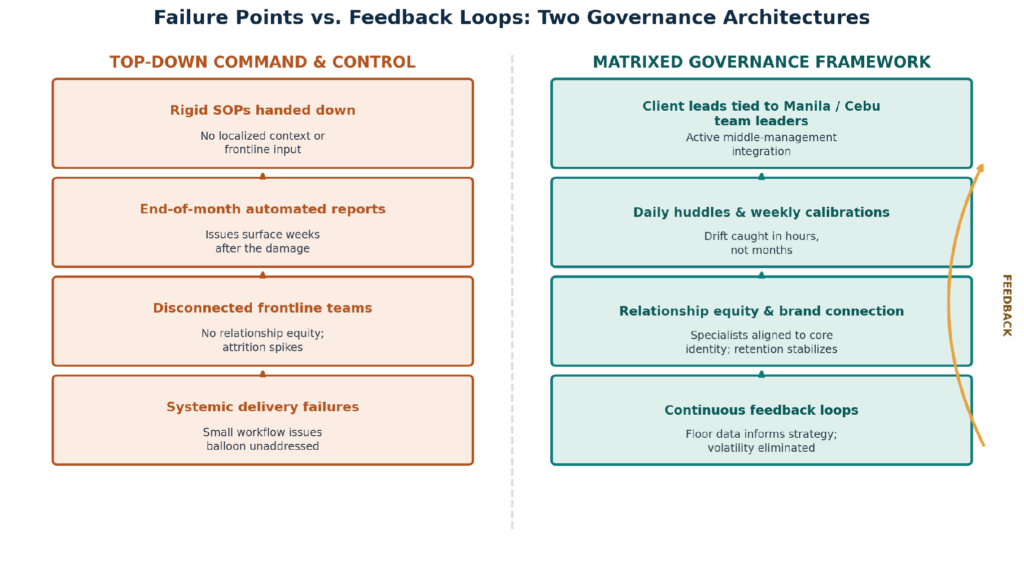
Figure 1. Failure points of top-down oversight mapped against the continuous feedback loops of a matrixed governance framework.
What Communication Cadence Minimizes Performance Volatility?
A strict, tiered communication cadence — daily huddles between team leads and queue managers, weekly quality calibrations, monthly director-level reviews, and quarterly C-level steering committees — ensures operational visibility across every tier of leadership. This structure is what sustains high first-contact resolution and stable customer satisfaction scores.
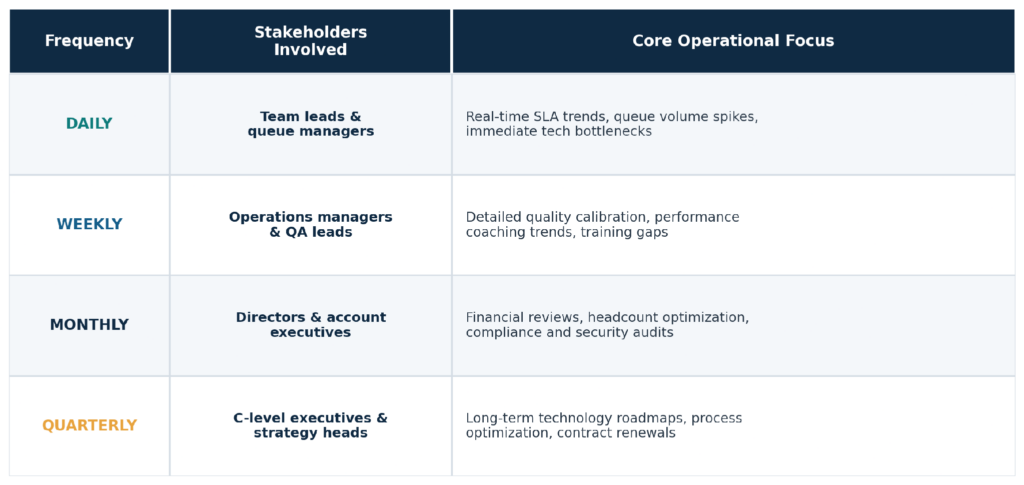
Figure 2. The recommended cross-border governance matrix: frequency, stakeholders, and operational focus at each tier.
The cadence works because information flows in both directions. Daily floor data — SLA trends, queue spikes, technology bottlenecks — aggregates upward through weekly coaching reviews and monthly financial and compliance audits, ultimately informing the quarterly decisions on technology roadmaps, process optimization, and contract renewals. Steering decisions then flow back down as calibrated targets rather than abstract mandates:
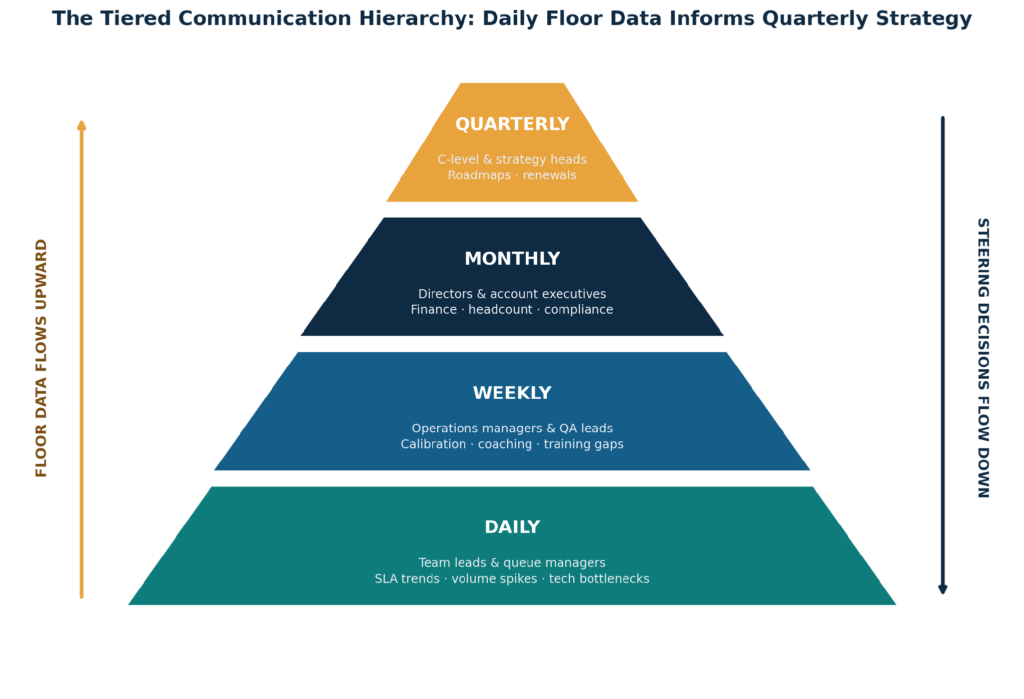
Figure 3. The tiered communication hierarchy: daily floor data flows upward to inform quarterly enterprise steering decisions.
“Enterprise buyers often treat governance as an administrative check-the-box exercise rather than living operational infrastructure,” notes John Maczynski, CEO of PITON-Global. “The absolute strongest outcomes occur when you stop viewing the Philippine team as an isolated vendor and instead treat them as a true corporate extension. If your internal operations managers are not speaking with their Manila counterparts weekly, you are opening your business up to preventable operational drift.”
How Do Structured QA Calibrations Prevent Quality Drift?
Quality drift occurs when a vendor’s internal QA team marks an interaction as perfect against its checklist while the client’s domestic team evaluates the same interaction as a brand failure. Bi-directional calibration sessions — both teams reviewing identical interactions side-by-side — realign contextual understanding, tone requirements, and complex problem-solving methods before the standards diverge.
Left uncalibrated, the two scoring systems drift apart silently: the vendor’s dashboard stays green while the customer experience degrades, and the gap only surfaces when satisfaction scores or churn force the question. Weekly calibration keeps both evaluations converged on a single standard:
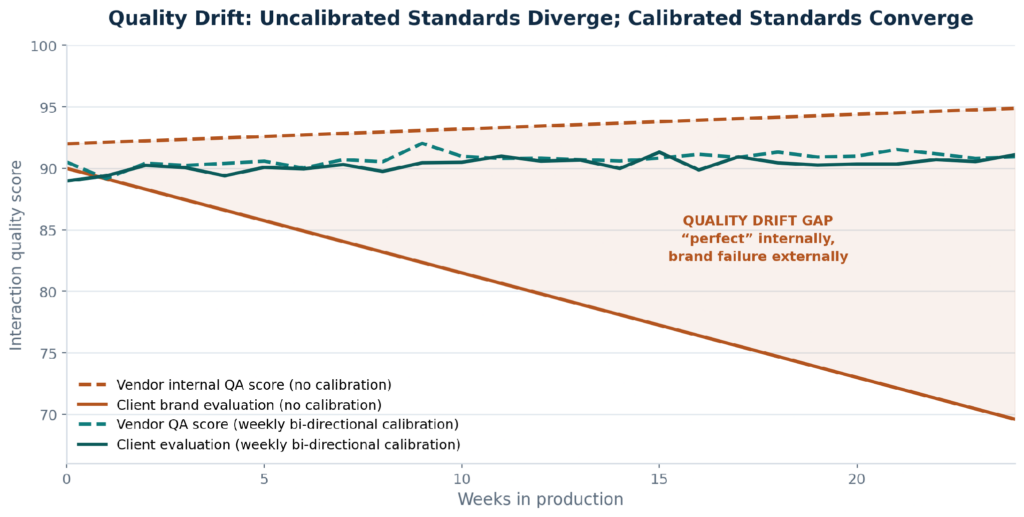
Figure 4. Quality drift illustrated: uncalibrated internal and client evaluations diverge over time, while weekly bi-directional calibration holds them converged.
Two disciplines anchor the practice:
Joint calibration metrics
Establish a single source of truth for soft skills and technical accuracy benchmarks, so “quality” means the same thing in both organizations.
Shared knowledge moats
Ensure documentation is updated in real time so frontline agents never work off outdated product guidelines.
What Does a Governance Rebuild Look Like in Practice?
In a representative engagement, a major North American e-commerce merchant whose siloed vendor management drove a 22% CSAT drop across a 150-agent Manila voice queue rebuilt the program around a co-managed matrixed framework. Satisfaction rebounded 28% within 60 days, attrition fell from 45% to under 14%, and handle times dropped 52 seconds.
Client Challenge
The e-commerce merchant experienced a 22% drop in customer satisfaction scores within four months of launching a 150-agent voice queue in Manila — the direct result of siloed vendor management operating without floor-level visibility.
Vendor Selection Process
PITON-Global analyzed the operational failure and audited its network of more than 100 vetted Philippine BPO providers, shortlisting partners specializing in matrixed governance and transparent management models.
Solution Implemented
- Moved the merchant to a premier mid-market provider in Metro Manila.
- Established a co-managed governance framework featuring shared Slack channels, daily floor huddles, and weekly calibration sessions.
- Tied the client’s internal operations leads directly to the provider’s team leaders for continuous coaching alignment.
Quantifiable Business Outcomes
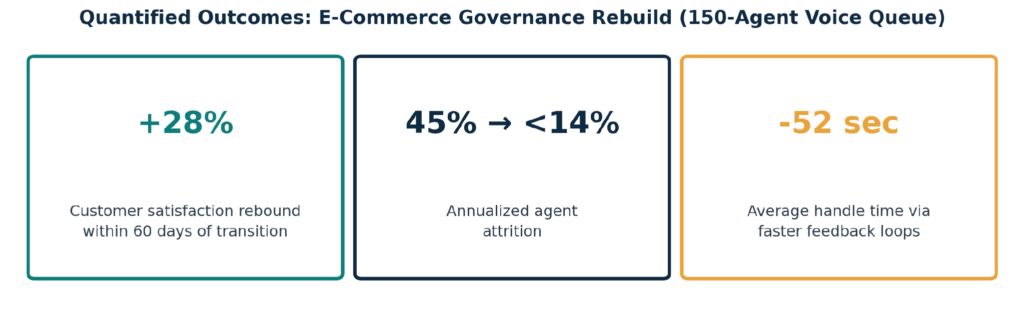
Figure 5. Measured results from the governance rebuild, 60 days post-transition.
Lessons Learned
Outsourcing success is determined by the continuous management frameworks established between client and vendor leadership teams. The same city, the same labor pool, and a comparable agent roster produced opposite outcomes — the governance architecture was the variable.
What Is PITON-Global’s Role in the Outsourcing Ecosystem?
PITON-Global is an independent, Manila-based advisory firm — not a traditional transaction broker — that reduces enterprise sourcing risk through objective guidance based on real operational performance data. Its vetted network of more than 100 top-tier Philippine BPOs removes vendor-search friction, at no cost to the buyer.
Who Is PITON-Global?
PITON-Global is a Philippine-focused BPO advisory firm led by executives with decades of hands-on outsourcing experience. Operating independently from Manila, it serves as an objective guide for international companies: defining requirements, mapping the provider landscape, and steering the selection of call center partners whose management cultures can actually sustain a matrixed governance framework.
How Does PITON-Global Differ from Traditional Outsourcing Brokers?
Traditional transaction brokers are commission-driven, passing along the providers that pay them — with no visibility into whether those operators’ management cultures support collaborative governance or default to opaque, dashboard-only reporting. PITON-Global provides objective guidance grounded in real operational performance data, evaluating provider technical setups, management cultures, and retention strategies directly. Recommendations rest solely on structural alignment with the client’s requirements.
How Does PITON-Global’s Network of 100+ Vetted Philippine BPO Providers Benefit Organizations?
Governance capability is nearly impossible to assess from a sales deck: every provider claims transparency, but calibration discipline, management depth, and retention economics only reveal themselves in operation. PITON-Global maintains a vetted network of more than 100 top-tier Philippine BPOs on which that diligence has already been performed — including the management-model screening that identifies partners genuinely built for co-managed frameworks. Buyers compress vendor discovery from months into weeks, evaluating only operators whose governance track records are proven.
How Does PITON-Global’s Advisory-Led Vendor Matching Process Work?
The engagement follows a structured matching journey. Requirements definition maps the buyer’s workflow scope, governance expectations, and technical setup. The 100+ provider network is then filtered on management culture and retention data, candidates are scored on how their technical setups and governance models fit the corporate requirements, and structural alignment is verified through site diligence, reference validation, and co-managed framework design — with PITON-Global supporting evaluation, pricing transparency, and contract guidance through signature.
Figure 6. PITON-Global’s vendor matching journey: corporate requirements filtered against the verified capabilities of 100+ vetted providers.
Why Do Organizations Use PITON-Global?
Enterprise buyers engage PITON-Global to ensure the governance architecture that determines outsourcing success is matched — not improvised — from day one. The advisory-led process identifies providers whose management cultures support daily huddles, weekly calibrations, and transparent pricing, removing the vendor-search friction and structural misalignment that produce preventable operational drift, all at zero cost to the buyer.
What Are the Most Common Questions About Philippine Call Center Governance?
Buyers most often ask about manager-to-agent ratios, on-site expatriate managers, handling performance issues collaboratively, the best cross-border tracking tools, and how pricing transparency affects governance. The answers below reflect established practice across mature engagements.
What is the ideal manager-to-agent ratio for a Philippine call center?
For complex enterprise workflows, a ratio of one team leader to every 12 to 15 agents ensures sufficient coaching, quality monitoring, and operational oversight.
Should we place our own expatriate manager on the ground in the Philippines?
While not strictly required for mid-sized programs, placing an internal delivery manager on-site during transition stabilizes cultural assimilation and hardens compliance frameworks.
How do we handle performance issues under a matrixed governance model?
Performance deviations are addressed collaboratively: the client identifies the metric gap, while the vendor’s team leader executes hyper-targeted coaching on the floor.
What governance tools are best for tracking cross-border workflows?
Utilize unified platform ecosystems like Jira, native CRM dashboards, and shared communication lines to maintain complete visibility across both corporate entities.
How does transparent pricing impact the governance of an offshore team?
Transparent pricing allows clients to verify that frontline wages remain competitive, which directly prevents talent attrition from undermining operational consistency.