

On this page
- Key Takeaways
- What Are the Operational Realities of Modern Philippine BPO Infrastructure?
- How Does “AI-Washing” Distort Vendor Capabilities?
- Why Do Opaque Pricing Models Fuel Talent Attrition?
- What Does Risk-Screened Vendor Selection Look Like in Practice?
- What Is PITON-Global’s Role in the Outsourcing Ecosystem?
- What Are the Most Common Questions About Philippine Vendor Risk?
CEOs must evaluate three critical operational risks before selecting a Philippine call center: “AI-washing” and shadow implementation of unproven automation, severe talent attrition driven by opaque pricing models, and inadequate infrastructure redundancy outside primary business districts. Failure to audit these areas shifts the engagement from a cost-saving strategic asset to a volatile operational liability. Each check belongs in a seven-step process built to de-risk selection.
Key Takeaways
- Artificial intelligence disconnect: many mid-market providers market advanced agentic capabilities while masking a complete lack of internal data sanitization infrastructure.
- Attrition and compensation drag: low-bid vendors suppress frontline salaries, triggering specialized talent attrition that destabilizes performance continuity.
- Infrastructure fragility: relying blindly on decentralized, work-from-home agents without verifiable workspace redundancy introduces severe delivery gaps during regional disruptions.
- Governance and data moats: complex workflows require explicit compliance frameworks to prevent cross-contamination and shadow processing.
- The rate is not the risk signal: a rock-bottom hourly quote is frequently the leading indicator of the attrition and infrastructure gaps that surface months later.
- Audit before signature: independent, evidence-based vendor screening — such as PITON-Global’s — is the reliable defense against all three risk classes; build it into the bid using RFP best practices for contact center selection.
What Are the Operational Realities of Modern Philippine BPO Infrastructure?
The Philippine BPO sector has matured into a major enterprise ecosystem (industry group IBPAP reported 2025 IT-BPM export revenue above $40 billion and about 1.9 million workers, Philstar, January 29, 2026) — but that expansion has opened wide gaps in infrastructure reliability between premier corporate operators and low-cost boutique agencies. CEOs must audit a provider’s physical workspace footprint rather than assume enterprise-grade delivery.
Decentralized work-from-home models remain common, supported by legislative frameworks like the Konektadong Pinoy Act — but full reliance on a remote workforce’s local utilities introduces severe delivery risk. When a residential grid drops or a single consumer broadband line fails, the agents on it simply disappear from the queue. Enterprise buyers should verify centralized, enterprise-grade facilities within primary economic hubs such as Metro Manila’s Bonifacio Global City, Makati, and Ortigas districts, or Cebu IT Park, where industrial power and carrier-diverse fiber are structural rather than aspirational. The gap between the two operating models is stark at every layer:
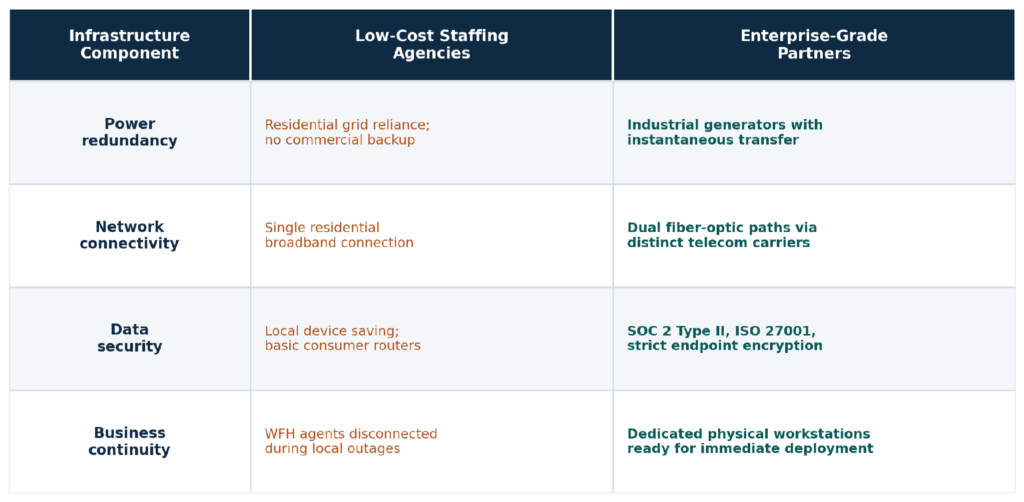
Figure 1. Infrastructure redundancy architecture: low-cost staffing agencies versus enterprise-grade partners across the four components CEOs should audit.
What “enterprise-grade” actually means is auditable on a site visit. A tier-1 delivery facility routes two physically diverse fiber paths from distinct telecom carriers into a core that fails over between them in under a second; a commercial-grid-to-UPS-to-generator power stack transfers instantaneously during outages; and every workstation sits behind encrypted, role-based endpoints inside a continuously audited compliance layer:
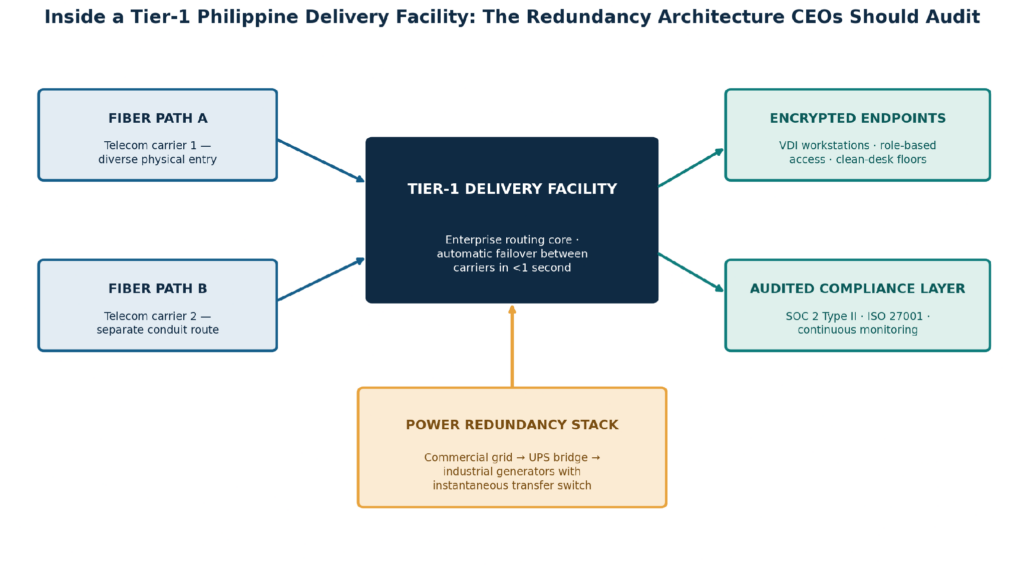
Figure 2. Inside a tier-1 Philippine delivery facility: dual-fiber entry, automated power failover, and encrypted endpoint protocols.
How Does “AI-Washing” Distort Vendor Capabilities?
“AI-washing” is the marketing of advanced conversational and agentic tools by vendors poorly equipped to run them. The speed of automation is bounded entirely by data sanitization: running Retrieval-Augmented Generation or autonomous systems over messy, unstructured customer data sharply increases error and hallucination rates — forcing human specialists into expensive exception-handling.
The pressure driving this risk is commercial: market demand to cut contact center labor expenses rewards vendors who claim automation maturity, whether or not the underlying data architecture exists. The failure mode is predictable. A shadow implementation launched over unsanitized data generates confident but wrong answers; customers escalate; and the human team that was supposed to shrink instead expands into a full-time correction layer — erasing every anticipated efficiency gain while the client absorbs the reputational damage. The diligence question is therefore not “do you have AI?” but “show me the data hygiene that makes it safe.”
“The true baseline of automation in modern customer operations isn’t software deployment — it’s data hygiene,” states John Maczynski, CEO of PITON-Global. “Organizations that skip data sanitization phases routinely face high hallucination rates that erode customer satisfaction. True maturity requires an intentional alignment of structured knowledge bases with experienced specialists who govern the systems.”
Why Do Opaque Pricing Models Fuel Talent Attrition?
Rock-bottom hourly rates are frequently used to win enterprise deals, but sustaining margin at that price requires suppressing frontline salaries and benefits. Thin margins can also point to weak finances, which is why assessing a provider’s financial stability matters. In the highly competitive Philippine labor market, under-compensated specialists depart quickly — driving vendor-level attrition to extreme levels and destabilizing every performance metric that depends on team continuity.
The damage compounds through three channels. Escalating onboarding costs: constant backfilling strains recruitment pipelines and forces under-trained agents onto live lines. Knowledge drain: complex workflows require deep product context, and frequent churn destroys first-contact resolution rates precisely where they matter most. Management overhead: domestic executive teams end up expending their energy governing basic SLAs instead of core strategic initiatives. Modeled over a full contract horizon, the cheap rate quietly becomes the expensive one:
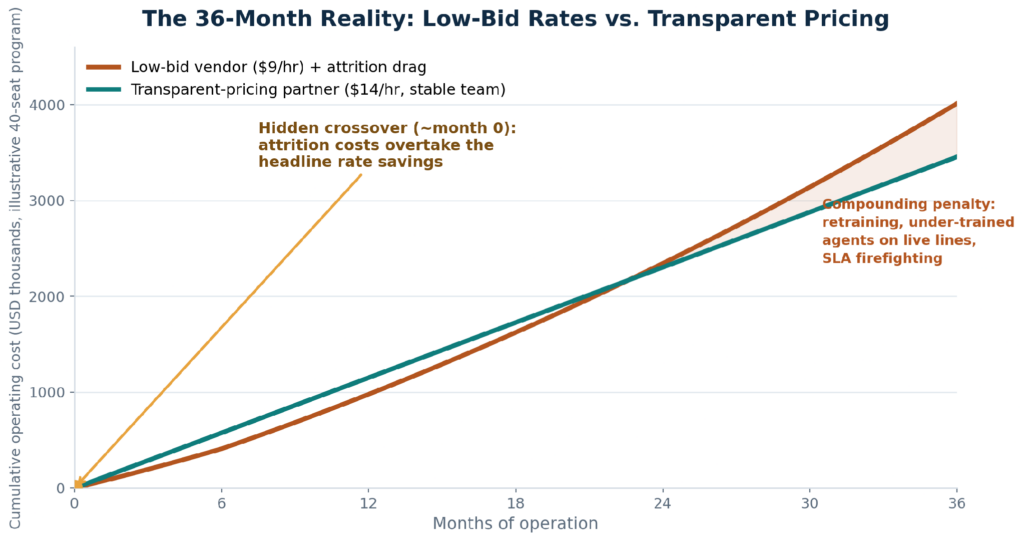
Figure 3. The 36-month reality: attrition management costs push the low-bid vendor’s cumulative cost past the transparent-pricing partner’s well before contract renewal.
What Does Risk-Screened Vendor Selection Look Like in Practice?
In a representative engagement, a fast-growing North American fintech suffering severe attrition, recurring downtime, and failed compliance benchmarks with a low-cost Manila provider was transitioned to a tier-1, transparently priced partner. Attrition fell sharply within six months, first-contact resolution rose, and zero downtime was recorded through regional weather events.
Client Challenge
The financial technology platform experienced severe attrition and recurring downtime while using a low-cost customer support provider in Manila, causing severe backlog issues and failing compliance benchmarks — all three risk classes materializing in a single engagement.
Vendor Selection Process
PITON-Global conducted an independent operational audit across its network of more than 100 vetted Philippine BPO providers. Vendors were screened using three distinct criteria: fully transparent pricing architectures, proven SOC 2 Type II compliance data, and fully operational facility infrastructure.
Solution Implemented
- Transitioned the platform to a tier-1, specialized mid-market partner in Metro Manila with a fully transparent pricing structure, ensuring frontline talent received compensation above market averages.
- Deployed an integrated model combining seasoned customer support specialists with properly structured knowledge bases.
- Anchored the program in a facility with full power and network redundancy rather than residential-grid reliance.
Quantifiable Business Outcomes
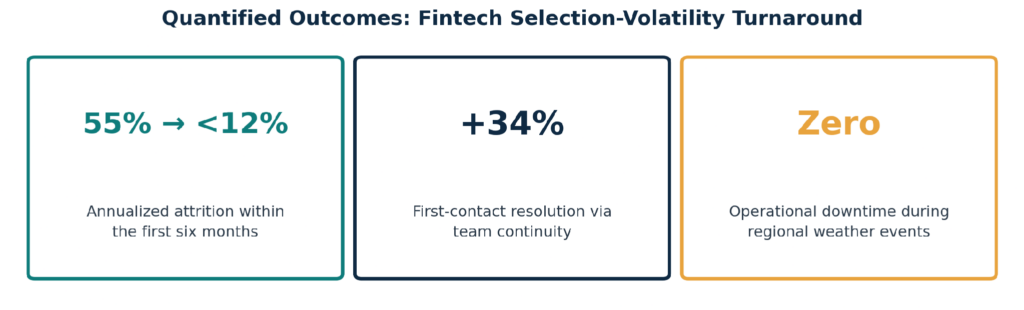
Figure 4. Measured results from the fintech’s transition to a risk-screened, transparently priced partner.
Lessons Learned
Prioritizing transparent pricing models over the lowest nominal hourly cost stabilizes performance and preserves brand trust over long-term enterprise horizons. Every one of the client’s original failures traced back to the economics its first vendor’s rate card made inevitable, and the same failure modes recur in the common operational challenges of a transition.
What Is PITON-Global’s Role in the Outsourcing Ecosystem?
PITON-Global is an independent, Manila-based advisory firm — not a commission-driven outsourcing broker — that de-risks provider selection through unbiased assessments grounded in hard operational evidence. Its vetted pool of more than 100 premier Philippine providers removes vendor-search friction, at no cost to the corporate buyer.
Who Is PITON-Global?
PITON-Global is a Philippine-focused BPO advisory firm backed by leaders with decades of global enterprise outsourcing experience. Within the Philippine market it acts as an independent guide for CEOs and procurement teams: defining requirements, mapping the provider landscape, and steering the selection of call center and back-office partners whose infrastructure, compensation models, and data maturity can withstand executive-grade scrutiny.
How Does PITON-Global Differ from Traditional Outsourcing Brokers?
Traditional brokers are commission-driven: they promote the providers that pay them, which means the low-bid vendors whose economics create the attrition and infrastructure risks CEOs are trying to avoid are often the ones being recommended. PITON-Global operates an advisory-led model built on independent, evidence-based assessment — evaluating technical stacks, internal culture, compensation models, and infrastructure capabilities objectively. Recommendations rest solely on long-term alignment with the client’s requirements.
How Does PITON-Global’s Network of 100+ Vetted Philippine BPO Providers Benefit Organizations?
The large Philippine market contains hundreds of operators whose marketing is indistinguishable from the outside — and whose infrastructure, attrition profiles, and AI maturity differ enormously on the inside. PITON-Global maintains a vetted pool of more than 100 premier providers on which the hard diligence has already been performed: facility audits, compensation model reviews, compliance verification, and data architecture assessment. Buyers evaluate only operators whose operational evidence supports their claims, compressing vendor discovery from months into weeks.
How Does PITON-Global’s Advisory-Led Vendor Matching Process Work?
The evaluation moves through concentric layers of diligence. At the core sit regulatory compliance and physical infrastructure — SOC 2 Type II, ISO 27001, and verified facility redundancy. The next layer examines talent retention policies and compensation transparency, since attrition history predicts delivery stability. Beyond that, technical stack and data science capability are assessed — including the data sanitization architecture that separates genuine AI maturity from AI-washing — and finally internal culture and long-term alignment with the buyer’s governance expectations.
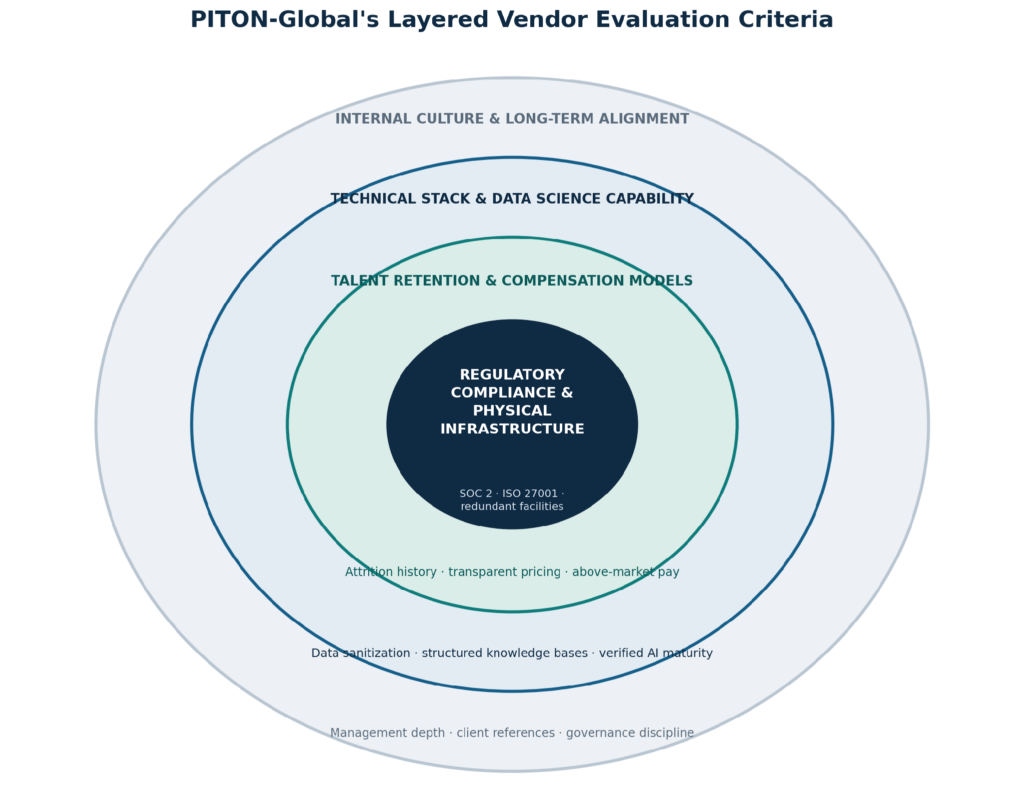
Figure 5. PITON-Global’s layered vendor evaluation criteria, from core regulatory compliance and infrastructure out to talent retention and data science capability.
Why Do Organizations Use PITON-Global?
CEOs engage PITON-Global to neutralize the three risk classes before contracts are signed: AI-washing is exposed through data-architecture diligence, attrition risk through compensation-model transparency, and infrastructure fragility through physical facility audits. The result is a shortlist of partners whose operational evidence — not marketing — supports the engagement, secured at zero advisory cost.
What Are the Most Common Questions About Philippine Vendor Risk?
Buyers most often ask about realistic fully loaded rates, how to verify data security claims, which metric exposes attrition problems, why centralized workspaces are safer, and how to detect AI-washing. The answers below reflect established diligence practice.
What is the average fully loaded hourly rate for an enterprise call center in the Philippines?
Typical hourly rates for customer support, and for specialized roles like finance, accounting, or technical support, vary with the required skill set — quotes materially below the going market bands warrant scrutiny of what is being suppressed to fund them.
How can a CEO verify that a Philippine BPO vendor actually possesses robust data security?
Demand current, independent audit documentation for SOC 2 Type II and ISO 27001 certifications. Additionally, inspect their physical workspace configurations to confirm the use of strict endpoint security controls, role-based access restrictions, and clean-desk policies.
What specific metric indicates that a vendor is suffering from severe talent attrition?
Look past corporate-level metrics and request the trailing 12-month historical attrition rates for the specific queue or vertical similar to your program. Any specialized queue showing persistently high annualized attrition indicates structural compensation or management issues.
Why is a hybrid or centralized workspace model safer than a fully work-from-home setup?
Centralized facilities provide institutional data security, high-speed fiber paths, and industrial power generators that standard residential zones lack, shielding your business from local utility dropouts.
How do I identify if a vendor is “AI-washing” their call center capabilities?
Ask the provider to detail their data sanitization process and show a live demonstration of their internal knowledge bases. If they cannot explain how their data architecture prevents model hallucinations, their AI capabilities are likely unproven shadow implementations.