

On this page
- Key Takeaways
- What Are the Core Cost-Per-Contact Dynamics Between Full Automation and Offshore Human Labor?
- What Does a Multi-Tiered Framework Balancing Automation and Human Capital Perform Functionally?
- What Long-Term Financial Risks Emerge When Enterprises Over-Automate Customer Workflows?
- What Does a Successful Hybrid Sourcing Program Look Like in Practice?
- What Is PITON-Global’s Role in the Outsourcing Ecosystem?
- What Are the Most Common Questions About Comparing BPO and Automation Investments?
Leaders should treat Philippine call center outsourcing and AI initiatives as complementary vectors, not mutually exclusive choices. Automation cuts routine query costs sharply, while Philippine teams hold a clear first-contact-resolution edge on emotionally complex escalations. The optimal strategy combines AI triage with specialized offshore talent to minimize blended costs while protecting retention, and that combination is the core of how AI changes an outsourced operation.
Key Takeaways
- Avoid the binary choice fallacy: view automation and offshore human capital as structural components of a single, integrated customer experience engine rather than distinct silos.
- Isolate tiered cost realities: automated self-service drives routine contact costs toward the floor, while high-tier Philippine talent handles complex interactions at a highly competitive cost per contact.
- Assess quality degradation risk: moving entirely to unassisted AI creates a friction loop that inflates contact volume through repeat attempts and can measurably elevate customer churn.
- Leverage the hybrid model: agentic AI layers for diagnostic triage and automated note summarization increase human agent occupancy and cut average handle times substantially.
- Compare fully loaded outcomes: the valid comparison unit is the cost of a fully resolved issue at a given satisfaction level — not the software subscription versus the hourly rate.
- Hybrid-readiness is selectable: advisory-led matching, such as PITON-Global’s, identifies the providers whose copilot infrastructure can actually run an integrated deployment.
What Are the Core Cost-Per-Contact Dynamics Between Full Automation and Offshore Human Labor?
For high-volume, repetitive inquiries, automation wins decisively — but it carries significant upfront capital, continuous fine-tuning, and usage-based token overhead. As complexity rises the model inverts: failed automated resolutions loop or break, while a Philippine human layer absorbs complex journeys flexibly, without the steep development cycles of custom generative models.
The honest capital allocation analysis looks past hourly line items and software subscription quotes to the fully loaded cost of an entirely resolved issue. An enterprise-grade natural language application excels at password resets and tracking lookups, where its marginal cost approaches zero after the build. But when an automated system fails on a nuanced problem, it either forces the customer through a frustrating loop or drops a broken interaction onto an internal team — and every one of those failures carries a hidden price in repeat volume and goodwill. A premier Philippine contact center offers the mirror-image profile: a highly educated, naturally empathetic workforce delivered as a flexible, fully loaded operating expense, strongest exactly where automation is weakest. The comparison, properly framed, is not either/or — it is which layer owns which tier, a question that runs across the whole customer experience value chain.
What Does a Multi-Tiered Framework Balancing Automation and Human Capital Perform Functionally?
The most effective models use technology to maximize human capacity, not replace it: interactive automation filters low-complexity transactional volume, and the remaining high-intent contacts route to trained professionals in Philippine technology centers. Each of the four tiers carries its own cost band, governing metric, and risk profile.
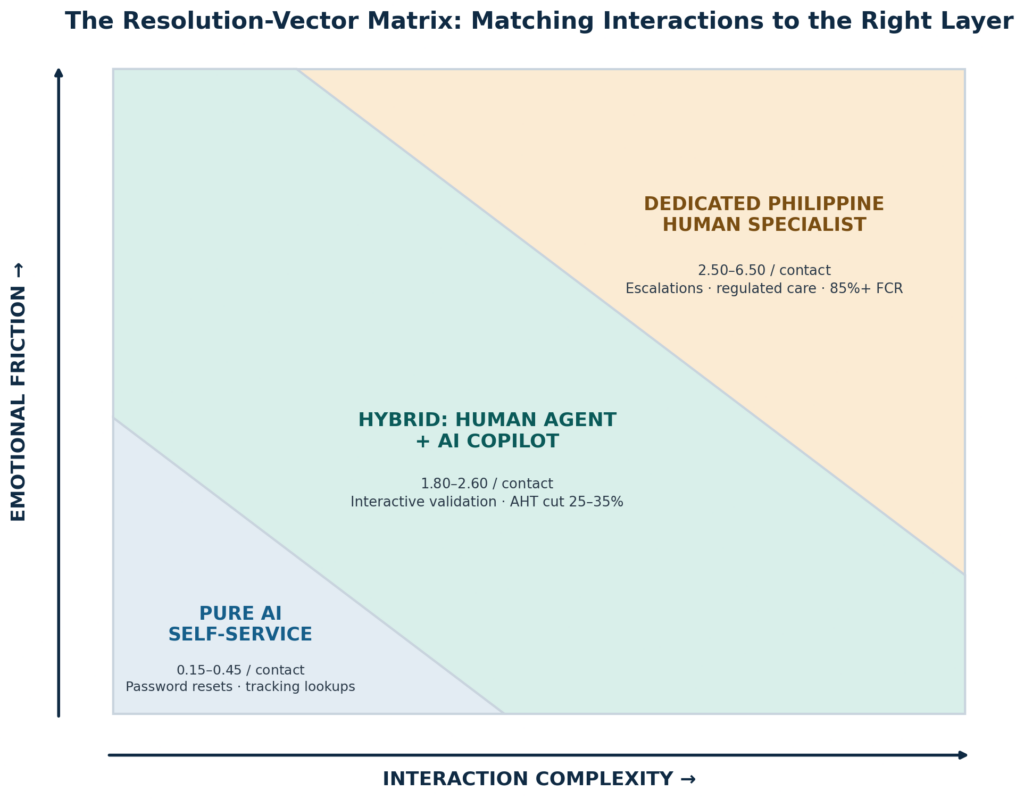
Figure 1. The resolution-vector matrix: interaction complexity and emotional friction determine whether pure AI, a hybrid copilot layer, or a dedicated Philippine specialist is the optimal — and cheapest fully resolved — channel.
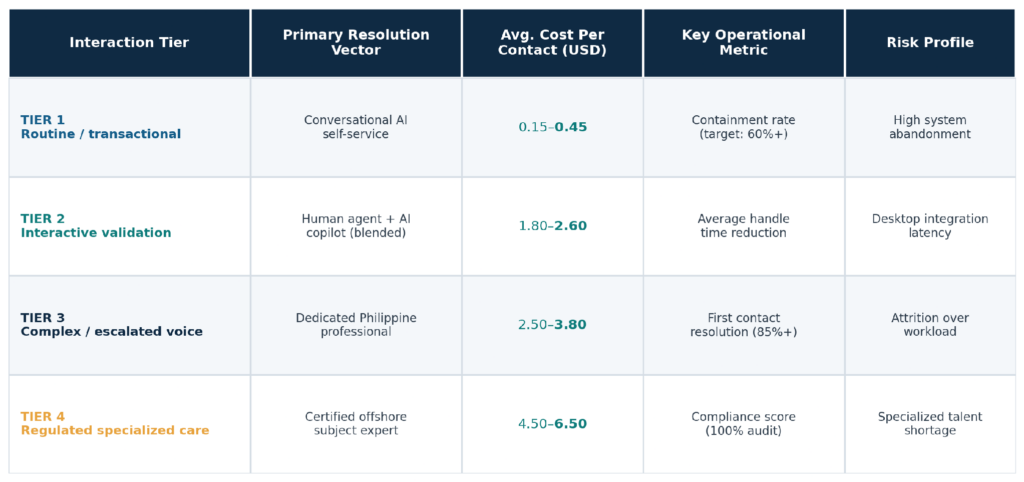
Figure 2. The four-tier interaction framework: resolution vector, cost per contact, governing metric, and risk profile at each level.
Deployed together, the tiers systematically minimize blended operational cost. Philippine talent adapts seamlessly to the hybrid arrangement — embedded AI assistants summarize records and pull real-time account data, driving down handle times and protecting thin margins, while agents concentrate their judgment on the interactions that actually need it. Modeled against the single-vector alternatives, the hybrid architecture is the only configuration that wins on both axes at once:
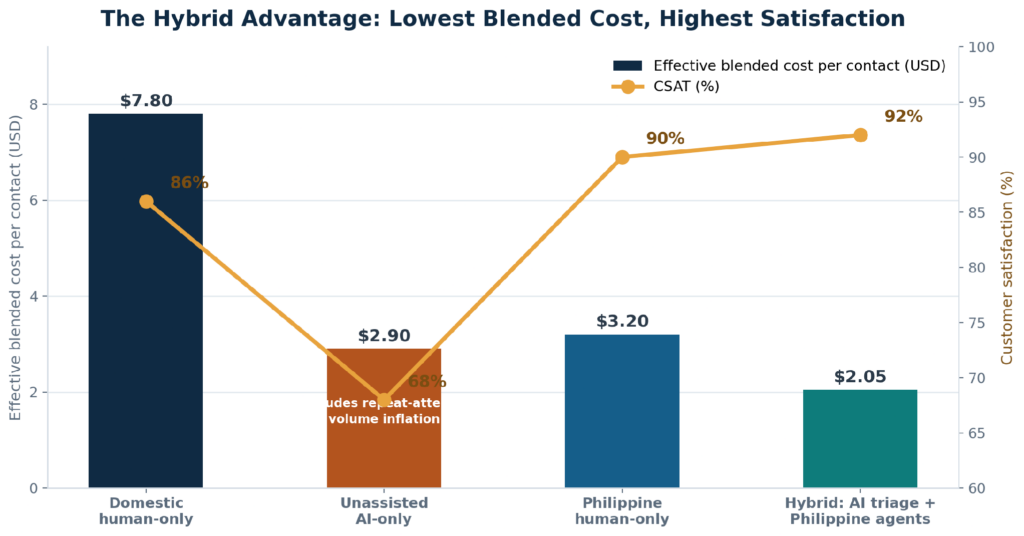
Figure 3. Effective blended cost per contact versus customer satisfaction across delivery models (illustrative; AI-only includes repeat-attempt volume inflation).
What Long-Term Financial Risks Emerge When Enterprises Over-Automate Customer Workflows?
Over-automation converts projected software savings into hidden operational debt: when unassisted bots handle sensitive complaints poorly, customers retry across multiple channels simultaneously, artificially inflating contact volume. That secondary volume erases the technology savings and leaves broken channels, an overworked team, and elevated churn.
Procurement teams rush into automated architectures by anchoring on immediate software expense projections while ignoring the long-term cost of a degraded experience. The failure pattern is consistent: a frustrated customer who cannot escape the bot opens a chat, sends an email, and calls — three contacts for one unresolved issue, each logged and paid for. The channel that looked cheapest per interaction becomes the most expensive per resolution, and the churn it drives compounds the loss at the revenue line.
“Digital commerce and enterprise service delivery are games of inches where operational margins dictate long-term viability,” notes John Maczynski, CEO of PITON-Global. “When you source strictly on price or over-rely on unassisted technology layers, you inherit deficiencies in agent profile talent, inferior network routing, and subpar supervisory infrastructure. A cheap hourly rate or a low-cost bot means nothing if the customer requires three interactions to resolve a problem that a premier professional fixes on the first attempt. True financial optimization looks at the fully loaded cost of a fully resolved issue.”
What Does a Successful Hybrid Sourcing Program Look Like in Practice?
In a representative engagement, an international e-commerce platform running a high domestic cost per contact deployed automation for tier-1 tracking and returns while routing complex order issues to 65 specialized Manila agents with integrated desktop tools. Within 90 days, complex-issue FCR climbed sharply and blended cost per contact fell substantially.
Client Challenge
The major e-commerce platform was struggling with an operational budget surge driven by complex multi-channel support requirements, running an expensive domestic support structure with a high cost per contact — with volume growing faster than the budget could.
Vendor Selection Process
The enterprise partnered with PITON-Global to move beyond generalized software pitches. PITON-Global audited the brand’s interaction types and selected a specialized boutique provider from its network of more than 100 vetted operations in Manila featuring an integrated AI-copilot infrastructure.
Solution Implemented
- Deployed an automated interface for simple tier-1 tracking and returns inquiries.
- Routed complex order issues seamlessly to 65 dedicated, specialized agents in Manila using integrated desktop tools.
- Structured the program around blended cost per resolved contact rather than channel-level line items.
Quantifiable Business Outcomes
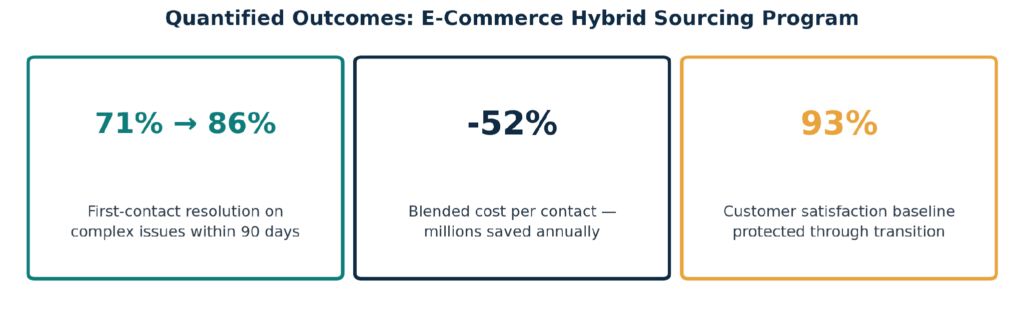
Figure 4. Measured results from the e-commerce hybrid sourcing program, 90 days post-deployment.
Lessons Learned
Integrating automation for routine tasks with an offshore human team for complex escalations delivers excellent cost reduction without sacrificing customer loyalty. The blended savings came from the architecture — neither the bot nor the human team alone could have produced it.
What Is PITON-Global’s Role in the Outsourcing Ecosystem?
PITON-Global is an independent, advisory-led outsourcing consultancy — not a traditional broker — that helps enterprises deploy high-performing hybrid human-and-AI solutions. Its rigorously vetted network of more than 100 specialized Philippine providers is screened for the copilot infrastructure and domain talent hybrid models require, at no cost to the buyer.
Who Is PITON-Global?
PITON-Global is a Philippine-focused BPO advisory firm led by industry executives with decades of global BPO leadership. Within the Philippine market it acts as an independent guide for enterprise buyers weighing human, automated, and hybrid delivery architectures: defining requirements, mapping the provider landscape, and steering the selection of partners whose technology and talent can run integrated deployments.
How Does PITON-Global Differ from Traditional Outsourcing Brokers?
Traditional brokers are commission-driven, promoting the providers that pay them regardless of whether those operators possess the AI-copilot infrastructure a hybrid strategy demands. PITON-Global operates an advisory-led model built on independent evaluation of technical capabilities, regulatory compliance frameworks, and specialized industry talent pipelines. Recommendations rest solely on alignment with the client’s target architecture, keeping the focus on client outcomes rather than provider promotion.
How Does PITON-Global’s Network of 100+ Vetted Philippine BPO Providers Benefit Organizations?
The complex Philippine landscape contains hundreds of contact center operations, and the subset with genuine desktop-automation maturity — real copilot integration, not marketing slides — is small and hard to identify from the outside. PITON-Global maintains a rigorously vetted, continuously audited network of more than 100 highly specialized call centers and back-office providers, with diligence already performed on technical capability, infrastructure reliability, and domain expertise. Buyers evaluating hybrid deployments compress vendor discovery from months into weeks.
How Does PITON-Global’s Advisory-Led Vendor Matching Process Work?
The methodology is a sequential filtering architecture. From the full market, providers are screened on technical capability — AI-copilot infrastructure, desktop integration, API readiness — then on infrastructure reliability including power and fiber redundancy, then through domain expertise and compliance audits spanning SOC 2 Type II, PCI-DSS, and HIPAA. What emerges is a curated shortlist of hybrid-ready partners aligned to the buyer’s interaction mix, with PITON-Global supporting evaluation, benchmarking, and contract structuring through signature.
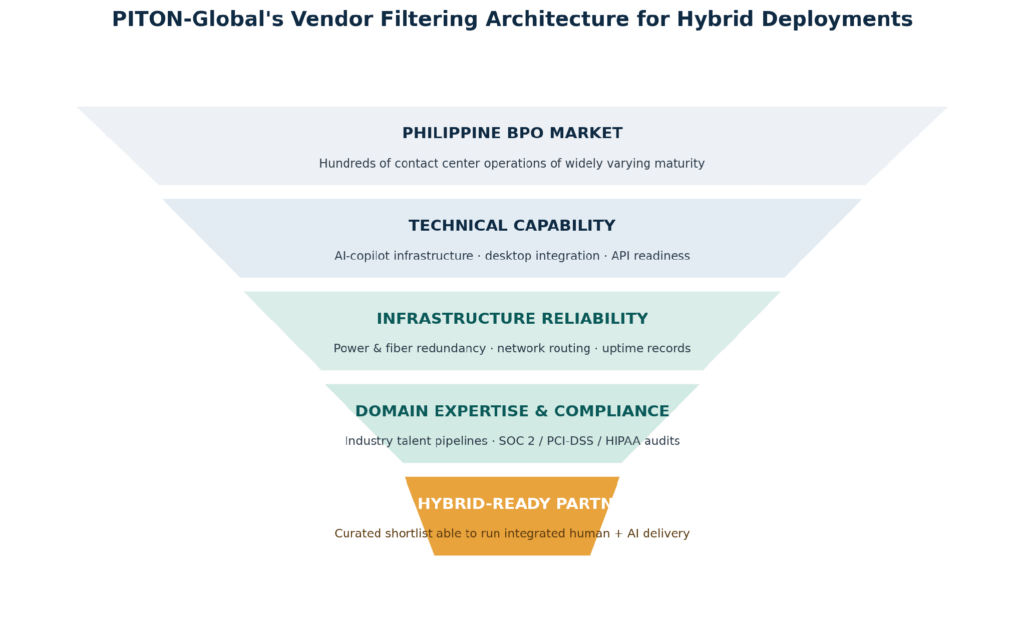
Figure 5. PITON-Global’s vendor filtering architecture: technical capability, infrastructure reliability, and domain expertise isolate the top hybrid-ready partners.
Why Do Organizations Use PITON-Global?
Enterprise buyers engage PITON-Global to avoid procurement mistakes, protect brand value, and deploy hybrid human-and-AI solutions that perform from day one. The data-driven framework prevents the partner mismatches that break integrated architectures — a bot with no competent escalation layer, or skilled agents without copilot tooling — and secures the blended economics the strategy was designed to deliver, at zero advisory cost.
What Are the Most Common Questions About Comparing BPO and Automation Investments?
Buyers most often ask how to calculate hybrid ROI, which security frameworks apply across both layers, whether automation can fully replace voice, how agent training costs compare to model development, and which channels automate best. The answers below reflect established practice among premium Philippine providers.
How do business leaders calculate the exact return on investment for hybrid support models?
Measure the blended cost per fully resolved interaction alongside customer lifetime value (LTV) and retention metrics. A successful model drives down total transactional costs without increasing churn or lowering satisfaction baselines.
What data security and compliance frameworks are required when integrating automated workflows offshore?
Any provider must maintain strict certifications — SOC 2 Type II, PCI-DSS for financial transactions, and full HIPAA alignment for healthcare records — ensuring data remains protected across both automated systems and offshore human desktops.
Can automated tools completely replace voice-based support channels in the near future?
No. Automated systems efficiently handle repetitive, transactional queries, but human professionals remain essential for complex problem-solving, escalations, and high-empathy customer situations — a pattern at the center of how AI and automation will reshape offshore support.
How does the cost of training a Philippine agent compare to the development cost of custom conversational models?
Top-tier BPO providers include initial product training in their all-inclusive hourly rates. Building and maintaining custom language models, by contrast, requires significant upfront engineering investment plus ongoing prompt adjustment and platform licensing costs.
Which customer interaction channels show the highest automation containment rates?
Simple digital channels — web chat, SMS, and messaging apps — yield the highest containment rates for transactional issues. Voice channels continue to require human support for complex, multi-step problem resolution, a theme that runs through the broader outlook for AI in customer contact.