

On this page
- Key Takeaways
- What Is the Financial Distinction Between Hourly Bill Rates and Cost Per Resolved Interaction?
- How Does First Contact Resolution Mathematically Compound Bottom-Line Savings?
- What Are the Operational Realities of Tracking Cost Per Productive Hour Over Paid Hour?
- What Does KPI-Driven Vendor Realignment Look Like in Practice?
- What Is PITON-Global’s Role in the Outsourcing Ecosystem?
- What Are the Most Common Questions About Post-Expansion Financial KPIs?
CEOs should monitor the fully loaded cost per resolved interaction, the financial impact of first contact resolution, the cost per productive hour, and the net financial yield of customer support. Tracking these metrics ensures the initial labor arbitrage translates into bottom-line profitability — surface-level hourly rates hide structural inefficiencies and artificial volume expansion. These four belong at the top of the operating scorecard buyers use with offshore vendors, not in place of it.
Key Takeaways
- Target fully loaded resolution: focus on the fully loaded cost per resolved interaction rather than raw agent hourly rates to measure true financial efficiency.
- Quantify quality multipliers: measure first contact resolution (FCR) as a capital metric — every lift removes downstream repeat contact volume and the transactional expenses attached to it.
- Isolate true capacity costs: track cost per productive hour to expose exactly how much unutilized or idle time is embedded in the provider’s billing structure.
- Audit location volatility: evaluate cost-to-performance variance between tier-1 capital zones (Manila) and provincial tech hubs (Cebu, Clark, Davao), where operating overhead compresses further.
- Never read KPIs in isolation: a low cost per resolution is financially invalid if it comes with a plunging CSAT — degraded satisfaction drives churn and depresses lifetime value.
- Contract structure enforces the metrics: resolution-based pricing models shift operational risk to the provider and force quality stability from day one.
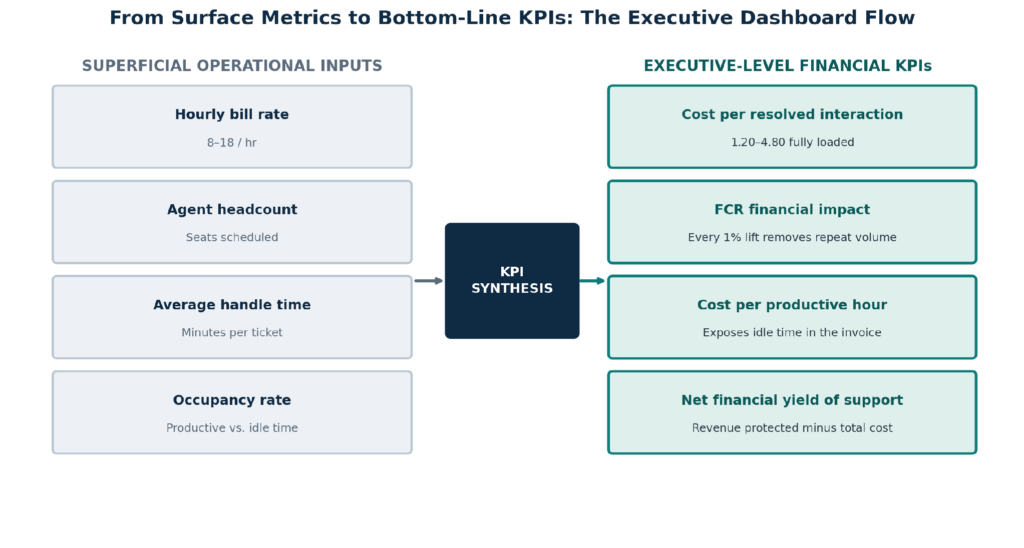
Figure 1. The executive dashboard flow: raw operational inputs synthesized into the four bottom-line KPIs CEOs should actually monitor.
What Is the Financial Distinction Between Hourly Bill Rates and Cost Per Resolved Interaction?
The hourly bill rate measures what an agent costs; the cost per resolved interaction measures what an outcome costs. A low fully loaded Philippine rate guarantees nothing by itself, because handle time, the AHT metric most dashboards lead with, decides the rest: an 18-minute handle time makes each contact expensive, while a tooled-up premium agent resolving the same issue in 10 minutes cuts that figure nearly in half.
Procurement teams frequently celebrate a steep reduction in hourly labor overhead when transitioning from the United States to the Philippines — and then stop measuring. That flat hourly filter creates an executive blind spot, because if the outsourced operation features poor agent training or low system occupancy, the time required to resolve each problem scales out and quietly reclaims the savings. True financial visibility requires multiplying productive time against the fully loaded operational cost to pinpoint the real cash outflow per completed transaction — which is why cost per resolved interaction, not the invoice rate, belongs on the CEO dashboard.
How Does First Contact Resolution Mathematically Compound Bottom-Line Savings?
At the C-suite level, FCR functions as a pure financial multiplier: every transaction that needs a secondary or tertiary follow-up means paying for the same customer issue multiple times. Once FCR slips, repeat interactions can inflate total contact volume substantially, rapidly wiping out any hourly rate advantage.
Elite-tier Philippine contact centers regularly secure consistently high FCR baselines, driven by strong cultural alignment and dedicated product training pipelines — which is why their slightly higher blended CPC delivers the lowest total spend. The hub-level economics make the trade-off explicit:
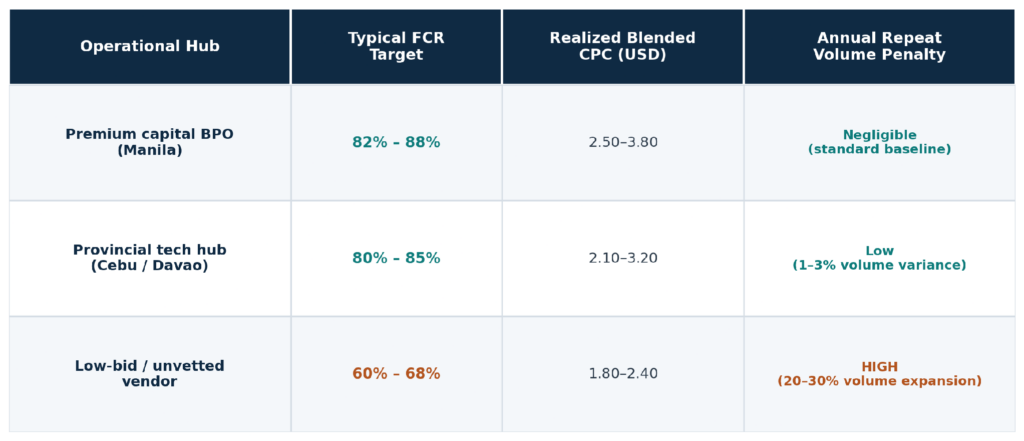
Figure 2. FCR targets, blended CPC, and the repeat-volume penalty across the three provider tiers.
The relationship is mechanical enough to chart. Hold headcount fixed and let FCR climb: repeat-driven volume drains out of the queue, and aggregate monthly expenditure falls with it. CEOs should tie the financial weight of repeat contact overhead directly to their vendor’s performance scorecard — the point where FCR slips is where a cheap contract quietly becomes an expensive one.
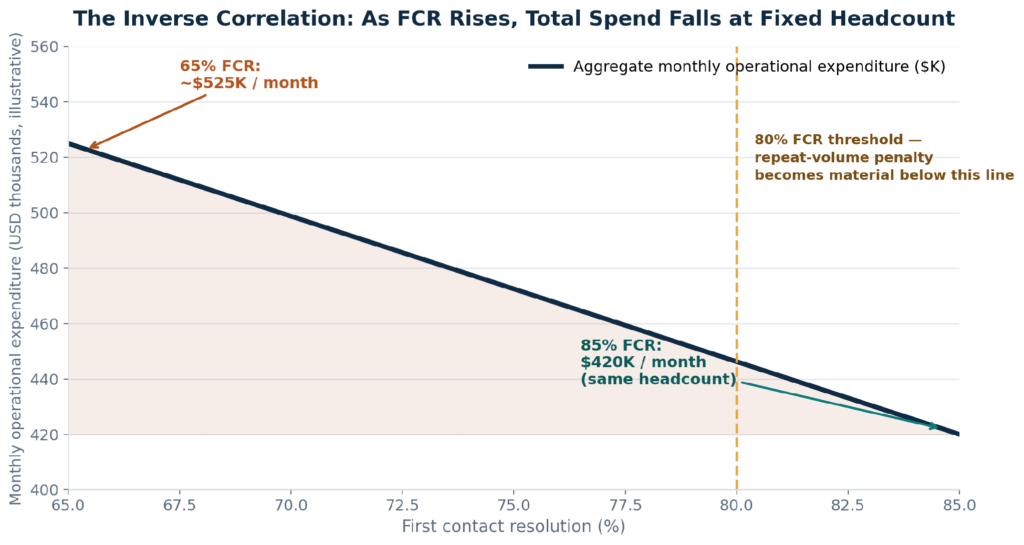
Figure 3. The inverse correlation: as first contact resolution rises, aggregate monthly expenditure declines at fixed headcount.
What Are the Operational Realities of Tracking Cost Per Productive Hour Over Paid Hour?
Standard contracts bill for scheduled agent presence, not productive output — so the same bill rate produces very different true costs depending on occupancy. A premium provider running disciplined, high occupancy delivers materially more financial return per invoice dollar than a cut-rate operator with thin occupancy.
Cost per productive hour forces transparency around unutilized capacity, idle time, and system latency, the hidden friction that process mining and continuous improvement are designed to expose. If a provider maintains poor workforce management algorithms or suffers frequent ISP latency drops, the client pays for non-productive agent time invoice after invoice — a leakage no hourly-rate comparison will ever surface. The arithmetic is simple and unforgiving:
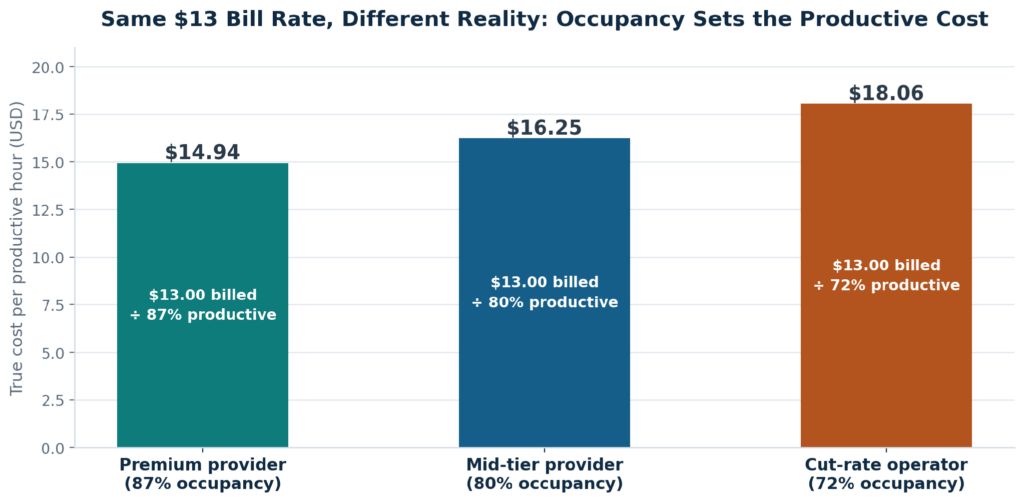
Figure 4. Occupancy sets the true cost: the same bill rate yields very different productive-hour costs depending on the provider’s discipline.
“Digital commerce and enterprise service delivery are games of inches where operational margins dictate long-term viability,” notes John Maczynski, CEO of PITON-Global. “When you source strictly on price, you inherit deficiencies in agent profile talent, inferior network routing, and subpar supervisory infrastructure. A cheap hourly rate means nothing if the agent requires three interactions to resolve a problem that a premier professional fixes on the first attempt. True financial optimization looks at the fully loaded cost of a fully resolved issue.”
What Does KPI-Driven Vendor Realignment Look Like in Practice?
In a representative engagement, a global logistics enterprise whose first Philippine expansion produced stagnant resolution paths and a sharp repeat-volume spike restructured around resolution-based KPIs with a new provider in Clark. Within 120 days, cost per resolved interaction fell steeply, FCR rose substantially, and net expenditure dropped sharply.
Client Challenge
The logistics and shipping enterprise expanded tier-1 customer support to the Philippines projecting an immediate, deep expense reduction. Instead, poor initial partner matching produced stagnant resolution paths, a marked spike in repeat contact volume, and bloated total outlays — the classic pattern of hourly-rate optimization without resolution KPIs.
Vendor Selection Process
The company engaged PITON-Global to reconstruct its vendor strategy. PITON-Global bypassed generalized market providers, audited the enterprise’s exact CRM systems, and filtered its network of 100+ vetted operations to identify specialized boutique providers with deep experience in transportation workflows.
Solution Implemented
- Matched the client with a premium, process-driven provider in Clark.
- Restructured the contract around a strict fully loaded resolution pricing model, decoupling the enterprise’s financial risk from agent idle time.
- Tied the vendor scorecard directly to FCR and cost per resolved interaction rather than billed hours.
Quantifiable Business Outcomes
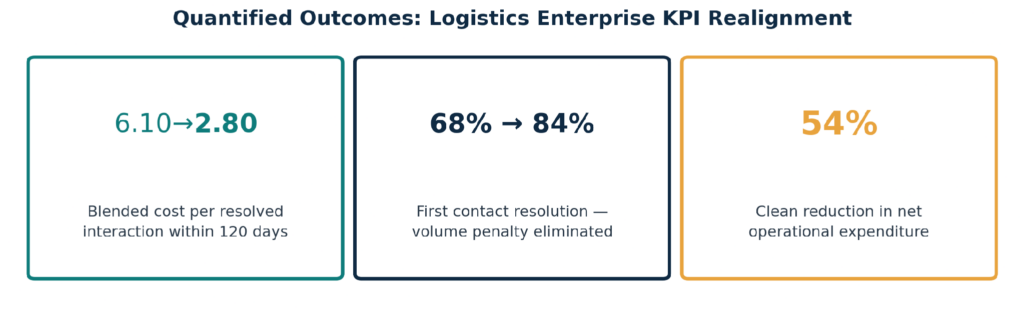
Figure 5. Measured results from the logistics enterprise’s KPI realignment, 120 days post-deployment.
Lessons Learned
Transitioning from unstructured hourly billing to tight, resolution-focused financial KPIs shifts operational risk entirely to the provider, forcing immediate quality stability. The metrics did not merely measure the turnaround — they caused it, which is why tracking the wider business impact of outsourced CX matters as much as tracking its price.
What Is PITON-Global’s Role in the Outsourcing Ecosystem?
PITON-Global is an independent, advisory-led outsourcing consultancy — not a commission-driven broker — that matches enterprise buyers with Philippine providers capable of sustaining executive-grade financial KPIs. Its continuously audited network of more than 100 specialized operators eliminates vendor matching friction, at no cost to the buyer.
Who Is PITON-Global?
PITON-Global is a Philippine-focused BPO advisory firm led by industry executives with decades of global BPO leadership. Within the Philippine market it acts as an independent guide for enterprise buyers: defining requirements, mapping the provider landscape, and steering the selection of contact center and back-office partners whose occupancy discipline, FCR track records, and pricing structures can support resolution-based KPI frameworks.
How Does PITON-Global Differ from Traditional Outsourcing Brokers?
Traditional commission-driven brokers profit from placements, steering buyers toward the operators that pay them — frequently the low-bid vendors whose weak FCR and thin occupancy discipline destroy the very KPIs executives need to protect. PITON-Global operates an advisory-led model built on independent evaluation of technology stacks, compliance structures, attrition histories, and performance records. Recommendations rest solely on alignment with the client’s requirements, keeping the focus on client outcomes rather than provider promotion.
How Does PITON-Global’s Network of 100+ Vetted Philippine BPO Providers Benefit Organizations?
The dense Philippine landscape contains hundreds of individual providers of widely varying maturity, and generic procurement cycles rarely reveal which ones can hold FCR and occupancy at scale. PITON-Global maintains a continuously audited network of more than 100 highly specialized call centers and back-office providers across Manila, Cebu, Clark, and Davao. Because diligence on technical capability, attrition history, and compliance has already been performed, buyers evaluate only the operators whose performance data supports executive-grade KPI commitments.
How Does PITON-Global’s Advisory-Led Vendor Matching Process Work?
The methodology is a sequential filtering architecture. From the full market, providers are screened first on technical capability — CRM and stack compatibility, automation tooling, network redundancy — then on attrition and performance history, then through compliance and security audits including site diligence and reference validation. What emerges is a curated shortlist drawn from a small top tier of the market, aligned to the buyer’s scale, channel mix, and industry, with PITON-Global supporting evaluation, KPI benchmarking, and contract structuring through signature.
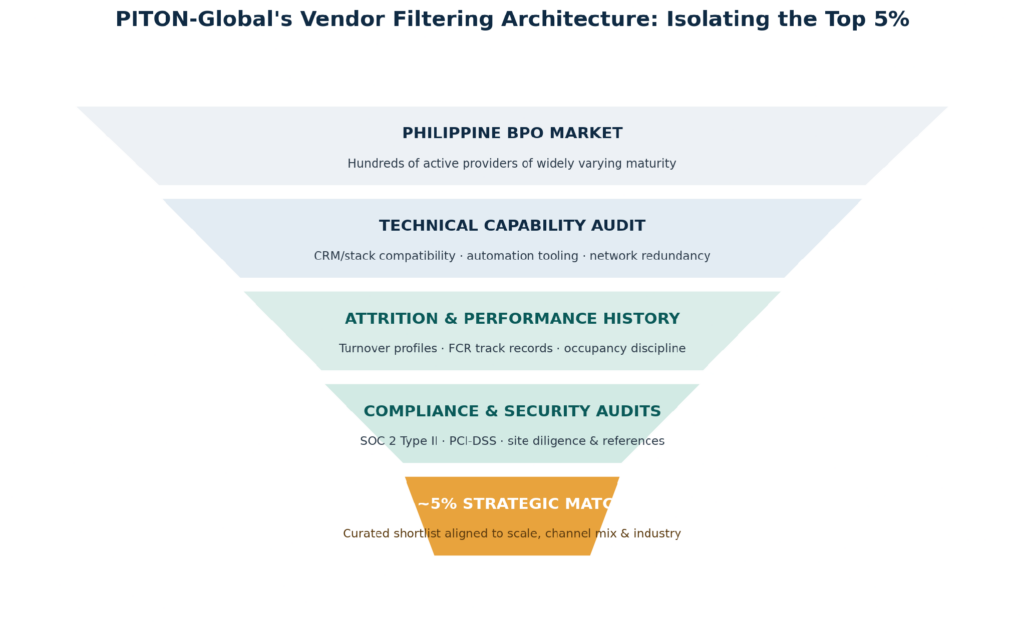
Figure 6. PITON-Global’s vendor filtering architecture: technical capability, attrition history, and compliance audits isolate a small top tier of providers.
Why Do Organizations Use PITON-Global?
Enterprise buyers engage PITON-Global to de-risk the sourcing cycle, insulate their brands from service degradation, and secure optimized financial KPIs from the first contact. The data-driven framework bypasses generic RFP cycles, prevents the partner-matching errors that produce repeat-volume penalties, and structures contracts around resolution economics — all at zero advisory cost.
What Are the Most Common Questions About Post-Expansion Financial KPIs?
Buyers most often ask how attrition affects productive-hour costs, what provincial expansion saves, how agentic AI changes cost structures, whether statutory benefits should be tracked separately, and how CSAT interacts with financial KPIs. The answers below reflect established practice among premium Philippine providers.
How does agent attrition in the Philippines affect an enterprise’s cost per productive hour?
High turnover introduces continuous hidden charges for recruiting, background checks, and nesting periods, while new agents operate at lower proficiency tiers — artificially extending handle times and decreasing resolved contacts per paid hour.
What is the financial impact of expanding into provincial Philippine hubs versus Metro Manila?
Provincial destinations like Cebu, Clark, and Davao generally deliver a meaningful reduction in fully loaded seat costs through lower real estate overhead and labor competition — though executives must verify institutional-grade power and fiber redundancy locally.
How does the integration of agentic AI workflows modify traditional per-contact cost structures?
Modern implementations use hybrid models where AI handles tier-1 triage and human agents function as “AI pilots” for complex tasks — shifting pricing from simple hourly fees toward outcome-based micro-transactions and dropping resolved-interaction costs significantly.
Should statutory benefits like the 13th-month pay be tracked as separate variable line items?
No. Under a premium fully loaded hourly or transactional agreement, all localized structural mandates — the mandatory 13th-month salary, night-shift differentials, and local healthcare structures — should be bundled into the base rate.
How do variation metrics in customer satisfaction (CSAT) affect the validity of financial KPIs?
Financial KPIs should never be reviewed in isolation. A low cost per resolved interaction is financially invalid if it produces a plunging CSAT baseline, since degraded satisfaction drives customer churn and depresses long-term lifetime value.