

TL;DR: The 2026 Strategic Pivot
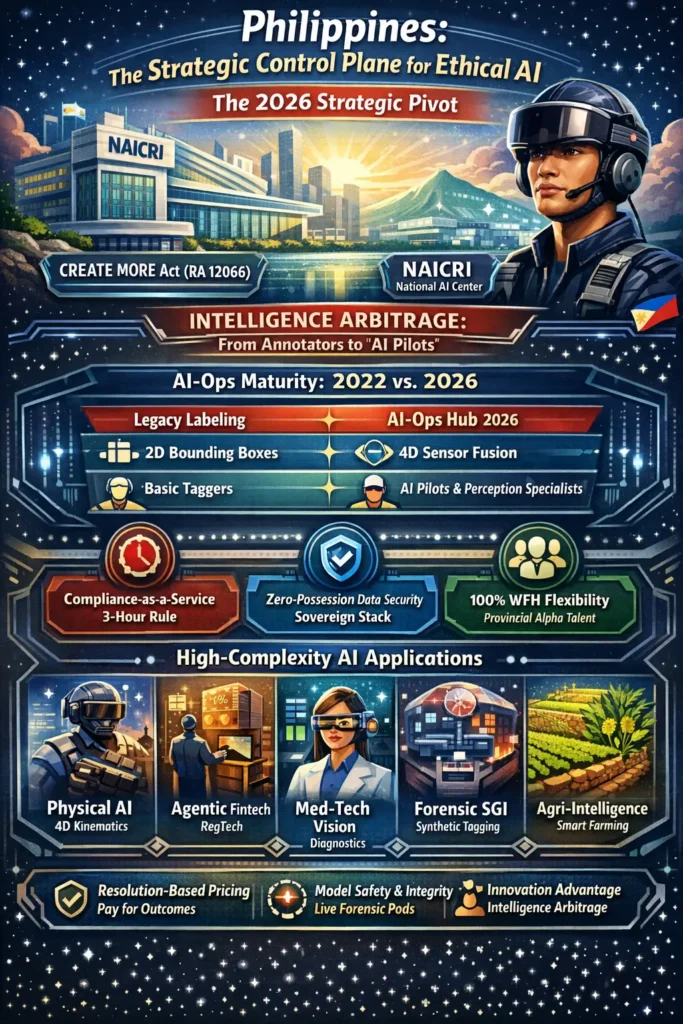
As of March 2026, labeling services in the Philippines have officially transcended the era of “manual data entry.” They are now one layer of the Filipino training-data teams serving AI companies, alongside RLHF and evaluation. The sector has ascended into a high-stakes tier of AI-Ops Governance, anchored by the CREATE MORE Act (RA 12066) and the newly launched National AI Center for Research and Innovation (NAICRI). The sector now provides the global market with “Intelligence Arbitrage”—combining high-AQ (Adaptability Quotient) human reasoning with a legally auditable, sovereign data pipeline that serves as a “human firewall” against model hallucinations.
The 2026 Operational Paradigm: From Annotators to “AI Pilots”
In the high-velocity AI economy of 2026, the term “annotator” is obsolete. Local labeling hubs now deploy AI Pilots—highly skilled technicians who do not merely tag data but orchestrate autonomous agents. These specialists handle the “Exception Path”—the critical minority of complex, high-stakes data that automated tools cannot resolve.
Under the February 2026 IT Rule Updates, global platforms are now legally mandated to identify and watermark Synthetically Generated Information (SGI) within a 3-hour window. These hubs have pioneered “Compliance-as-a-Service,” providing 24/7 forensic teams that perform real-time metadata tagging and “Red Teaming” to ensure that AI models remain safe, unbiased, and ethically aligned before they reach production.
The CREATE MORE Act: 2026 Fiscal Velocity
The CREATE MORE Act (RA 12066), fully operational as of late 2025, has redefined the economics of AI-Ops. This legislation provides a specific competitive moat for the local labeling sector:
- Enhanced Deductions: RBEs (Registered Business Enterprises) now enjoy a reduced Corporate Income Tax rate and additional deductions for power and AI-specific upskilling.
- Compute Subsidies: Because 4D sensor fusion and volumetric labeling are compute-intensive, these deductions allow local firms to maintain a substantial TCO reduction compared to onshore labs while utilizing top-tier GPU infrastructure.
- Full WFH Flexibility: The Act has institutionalized remote work, allowing BPOs to tap into “Provincial Alpha” talent—highly educated specialists in regional hubs where attrition runs lower than in Metro Manila.
Table 1: The AI-Ops Maturity Matrix (2022 vs. 2026)
How the sector has elevated the “Ground Truth” standard for the global enterprise.
| Capability | Legacy Labeling (Pre-2025) | Philippine AI-Ops Hub (2026) |
| Primary Task | 2D Bounding Boxes | 4D Sensor Fusion & Temporal Tracking |
| Workforce Skill | Basic visual recognition | AI Pilots / Perception Specialists |
| Core Metric | Cost-per-Asset / Hourly Rate | Model Performance Lift / Safety Gain |
| Data Security | Standard VPN / NDAs | Zero-Possession Pixel-Streaming |
| Success Logic | Labor Arbitrage (Save Money) | Intelligence Arbitrage (Scale Precision) |
The Sovereign Stack: Zero-Possession Architecture
To satisfy the EU AI Act and the US SEC Cyber Resilience Framework, premier providers have implemented Zero-Possession Data Architecture. In this 2026 gold-standard setup:
- Data Sovereignty: Your proprietary training data remains on your home servers (US/UK/AU).
- Pixel-Streaming: Offshore specialists “view” the data through encrypted, low-latency VDI (Virtual Desktop Infrastructure).
- Zero Residency: No data is ever cached, stored, or physically resides in-country, ensuring total compliance with global data residency mandates and the Philippine Data Privacy Act.
Strategic Application: The 4D Kinematic Frontier
As “Physical AI”—humanoid robots and autonomous logistics—moves from lab to city streets, the demand for 4D Kinematic Mapping has surged. Filipino labs excel at synchronizing multi-modal feeds (LiDAR + Radar + 4K Video) into a single “Environmental Twin.” This requires more than sight; it requires a deep understanding of physics, object permanence, and human intent, as traced in how data labeling moved from 2D tags to 4D fusion.
Table 2: 2026 High-Complexity Strategic Blueprints
The country provides specialized clusters for the most regulated AI domains, including medical image annotation for diagnostics.
| Application Sector | Complexity | Necessary Knowledge | Strategic ROI |
| Physical AI | Extreme | 4D Kinematics & Physics | Powers safe human-robot proximity. |
| Agentic Fintech | High | Logic & Workflow Mapping | Ensures agents follow 2026 legal protocols. |
| Med-Tech Vision | High | Anatomy & Pathology | Drives 98%+ clean-claim & diagnostic rates. |
| Forensic SGI | Moderate | Metadata & Provenance | Compliance with the 3-Hour Takedown Rule. |
| Agri-Intelligence | Moderate | Multispectral Analysis | Validates carbon credits & predictive harvest. |
Expert Strategic Insights: The PITON-Global Q&A
What is the impact of the “3-Hour Rule” on Philippine labeling?
The 2026 IT Rule amendments require platforms to remove or label harmful synthetic content rapidly. Local hubs now offer “Live Forensic Pods” that work in real-time to identify and watermark AI-generated content, keeping your platform within the legal safe harbor of the world’s most stringent regulators.
How does “Intelligence Arbitrage” differ from traditional outsourcing?
Traditional outsourcing was about saving on hourly labor. In 2026, you outsource to gain an Innovation Advantage. It is the strategy of using high-tier, Western-trained Filipino talent to manage AI-augmented workflows, providing the “judgment layer” that prevents model collapse.
Can I transition from “Per-FTE” to “Outcome-Based” billing?
Yes. In 2026, top-tier providers offer Resolution-Based Pricing. You pay for a successful model outcome (e.g., a fee per batch of validated edge cases) rather than raw hours, aligning the partner’s incentives with your model’s accuracy.
How does PITON-Global vet its partners in this high-tech era?
We have moved from auditing “speed” to auditing “Logical Integrity.” We verify that our partners utilize Zero-Possession frameworks and have a workforce with high spatial-reasoning scores, ensuring they can function as “Logic Guardians” for your most sensitive IP. The wider checklist is in what sets the top AI and autonomy vendors apart.