

On this page
- Key Takeaways
- What Are the Key Fiscal and Foreign Exchange Risk Vectors in Philippine BPO Engagements?
- How Does the CREATE MORE Act Alter the Tax and Regulatory Landscape for Foreign Buyers?
- How Do Geopolitical Realities and Regional Strains Impact Operational Continuity?
- What Physical and Operational Infrastructure Safeguards Are Required to Ensure Resilience?
- What Does Structural Risk Mitigation Deliver in Practice?
- How Does PITON-Global Reduce Outsourcing Risk for Enterprise Buyers?
- Frequently Asked Questions
Finance leaders must weigh macro-fiscal policy, FX exposure, and regional geopolitics against operational delivery frameworks. The Philippines offers a mature, large-scale IT-BPM sector, but managing tail risk means structuring contracts around local tax incentives, dual-peered infrastructure redundancy, and multi-hub delivery rather than unhedged spot rates and single-site operations. These financial safeguards sit on top of the business continuity and risk controls for offshore operations a qualified vendor should already hold.
Key Takeaways
- Fiscal reform stability. The CREATE MORE Act (RA 12066), signed into law in 2024, provides long-term tax clarity: a 20% corporate rate under the Enhanced Deductions Regime, or a 5% Special Corporate Income Tax.
- Foreign exchange hedging. Unhedged PHP/USD movement flows straight into fully loaded hourly seat rates; models need rolling corridors and indexation clauses.
- Geopolitical positioning. The Philippines maintains defense alignment with Western nations, insulating service delivery from the trade disputes affecting other regional processing hubs.
- Geographic diversification. Typhoon activity and localized grid strain require split delivery across Metro Manila and Next Wave cities such as Cebu, Clark, and Iloilo.
- Advisory-led partner vetting. An independent advisor removes brokerage markups and narrows a 1,000-provider market to audited mid-market operators.
What Are the Key Fiscal and Foreign Exchange Risk Vectors in Philippine BPO Engagements?
Three vectors dominate: PHP/USD volatility eroding planned margin, legislative and tax policy shifts affecting export status, and localized wage inflation from statutory increases and talent competition. Each is contractible in advance through currency corridors, registered-facility delivery, and multi-tier hub wage structures.
Cost structure analysis has to go beyond headline labor arbitrage, because the arbitrage is stable while the variables around it are not. A rate agreed in year one is exposed to currency movement, statutory wage orders, and incentive-regime changes across a multi-year term, and none of those are visible in the comparison that won the business case. Margin, not rate, is what finance is protecting, the same logic that turns fraud review for online travel agencies from a cost line into revenue protection.
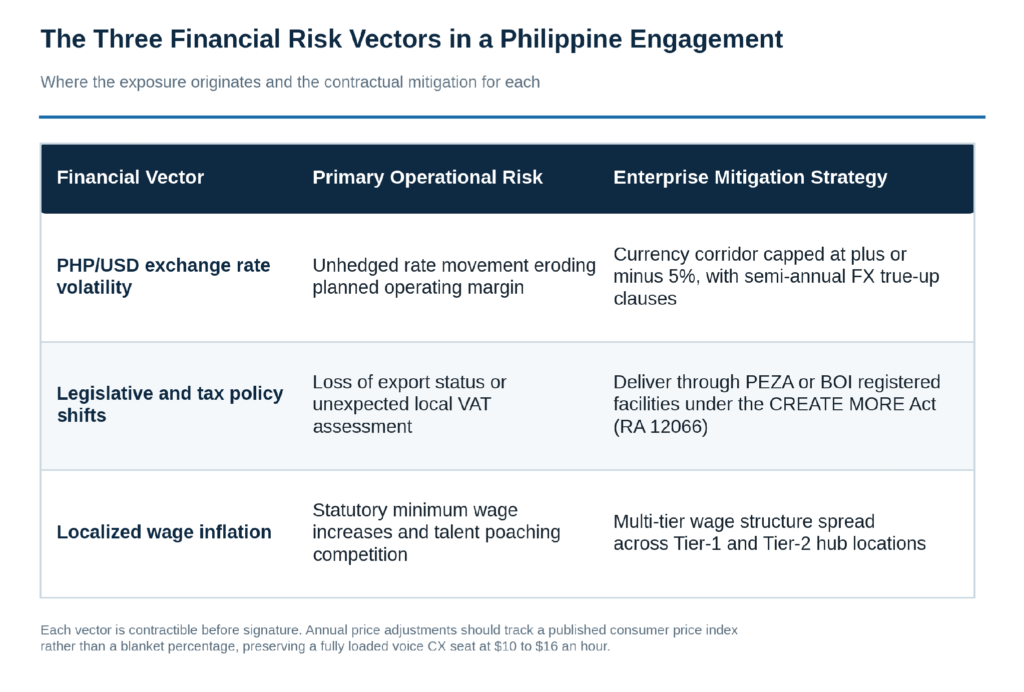
Figure 1. The three financial risk vectors, their operational consequence, and the mitigation that belongs in the contract.
Currency Corridors and the Value of Predictability
Philippine delivery billed in USD leaves the provider carrying peso-denominated costs, and an unhedged contract eventually resolves that tension through a renegotiation the buyer did not budget for. A narrow corridor with semi-annual true-up clauses means billing moves only on systemic shifts.
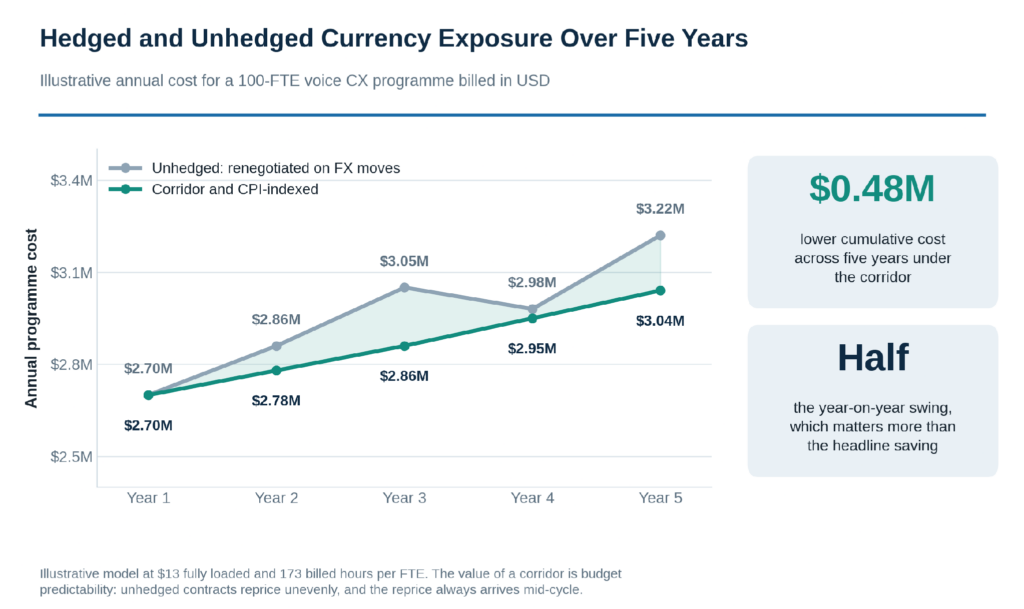
Figure 2. Hedged and unhedged currency exposure across five years for an illustrative 100-FTE voice CX program.
The headline saving in that model is modest next to what the program costs each year. The more valuable outcome is the shape of the line. Unhedged contracts reprice unevenly and always mid-cycle, which is precisely when a finance function has least room to absorb it. A corridor converts an unpredictable event into a scheduled adjustment.
Index Inflation to Something Published
Annual price adjustments should track a published consumer price index rather than a blanket percentage increase, and should apply to the labor component rather than the total invoice — facilities, technology, and vendor margin do not move with Philippine wage inflation. Handled this way, a fully loaded voice CX seat stays inside its contracted band across the term rather than drifting above it.
Spread Wage Exposure Across Hub Tiers
Statutory minimum wage increases and talent poaching pressure are strongest in Metro Manila, where competition for experienced agents is most intense. A multi-tier wage structure that places part of the program in Tier-2 locations reduces the average exposure to any single regional wage order and gives the provider a genuine option when Manila pay bands move.
How Does the CREATE MORE Act Alter the Tax and Regulatory Landscape for Foreign Buyers?
Republic Act 12066, signed in 2024, lets Registered Export Enterprises elect either a 5% Special Corporate Income Tax on gross income or an Enhanced Deductions Regime at a 20% corporate rate, down from 25%. It also codifies VAT zero-rating on directly attributable local purchases and permits work-from-home without forfeiting incentives.
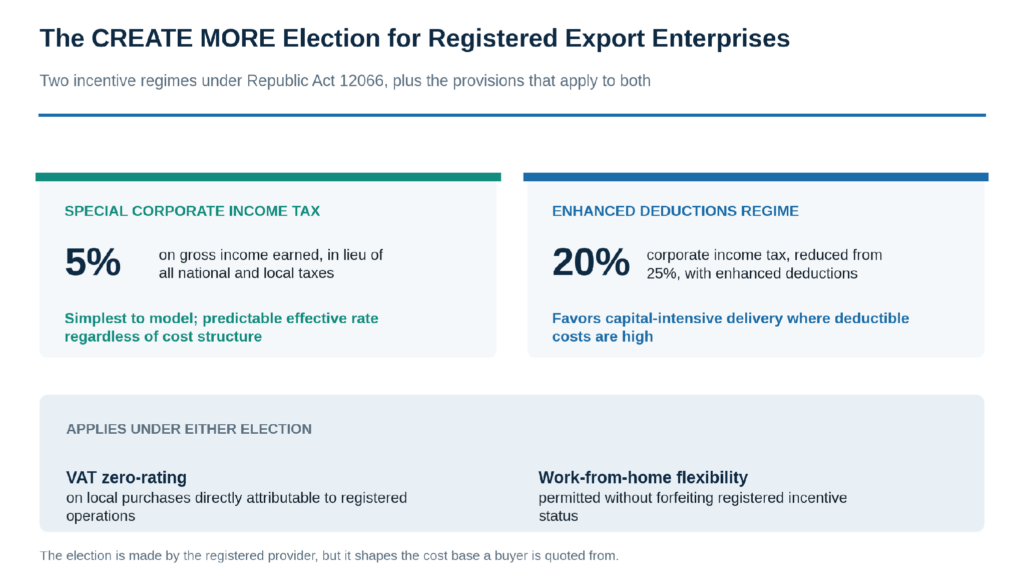
Figure 3. The CREATE MORE election for Registered Export Enterprises, and the provisions that apply under either regime.
The election is made by the provider rather than the buyer, but it shapes the cost base a buyer is quoted from and it is worth understanding during evaluation. The gross-income regime is simpler to model and produces a predictable effective rate; the enhanced deductions route favors capital-intensive delivery where deductible costs are high. A provider that cannot explain which regime it operates under, and why, is telling you something about its financial sophistication.
Work-From-Home Flexibility Is a Continuity Asset
The codified allowance for flexible work arrangements without jeopardizing incentive status matters more than it appears in a tax discussion. It gives a provider a legitimate third continuity option alongside its primary and secondary sites, and it removes the tension that previously existed between maintaining registered status and keeping agents productive during a regional disruption.
Offshoring is no longer a simple labor arbitrage calculation; it is an exercise in structural risk management. If your advisory partner isn’t auditing vendor balance sheets, dual-source fiber paths, and WFH compliance protocols down to the floor-level operator, you aren’t saving money — you’re underwriting unhedged liability.
— John Maczynski, CEO, PITON-Global
How Do Geopolitical Realities and Regional Strains Impact Operational Continuity?
Separate maritime headlines from onshore operational security. South China Sea tensions remain a diplomatic matter, while the Philippines maintains defense ties with Western allies, operates under a democratic framework with legislative backing for foreign investment, and treats IT-BPM as national infrastructure given its share of GDP.
The practical question for a finance leader is not whether regional tension exists but whether it reaches the delivery floor. The distinction that matters commercially is between jurisdictions where regulatory direction can change abruptly — sudden clampdowns, data localization mandates, or digital access restrictions imposed without consultation, a problem explored in our look at compliance across multi-country delivery — and jurisdictions where change moves through legislative process. The Philippines sits in the second category, and the CREATE MORE Act is a recent illustration of how incentive policy moves there: through published legislation with transition provisions.
Sector Weight Creates Institutional Protection
IT-BPM accounts for a substantial share of national GDP and employs close to two million people, which makes the sector’s operational security a policy priority rather than a private concern. That alignment is worth something in a risk assessment: infrastructure investment, law enforcement attention, and regulatory accommodation all follow economic weight, and the sector has enough of it to be treated as national infrastructure.
Assess Concentration, Not Geography
The residual geopolitical exposure most buyers actually carry is concentration rather than country: a single provider, in a single facility, in a single metro area. That is a manageable risk with a known structural answer, and it is the same answer whether the disruption arrives as weather, grid failure, or something else entirely.
What Physical and Operational Infrastructure Safeguards Are Required to Ensure Resilience?
Three standards: Tier-IV facility characteristics with dual utility sub-station feeds and generators backed by 72-hour fuel contracts, multi-carrier fiber over diverse subsea cable landings on separate physical backbones, and split-site delivery for any program above 50 FTEs.
Typhoon season is an annual, predictable event rather than an exceptional one, which means resilience is a partner-selection standard rather than a matter of geographical avoidance. Every major Philippine hub carries some weather exposure; the difference between providers is what happens to your program when the weather arrives.
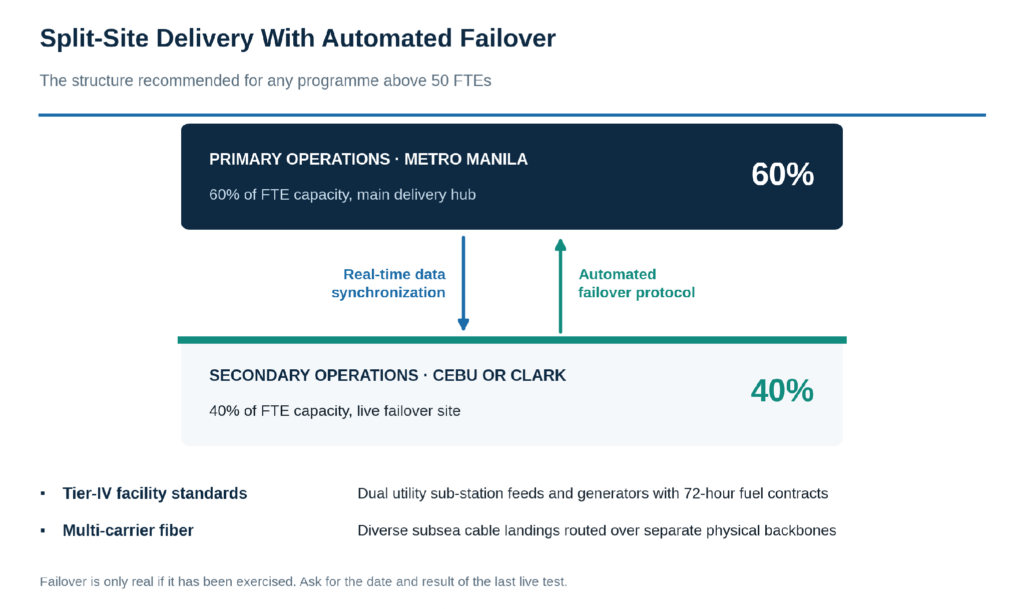
Figure 4. Split-site delivery with automated failover, the structure recommended above 50 FTEs.
Verify the Fiber Path, Not the Carrier Count
Two carriers routed over the same physical backbone or the same subsea landing station is one carrier with two invoices. Ask which cable systems each route uses and confirm they are physically diverse, because a single cable fault has taken out nominally redundant arrangements more than once in this region.
Split-Site Only Works If It Has Been Exercised
A 60/40 split across Metro Manila and a secondary hub gives real capacity to fail into, provided the synchronization is live and the failover has been rehearsed. Ask for the date and result of the last live test rather than the continuity plan document. A plan that has never been exercised under load is a hypothesis, and the first real test should not be a Category 4 typhoon.
What Does Structural Risk Mitigation Deliver in Practice?
A mid-market North American fintech running 120 onshore FTEs at a high fully loaded rate moved 80 seats to Bonifacio Global City with a 20-FTE recovery hub in Iloilo, under a provider on the Special Corporate Income Tax regime and a narrow currency band. The rate fell to a fraction of the onshore figure, saving millions of dollars a year.
Client Challenge
The company carried escalating fully loaded onshore labor costs and, more seriously, ran its entire back-office and customer support function from a single onshore location. The cost problem was visible on every invoice; the concentration problem was invisible until something interrupted it, which is the usual sequence.
Vendor Selection Process
PITON-Global audited 14 mid-sized Philippine operators against balance sheet health, power redundancy, SOC 2 Type II compliance, and geographic distribution, producing a shortlist of three within 72 hours. Screening financial health alongside infrastructure matters here: a provider without reserves cannot fund the redundancy it has described, and both failures surface at the same moment.
Solution Implemented
Eighty FTEs moved to a high-performing mid-market provider in Bonifacio Global City with a 20-FTE disaster recovery hub in Iloilo. The provider was structured under the gross-income SCIT regime, and the agreement fixed a narrow USD/PHP currency band.
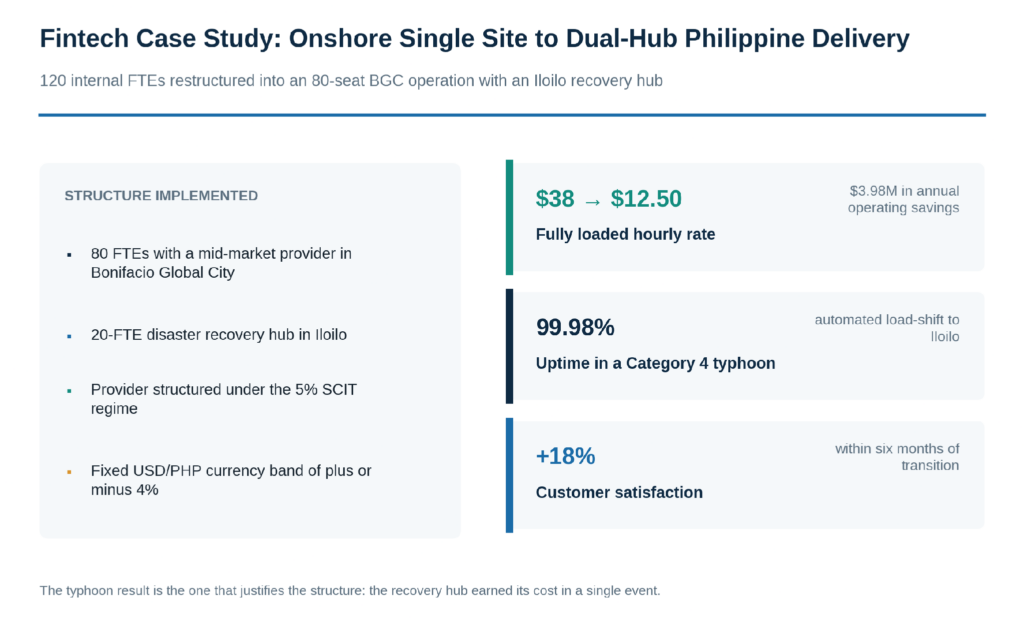
Figure 5. The structure implemented and the outcomes achieved.
Outcomes and Lessons
The fully loaded rate fell to a fraction of the onshore figure, yielding a multi-million-dollar annual operating saving, while customer satisfaction rose measurably within six months on the back of specialized financial services staffing. The result that justifies the architecture, though, is the near-continuous uptime maintained through a Category 4 typhoon via automated load-shifting to Iloilo. The recovery hub was an ongoing cost until that week, and it repaid itself in a single event. Offshoring financial workflows requires dual-hub redundancy inside the Philippines and contractual currency safeguards to protect the margin over the term.
How Does PITON-Global Reduce Outsourcing Risk for Enterprise Buyers?
PITON-Global is an independent, vendor-neutral BPO advisory firm headquartered in Manila and operating on the ground since 2001. It audits more than 1,000 Philippine providers, maintains a curated network drawn from the strongest of them, and delivers a shortlist of six to ten qualified operators within 48 to 72 hours at no cost to the buyer.
Who Is PITON-Global?
Led by John Maczynski and Ralf Ellspermann, the firm brings more than 65 combined years of operational leadership across a large portfolio of BPO contracts. That operating background is what the advisory work rests on: assessing whether a provider’s redundancy claims are real, whether its balance sheet supports the structure being proposed, and whether its incentive registration is current requires having run delivery rather than having read about it.
How Does PITON-Global Differ from Traditional Outsourcing Brokers?
Traditional brokers sell seats for whichever vendor offers the highest commission, which shapes both the recommendation and the point at which the relationship ends. PITON-Global operates with vendor neutrality: the advisory service is delivered at no cost to the buyer, recommendations may include providers with no commercial relationship to the firm, and the engagement continues through RFP governance and commercial structuring rather than concluding at introduction.
How Does PITON-Global’s Network of 100+ Vetted Philippine BPO Providers Benefit Organizations?
The network is the residue of auditing more than 1,000 operators: roughly 100 vetted mid-market providers, filtered to exclude both under-resourced shops and conglomerates that would treat a mid-sized account as secondary. For risk work specifically, that filtering matters because balance sheet health, power redundancy, and compliance certification, measured against the standards Philippine call centers are expected to meet, are assessed before a buyer ever sees a name.
How Does PITON-Global’s Advisory-Led Vendor Matching Process Work?
Three steps: a requirements audit covering operational, compliance, and cultural criteria; network filtering to the curated top tier; and a competitive RFP in which six to ten qualified providers pitch directly and are compared on a like-for-like basis.
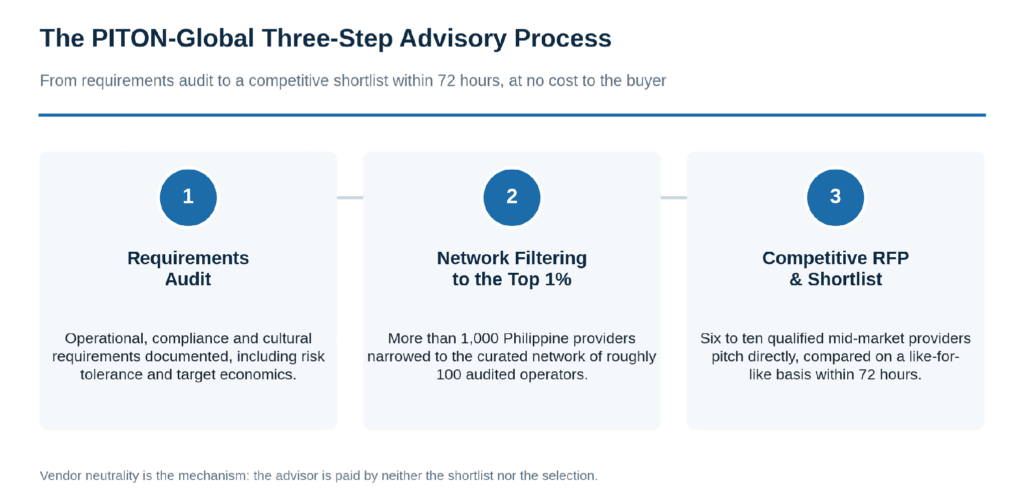
Figure 6. The three-step advisory process, from requirements audit to competitive shortlist within 72 hours.
Why Do Organizations Use PITON-Global?
- Reduced selection risk. Balance sheet health, redundancy, and compliance verified before shortlisting rather than after an incident.
- Institutional-grade pricing. Competitive RFP discipline among pre-qualified providers replaces a single negotiation with an incumbent.
- Structural risk management. Currency corridors, split-site design, and incentive-regime alignment engineered into the agreement.
- Speed without shortcuts. A qualified shortlist within 48 to 72 hours, drawn from diligence already completed.
- No cost to the buyer. Advisory, matching, and RFP governance delivered from the buyer’s side of the table.
Frequently Asked Questions
What is the average fully-loaded hourly rate for a voice CX agent in the Philippines?
Fully loaded voice CX rates are quoted per hour and bundle direct wages, health benefits, facilities, technology licensing, management oversight, and vendor margin; current bands are set out on our pricing page. Back-office processing sits lower, and specialized financial or technical roles sit above the voice band.
How does the CREATE MORE Act protect foreign companies from local tax exposure?
Since its 2024 enactment, it clarifies VAT zero-rating on local purchases directly attributable to registered operations, reduces corporate income tax to 20% under the enhanced deductions route, offers a 5% special rate on gross income as an alternative, and permits flexible work-from-home arrangements without forfeiting incentive status.
Should enterprise buyers choose a large global BPO or a mid-sized Philippine provider?
For programs scaling between 15 and 300 FTEs, mid-sized providers of roughly 500 to 5,000 seats typically deliver higher executive focus, lower attrition, and greater agility. Large global providers may assign smaller accounts to secondary teams, which is a service risk rather than a pricing one.
How do finance leaders manage currency risk when paying Philippine BPO providers?
Through an FX corridor written into the contract. Rates stay fixed while USD/PHP remains inside an agreed band, commonly a few points either side, with cost-sharing triggered only if movement exceeds the band and persists. Make the mechanism symmetrical so it works in both directions.
Is PITON-Global’s advisory service really free to enterprise buyers?
Yes. Vendor-neutral advisory, matching, and RFP governance are provided at no cost to the buyer, with the firm operating as an independent advisor on the buyer’s side of the table rather than as a reseller of provider capacity.