

On this page
- Key Takeaways
- Which Operational Metrics Form the Foundation of Reliable Service Guarantees?
- How Can Contracts Balance Accountability with Philippine Market Realities?
- How Should Financial Remedies and Incentives Be Tiered?
- How Should Procurement Teams Design a Guarantee End to End?
- What Does a Balanced Guarantee Deliver in Practice?
- Why Partner with PITON-Global for Strategic Offshore BPO Selection?
- Frequently Asked Questions
Enterprises should structure BPO performance guarantees by pairing objective operational metrics such as First Contact Resolution and Average Handling Time with enforceable financial remedies like tiered service credits. Contracts must establish baseline thresholds while building in realistic buffers for local attrition, statutory holidays, and seasonal volume spikes. Guarantees are one clause set inside the wider agreement, alongside audit rights, governance cadence and exit terms.
Key Takeaways
- Core metric alignment. Tie guarantees to quantifiable operational KPIs: First Contact Resolution, Net Promoter Score, and schedule adherence.
- Tiered financial remedies. Apply symmetrical service credits, set as a tiered share of monthly management fees, for repeated KPI failures, paired with an upside pool.
- Baseline exclusion buffers. Account for Philippine holiday staffing, typhoon-season disruption, and the ramp-up learning curve before penalties bind.
- Continuous monitoring. Use real-time workforce management dashboards so both parties audit performance from the same source.
- Advisory-led structuring. Balance punitive clauses with realistic incentives that protect continuity rather than provoking defensive behavior.

Figure 1. A basic penalty model compared with a balanced scorecard model across metrics, remedies, exclusions, and monitoring.
Which Operational Metrics Form the Foundation of Reliable Service Guarantees?
Select metrics that reflect delivery quality without creating perverse incentives: First Contact Resolution, schedule adherence, Net Promoter Score, and monthly attrition, each with a written target drawn from measured baseline performance. Three to five well-chosen indicators outperform a long list weighted equally.
Accountable contracts in Metro Manila, Cebu, or Clark depend on a balanced scorecard covering efficiency, customer satisfaction, and workforce stability. The reason to keep the list short is behavioral: a provider managing fifteen equally weighted targets manages none of them deliberately, while a provider managing four knows exactly where to invest supervision and coaching.
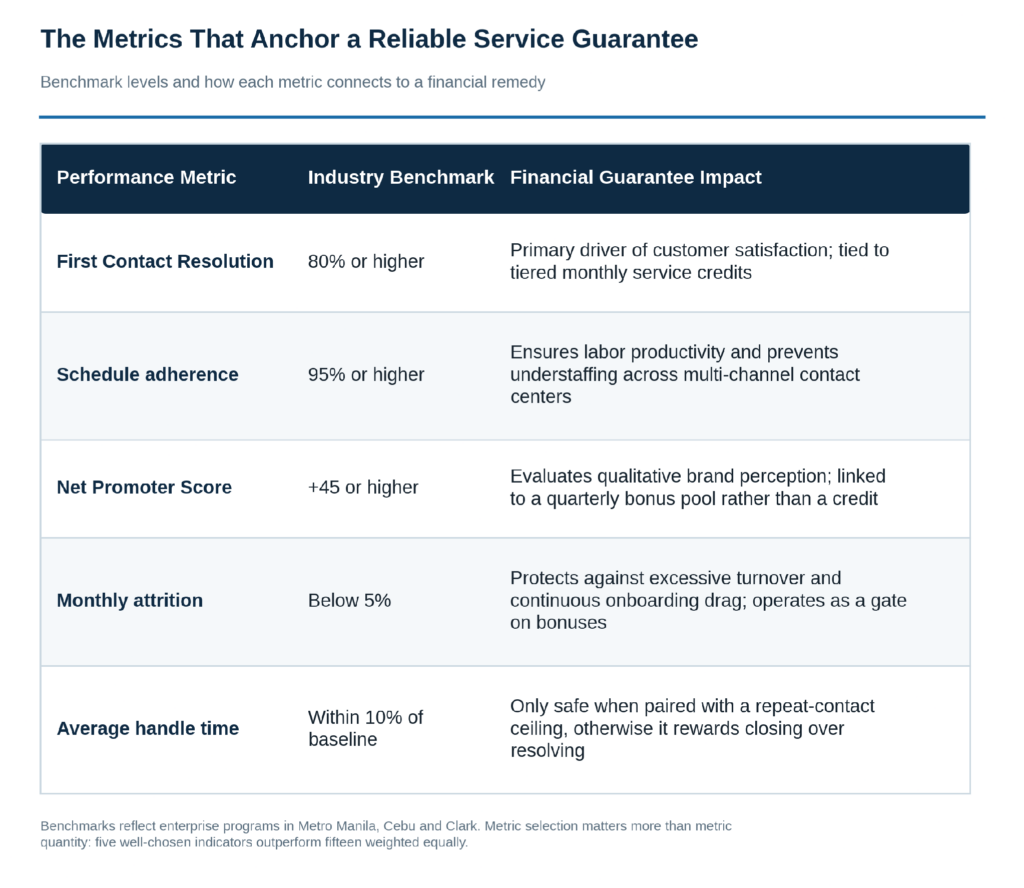
Figure 2. The metrics that anchor a reliable service guarantee, with benchmark levels and the financial remedy each connects to.
Pair Every Efficiency Metric With a Quality Guardrail
Average Handle Time is the clearest example of a metric that is safe only in pairs. Incentivized alone, the fastest route to the target is closing contacts rather than resolving them, which raises repeat-contact volume and depresses the resolution rate the buyer actually cares about. Bracket it with a repeat-contact ceiling and a quality assurance floor, and the incentive points the right way.
Use Attrition as a Gate, Not Another Scored Line
A monthly attrition cap belongs in the guarantee, but as a condition rather than a competing target. If turnover breaches the cap, no bonus is payable for that period regardless of how the other metrics performed. This prevents the most common failure in performance contracts, where short-term metric gains are purchased by running a team harder than it can sustain — a trade that always reverses within two quarters.
Separate Credit Metrics From Bonus Metrics
Not every metric suits the same remedy. First Contact Resolution and schedule adherence are measured monthly and move quickly, which makes them appropriate for service credits. Net Promoter Score is slower, noisier, and shaped by factors beyond the contact center, which makes it better suited to a quarterly bonus pool than to a monthly penalty.
How Can Contracts Balance Accountability with Philippine Market Realities?
Build in a ramp grace period of 60 to 90 days, carve out named typhoon events and statutory holidays, and agree volume elasticity bands before go-live. Rigid structures that ignore training curves or seasonal disruption push providers into defensive behavior and margin compression rather than improvement.
Effective guarantees start from local labor dynamics: attrition patterns, statutory holiday schedules, and the reality that July to October brings weather disruption every year rather than occasionally. A penalty regime that treats an annual, predictable event as a provider failure is not enforcing accountability; it is transferring an operational risk the buyer could have priced into a dispute the buyer will have to argue.
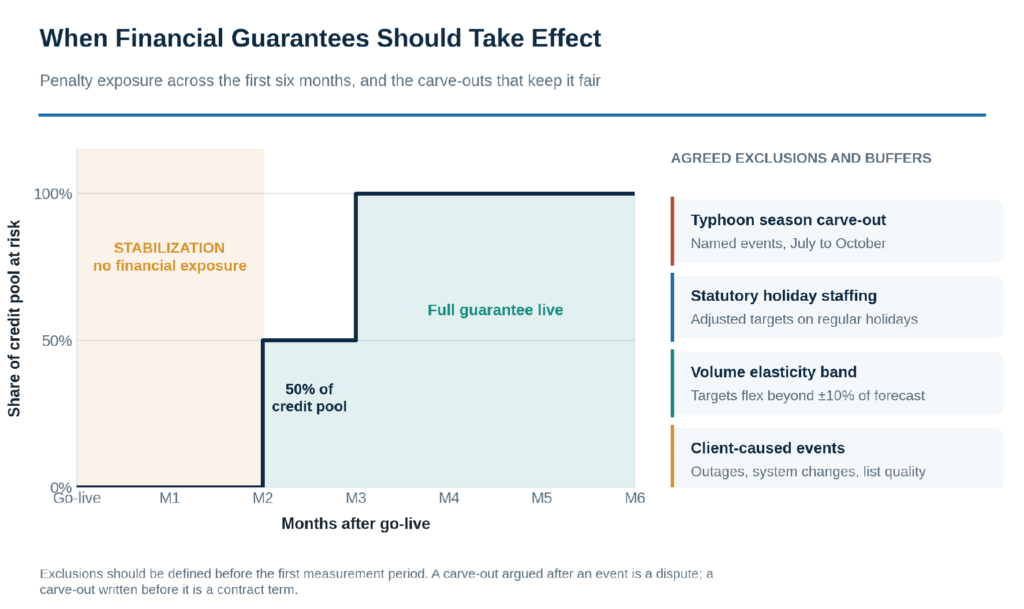
Figure 3. When financial guarantees should take effect across the first six months, and the carve-outs that keep them fair.
The Ramp Grace Period Is Not a Concession
Providers need 60 to 90 days after go-live to stabilize workflows before full financial penalties apply. Staging exposure — no penalties during stabilization, half the credit pool at risk from month three, full exposure thereafter — produces better targets, because the numbers used at full exposure come from measured performance on the buyer’s actual contact mix rather than from an assumption made during procurement.
Define Exclusions Before the First Measurement Period
Named exclusions for typhoon events, regular holiday staffing, client-side outages, and volume beyond agreed elasticity bands should be written before anything is measured. A carve-out argued after an event is a dispute; the same carve-out written in advance is simply a contract term. This is also what preserves the credibility of the penalties that remain: a framework that charges a provider for the buyer’s own system outage will be contested every time it triggers.
Many enterprises make the mistake of imposing rigid, punitive penalty structures that alienate high-quality partners. Effective performance guarantees must be balanced, aligning executive expectations with the operational realities of the local labor market to foster genuine accountability.
— John Maczynski, CEO, PITON-Global
How Should Financial Remedies and Incentives Be Tiered?
Apply service credits as a tiered share of monthly billing, escalating with sustained failure and capped at a monthly ceiling. Pair them with a bonus pool of comparable size for exceeding targets, and allow earn-back of withheld credits after two consecutive months of over-performance.
Escalate With Persistence, Not With a Single Miss
A single month’s miss should trigger root-cause analysis rather than a payment. Two consecutive months trigger credits and an executive remediation plan; three trigger credits at the ceiling and open other remedies. Structuring it this way means each rung is reached only by sustained failure, and it avoids the two common extremes: a discretionary regime that is disputed whenever it is used, and a regime whose first available remedy is termination and therefore never gets used at all.
Symmetry Is What Makes the Guarantee Work
Credits alone reliably produce minimum compliance, because a provider that has already lost the period’s pool has no financial reason to invest in recovery. A matching bonus pool gives exceeding the target commercial value, and earn-back keeps the incentive to fix a problem alive during the period when the problem exists. The cap matters for the same reason: credits are a remedy, not a revenue line. Credits and bonus pools sit inside the broader commercial package covered in our guide to pre-signing commercial terms.
Handle Attrition Cost Recovery Explicitly
Where the agreement sets a maximum monthly attrition rate, state what happens above it. Standard practice is for the provider to absorb recruitment and replacement training costs when turnover exceeds the benchmark, since that turnover reflects its own retention performance. Leaving this unstated is the most common route by which a provider’s workforce problem becomes a line on the buyer’s invoice.
How Should Procurement Teams Design a Guarantee End to End?
Four steps: select three to five controllable metrics with written definitions, measure a 60 to 90 day baseline before targets bind, design automatic tiered remedies with an upside pool, and instrument monitoring on a named system of record visible to both parties. Buyers who cannot yet measure a baseline may not be ready to offshore at all, as our readiness checklist explains.
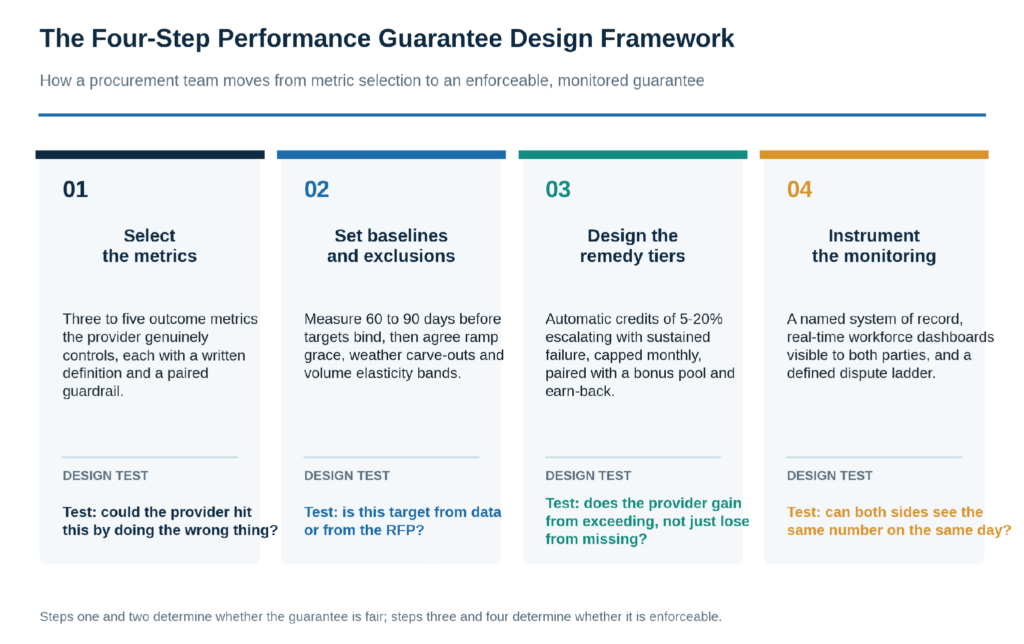
Figure 4. The four-step performance guarantee design framework, with the test to apply at each stage.
The sequence matters. Steps one and two determine whether the guarantee is fair, and steps three and four determine whether it is enforceable — a fair guarantee nobody can measure is as useless as an enforceable one built on invented targets. The most frequently skipped step is the fourth. Real-time workforce management dashboards visible to both parties turn performance into a shared observation rather than a monthly negotiation, and they prevent the slow degradation that goes unnoticed when the only evidence is a provider-supplied report reviewed after the period closes.
What Does a Balanced Guarantee Deliver in Practice?
A US e-commerce retailer whose previous Philippine supplier missed targets with no financial recourse moved to a balanced structure with tiered credits on FCR and quarterly improvement reviews. First Contact Resolution improved, customer escalations fell sharply, and accountability held across a three-year term.
Client Challenge
A fast-growing US e-commerce retailer was experiencing severe customer dissatisfaction and repeated service lapses. The commercial root cause was that the previous supplier missed delivery targets without any financial consequence: the agreement stated performance expectations but attached no remedy, so underperformance was a governance conversation rather than a commercial event.
Vendor Selection Process
PITON-Global audited the operational requirements and matched the retailer with a top-tier provider from its network of more than 100 Philippine providers specializing in scalable e-commerce support. Willingness to accept automatic credits and share dashboard access was treated as a selection criterion rather than a negotiation topic, which narrowed the field to providers confident in their own delivery.
Solution Implemented
The new master services agreement combined balanced SLA guarantees across resolution, adherence, and quality, tiered financial credits triggered by missed FCR thresholds, a ramp grace period with peak-season elasticity bands, and quarterly collaborative continuous improvement reviews.

Figure 5. The structure applied in the restructured agreement and the outcomes it produced.
Outcomes and Lessons
First Contact Resolution improved markedly, customer escalation rates fell sharply, and vendor accountability became predictable across a three-year contract. The two operational results are connected rather than independent: contacts resolved on the first attempt never reach a manager, so the escalation reduction followed the resolution gain automatically. Working through a structured advisory model removed the friction of negotiating enforceability with a provider that had not expected to be measured.
Why Partner with PITON-Global for Strategic Offshore BPO Selection?
PITON-Global is a BPO advisory and outsourcing consultancy offering advisory-led matching across a curated network of more than 100 top-tier Philippine providers, combining operational benchmarking with contract risk evaluation to reduce exposure and accelerate negotiation.
Who Is PITON-Global?
PITON-Global advises enterprise buyers on Philippine outsourcing across provider selection, performance benchmarking, and commercial structuring. Its relevance to guarantee design is practical: knowing what FCR a given provider actually sustains on comparable accounts, what attrition it runs, and whether it will accept automatic credits determines whether a proposed guarantee is achievable or theatrical. In a market of more than 1,000 providers, that information is not published anywhere.
How Does PITON-Global Differ from Traditional Outsourcing Brokers?
Traditional intermediaries earn on placement, which narrows the recommendation set to whichever providers pay best and ends their involvement at introduction — before the guarantee is drafted. An advisory-led model is organized around the buyer’s outcome: objective evaluation, recommendations that may include providers with no commercial relationship to the advisor, and continued engagement through structuring and governance. On guarantee work the distinction is concrete, because an intermediary paid on placement has no reason to report that a shortlisted provider has never held the target it is agreeing to.
How Does PITON-Global’s Network of 100+ Vetted Philippine BPO Providers Benefit Organizations?
Providers in the network are assessed on performance evidence, workforce stability, guarantee readiness, and commercial fit before reaching a buyer. That means the shortlist contains providers that can realistically deliver the guaranteed levels rather than providers willing to sign them, which is a meaningfully different set. Coverage spans voice and CX, back office and finance, e-commerce support, technical support, and specialist verticals across Manila, Cebu, Clark, and Davao. For how that plays out in a regulated specialty, see our look at precision biotech partnerships.

Figure 6. The matching framework for SLA optimization, applied before a provider reaches a performance-guaranteed program.
How Does PITON-Global’s Advisory-Led Vendor Matching Process Work?
Requirements, volumes, channel mix, and target performance levels are documented; the vetted network is filtered on domain expertise and capacity; candidates are assessed on account-level performance evidence, attrition history, and willingness to accept automatic remedies; and the buyer is supported through baseline measurement, remedy tier design, and the governance cadence that keeps the guarantee live after signature.
Why Do Organizations Use PITON-Global?
- Achievable guarantees. Targets set against what providers have actually sustained rather than against what they will agree to.
- Accelerated negotiation. Providers already comfortable with automatic credits and shared dashboards remove entire rounds from contracting.
- Improved provider fit. Capability and guarantee readiness assessed together, so the shortlist can deliver what it signs.
- Balanced structures. Credit tiers, bonus pools, exclusions, and ramp allowances engineered rather than inherited from a template.
- Support beyond signature. Governance design that exercises the guarantee instead of leaving it dormant until a crisis.
Frequently Asked Questions
What metrics are most critical in a BPO performance guarantee?
First Contact Resolution, Average Speed of Answer, schedule adherence, customer satisfaction, and quality assurance audit results. Keep the set to three to five weighted metrics with written definitions, and pair any efficiency measure with a quality guardrail.
How do seasonal volume spikes affect performance guarantees?
Include volume elasticity clauses and agreed buffer zones so staffing benchmarks adjust during high-demand periods such as the holiday shopping season. Without them, a provider staffed for forecast is penalized for a surge the buyer generated.
What are typical financial remedies for repeated SLA failures?
Service credits set as a tiered share of the monthly billing invoice where a provider breaches agreed thresholds across consecutive months, applied automatically on verified breach, capped monthly, and paired with earn-back so a recovering provider retains a reason to invest.
How are agent attrition rates factored into guarantees?
Through a maximum monthly attrition cap, with the provider covering recruitment and training costs when turnover exceeds the benchmark. Attrition works best as a gate on bonus payments rather than as another scored metric competing for management attention.
Why is an initial ramp-up period necessary in performance contracts?
Providers need a 60 to 90 day stabilization window after go-live to tune workflows before full financial penalties apply. The period also produces the measured baseline that makes the eventual targets defensible rather than assumed.