

On this page
- Key Takeaways
- What Balance-Sheet Metrics Indicate a High-Performing Philippine BPO Provider?
- Which Filings and Documents Actually Verify These Metrics?
- How Do Local Economic Realities Impact Offshore Vendor Solvency?
- What Does a Financial Stability Failure Look Like in Practice?
- Why Partner with PITON-Global for Strategic Offshore BPO Selection?
- Frequently Asked Questions
Enterprises must evaluate a Philippine BPO’s financial stability through a multi-tiered analysis of balance sheet strength, liquidity ratios, wage inflation buffers, and client concentration risk. Key indicators include SEC-audited financial statements, a current ratio of at least 1.5x, and enough margin headroom to absorb mandatory wage adjustments without service degradation. Financial screening is one stage of the full seven-step vetting framework.
Key Takeaways
- Start with regulatory filings. Request SEC-audited financial statements and BIR tax filings to verify revenue growth, working capital, and leverage.
- Test client concentration. No single client should represent an outsized share of vendor revenue; beyond that point, one account loss becomes your service problem.
- Check inflation and wage resilience. Healthy gross margins give a provider room to absorb regional wage board increases without cutting delivery.
- Examine capital allocation. Look at what the provider actually spends on technology, redundant power, and security compliance, not what it plans to.
- Use neutral advisory to reduce friction. A vetted network removes the providers that would fail diligence before the evaluation starts.
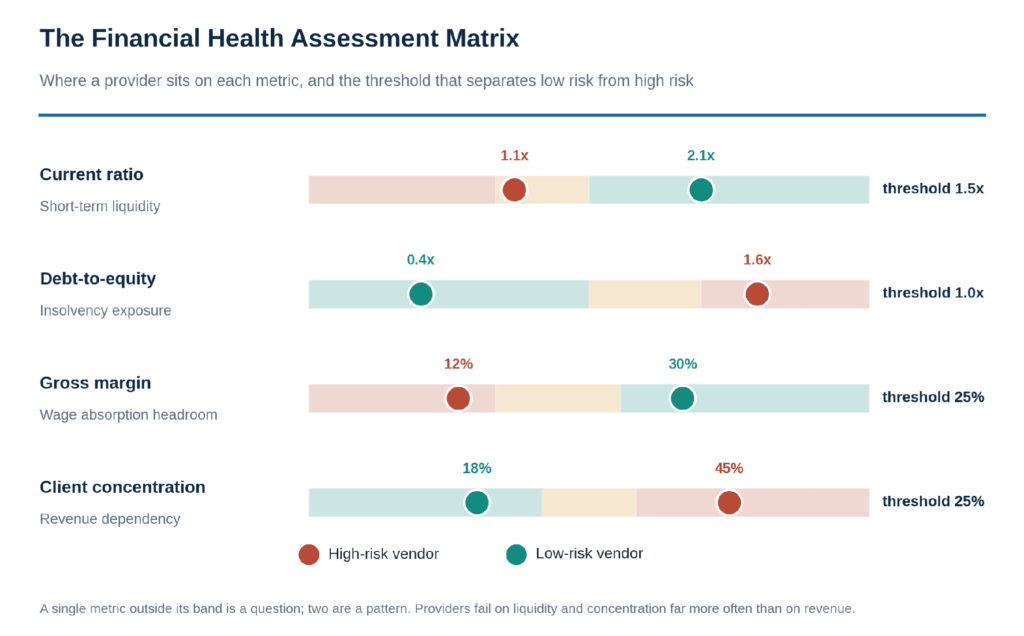
Figure 1. The financial health assessment matrix: where a provider sits on each metric, and the threshold separating low risk from high risk.
What Balance-Sheet Metrics Indicate a High-Performing Philippine BPO Provider?
Four metrics carry most of the signal: a current ratio of 1.5x or higher, debt-to-equity below 1.0x, a healthy gross margin cushion, and no single client carrying an outsized share of revenue. A thin operating margin is a separate warning sign in a labor-intensive delivery model.
Evaluating mid-market and enterprise vendors in Metro Manila, Cebu, or Clark requires metrics tailored to an offshore delivery model rather than generic corporate screening. The defining characteristic is labor intensity: payroll dominates the cost base, it is due on a fixed cycle regardless of client payment timing, and it rises on a schedule set by regional wage boards rather than by the provider. Liquidity and margin headroom therefore matter more here than in most industries.
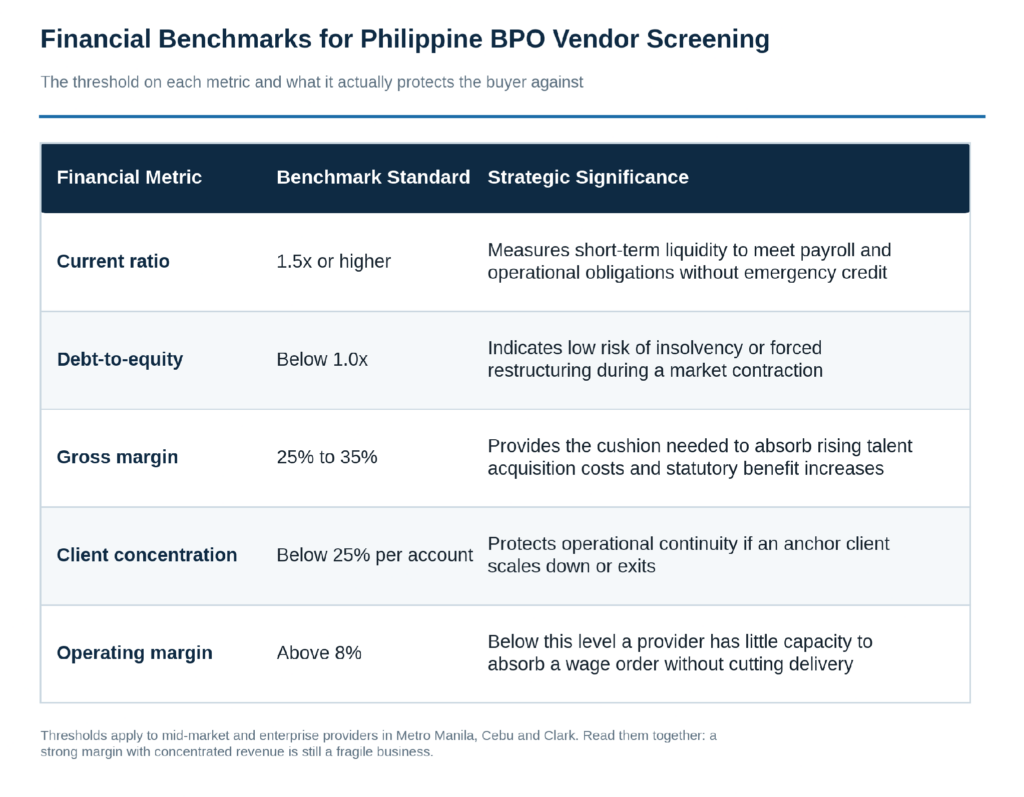
Figure 2. Financial benchmarks for vendor screening, with the threshold on each metric and what it protects against.
Liquidity Is a Payroll Question
A current ratio of 1.5x or better means the provider can meet payroll and operational obligations without reaching for emergency credit. Below 1.0x, a delayed client payment or an unexpected statutory cost becomes a cash event, and cash events in a labor business resolve one way: by deferring something the buyer is paying for.
Leverage Determines What Happens in a Downturn
Debt-to-equity below 1.0x indicates a business that can survive a contraction without forced restructuring. Highly leveraged providers are not necessarily poorly run, but they have fewer options when a client scales down, and their creditors, not their clients, determine which options get taken.
Margin Is Absorption Capacity, Not Profit
Gross margin should be read as the cushion available for rising talent acquisition cost and statutory benefit increases, not as an indicator of how much the buyer is overpaying. A provider running thin margins has nothing to absorb a wage order with, which is why aggressive rate negotiation with an already-thin vendor tends to produce a service problem rather than a saving.
Concentration Is the Risk Buyers Check Last and Regret First
If one customer represents an outsized share of revenue, losing that contract can cause a cash flow freeze, mass attrition, and rapid service deterioration across every other account, including yours. Ask for revenue share by top client and the renewal dates attached to it. A provider whose anchor contract expires six months into your term is carrying a risk you have just joined.
Which Filings and Documents Actually Verify These Metrics?
Audited financial statements filed with the Philippine SEC and tax filings with the BIR are the primary sources, supported by current PEZA registration status. Request three years rather than one, and read the notes and auditor’s opinion rather than only the headline figures.
The documents exist and are obtainable; the discipline is in reading them properly. A single year of statements shows a position, while three years show a direction, and direction is what predicts whether a provider will still be viable in the third year of your contract. Pay particular attention to the auditor’s opinion, related-party transactions in the notes, and the gap between reported revenue growth and headcount growth — a provider growing revenue while shrinking staff is either automating well or losing accounts, and the notes usually reveal which.
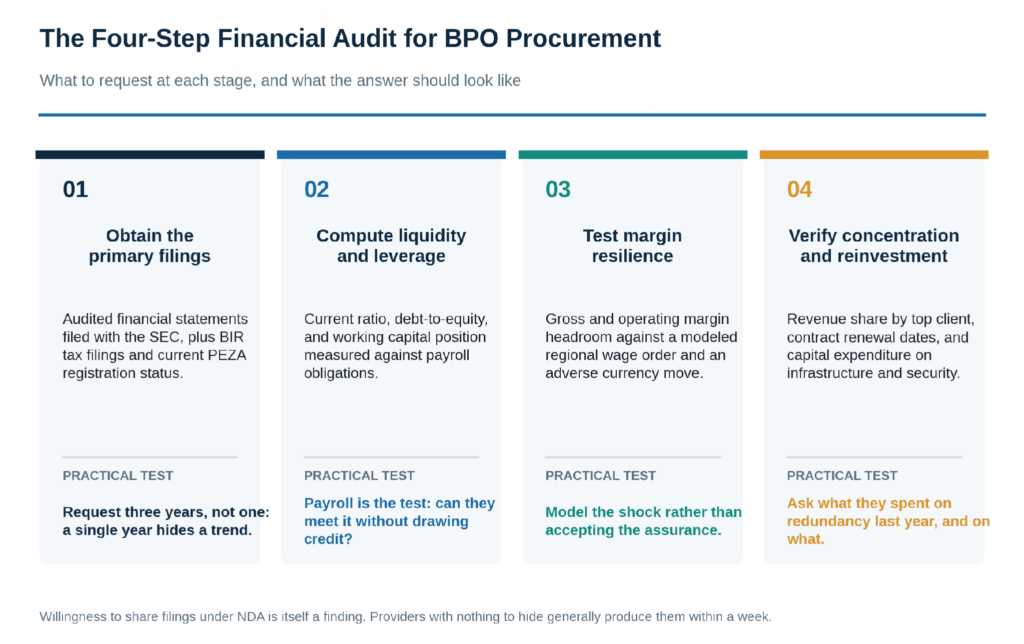
Figure 3. The four-step financial audit for procurement teams, with what to request and the practical test at each stage.
PEZA Registration Is a Financial Indicator
Philippine Economic Zone Authority registration grants tax holidays and duty exemptions that allow providers to maintain higher net margins and reinvest in facilities. Its presence tells you something about margin structure; its absence, or a lapse in registration, tells you more. Incentive terms were revised under the CREATE framework and further amended by the CREATE MORE Act, so confirm the provider’s current status rather than assuming continuity from a prior year.
How Do Local Economic Realities Impact Offshore Vendor Solvency?
Annual wage board adjustments across NCR and provincial hubs feed directly into vendor cost structures. Providers operating on thin operating margins frequently face distress or service failure when a wage order, a currency move, or a change in IT-BPM tax incentives arrives — all three of which are routine rather than exceptional.
Philippine wages are set regionally and move on independent cycles. Metro Manila’s non-agricultural daily minimum rose to ₱755 on 25 July 2026 and reaches ₱780 in January 2027. Because labor typically represents around half of a provider’s revenue, a wage adjustment of that magnitude removes roughly three points of operating margin — which is survivable at 25% and close to fatal at 8%.
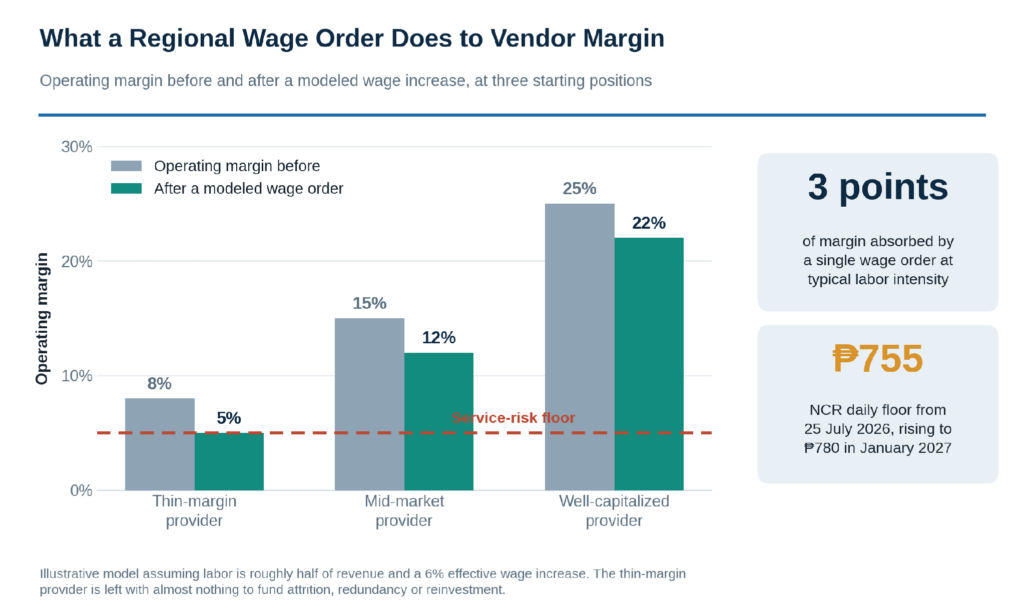
Figure 4. Operating margin before and after a modeled wage order, at three starting positions.
The chart explains why financial screening is a service-quality control rather than a procurement formality. A provider left with a razor-thin operating margin has almost nothing to fund attrition management, infrastructure redundancy, or reinvestment, and those are precisely the areas that get cut first because the client cannot see them until they fail. Those cuts surface first as falling workforce quality on the floor.
Evaluating financial viability goes far beyond reviewing last year’s audited statements. Real stability shows up in how a provider structures its capital reserves to absorb labor market adjustments, reinvests in redundant infrastructure, and protects client operations from localized inflation.
— John Maczynski, CEO, PITON-Global
Currency and Incentive Risk Compound the Same Exposure
Most enterprise contracts bill in dollars while provider costs sit in pesos, so a currency move against the provider compresses margin exactly as a wage order does. Stable vendors maintain hedging strategies or negotiate risk-sharing corridors rather than absorbing the movement silently. Changes in IT-BPM tax incentive guidelines work the same way, arriving as a margin event rather than an operational one — which is why all three belong in a single resilience test rather than three separate checkboxes.
What Does a Financial Stability Failure Look Like in Practice?
A US healthcare firm lost service continuity when its mid-sized Philippine provider entered distress after an anchor client departed and margins compressed. Migrating a 120-FTE patient support operation to a provider screened on leverage and revenue diversification restored full continuity and cut cost per contact materially.
Client Challenge
The firm experienced critical service interruptions when its incumbent provider went into financial distress. The trigger was not cost or performance: it was concentration. The provider lost a large account, the resulting margin compression left it unable to fund delivery across its remaining clients, and the healthcare firm’s patient support operation degraded alongside every other account on the floor.
Vendor Selection Process
PITON-Global ran a financial stability audit across its vetted network of more than 100 Philippine providers, shortlisting on debt-to-equity below 0.5x and demonstrably diversified client revenue. Setting the leverage threshold well below the 1.0x general benchmark reflected the circumstances — a buyer recovering from a vendor failure has a lower tolerance for balance sheet risk, and the screening should say so explicitly.
Solution Implemented
A 120-FTE patient support operation was migrated to a top-tier mid-market provider with dedicated capital reserves and redundant operational hubs in Metro Manila, on a three-year enterprise agreement.
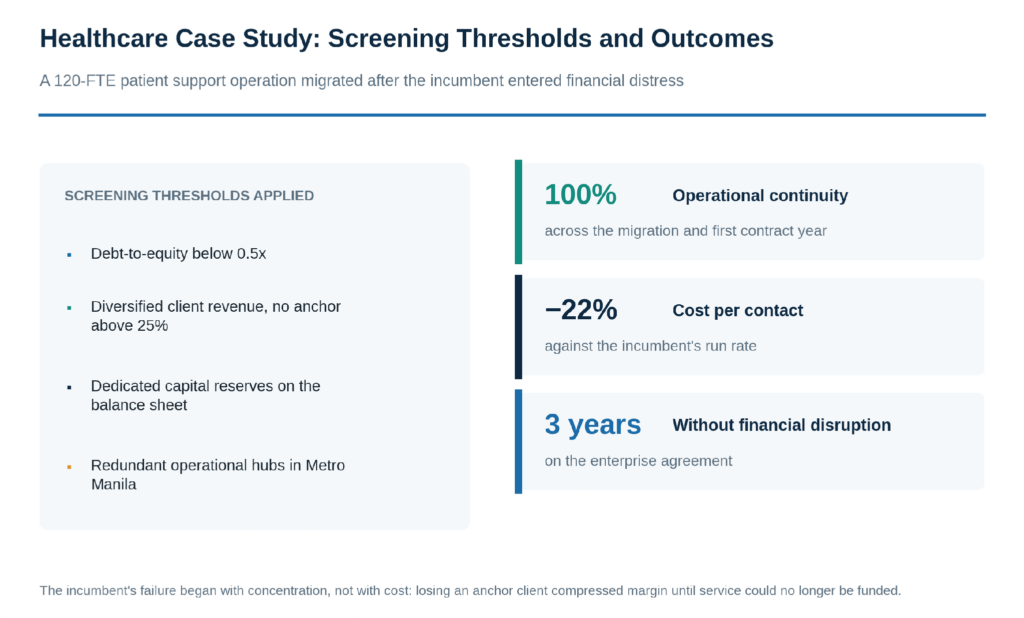
Figure 5. The screening thresholds applied and the outcomes achieved across the three-year agreement.
Outcomes and Lessons
The migration achieved full operational continuity, reduced cost per contact materially, and ran three years without financial disruption. The lesson is about sequence rather than criteria: balance sheet health and revenue diversification are cheap to verify during selection and extremely expensive to discover afterward, because an emergency migration, the pattern behind many failed inbound migrations, costs more than the entire diligence exercise and carries brand damage that no contract clause recovers.
Why Partner with PITON-Global for Strategic Offshore BPO Selection?
PITON-Global is a BPO advisory firm providing conflict-free guidance backed by a network of more than 100 vetted Philippine call center and back-office providers, evaluated on financial health, operational delivery, and infrastructure stability before they reach a buyer’s shortlist.
Who Is PITON-Global?
PITON-Global advises enterprise buyers on Philippine outsourcing across provider selection, financial diligence, and commercial structuring. Its relevance to a stability assessment is specific: reading a provider’s filings tells you where it stood at year end, while knowing which providers recently lost an anchor account, which are carrying facility debt, and which have reinvested in redundancy requires presence in the market. In an ecosystem of more than 1,000 providers, that difference decides which shortlist a buyer starts from.
How Does PITON-Global Differ from Traditional Outsourcing Brokers?
Traditional brokers charge matchmaker fees or promote preferred vendors, and their involvement ends at the introduction. An advisory-led model is organized around the buyer’s outcome: conflict-free evaluation, recommendations that may include providers with no commercial relationship to the advisor, and continued engagement through structuring and governance. On financial screening the distinction is concrete, because an intermediary paid on placement has no incentive to disclose that a shortlisted provider is thinly capitalized or dangerously concentrated.
How Does PITON-Global’s Network of 100+ Vetted Philippine BPO Providers Benefit Organizations?
Every provider in the network has been evaluated on financial health, delivery track record, and infrastructure stability before entering it, which means the buyer’s screening starts from a field where the obvious failures have already been removed. Coverage spans voice and CX, back office and finance, healthcare administration, technical support, and specialist verticals across Manila, Cebu, Clark, and Davao, so domain fit and financial fit can be assessed together rather than traded against each other.
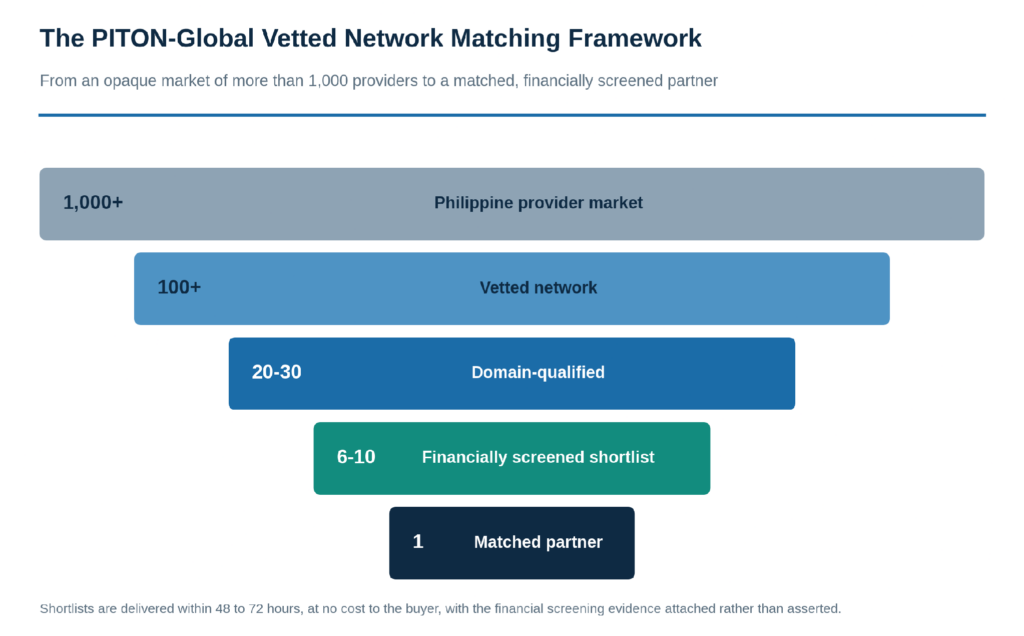
Figure 6. The vetted network matching framework, from an opaque market of 1,000-plus providers to a financially screened match.
How Does PITON-Global’s Advisory-Led Vendor Matching Process Work?
Requirements, volumes, and risk tolerance are documented; the vetted network is filtered for domain expertise, location tier, and capacity; candidates are screened on liquidity, leverage, margin headroom, and client concentration; and the buyer receives a shortlist with the financial evidence attached rather than asserted. Support continues through negotiation, contract structuring, and the governance cadence that follows signature.
Why Do Organizations Use PITON-Global?
- Reduced vendor failure risk. Financial diligence happens before shortlisting, not after a service interruption forces it.
- Conflict-free recommendations. Advisory positioning rather than placement fees, so the shortlist reflects fit rather than referral economics.
- Improved provider fit. Domain expertise, location tier, and balance sheet strength assessed as one question rather than three.
- Accelerated selection. A pre-screened shortlist compresses a discovery cycle that typically runs for months into days.
- Stronger contract structures. Terms built around the provider’s actual risk profile, including the exposures the filings revealed.
Frequently Asked Questions
What official filings verify a Philippine BPO’s financial health?
Audited financial statements filed annually with the Philippine Securities and Exchange Commission, supported by tax filings with the Bureau of Internal Revenue. Request three consecutive years and read the auditor’s opinion and the notes, particularly related-party transactions and contingent liabilities.
How does currency volatility affect Philippine BPO pricing stability?
Most enterprise contracts use USD/PHP collars or fixed rates. Stable vendors maintain hedging strategies or negotiate explicit risk-sharing corridors; unstable ones absorb the movement until they cannot, at which point the buyer receives either a rate request or a quiet reduction in service investment.
Why is client concentration a major financial risk factor?
If a vendor depends on one customer for an outsized share of revenue, losing that contract can cause cash flow freezes, mass attrition, and service deterioration across every remaining account. Concentration risk is the most common route from a healthy-looking balance sheet to a distressed provider.
What minimum contract length balances stability and flexibility?
A 12 to 24-month master services agreement with structured performance review periods gives the vendor revenue stability to plan and invest against while preserving buyer flexibility. Pair it with defined review points rather than relying on term length alone, and plan the handover around the operational challenges most common in transitions.
What role do PEZA incentives play in a BPO’s financial stability?
PEZA registration grants tax holidays and duty exemptions that support higher net margins and enable reinvestment in facility infrastructure. Verify current registration status directly, since incentive terms have been revised under the CREATE framework and its subsequent amendments.