

On this page
- Key Takeaways
- Which Operational Thresholds Define Acceptable Vendor Concentration Limits?
- How Do Regional Economic and Infrastructural Realities Shape Exposure?
- How Should CFOs Audit an Existing Offshore Portfolio?
- What Does Diversification Cost, and When Is a Single Vendor Defensible?
- What Does Portfolio Diversification Deliver in Practice?
- Why Partner with PITON-Global for Strategic Offshore BPO Selection?
- Frequently Asked Questions
CFOs should evaluate vendor concentration risk by auditing multi-site geographical distribution, analyzing vendor revenue exposure caps, and verifying redundant infrastructure capacity. Mitigating single-source vulnerability means capping any single provider’s share of total outsourced headcount and enforcing disaster recovery failover across distinct provincial hubs. Those caps belong in the contract, alongside the exit and transition terms of offshore agreements.
Key Takeaways
- Geographic diversification. Distribute seats across Metro Manila and Tier-2 locations such as Cebu, Clark, or Davao so a localized disruption cannot stop the program.
- Revenue exposure ceilings. No single provider should hold a dominant share of your operational portfolio, and your account should not become a dominant share of theirs.
- Redundant infrastructure audits. Verify N+1 power redundancy, multi-carrier internet failover, and an active secondary continuity site — tested, not documented.
- Subcontractor transparency. Require full visibility into lower-tier dependencies to eliminate hidden single points of failure in support pipelines.
- Advisory-led risk architecture. Use independent frameworks to benchmark provider stability, solvency, and how contract risk is distributed.
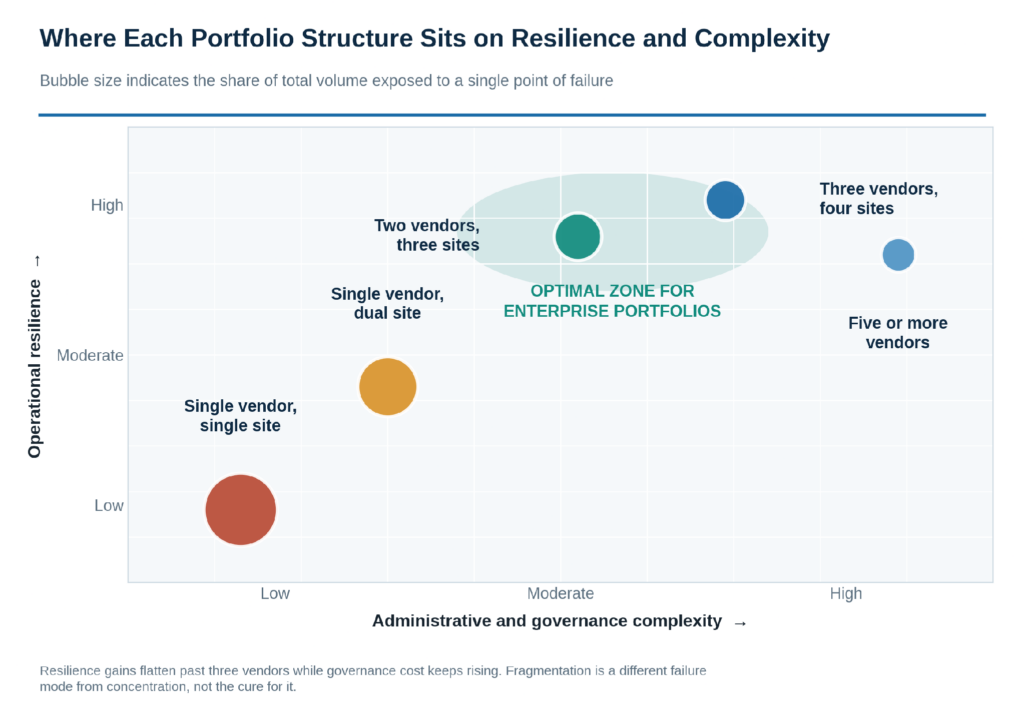
Figure 1. Where each portfolio structure sits on operational resilience and governance complexity.
Which Operational Thresholds Define Acceptable Vendor Concentration Limits?
Four ceilings define a defensible portfolio: a cap on any single vendor’s share of offshore FTEs, a cap on the share of seats in one metro zone, no unauthorized subcontracting, and a cap on how much of the provider’s own revenue comes from your account.
When an enterprise concentrates all of its customer support or financial data processing with one provider in a single Bonifacio Global City tower, a localized weather event, labor action, or financial insolvency can halt an entire business unit. Thresholds convert that abstract exposure into something a finance function can measure monthly and act on before it becomes an incident.
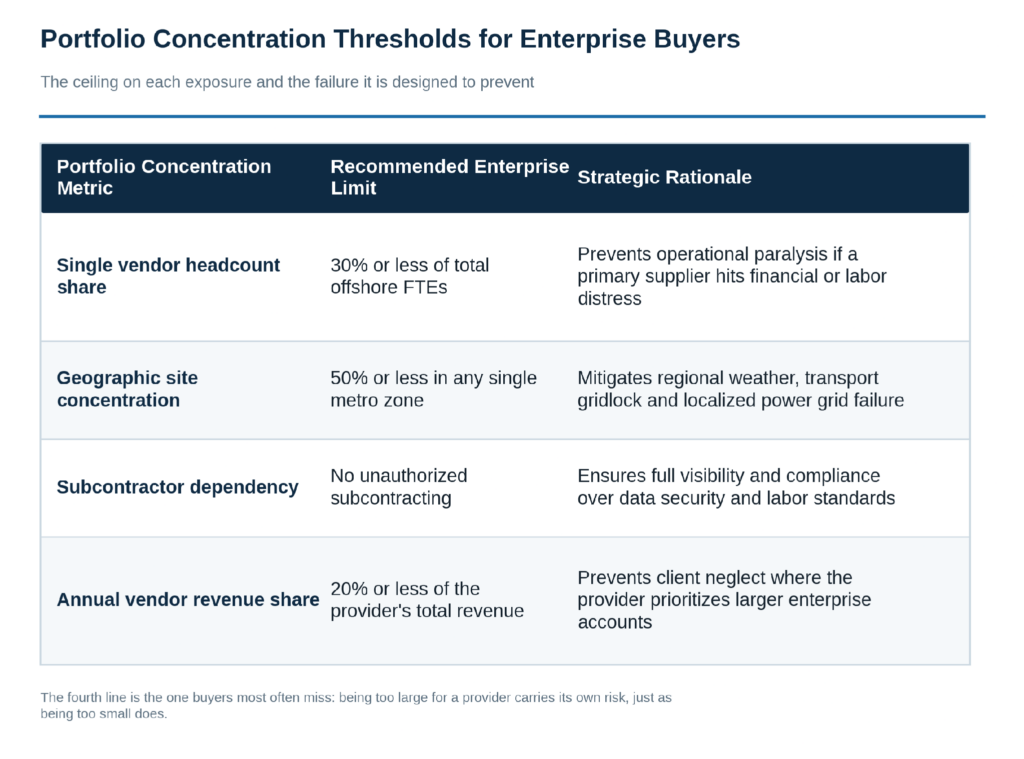
Figure 2. Portfolio concentration thresholds, with the specific failure each ceiling is designed to prevent.
The Exposure That Runs the Other Way
Three of the four ceilings limit your dependence on a provider. The fourth limits the provider’s dependence on you, and it is the one buyers most often miss. Holding too large a share of a provider’s total revenue creates a different fragility: your program becomes the account whose loss would destabilize the business, which changes how the provider behaves in negotiation and how exposed you are to its other clients’ decisions. Being too large for a provider carries risk, just as being too small means competing for attention against accounts that matter more.
Subcontracting Is the Hidden Concentration
A portfolio that looks diversified at the prime-vendor level can converge one tier down, where two nominally independent providers use the same specialist technical support subcontractor or the same carrier. Require disclosure of every lower-tier dependency and prohibit unauthorized subcontracting outright, or the diversification you paid for exists only on the org chart.
How Do Regional Economic and Infrastructural Realities Shape Exposure?
Metro Manila offers the deepest talent pools alongside congestion and monsoon flooding exposure. Tier-2 hubs such as Cebu and Clark provide mature infrastructure at lower cost, while Davao and Iloilo deliver lower attrition and alternative infrastructure with narrower specialist pipelines. Distribution hedges the first against the second.
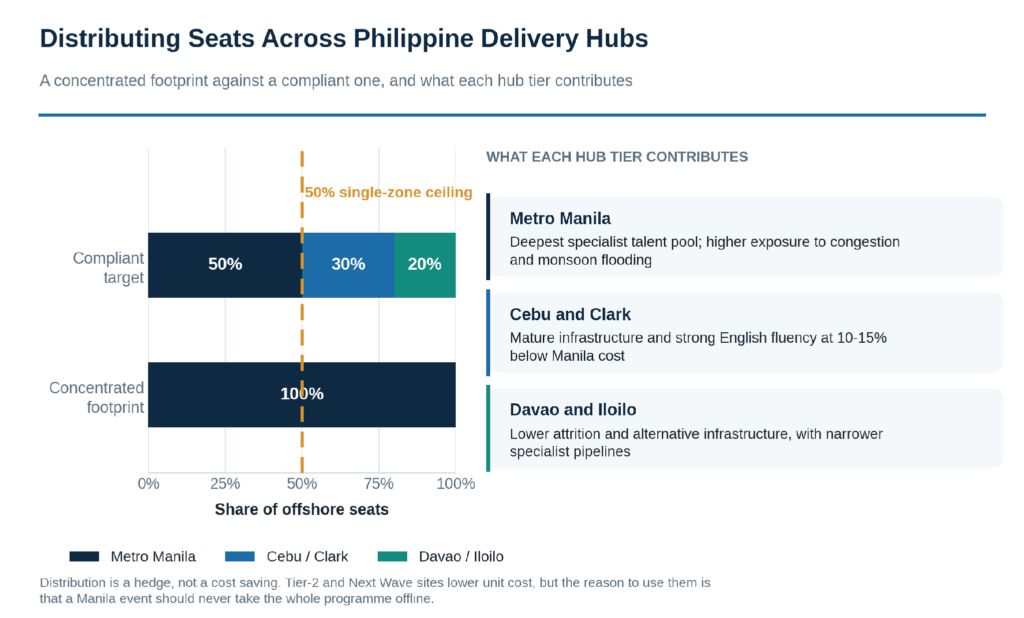
Figure 3. A concentrated footprint against a compliant one, and what each Philippine hub tier contributes.
The trade-off is genuine rather than one-directional. Manila holds the specialist financial, technical, and regulated-industry talent that a complex program needs, which is why a ceiling rather than a prohibition is the right instrument. Tier-2 and Next Wave locations offer better continuity characteristics and lower attrition, partly because agents there have fewer alternative employers within commuting distance, but hiring against a narrow skill profile takes longer.
Diversification Is a Hedge, Not a Saving
Moving volume to lower-cost hubs does reduce unit cost, but that is a secondary benefit and a poor reason to do it. The reason to distribute is that a Manila event — a typhoon, a grid failure, a transport shutdown — should never take the whole program offline. Framing distribution as a cost play invites the wrong decision when the cheaper hub turns out to lack the skill depth a function needs. Whether to add a second site or restructure the incumbent is its own decision, covered in our guide to expand, renew or restructure choices.
Many CFOs focus exclusively on unit labor cost arbitrage while ignoring the staggering hidden costs of single-vendor dependency. True risk mitigation requires a balanced portfolio approach that distributes operational volume across vetted providers in both primary and emerging provincial hubs.
— John Maczynski, CEO, PITON-Global
How Should CFOs Audit an Existing Offshore Portfolio?
Four steps: map seats, spend, and process criticality by vendor and site; test actual allocation against the concentration ceilings; verify redundancy including the date of the last live failover test; and model the revenue at risk from a two-week outage at the largest point of concentration.
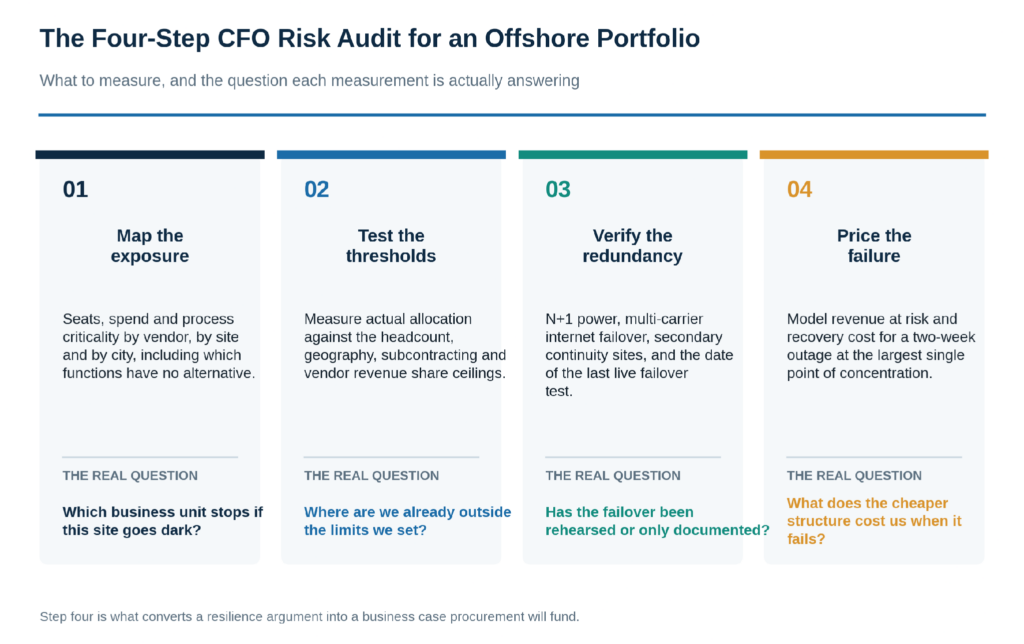
Figure 4. The four-step CFO risk audit for an offshore portfolio, with the question each step answers.
The fourth step is what turns a resilience argument into a business case. Concentration risk loses budget arguments because the cost of diversification is certain and immediate while the cost of failure is probabilistic and deferred. Putting a number on the second — revenue at risk, recovery cost, customer churn from a fortnight of degraded service at your largest site — lets the comparison happen in the same units, which is the only way the resilience case gets funded.
Verify Rehearsal, Not Documentation
The most common gap in a redundancy audit is the difference between a continuity plan and a tested one. Ask for the date and result of the last live failover, not the plan document. N+1 power and multi-carrier routing that have never been exercised under load are a hypothesis, and the first real test should not be an actual typhoon.
What Does Diversification Cost, and When Is a Single Vendor Defensible?
A dual-vendor structure typically costs somewhat more through lost volume tiering and duplicated governance, and adds real management overhead. Below roughly 50 seats that premium rarely pays for itself; above 200 seats, single-vendor concentration is difficult to defend on any measure other than convenience.
Honest advice here matters more than advocacy. Splitting volume forfeits some volume-based discounting, duplicates account management and QA governance on the buyer side, and introduces the coordination cost of two contracts, two reporting formats, and two escalation paths. Those costs are real and they arrive immediately.
What changes the calculation is scale and criticality. For a 40-seat pilot supporting a non-critical function, a single well-chosen provider with dual-site delivery is a reasonable structure and a second vendor is mostly overhead. For a 500-seat operation running customer-facing or regulated processes, the arithmetic reverses: the premium is a small slice of spend, while the exposure is a business unit.
Fragmentation Is Its Own Failure Mode
Resilience gains flatten past three providers while governance cost continues to rise, and beyond that point the portfolio starts to suffer from the opposite problem: no vendor holds enough volume to prioritize the account, standards drift between providers, and the buyer’s own team spends its capacity on coordination rather than on performance. Two to three primary vendors with clear volume distribution is the structure most enterprise portfolios should target.
What Does Portfolio Diversification Deliver in Practice?
A multinational logistics firm lost two weeks of operations when its sole Metro Manila provider suffered typhoon damage to telecom infrastructure. Restructuring 500 FTEs across two tier-one providers with redundancy in Clark and Cebu eliminated the single point of failure, cut handle time, and delivered near-continuous uptime.
Client Challenge
The firm had concentrated its entire offshore customer support operation with one provider in Metro Manila. When a regional typhoon damaged telecom infrastructure serving that facility, there was no alternative site and no second provider to absorb volume, and the operation stopped for two weeks. The failure was structural rather than a provider performance issue: no amount of vendor management substitutes for a second delivery path.
Vendor Selection Process
PITON-Global conducted a portfolio risk audit to establish where exposure sat by site and function, then used its network of more than 100 vetted Philippine providers to restructure delivery across a multi-vendor model. Multi-site delivery capability and tested failover were treated as threshold criteria, since a second provider that cannot absorb the first one’s volume adds cost without adding resilience.
Solution Implemented
The 500 customer support FTEs were split across two tier-one providers, with primary facilities in Metro Manila and disaster recovery redundancy in Clark and Cebu, connected by redundant routing tested on a schedule rather than assumed. Splits like this are a transition project in their own right; see our guide to managing an efficient BPO transition.
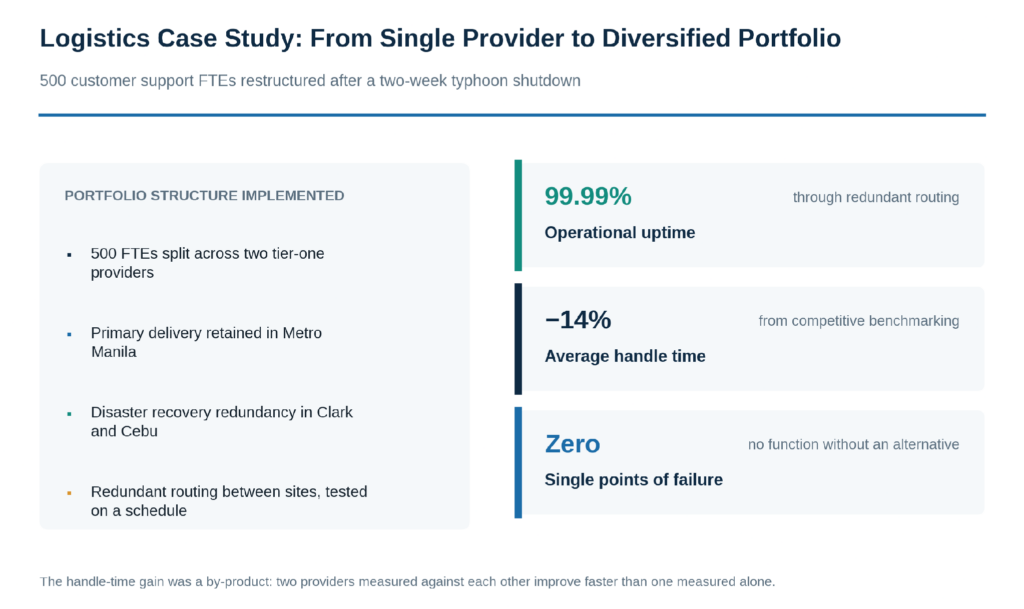
Figure 5. The portfolio structure implemented and the outcomes it produced.
Outcomes and Lessons
The restructuring eliminated single-point-of-failure vulnerability, reduced average handle time, and delivered near-continuous operational uptime through redundant routing. The handle-time improvement deserves a note, because it was not the objective: two providers measured against each other on the same metrics improve faster than one provider measured alone. That competitive effect is a recurring secondary benefit of dual sourcing, and it partly offsets the diversification premium.
Why Partner with PITON-Global for Strategic Offshore BPO Selection?
PITON-Global is a BPO advisory and outsourcing consultancy offering advisory-led matching across a curated network of more than 100 top-tier Philippine providers, combining operational benchmarking with vendor concentration risk evaluation to reduce exposure and accelerate negotiation.
Who Is PITON-Global?
PITON-Global advises enterprise buyers on Philippine outsourcing across provider selection, portfolio risk assessment, and commercial structuring. Its relevance to concentration risk is specific: designing a split requires knowing which providers genuinely operate multiple sites rather than one site with a satellite, which have tested failover, and which have the capacity to absorb a partner’s volume in an emergency. In a market of more than 1,000 providers, that distinction is not visible from a capability deck.
How Does PITON-Global Differ from Traditional Outsourcing Brokers?
Traditional intermediaries earn on placement, which favors consolidating volume with whichever provider pays best — the opposite of what a diversified portfolio requires — and ends their involvement at introduction. An advisory-led model is organized around the buyer’s outcome: objective evaluation, recommendations that may include providers with no commercial relationship to the advisor, and continued engagement through structuring and governance across multiple vendors.
How Does PITON-Global’s Network of 100+ Vetted Philippine BPO Providers Benefit Organizations?
Providers are assessed on multi-site delivery capability, infrastructure redundancy, financial stability, and subcontracting disclosure before reaching a buyer. Because the network spans Manila, Cebu, Clark, Davao, and Next Wave locations across voice, back office, finance, healthcare, and technical support, a buyer can design a geographic and functional split from a single vetted field rather than running parallel searches for each leg of the portfolio.
Figure 6. The matching framework for geographic risk distribution, applied before seats are allocated.
How Does PITON-Global’s Advisory-Led Vendor Matching Process Work?
Current exposure is mapped by vendor, site, and function; hub suitability is assessed against the skill tiers each function needs; candidate providers are screened on multi-site capability, failover testing, financial stability, and subcontracting disclosure; and the buyer is supported through split ratio design, redundant routing, exit terms, and the governance model that runs a multi-vendor portfolio without doubling its own overhead.
Why Do Organizations Use PITON-Global?
- Reduced concentration exposure. Portfolio thresholds tested against actual allocation rather than assumed from the org chart.
- Genuine second sources. Providers verified as capable of absorbing partner volume, not simply available as an alternative name.
- Faster restructuring. A pre-vetted field lets a split be designed in weeks rather than through sequential searches.
- Balanced commercial terms. Volume tiering, exit management, and cross-vendor governance engineered into both agreements.
- Support beyond selection. Governance design that manages two providers as one portfolio rather than two programs.
Frequently Asked Questions
What is the ideal number of BPO vendors for an enterprise portfolio?
For enterprises running more than 200 offshore seats, two to three primary vendors with clear volume distribution prevents over-concentration while preserving administrative efficiency. Below roughly 50 seats, a single provider with genuine dual-site delivery is usually the better structure.
How does geographic concentration affect business continuity?
Concentrating operations in one city exposes the enterprise to localized typhoons, grid failures, and transit strikes simultaneously, since all three affect the same workforce. Multi-site dispersion means an event removes part of your capacity rather than all of it, and gives failover somewhere to go.
What financial indicators signal high vendor concentration vulnerability?
High debt-to-equity, thin operating margins, and heavy reliance on a single anchor client. A provider whose largest customer represents a substantial share of revenue is one contract loss away from the margin compression that degrades every other account it serves, including yours.
How can contracts mitigate single-vendor transition risks?
Master services agreements should include strict exit management clauses, mandatory knowledge transfer timelines with a priced transition rate card agreed at signature, and escrow-backed software and data handover. Negotiating transition terms at the point of departure is expensive and slow. How those handovers run in practice is covered in our transition methodology guide.
What role do Tier-2 Philippine cities play in risk mitigation?
Cities such as Davao, Clark, and Iloilo offer lower attrition, reduced real estate costs, and alternative infrastructure networks that insulate operations from Metro Manila congestion and flooding. The trade-off is a narrower pipeline for specialized financial and technical skills.
Why do CFOs often overlook vendor concentration risk during initial contracting?
Because procurement scoring rewards the lowest-cost bid, and consolidating volume with one provider produces the lowest cost. The exposure only becomes visible when something fails, by which point the cost of the cheaper structure exceeds everything it saved.