

On this page
- Key Takeaways
- How Do Unbundled Pricing Models Protect Buyer Margins?
- Which Performance Incentives and Penalties Align Operational Goals?
- How Should Currency and Statutory Risks Be Structured in the Philippines?
- Which Exit, Escalator, and Transition Terms Prevent Lock-In?
- What Does a Well-Negotiated Commercial Framework Deliver in Practice?
- How Does PITON-Global Reduce Commercial Outsourcing Risk?
- Frequently Asked Questions
Before executing an outsourcing agreement, companies must negotiate commercial terms that include unbundled rate structures, explicit SLA-linked financial credits, capped overhead markups, and transparent pass-through costs. Defining statutory compliance audits, volume-based margin compression schedules, and foreign exchange stabilization bands protects client operating margins and prevents scope creep. Pricing is only half the contract, though; how the offshore agreement is governed after signing matters as much.
Key Takeaways
- Contractually guarantee rate unbundling. Require vendors to itemize base salary, statutory benefits, technology overhead, and management fee to prevent hidden margin expansion.
- Establish SLA-tiered earn-backs. Tie service level failures to financial remedies in monthly fee credits, with earn-backs that align operational incentives.
- Lock in FX stabilization bands. A dual-currency corridor with a narrow neutral band neutralizes exchange rate volatility across a multi-year contract.
- Cap ramp-up and training billing. Restrict initial wave training to net direct labor cost and require the vendor to absorb replacement training for routine turnover.
- Enforce statutory compliance audits. Embed quarterly verification rights for SSS, PhilHealth, and Pag-IBIG remittances and 13th-month pay.
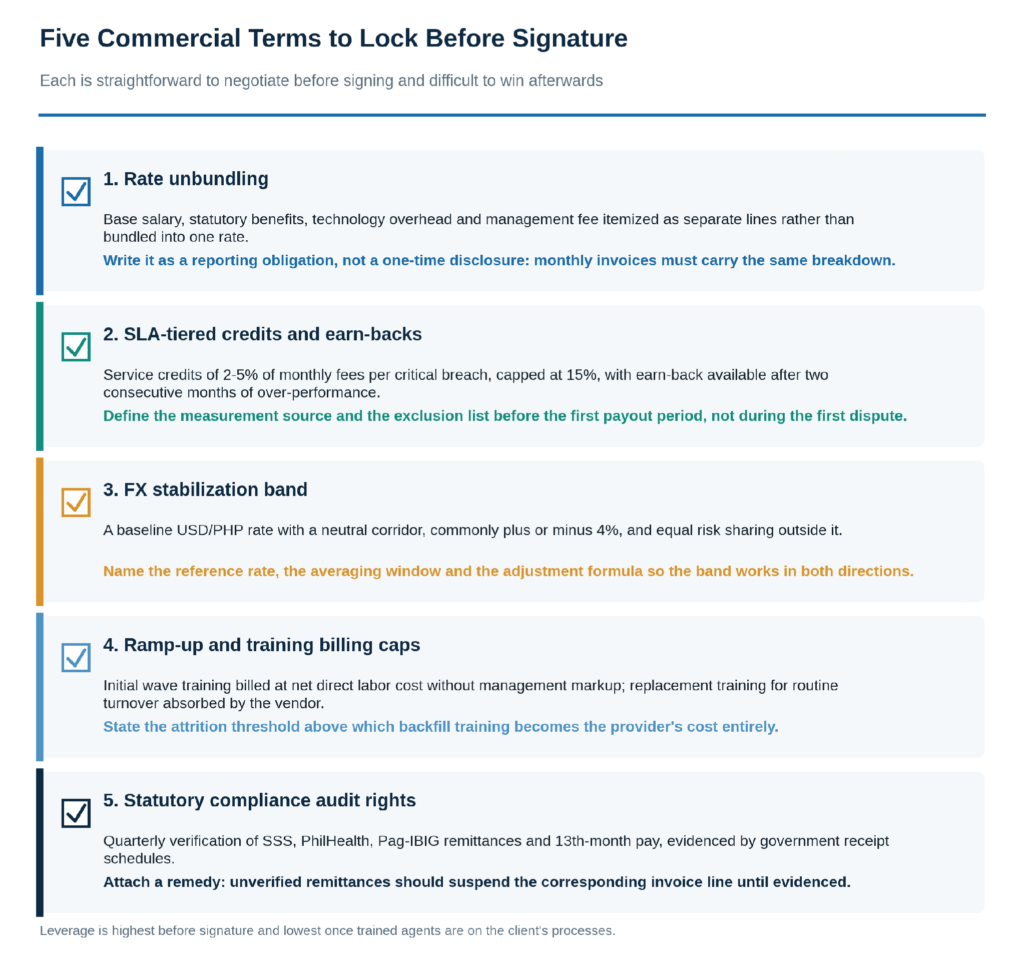
Figure 1. The five commercial terms to lock before signature, with the specific contractual language each requires.
How Do Unbundled Pricing Models Protect Buyer Margins?
Unbundling isolates frontline wages from vendor overhead and management margin, so a provider under margin pressure cannot quietly reduce agent pay to protect its own economics. A flat hourly rate conceals that allocation entirely, which is why wage compression is invisible until attrition exposes it.
Negotiating commercial terms begins with billing transparency, because every other protection depends on it. A fully loaded hourly rate is a single number covering wages, statutory benefits, facilities, technology, supervision, and profit. Nothing about that is improper. The problem is that it conceals the variable most predictive of program performance — what the agent is actually paid — and gives the provider one silent lever when inflation, a wage order, or an aggressive renewal squeezes its margin.
Pulling that lever drives attrition sharply higher, and the buyer absorbs the consequences through lost domain knowledge, repeated onboarding, and falling resolution rates, all while the invoice stays constant. An unbundled cost-plus structure removes the lever by making the direct labor line visible and benchmarkable against local market rates for the skill tier.
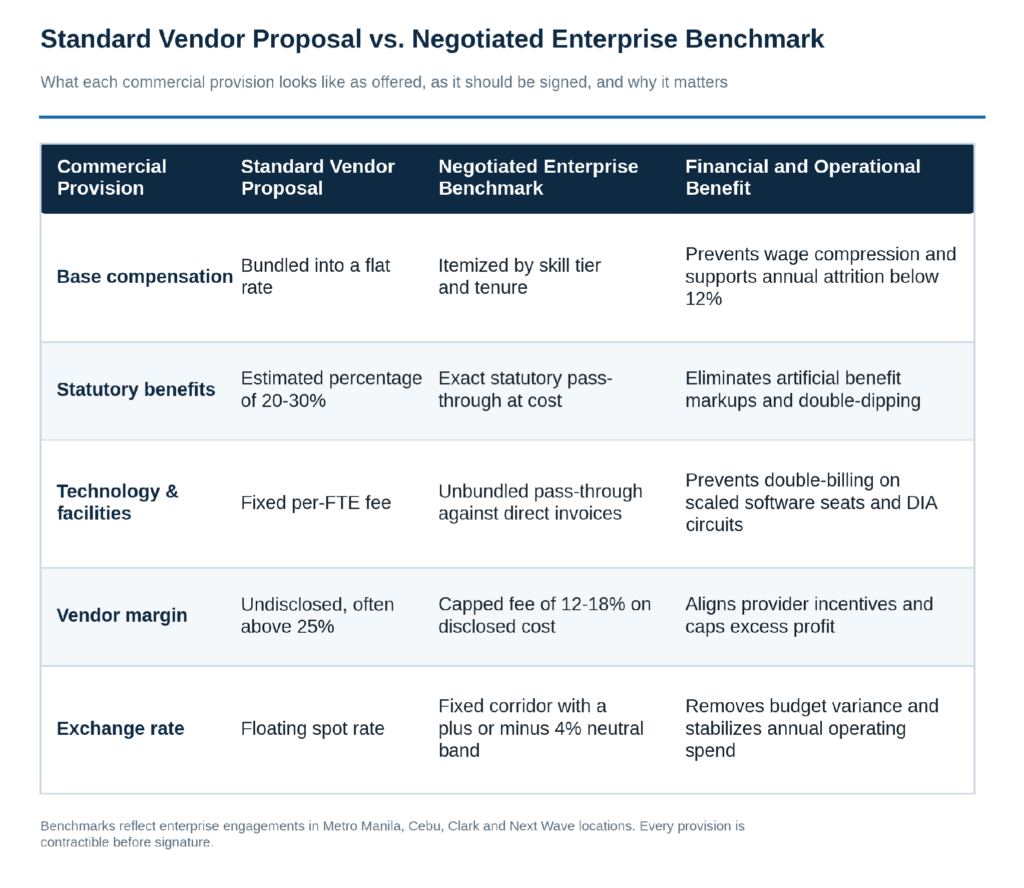
Figure 2. How each commercial provision is typically proposed, how it should be signed, and the financial and operational benefit of the negotiated position.
Make Unbundling a Reporting Obligation
The most common failure is treating unbundling as a one-time disclosure during procurement. A rate card broken out at signature and then invoiced as a single blended number for the next three years delivers none of the benefit. Write the breakdown into the reporting schedule so every monthly invoice carries the same itemization, and tie the audit rights to that schedule rather than to a document produced once.
Which Performance Incentives and Penalties Align Operational Goals?
Targets without remedies are aspirations. Negotiate service credits set as a small share of monthly fees per critical SLA breach, capped at a fixed share of monthly account fees, with earn-backs available after two consecutive months of over-performance and a termination-for-cause trigger at three consecutive months of primary SLA failure.
Most contracts specify performance targets — a First Contact Resolution floor, an Average Handle Time ceiling — and then stop. Without a financial consequence attached, a missed SLA becomes a governance conversation rather than a commercial event, and governance conversations rarely change staffing decisions. The credit and earn-back structure is what converts the SLA from a reporting artifact into something the provider’s operations director manages against.
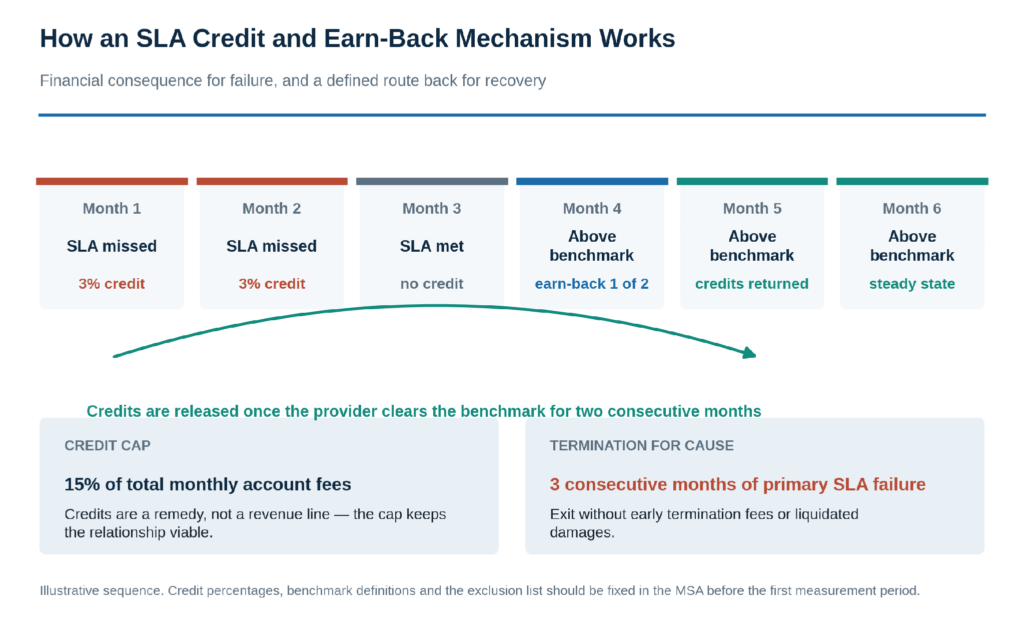
Figure 3. How a service credit and earn-back mechanism operates across a six-month cycle, with the credit cap and termination trigger.
Why Earn-Backs Matter as Much as Credits
A pure penalty regime creates a perverse incentive: once a provider has lost the quarter’s credit pool, it has no financial reason to invest in recovery for the remainder of the period. Earn-back provisions let the vendor recover withheld credits by exceeding benchmarks for two consecutive months, which keeps the incentive to fix the problem alive precisely when the problem exists. The cap matters for the same reason — credits are a remedy, not a revenue line, and an uncapped regime pushes a struggling provider toward exit rather than recovery.
Define the Measurement Before the First Dispute
Credits fail in practice when the parties disagree about whether the SLA was met. Name the system of record whose numbers are contractually authoritative, document the calculation for each metric, and agree the exclusion list — outages, force majeure, buyer-caused delays, out-of-scope contacts — before the first measurement period rather than during the first disputed invoice.
Set the Termination Trigger Explicitly
Define the operational breach that permits exit: missing primary SLAs for three consecutive months is a common and defensible threshold. Termination for cause should carry no early exit fee or liquidated damages and take effect within 30 days of an uncured breach. The clause is rarely used, but its presence changes the tenor of every remediation conversation.
How Should Currency and Statutory Risks Be Structured in the Philippines?
Statutory obligations should be billed at net actual cost with quarterly remittance verification, and FX exposure managed through a defined corridor rather than an undisclosed buffer. Movements inside a narrow agreed band are absorbed by the vendor; movements beyond it trigger equal risk sharing.
Philippine commercial terms have to address a specific regulatory environment. The Department of Labor and Employment enforces a mandatory 13th-month salary bonus under Presidential Decree 851, a night shift differential of at least 10% for work between 10:00 p.m. and 6:00 a.m., and regular holiday pay at a 100% premium. Wage floors are also set regionally and move on their own schedule — Metro Manila’s non-agricultural daily minimum rose to ₱755 on 25 July 2026 and reaches ₱780 in January 2027. Opaque contracts wrap these items into general billing, which leaves the buyer exposed to unexplained price adjustments every time a statutory rate changes.
Statutory Pass-Through Reconciliation
Require statutory contributions to be billed at net actual cost and verified through quarterly remittance schedules delivered directly to the buyer’s audit team. This serves two purposes: it prevents an administrative markup being applied on top of a legal obligation, and it confirms the provider is actually remitting on behalf of the agents serving the account — a compliance exposure that becomes the buyer’s reputational problem regardless of where the legal liability sits.
FX Corridors Instead of Buffers
A provider billing in USD while paying peso costs carries real exposure, and sharing it is reasonable. What is not reasonable is a premium embedded in the rate with no disclosure and no reversal when the currency moves the other way. A corridor mechanism sets a baseline rate, absorbs movement inside the band at the vendor’s risk, and shares adjustment equally outside it.
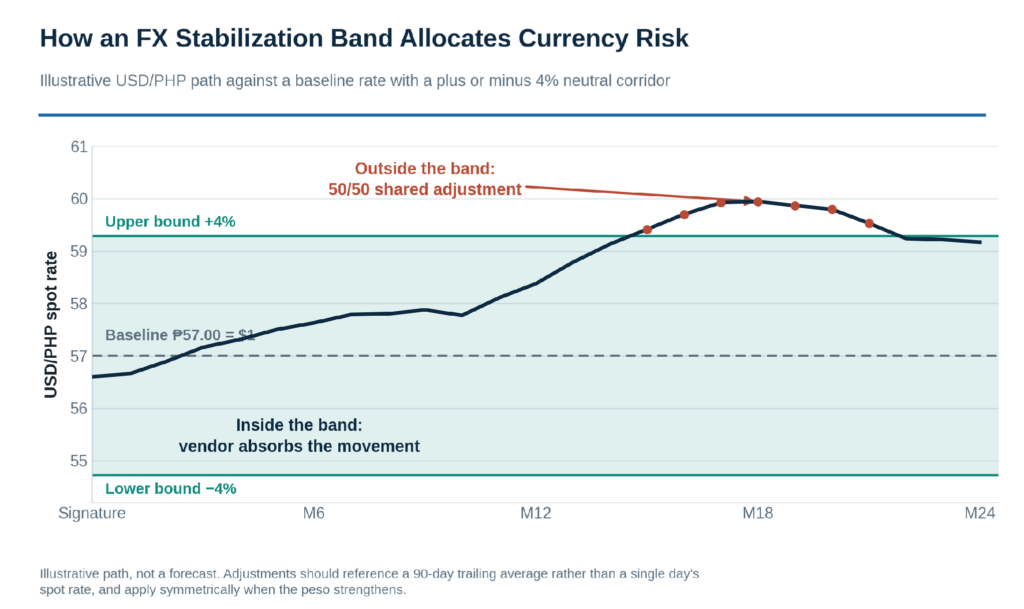
Figure 4. How an FX stabilization band allocates currency risk between buyer and provider.
Two details make the mechanism work. Reference a 90-day trailing average rather than a single day’s spot rate, so neither party can time an adjustment request. And make the band symmetrical: if the buyer shares the cost when the peso weakens against the corridor, the buyer should share the benefit when it strengthens.
Which Exit, Escalator, and Transition Terms Prevent Lock-In?
Negotiate a 60- to 90-day termination for convenience with fees limited to unamortized client-specific capital expenditure, CPI-linked escalators applied only to the base salary component, and a costed transition-out obligation covering knowledge transfer, documentation, and data return.
Exit terms are the clauses buyers most often defer and most often regret. The asymmetry is structural: switching costs rise every month as a provider accumulates process knowledge, so terms that seemed adequate at signature become the buyer’s main constraint two years later. Three provisions carry most of the protection.
Escalators Tied to the Right Base
A blanket percentage increase applied to the total invoice compounds against facilities, technology, and margin — costs that do not rise with Philippine wage inflation. Tie annual adjustments to a published consumer price index and apply them only to the base salary component, with statutory increases flowing through separately at documented cost. On a typical rate structure this alone reduces the effective escalation by more than half.
Termination Terms That Distinguish Cause from Convenience
Termination for convenience with 60 to 90 days’ notice is standard, and an early termination fee covering genuinely unamortized client-specific capital expenditure — dedicated hardware, bespoke build-out — is fair. What should be resisted is a fee calculated as a percentage of remaining contract value, which prices the buyer’s freedom rather than the provider’s stranded cost. Termination for cause should carry zero penalty.
Transition-Out as a Priced Obligation
Specify the transition-out service in the original agreement: duration, rate, knowledge transfer deliverables, documentation standards, and the return or destruction of client data. A transition-out clause negotiated at the point of departure will be expensive and slow, because by then the provider has no commercial interest in the outcome. Termination and step-in mechanics are covered further in our guide to contractual protections.
What Does a Well-Negotiated Commercial Framework Deliver in Practice?
A US EdTech scaling a Manila operation from 40 to 150 seats replaced a flat hourly rate carrying a fixed annual escalator with a fully unbundled agreement. The blended rate fell, annual spend dropped substantially, attrition fell to a fraction of its former level, and SLA adherence rose markedly.
Client Challenge
A rapidly growing US educational technology provider was scaling its Manila support operation from 40 to 150 seats. The incumbent insisted on a flat hourly rate with a fixed annual escalator, offering no visibility into labor allocation and no volume-based pricing mechanism — meaning the client would fund the same overhead structure nearly four times as it grew.
Audit and Vendor Selection
PITON-Global audited the commercial framework, identified substantial duplicated vendor overhead, and evaluated proposals across its network of more than 100 vetted Philippine providers to find those willing to execute unbundled, open-book cost-plus terms. Willingness to open the cost base functioned as a selection filter in its own right.
Solution Implemented
The client moved to an enterprise-grade provider in Clark under a fully unbundled agreement: a direct base wage placing agent compensation near the top of the local market, statutory benefits billed as a net pass-through, a facility and technology fee unbundled against invoices, and a capped vendor management margin that compressed automatically on reaching the 100-seat threshold.
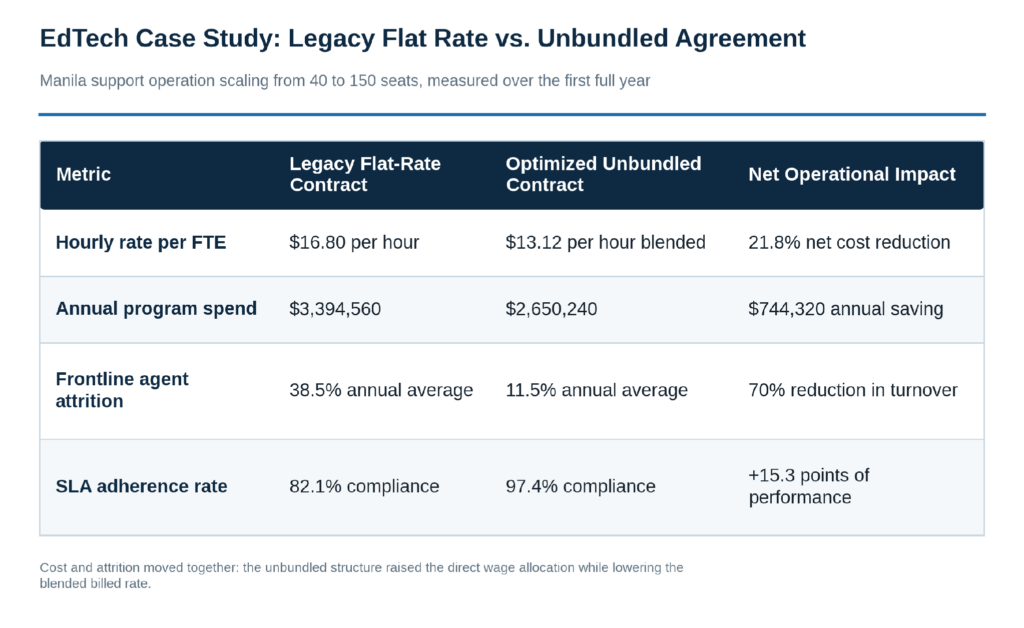
Figure 5. Legacy flat-rate contract versus the optimized unbundled agreement across cost, attrition, and SLA performance.
Why Cost and Quality Moved Together
The result that matters is the one that looks contradictory: the agent was paid more while the client paid less. That is only possible when the spread between the billed rate and the delivered cost was previously retained rather than invested. Higher direct compensation cut attrition sharply, which removed most of the recurring recruitment and re-training overhead and let domain knowledge accumulate — which is what carried SLA adherence markedly higher.
Key Takeaway
Securing unbundled commercial terms before execution prevents margin erosion, stabilizes scaling costs, and protects long-term operational performance. Every provision in that agreement was available at signature; almost none of it would have been winnable in year two.
How Does PITON-Global Reduce Commercial Outsourcing Risk?
PITON-Global is a BPO advisory and management consultancy that guides enterprise buyers through provider selection, financial modeling, and contract negotiation in the Philippines. It advocates for client interests through open-book governance and risk-mitigated commercial structuring rather than transactional placement fees.
Who Is PITON-Global?
PITON-Global advises enterprise buyers on Philippine outsourcing across provider selection, commercial structuring, and the governance that follows signature. Its relevance to contract negotiation is specific: pricing terms correctly requires knowing what site overhead actually costs in Manila versus Clark, what margin is defensible at a given seat count, and which providers have the financial structure to accept a capped fee. In a market of more than 1,000 contact centers and back-office operations, none of that is visible from a rate card or a capability deck.
How Does PITON-Global Differ from Traditional Outsourcing Brokers?
Traditional brokers earn transactional referral fees, which narrows the recommendation set to whichever providers pay best and ends their involvement at the introduction — precisely the point before commercial terms are negotiated. An advisory-led model is organized around the client’s outcome: independent evaluation, objective recommendations that may include providers with no commercial relationship to the advisor, and continued engagement through modeling, negotiation, and governance. On commercial terms the distinction is concrete, because an intermediary paid on placement has no reason to tell a buyer that the proposed margin is four points above market.
How Does PITON-Global’s Network of 100+ Vetted Philippine BPO Providers Benefit Organizations?
The network spans enterprise-grade providers across voice, back-office processing, IT services, and AI-assisted operations in Manila, Cebu, Clark, and Davao. Because candidates are pre-assessed for capacity, certifications, financial stability, and attrition performance — and screened for willingness to contract on open-book terms — buyers skip the discovery phase and negotiate with providers that can actually accept the commercial structure being proposed. Qualification compresses from months to weeks. Specialized sectors add their own requirements, as our look at precision biotech partnerships shows.
How Does PITON-Global’s Advisory-Led Vendor Matching Process Work?
Matching runs from requirement definition through to executed terms, with commercial structuring deliberately placed before negotiation so the framework is engineered rather than inherited from a vendor template.
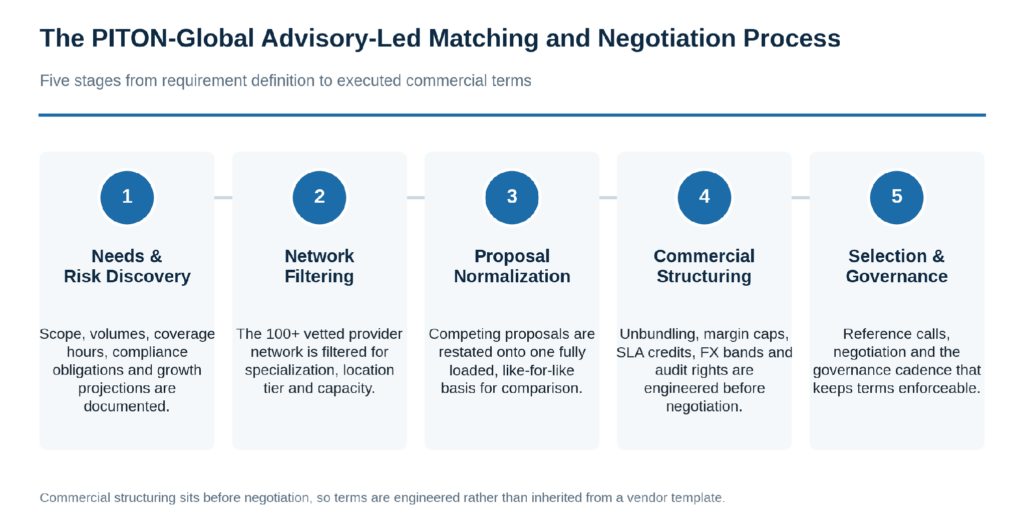
Figure 6. PITON-Global’s five-stage advisory-led matching and negotiation process.
Why Do Organizations Use PITON-Global?
- Reduced commercial risk. Independent diligence on delivery capability, statutory compliance, and financial stability surfaces problems before they are contractual.
- Stronger negotiated terms. Unbundling, margin caps, SLA credits, FX bands, and audit rights are engineered into the agreement rather than requested afterwards.
- Improved provider fit. Matching on domain expertise and program size ensures the account remains strategic revenue for the provider.
- Accelerated vendor selection. A pre-qualified shortlist compresses a discovery cycle that typically runs for months into weeks.
- Governance through the lifecycle. Support continues through MSA negotiation, audit rights, and the cadence that keeps terms enforceable.
Frequently Asked Questions
What is a reasonable vendor margin for BPO contracts in the Philippines?
Market-aligned margins for established Philippine providers sit in a moderate band. Margins well above that band in a flat-rate agreement typically indicate unearned overhead markups or underinvestment in agent compensation — both of which surface later as attrition and quality problems rather than as a line on the invoice.
How should initial training and onboarding costs be negotiated?
Initial wave training should be billed at net direct labor cost without full management markup. Ongoing replacement training for standard turnover should be absorbed by the provider, since it reflects the provider’s own retention performance. State the attrition threshold at which backfill training becomes entirely the provider’s cost. Training bills also shrink when processes are unified first, as our guide to pre-outsourcing centralization explains.
What are standard termination clauses in Philippine BPO agreements?
Enterprise agreements should include termination for convenience on 60 to 90 days’ notice, with early termination fees limited to unamortized client-specific capital expenditure. Termination for cause should carry zero penalty and take effect within 30 days of an uncured breach.
How do annual rate escalators work in unbundled BPO agreements?
Annual adjustments should be tied to a published consumer price index and applied only to the base salary component, rather than as a blanket percentage across the total invoice. Statutory increases flow through separately at documented cost, which keeps the escalator honest in both directions.
What financial audits should buyers require in their master services agreement?
Secure audit rights permitting independent finance teams to inspect statutory remittance receipts, overtime and night differential calculations, software seat licensing invoices, and currency conversion adjustments for the buyer’s account. Name the cadence and attach a remedy — an audit right with no consequence for a failed audit changes nothing.