

On this page
- Key Takeaways
- Which Legal Frameworks Govern Outsourcing Contracts in the Philippines?
- How Can Service Level Agreements and Penalties Be Enforced Effectively?
- What Protections Apply When a Vendor Fails or the Relationship Ends?
- How Should Contractual Protections Be Audited Across the Lifecycle?
- What Does Restructured Contractual Protection Deliver in Practice?
- Why Partner with PITON-Global for Strategic Offshore BPO Selection?
- Frequently Asked Questions
Enterprises must safeguard Philippine outsourcing engagements with contractual protections covering data security, step-in rights, intellectual property ownership, and clear termination mechanics. Critical clauses should enforce Data Privacy Act compliance, specify service credits for SLA breaches, and set out structured offboarding protocols that protect operational continuity. Together they form the legal core of a well-governed offshore agreement.
Key Takeaways
- Data privacy compliance. Mandate adherence to the Data Privacy Act of 2012 (Republic Act No. 10173) and to ISO/IEC 27001 to insulate against regulatory breach.
- Enforceable service level agreements. Tie service credits directly to core indicators such as First Contact Resolution and Average Speed of Answer.
- Step-in rights. Include explicit authority to assume operational control of infrastructure or facility management during a vendor default.
- Intellectual property assignment. Secure absolute assignment of workflow artifacts, custom scripts, and generated assets under Philippine IP law.
- Exit management protocols. Contract transition assistance, knowledge transfer timelines, and certified data purging before you need them.
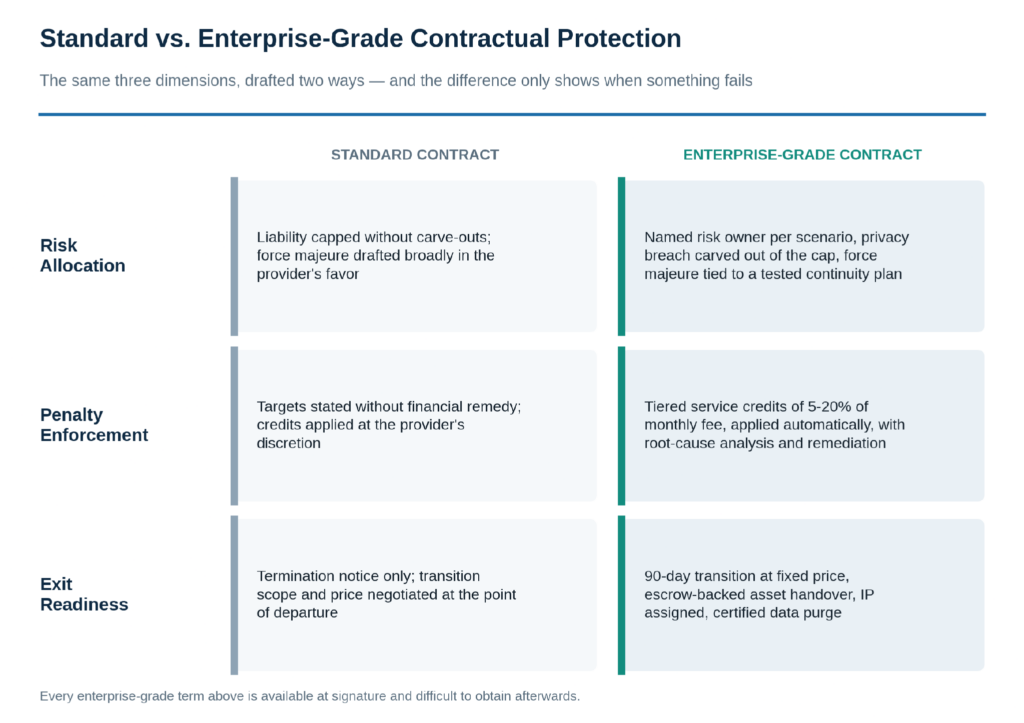
Figure 1. Standard versus enterprise-grade contractual protection across risk allocation, penalty enforcement, and exit readiness.
Which Legal Frameworks Govern Outsourcing Contracts in the Philippines?
A master services agreement must align with Philippine labor law, the Data Privacy Act administered by the National Privacy Commission, and PEZA guidelines where the provider is a registered enterprise. Well-drafted agreements also name jurisdiction, a dispute resolution venue such as arbitration under the PDRC, and statutory obligations including 13th-month pay.
The frameworks are not optional background; they determine which clauses are enforceable and where. An agreement that specifies a foreign governing law but relies on remedies that must be exercised against Philippine assets — seizing equipment, stepping into a facility, compelling a data purge — will find the practical enforcement route runs through Philippine institutions regardless. Name the venue deliberately, and check that the remedies you have drafted can actually be obtained there.
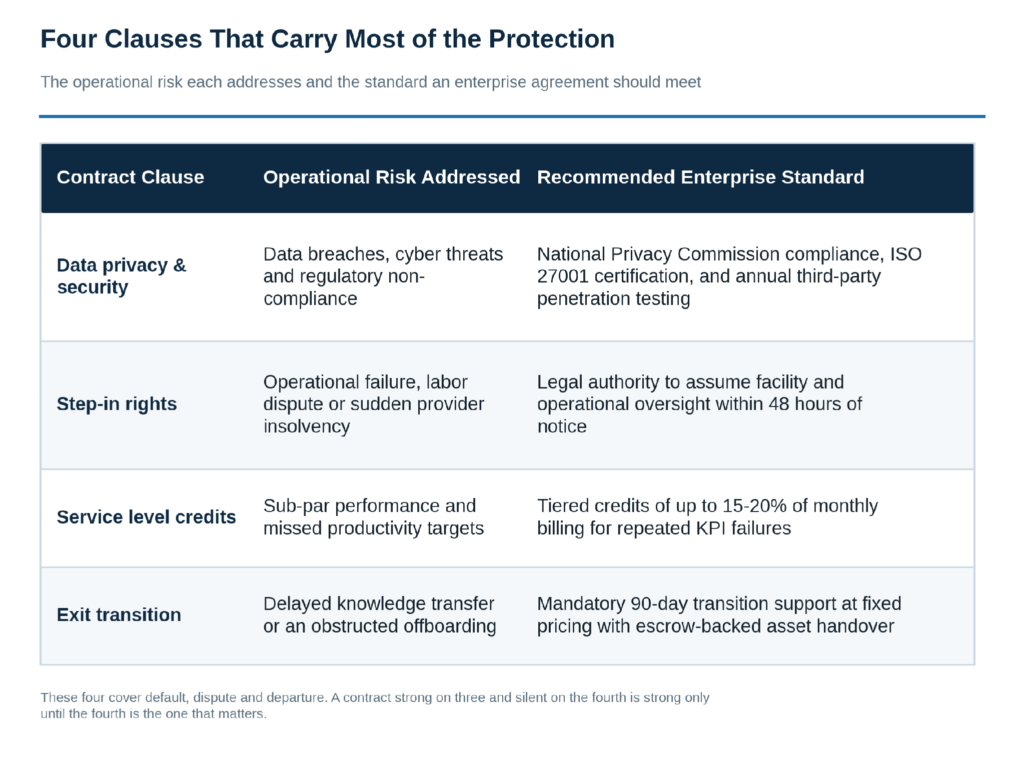
Figure 2. The four clauses that carry most of the protection, with the risk each addresses and the enterprise standard to require.
Data Privacy and the National Privacy Commission
Republic Act No. 10173 governs personal data processing, cross-border transfer, and breach notification, and it is enforced by the National Privacy Commission. Require registration with the NPC, a designated Data Protection Officer, ISO 27001 certification with a scope covering your site and service, and annual third-party penetration testing. Breach notification timelines should be written into the contract rather than left to the statutory minimum.
Labor Law and Statutory Benefits
The provider is the employer, but the buyer inherits the consequences of non-compliance through service disruption and reputational exposure. Reference statutory obligations explicitly — 13th-month pay under Presidential Decree 851, night shift differential, holiday premiums, and SSS, PhilHealth, and Pag-IBIG remittances — and attach an audit right so compliance can be verified rather than assumed.
PEZA Status and Data Residency
Where the provider operates in a PEZA-accredited facility, the accreditation carries operational and tax implications worth confirming as current. It also matters for data residency: if your agreement guarantees that regulated data stays within a specific facility, the facility’s status and the physical location of the processing should both be named in the contract.
How Can Service Level Agreements and Penalties Be Enforced Effectively?
Accountability depends on granular SLAs linked to financial remedies. Define thresholds for metrics such as schedule adherence, occupancy, and Net Promoter Score, then escalate automatically: a single miss triggers root-cause analysis, two consecutive months trigger service credits and an executive remediation plan.
Most SLA frameworks fail for one of two reasons. Either the remedy is discretionary, in which case it is applied inconsistently and disputed when it is applied, or the first remedy available is termination, which is so disproportionate that it never gets used. A graduated ladder solves both: each rung is reached only by sustained failure, and each carries a consequence proportionate to what has actually happened.
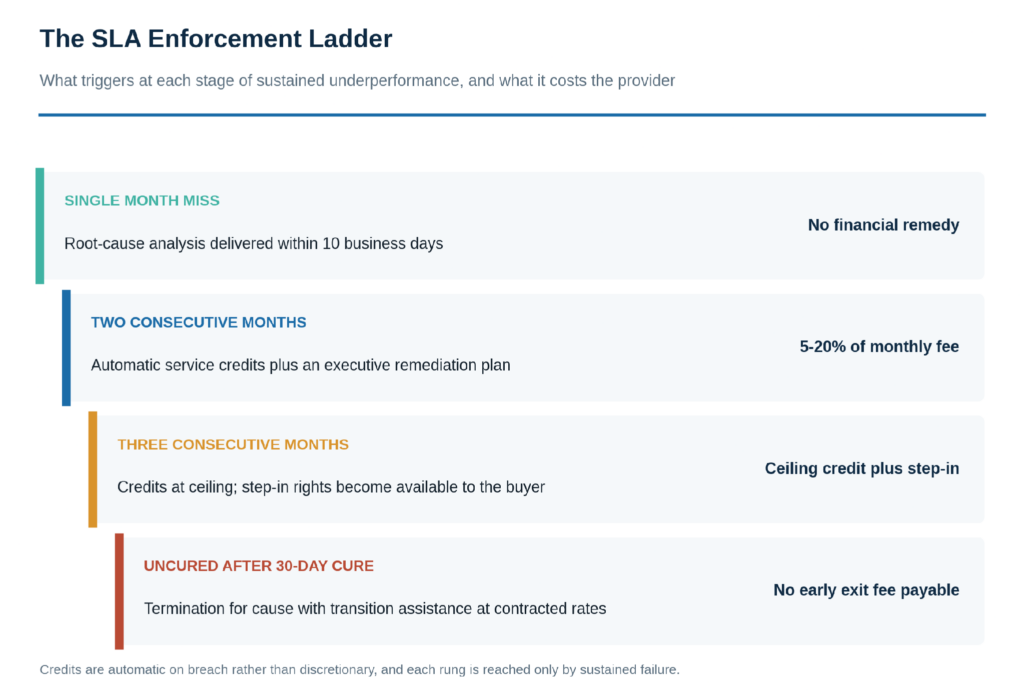
Figure 3. The SLA enforcement ladder: what triggers at each stage of sustained underperformance.
Make Credits Automatic, Not Discretionary
Service credits set as a tiered share of the monthly management fee are standard for sustained failure against agreed productivity or quality thresholds. The important drafting point is that they apply automatically on a verified breach rather than on request. A credit the buyer has to argue for is a negotiation, and a monthly negotiation is precisely what a well-drafted SLA framework exists to prevent.
Name the Measurement Source Before the First Dispute
Specify which system’s numbers are contractually authoritative, how each metric is calculated, and what is excluded — client-side outages, volume spikes beyond agreed bands, unannounced system changes. Most SLA arguments are not disagreements about performance; they are disagreements about measurement, and they are cheap to prevent and expensive to litigate.
Standard industry contracts often favor the service provider by burying accountability in vague language. Enterprise buyers must insist on transparent, enforceable performance metrics and explicit step-in rights that protect operational continuity from unexpected provider distress.
— John Maczynski, CEO, PITON-Global
What Protections Apply When a Vendor Fails or the Relationship Ends?
Three clauses do the work: step-in rights authorizing the buyer to assume operational oversight within 48 hours of notice, absolute IP assignment covering everything built during the engagement, and an exit management protocol with a fixed-price 90-day transition and certified data purge.
Step-In Rights
Step-in rights give the buyer legal authority to take temporary direct control of operations, workspace, or IT infrastructure during a severe default, labor dispute, or provider insolvency. Draft them with three specifics: the trigger events, the notice period — 48 hours is a defensible standard — and what the buyer may actually do once invoked, including access to systems, facilities, and staff. Rights that exist without operational detail are unusable in the compressed timeline of an actual failure.
Intellectual Property Assignment
Under the Intellectual Property Code of the Philippines, ownership of work product does not automatically vest in the client. Include comprehensive work-for-hire and assignment clauses covering software code, custom scripts, process documentation, training materials, and operational workflows, with the assignment effective on creation rather than on payment or termination. Where the provider builds tooling on top of its own platform, define the license that survives exit. Those workflows are also easier to specify, and to own, when they are centralized first, as our guide to pre-outsourcing centralization argues.
Exit Management and Data Purge
Termination for convenience typically requires 90 to 180 days’ written notice, paired with a mandatory transition period. The clause is worth more when it is priced: specify the transition rate card at signature, because a provider negotiating transition support at the point of departure has no commercial reason to be reasonable. Include escrow-backed asset handover and a certified data purge with written confirmation of destruction.
Force Majeure Written for This Market
Force majeure clauses should account for regional realities — typhoons, seismic events, grid instability — by requiring the provider to maintain a business continuity plan, redundant power, and alternative site failover rather than by simply excusing performance. A clause that excuses a provider for an annual, predictable weather season transfers a manageable operational risk back to the buyer as an unmanageable one.
How Should Contractual Protections Be Audited Across the Lifecycle?
Protections are established in five stages: pre-contract diligence, drafting and negotiation, onboarding and baseline, in-life governance, and exit. Each stage verifies something the previous stage assumed, and the clauses written during negotiation are worth only what in-life governance enforces. Pre-contract diligence starts with the buyer’s own house, as our readiness guide for offshore programs explains.
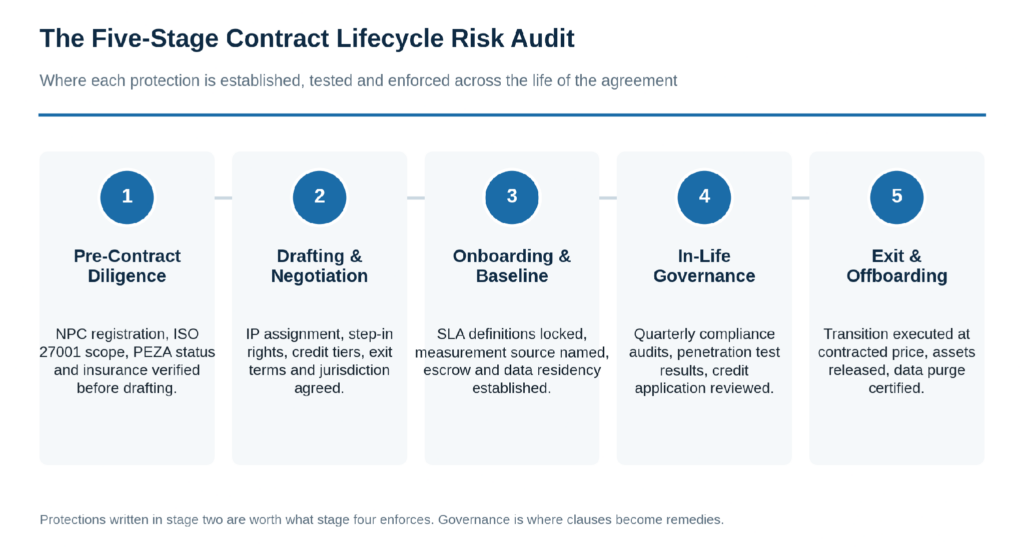
Figure 4. The five-stage contract lifecycle risk audit, from pre-contract diligence through offboarding.
The stage most often skipped is the fourth. Buyers negotiate hard, sign a strong agreement, and then never test it: penetration test results go unread, credit entitlements go unclaimed, and compliance audit rights sit unused until an incident makes them urgent. By that point the evidence trail that would have supported a claim does not exist. Quarterly governance that actually exercises the contract’s rights is what converts drafting into protection. Designing that governance is covered in our guide to oversight frameworks for BPO relationships.
What Does Restructured Contractual Protection Deliver in Practice?
A multinational financial institution facing regulatory exposure and no recourse over unreturned proprietary software moved to a restructured MSA with strict IP assignment, milestone-based escrow, and PEZA-facility data residency. Regulatory exposure was eliminated, dispute resolution time fell sharply, and the client secured full legal ownership of its workflows.
Client Challenge
The institution’s legacy Philippine vendor had missed security milestones and failed to transfer custom proprietary software assets. The underlying problem was contractual rather than operational: the agreement contained no assignment clause covering work product, no payment mechanism tied to security deliverables, and no defined escalation path, so the client had regulatory exposure and no mechanism for obtaining a remedy.
Vendor Selection Process
PITON-Global audited the existing agreements to identify precisely which protections were absent, then used its network of more than 100 vetted Philippine providers to identify a tier-one partner already operating with enterprise-grade contractual templates. Willingness to accept step-in rights and IP assignment was treated as a screening criterion, not a negotiation topic.
Solution Implemented
The new master services agreement combined strict intellectual property assignment, milestone-based escrow releasing payment against verified security deliverables, and localized data residency guarantees inside a PEZA-accredited facility.
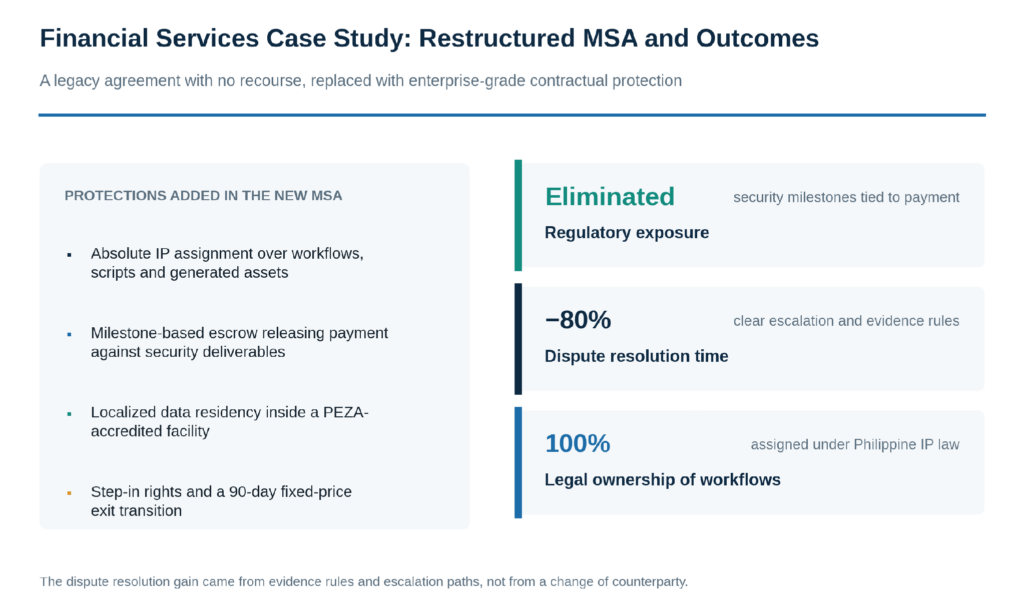
Figure 5. The protections added in the restructured MSA and the outcomes they produced.
Outcomes and Lessons
The restructuring eliminated regulatory exposure, cut dispute resolution time sharply, and secured full legal ownership of proprietary operational workflows. The reduction in dispute time is the most transferable result: it came from evidence rules and defined escalation paths rather than from changing counterparty, which means the same gain is available inside an existing relationship if the agreement is amended. Proactive structuring prevents costly litigation and protects assets across a multi-year lifecycle.
Why Partner with PITON-Global for Strategic Offshore BPO Selection?
PITON-Global is a BPO advisory and outsourcing consultancy offering advisory-led matching across a curated network of more than 100 top-tier Philippine providers, combining operational benchmarking with contract risk evaluation to reduce exposure and accelerate negotiation.
Who Is PITON-Global?
PITON-Global advises enterprise buyers on Philippine outsourcing across provider selection, contract risk evaluation, and commercial structuring. Its relevance to contractual protection is practical: knowing which providers will accept step-in rights, which have enterprise MSA templates already in use, and which will resist IP assignment saves a negotiation cycle that would otherwise be discovered clause by clause. In a market of more than 1,000 providers, that intelligence is not published anywhere.
How Does PITON-Global Differ from Traditional Outsourcing Brokers?
Traditional intermediaries earn on placement, which narrows the recommendation set to whichever providers pay best and ends their involvement at introduction — before the agreement is drafted. An advisory-led model is organized around the buyer’s outcome: objective evaluation, recommendations that may include providers with no commercial relationship to the advisor, and continued engagement through contracting and governance. On protection work the distinction is concrete, because an intermediary paid on placement has no reason to flag that a shortlisted provider’s standard terms exclude step-in rights entirely.
How Does PITON-Global’s Network of 100+ Vetted Philippine BPO Providers Benefit Organizations?
Providers in the network are screened on regulatory standing, security certification, contract readiness, and operational evidence before they reach a buyer. That means a shortlist arrives already filtered for the providers capable of signing an enterprise-grade agreement, rather than a field where half the candidates will decline the protections once drafting begins. Coverage spans voice and CX, back office and finance, healthcare administration, and specialist verticals across Manila, Cebu, Clark, and Davao.
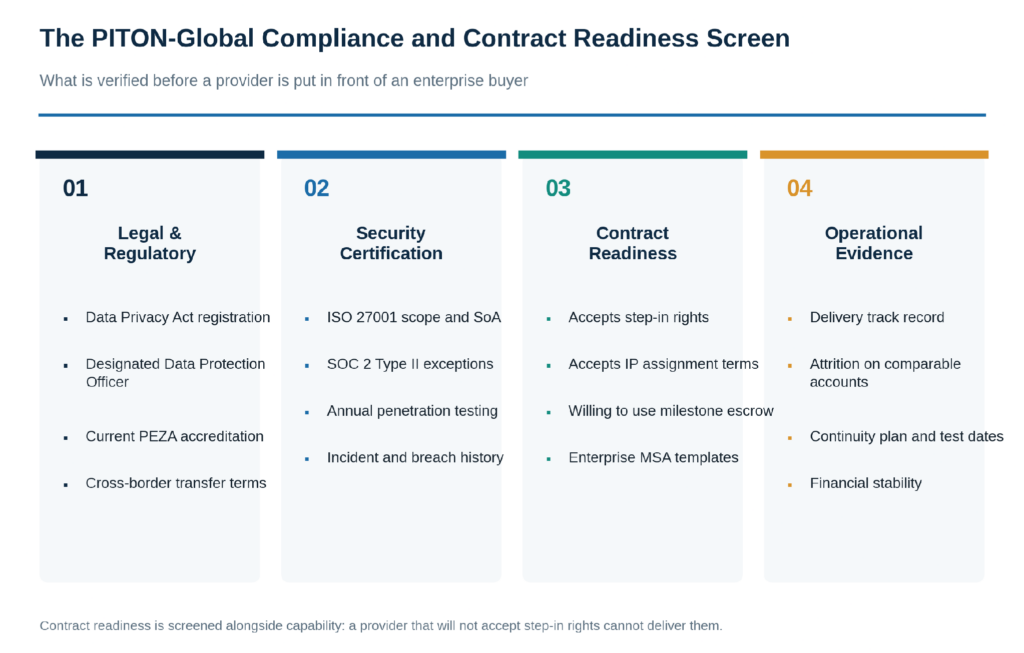
Figure 6. The compliance and contract readiness screen applied before a provider reaches an enterprise buyer.
How Does PITON-Global’s Advisory-Led Vendor Matching Process Work?
Requirements, regulatory obligations, and risk tolerance are documented; the vetted network is filtered on domain expertise, location tier, and capacity; candidates are screened on privacy registration, security certification scope, and willingness to accept enterprise contractual terms; and the buyer is supported through negotiation, MSA structuring, and the governance cadence that keeps the protections live.
Why Do Organizations Use PITON-Global?
- Reduced contractual exposure. Regulatory standing and security certification are verified before shortlisting rather than during drafting.
- Accelerated negotiation. Providers already operating enterprise-grade templates remove entire rounds from the contracting cycle.
- Improved provider fit. Capability and contract readiness assessed as one question, so the shortlist can actually sign what you need.
- Stronger agreements. Step-in rights, IP assignment, credit tiers, and exit terms engineered rather than inherited from a provider template.
- Support beyond signature. Governance design that exercises the contract’s rights instead of leaving them dormant.
Frequently Asked Questions
What Philippine laws govern data protection in outsourcing contracts?
The Data Privacy Act of 2012, Republic Act No. 10173, overseen by the National Privacy Commission. It establishes protocols for personal data processing, cross-border transfer, and breach notification, and it applies to the provider as a personal information processor acting on the buyer’s instructions.
How are intellectual property rights protected in Philippine BPO agreements?
Through comprehensive work-for-hire and assignment clauses under the Intellectual Property Code of the Philippines, covering software code, operational processes, documentation, and customer data. Make the assignment effective on creation rather than on payment, and define what license survives if the provider builds on its own platform.
What are step-in rights and why are they critical?
Step-in rights give the buyer legal authority to take temporary direct control of the provider’s operations, workspace, or IT infrastructure during a severe default or financial distress. They matter because every other remedy — credits, damages, termination — compensates after the fact, while step-in is the only clause that keeps the service running.
What is a standard notice period for terminating a BPO contract?
Typically 90 to 180 days’ written notice for termination for convenience, paired with a mandatory transition and knowledge-transfer period. Termination for cause should be shorter and carry no exit fee, usually taking effect 30 days after an uncured breach.
How do force majeure clauses apply to Philippine BPO operations?
They should account for typhoons, seismic events, and grid instability by requiring a maintained business continuity plan, redundant power, and alternative site failover — not by excusing performance for seasonal weather. Ask for the date and result of the last live failover test as evidence the plan is real.
What financial penalties are enforceable for SLA failures?
Service credits set as a tiered share of the monthly management fee where the provider misses agreed productivity or quality thresholds over a sustained period. Cap total monthly exposure, apply credits automatically on verified breach, and pair them with earn-back so a recovering provider retains a reason to invest in recovery.