

On this page
- Key Takeaways
- When Is a Business Operationally Mature Enough to Move Processes Offshore?
- What Cost Benchmarks and Performance Realities Define the Philippine Market?
- Perspective From the Field
- How Do Global Compliance and Enterprise Risk Align Offshore?
- What Does a Successful Philippine BPO Migration Look Like in Practice?
- How Does PITON-Global Help Enterprises De-Risk BPO Provider Selection?
- What Else Should Enterprises Know Before Outsourcing to the Philippines?
Your business is ready for BPO outsourcing to the Philippines once core processes are fully documented, performance baselines are defined with measurable KPIs, and compliance requirements are mapped. Readiness depends on process stability — not headcount cost — because offshoring amplifies whatever workflows you transfer. Standardizing operations beforehand cuts migration friction considerably. It also means knowing what the eventual agreement must cover, from SLA structure and oversight cadence to exit terms.
Key Takeaways
- Operational maturity comes first: Document every in-scope process as a clear, digital SOP before transitioning it offshore; ambiguity does not disappear in transit — it migrates and amplifies.
- Cost arbitrage is real but secondary: Premium Philippine providers deliver large labor savings, yet the larger gain is reclaiming your internal team’s strategic focus.
- Infrastructure is enterprise-grade: Vetted providers run dual-feed power grids and redundant subsea fiber backbones to sustain near-continuous uptime.
- Compliance is built in: Top-tier vendors maintain active SOC 2 Type II, ISO 27001, HIPAA, and GDPR compliance architectures.
- Advisory beats brokerage: Independent, advisory-led matching compresses vendor selection from months to days while improving provider fit.
- A maturing, resilient market: The Philippine IT-BPM sector is projected to reach roughly $42 billion in revenue in 2026, per IBPAP projections, employing about 1.9 million professionals.
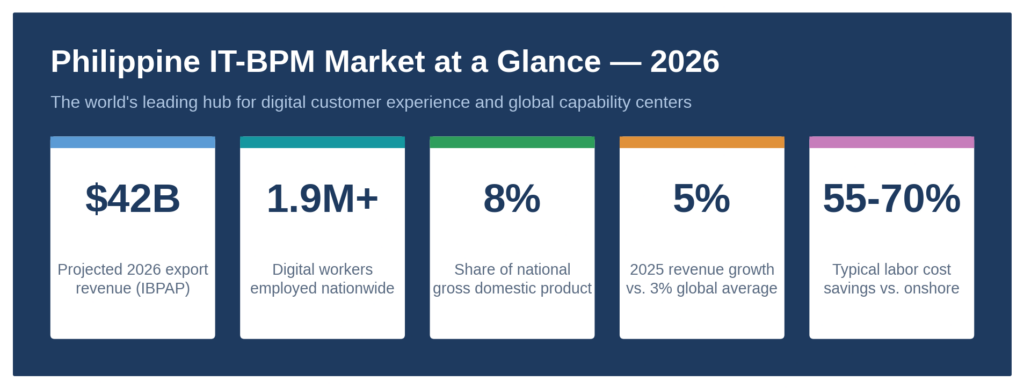
Figure 1. The 2026 Philippine IT-BPM market at a glance (source: IBPAP industry projections).
When Is a Business Operationally Mature Enough to Move Processes Offshore?
A business is operationally mature when its workflows are captured in standardized SOPs, performance is tracked through granular metrics such as Average Handle Time (AHT) and First Contact Resolution (FCR), systems are cloud-native with role-based access, and internal governance is assigned. Offshoring magnifies existing inefficiencies, so stabilize internal KPIs before engaging any vendor.
Enterprise buyers frequently miscalculate readiness by focusing strictly on headcount costs rather than process stability. The instinct is understandable — a lower hourly rate is easy to quantify and easy to defend to a board. But the variable that actually determines success is whether the work being transferred is repeatable and well understood. If an internal workflow is fragmented, poorly documented, or reliant on tribal knowledge, moving it into a business process outsourcing (BPO) model will not fix those weaknesses; it will scale them across a larger, more distributed team.
True readiness therefore requires stabilizing your internal performance first. The objective is to reach a state where any competent operator could read your documentation, observe your metrics, and reproduce your outcomes. The comparison below contrasts an unready environment with a fully optimized one across the four dimensions that most reliably predict a smooth migration.
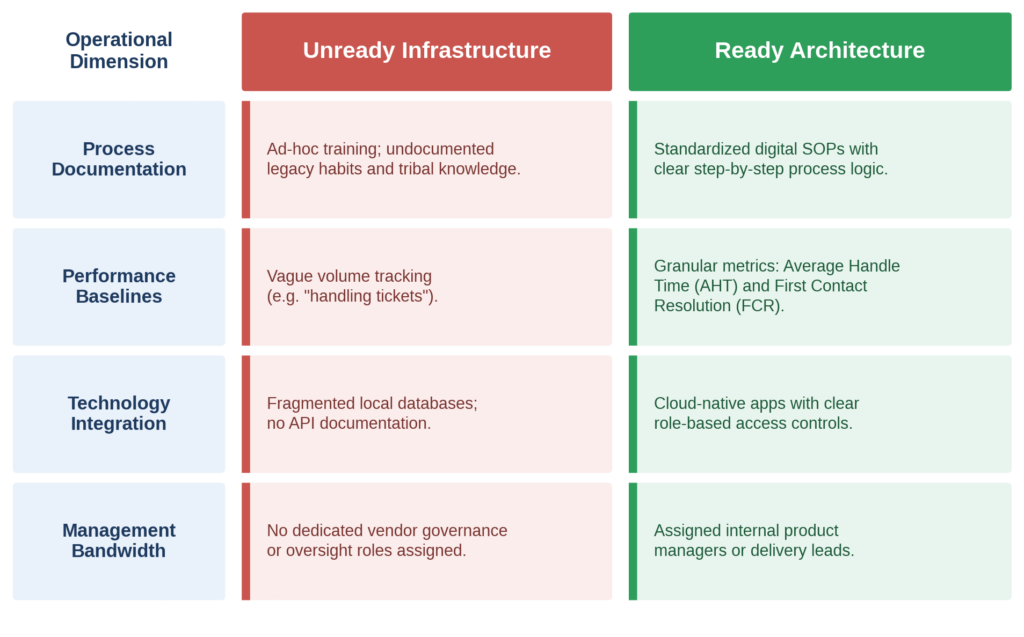
Figure 2. The operational dimensions that separate an unready environment from a migration-ready one.
From Tribal Knowledge to Documented SOPs
The single biggest predictor of offshore failure is undocumented process knowledge that lives only in the heads of long-tenured staff. Before transition, convert that knowledge into standardized, digital standard operating procedures with explicit, step-by-step logic and decision trees for edge cases. This documentation becomes the backbone of provider training and the reference point for quality assurance. Multi-site companies face the extra step of harmonizing each office’s version first, as our guide to standardizing operations across locations explains.
Establishing Performance Baselines
You cannot improve — or even fairly evaluate — what you have not measured. Replace vague volume tracking with granular metrics: Average Handle Time, First Contact Resolution, quality scores, and customer satisfaction. These baselines let you set realistic service-level agreements (SLAs) and detect regression early once the team is live. Turning them into enforceable commitments is covered in our guide to structuring performance guarantees.
Assigning Governance and Oversight
Offshoring is not a hand-off; it is a partnership that requires active management. Designate internal product managers or delivery leads who own the vendor relationship, run cadence calls, and arbitrate priorities. Without this bandwidth, even a strong provider drifts from your intent. The path from a messy starting point to a confident launch is sequential, not simultaneous.

Figure 3. Readiness is a sequence: document, standardize, baseline, then launch.
What Cost Benchmarks and Performance Realities Define the Philippine Market?
IBPAP projects the Philippine IT-BPM sector to reach roughly $42 billion in 2026, employing about 1.9 million professionals and growing faster than the global average. Premium mid-market providers charge fully-loaded rates for specialized roles that sit well below onshore equivalents.
The IT-Business Process Management (IT-BPM) industry closed 2025 with export revenues exceeding $40 billion and is on track for about $42 billion in 2026, according to the IT and Business Process Association of the Philippines (IBPAP). The sector accounts for more than 8% of national GDP and remains the global leader in digital customer experience, with growth increasingly driven by global capability centers (GCCs) in banking, financial services, and healthcare. That depth of demand has produced a deep, English-fluent, university-educated talent pool — the structural advantage that underpins the market.
Navigating cost, however, requires analyzing fully-loaded hourly rates rather than basic salaries. In the premium mid-market tier, an enterprise receives dedicated talent backed by tier-1 infrastructure. Typical fully-loaded hourly rates — inclusive of management, facilities, technology licenses, and localized benefits — sit at a fraction of onshore levels for specialized back-office, customer experience (CX), or finance and accounting roles.
Perspective From the Field
Many enterprise buyers treat offshoring as a pure procurement exercise focused on the lowest hourly rate. That is a critical error. In the modern landscape, the goal is buying back your internal team’s strategic focus. Savings are standard, but the real alpha comes from pairing exceptional human empathy with advanced, platform-integrated workflows.
— John Maczynski, CEO, PITON-Global

Figure 4. Representative fully-loaded hourly rates by function, onshore versus premium Philippine BPO.
Reading Fully-Loaded Rates Correctly
A published “base rate” rarely reflects true cost. Fully-loaded pricing bundles supervision, facilities, redundant connectivity, software licensing, recruitment, attrition management, and statutory benefits into a single number you can compare directly against your onshore cost-to-serve. When you benchmark fully-loaded against fully-loaded, the delta holds across customer experience, back-office data management, and finance and accounting functions. Which of those cost lines to unbundle in the contract is covered in our guide to the commercial terms worth negotiating.
Beyond Cost — Buying Back Strategic Focus
The most sophisticated buyers treat savings as the floor, not the ceiling. Offloading high-volume, repeatable work frees senior internal staff to concentrate on product, customers, and growth. Pairing well-trained Filipino agents with automation and platform-integrated workflows compounds the benefit: you lower cost and raise quality at the same time, rather than trading one for the other.
How Do Global Compliance and Enterprise Risk Align Offshore?
Premium Philippine providers operate inside PEZA-accredited technology parks with institutional-grade security spanning three vectors: digital defenses, physical controls, and network redundancy. Enterprise-grade vendors maintain SOC 2 Type II, ISO 27001, HIPAA, and GDPR compliance, and use thin-client environments so sensitive data never resides on an agent’s local terminal.
Data privacy regulations require stringent physical and digital security architectures, and the strongest providers treat compliance as a design principle rather than a checkbox. To satisfy international standards, enterprise buyers should audit potential partners across three primary risk vectors before signing.

Figure 5. The three risk vectors and the certifications enterprise-grade providers maintain.
Digital Defenses
Secure environments use thin-client computing models in which data never resides locally on an agent’s terminal. Look for end-to-end encryption, multi-factor authentication, automated data masking, and clearly enforced role-based access controls that limit each agent to exactly the data their task requires.
Physical Controls
Top-tier delivery centers enforce biometric entry access to production floors, strict clean-desk policies, and continuous CCTV monitoring with visitor logging. These controls matter most for regulated workloads such as healthcare and financial services, where physical access governance is part of the compliance perimeter.
Network Redundancy
Resilient infrastructure leverages dual-feed power configurations backed by automated industrial generators, alongside redundant subsea fiber-optic backbones that neutralize regional weather and connectivity risks. Combined with PEZA-accredited facilities, this architecture is what allows leading providers to commit to near-continuous uptime.
What Does a Successful Philippine BPO Migration Look Like in Practice?
A representative mid-market SaaS provider eliminated a mounting ticket backlog within 45 days by deploying a dedicated 30-agent Philippine technical-support team — lifting CSAT and cutting delivery costs sharply. An advisory-led matching process shortlisted three specialist providers in five business days, sidestepping slow legacy vendors.

Figure 6. Quantifiable outcomes from an advisory-led mid-market technical-support engagement.
The Challenge
A rapidly growing software-as-a-service (SaaS) provider faced severe customer churn driven by an expanding ticket backlog. A 90-day domestic hiring cycle could not scale support teams quickly enough to meet peak demand, and every week of delay deepened the backlog and the churn it caused.
The Vendor Selection Process
Using an analytical, advisory-led matching framework, the client skipped broad market requests for proposals (RFPs). Instead, their operational requirements were screened against a network of thoroughly vetted providers, identifying three specialized mid-market technical-support BPOs within five business days — a process that traditionally consumes weeks of internal effort.
The Solution Implemented
The selected Philippine partner provisioned a dedicated 30-agent technical-support team within 45 days. The workflow paired an automated ticket-routing platform with tier-1 Filipino technical-support agents trained extensively on the client’s platform architecture, so quality scaled alongside volume.
The Quantifiable Outcomes
- The ticket backlog was completely eliminated within 45 days of deployment.
- Customer Satisfaction (CSAT) scores improved measurably.
- Operational delivery costs fell well below domestic projections.
Lessons Learned
Successful scaling means avoiding massive, slow-moving legacy providers. Agile, specialized mid-market operators deliver materially better cultural alignment and direct executive attention for growing brands — and the right matching process surfaces them in days, not months.
How Does PITON-Global Help Enterprises De-Risk BPO Provider Selection?
PITON-Global is a premium BPO advisory firm — not a transactional broker — that maintains a curated, continuously audited network of more than 100 vetted Philippine providers. Through advisory-led matching, it analyzes each enterprise’s workflows, volumes, compliance needs, and culture, then introduces the operators best equipped for the work, reducing risk at zero cost to the buyer.
Who Is PITON-Global?
PITON-Global is a premium BPO advisory and consultancy that sits between enterprise buyers and the Philippine outsourcing market. Led by international contact-center executives with decades of hands-on governance experience, the firm acts as an objective corporate advocate for organizations seeking offshore capabilities. Rather than operating its own call centers, it specializes in BPO advisory and provider selection — helping clients navigate a complex, fast-moving market with clarity.
How Does PITON-Global Differ from Traditional Outsourcing Brokers?
The difference is structural. Traditional brokers are commission-driven and effectively paid by the provider, which biases them toward whichever vendor offers the highest referral fee. PITON-Global is advisory-led: it evaluates providers independently, makes objective recommendations, and focuses on client outcomes rather than provider promotion. That independence is what converts vendor selection from a sales process into a genuine due-diligence exercise.

Figure 7. Commission-driven brokerage versus independent, advisory-led vendor selection.
How Does PITON-Global’s Network of 100+ Vetted Philippine BPO Providers Benefit Organizations?
Access to a large, pre-vetted provider ecosystem dramatically accelerates discovery and qualification. The network spans industries and service categories — customer experience, technical support, back office, finance and accounting, and more — and every provider is continuously audited rather than vetted once and forgotten. For the buyer, that means faster shortlisting, broader optionality, and confidence that candidates already meet baseline capability and compliance standards.
How Does PITON-Global’s Advisory-Led Vendor Matching Process Work?
The process is methodical. It begins with a needs assessment that analyzes an enterprise’s distinct workflows, volume metrics, compliance requirements, and cultural needs. Those requirements are then screened against the vetted network to produce a tight shortlist, and a matching methodology pairs the buyer with the exact operators best equipped for the specific scope. Risk-reduction steps remove procurement blind spots and secure favorable commercial terms, and selection support guides due diligence through to a confident final decision.
Figure 8. The five stages of PITON-Global’s advisory-led vendor matching.
Why Do Organizations Use PITON-Global?
Organizations use PITON-Global to reduce outsourcing risk, improve provider fit, and accelerate vendor selection — turning a process that often takes months into one that takes days. By removing procurement blind spots, securing favorable commercial terms, and eliminating the noise of generic market bidding, the firm provides strategic guidance throughout the evaluation process and better outsourcing outcomes overall — all at zero cost to the buying enterprise.
What Else Should Enterprises Know Before Outsourcing to the Philippines?
Common questions center on minimum team size, time-zone alignment, language coverage, onboarding speed, and cross-border quality assurance. In short: agile teams can start at 5–10 agents, providers run true 24/7 operations aligned to Western hours, multilingual support is available, launches take 30–45 days, and QA is owned by dedicated analysts.
What is the Typical Minimum Team Size Required to Partner with a Premium Philippine BPO?
While massive legacy providers often mandate minimums of 50 to 100 full-time positions, premium mid-market providers in a vetted network can efficiently provision and scale agile teams starting at 5 to 10 full-time agents — ideal for growing brands that need quality without overcommitting.
How Do Philippine Providers Manage Time-Zone Differences for Western Markets?
The industry operates on a true 24/7/365 delivery footprint. Specialized night-shift (graveyard) operations are standard, so teams align directly with U.S., U.K., or Australian business hours without any loss in performance or coverage.
What Languages Can Be Supported Out of Delivery Hubs in the Philippines?
English and Filipino are the primary operational languages. Major economic hubs such as Metro Manila and Cebu also feature dedicated multilingual teams capable of supporting Spanish, Mandarin, Japanese, and various European languages.
How Long Does a Typical Migration and Onboarding Process Take?
Where domestic onboarding or building internal shared services can take 90 to 120 days, an established Philippine provider can provision secure infrastructure, align telecom paths, complete systems training, and launch operations within 30 to 45 days.
How Are Training and Quality Assurance Managed Across Borders?
Providers assign dedicated Quality Assurance (QA) analysts who monitor interactions against agreed performance rubrics. Training typically uses a “train-the-trainer” model: your internal specialists train the provider’s team leads, who then handle agent lifecycle training locally — preserving fidelity to your standards as you scale.