
On this page
- Key Takeaways
- What Pricing Models Best Balance Operational and Financial Risk?
- How Do Governance, Service Levels, and Penalties Drive Alignment?
- How Should Foreign Exchange and Local Wage Inflation Be Managed?
- How Should Transition and Change-Control Risk Be Allocated?
- What Does Restructured Risk Allocation Deliver in Practice?
- Why Do Enterprises Partner with PITON-Global to Mitigate Outsourcing Risk?
- Frequently Asked Questions
Outsourcing contracts allocate financial risk by matching the commercial pricing model to process maturity and performance control. Standardized, high-certainty processes suit fixed-price structures that shift operational risk to the vendor, while evolving or complex workflows need time and materials or performance-based models with risk-sharing fee adjustments.
Key Takeaways
- Match risk to process maturity. Use fixed-price only for standardized, static workflows; move to managed services, T&M, or gainshare as scope complexity and volatility rise.
- Establish balanced at-risk SLRs. Pair service level requirements with dual-directional mechanisms: monthly credits, quarterly earn-backs, and outperformance bonuses.
- Implement tiered liability caps. Cap general operational liability at 12 to 24 months of base fees, leaving gross negligence, willful misconduct, and privacy breach uncapped.
- Engineer FX and inflation corridors. Set a plus-or-minus 5% USD/PHP neutral band and index annual escalation to the Philippine CPI rather than a flat percentage.
- Eliminate hidden cost drivers. Gated milestone payments and explicit change-control protocols contain scope creep, transition overruns, and governance friction.
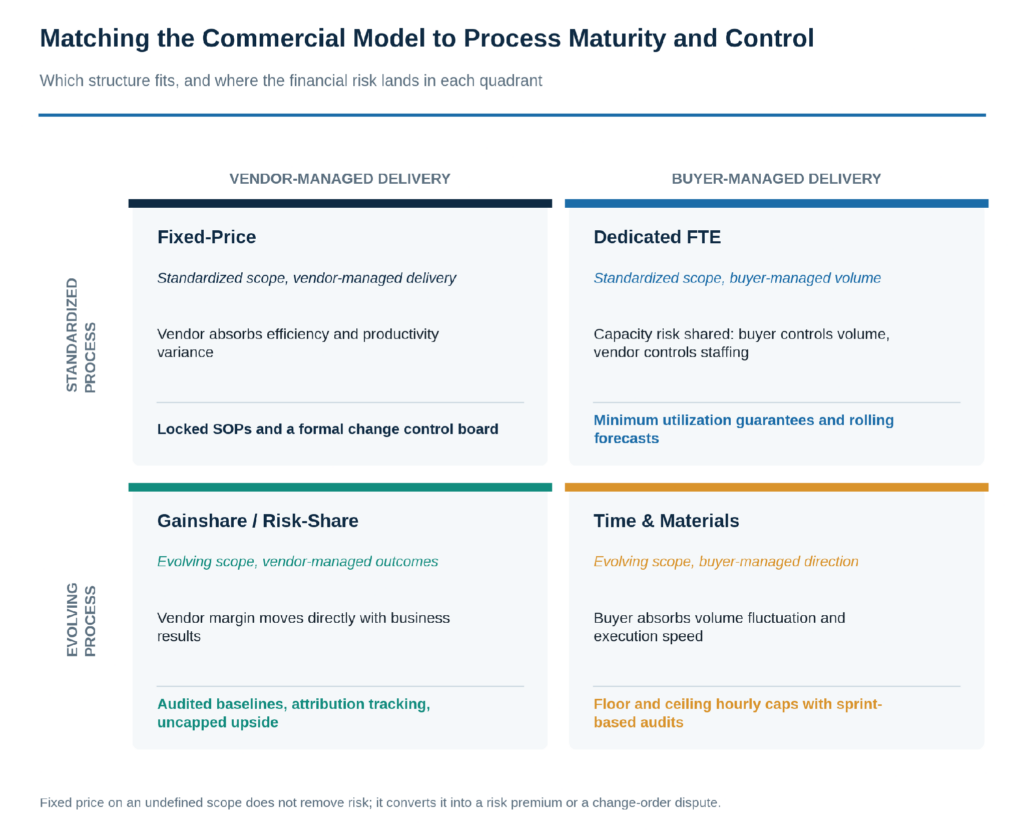
Figure 1. Matching the commercial model to process maturity and control, with the risk allocation and mitigation for each quadrant.
What Pricing Models Best Balance Operational and Financial Risk?
Four structures cover most engagements: fixed-price for repeatable work with locked SOPs, time and materials for evolving scope, dedicated FTE for capacity-driven CX programmes, and gainshare for outcome-driven work. Most Philippine enterprise agreements land on a hybrid FTE model with 10% to 20% of fee at risk.
Buyers frequently default to fixed price on the assumption that it eliminates financial risk. It does not; it relocates it. Imposing a fixed fee on a poorly defined or shifting scope either inflates the vendor’s risk premium — you pay for the uncertainty either way — or produces delivery failure and a stream of change-order disputes that consume more management time than the savings were worth.
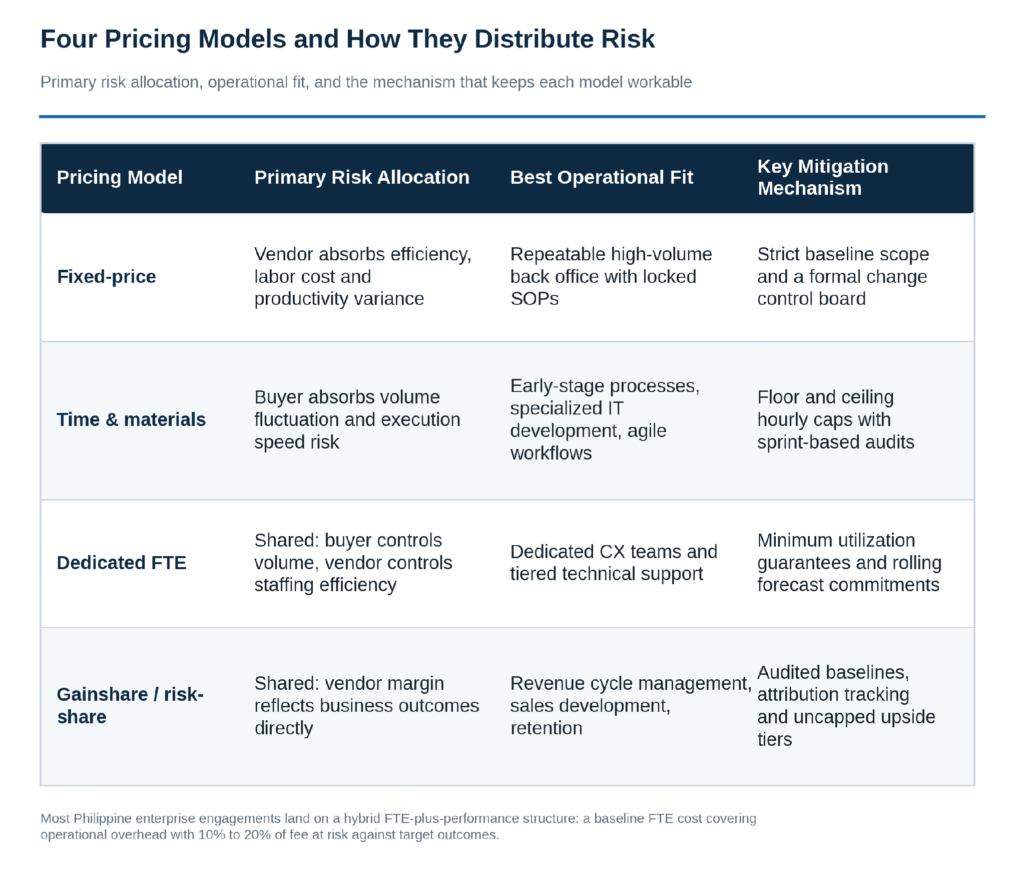
Figure 2. Four pricing models compared on risk allocation, operational fit, and the mechanism that keeps each workable.
Fixed-Price Needs a Change Control Board
Fixed price works where the process is genuinely repeatable and the standard operating procedures are locked. What makes it survive contact with a real programme is the governance around scope: a strict baseline definition and a formal change control board that prices variations against a documented rate card rather than negotiating each one from scratch.
Time and Materials Needs Caps and Audits
T&M is the right answer for early-stage processes, specialized development, and agile workflows where the specification is still moving. Its weakness is that guaranteed margin removes any incentive to reduce hours. Floor and ceiling hourly caps plus sprint-based deliverable audits restore some of that discipline, and a documented transition to a fixed or unit-based structure should be written in from the start.
Dedicated FTE Shares the Capacity Question
Under a dedicated FTE model the buyer controls volume and the vendor controls staffing efficiency, which splits capacity risk in a way that suits dedicated CX teams and tiered technical support. Minimum utilization guarantees protect the vendor from carrying idle bench, while rolling forecast commitments give it enough visibility to staff against real demand.
Hybrid FTE-Plus-Performance Is the Practical Default
The structure most Philippine enterprise engagements converge on establishes a baseline FTE cost covering core operational overhead, then attaches a 10% to 20% at-risk fee pool tied to target outcomes. It protects the staffing model that produces quality while still making performance financially consequential — which is the whole point of the exercise.
How Do Governance, Service Levels, and Penalties Drive Alignment?
Cap aggregate monthly service credits at 10% to 15% of invoice value, allow earn-back where the provider sustains compliance across the following quarter, and pair liquidated damages with bonuses of 3% to 5% for exceeding critical metrics. Penalties beyond that threshold destabilize the vendor and worsen delivery.
Service level requirements maintain day-to-day quality, but the financial remedies attached to them have to be engineered rather than assumed. A remedy that compromises the provider’s ability to staff the account produces the next failure it was meant to prevent, which is why the ceiling matters as much as the trigger.
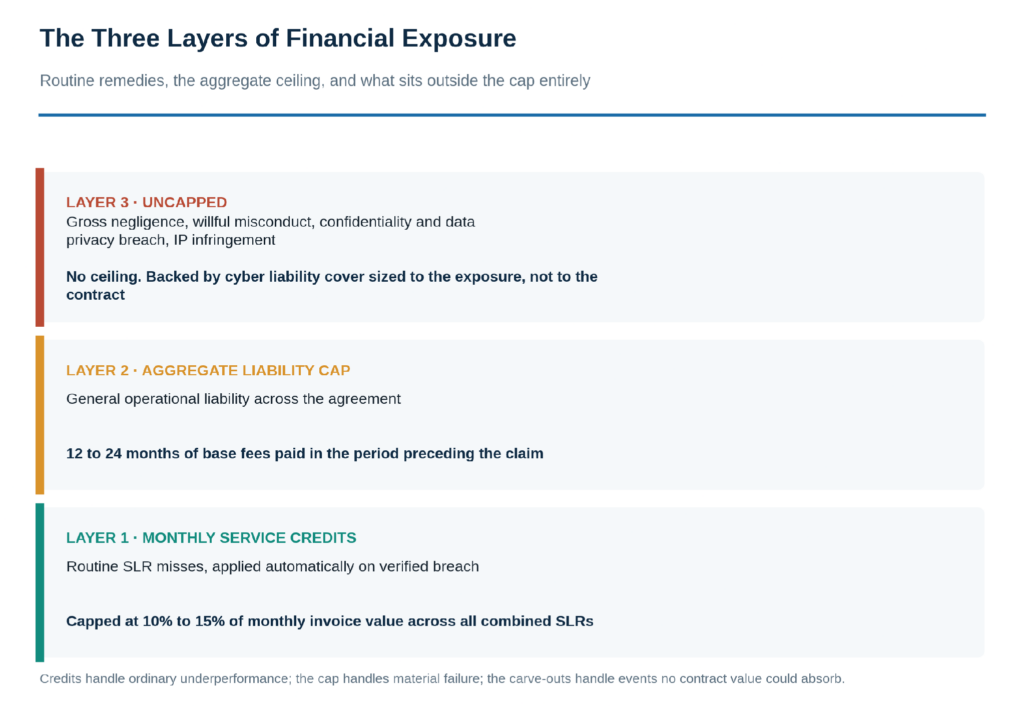
Figure 3. The three layers of financial exposure: routine credits, the aggregate cap, and the uncapped carve-outs.
Three Layers, Three Purposes
Monthly service credits handle ordinary underperformance and should be automatic on verified breach. The aggregate liability cap — conventionally 12 to 24 months of base fees paid in the period preceding a claim — handles material failure. Gross negligence, willful misconduct, confidentiality and data privacy breach, and IP infringement sit outside the cap entirely, because their potential cost bears no relationship to contract value. Confirm the provider carries cyber liability cover sized to that carve-out rather than to the contract.
Earn-Back and Symmetry
Grant the provider the ability to recover withheld credits by sustaining or exceeding target SLRs across the subsequent quarter — 90 days of compliance following a single-month breach is a common construction. Balance the downside with positive incentives of roughly 3% to 5% of monthly billing where the vendor exceeds critical primary metrics such as First Contact Resolution or Net Promoter Score across consecutive quarters. Without the upside, the framework rewards defending a threshold rather than clearing it.
Financial risk allocation isn’t about penalizing your provider when operational friction occurs; it’s about engineering a commercial structure where both the enterprise client and the offshore vendor share the direct economic rewards of process optimization, efficiency gains, and long-term innovation.
— John Maczynski, CEO, PITON-Global
How Should Foreign Exchange and Local Wage Inflation Be Managed?
Set a neutral USD/PHP corridor of roughly plus or minus 5%, with movement inside the band absorbed by the provider and movement beyond it for more than 30 consecutive days splitting the variance 50/50. Index annual escalation to the Philippine CPI and regional wage board adjustments, capped at 3.5% to 5%.
Multi-year cross-border agreements carry two macroeconomic exposures that a rate card cannot address. The first is currency: the provider earns dollars and pays pesos, so an unhedged contract eventually resolves that tension through a renegotiation nobody budgeted. The second is statutory wage movement, which arrives on the Regional Tripartite Wages and Productivity Board’s schedule rather than the contract’s.
Build the Corridor as a Mechanism, Not a Buffer
Three details make an FX band work: the baseline rate and its source, the persistence test before adjustment triggers, and the sharing ratio outside the band. Requiring the breach to hold for 30 consecutive days stops a volatile fortnight from repricing a multi-year agreement, and a 50/50 split keeps the mechanism symmetrical so it operates in both directions rather than only when the provider is squeezed.
Index Escalation to Published Benchmarks
Avoid arbitrary annual increases. Tie multi-year adjustments to a combination of the Philippine Consumer Price Index and official RTWPB wage orders, capped at an agreed ceiling of roughly 3.5% to 5%. Apply the adjustment to the labor component rather than the total invoice — facilities, technology, and vendor margin do not move with local wage inflation and should not escalate as though they did.
How Should Transition and Change-Control Risk Be Allocated?
Tie transition fees to milestone gates with documented acceptance criteria rather than to elapsed time, and route every scope variation through a change control board pricing against an agreed rate card. Together these remove the two largest sources of unbudgeted cost in a new engagement.
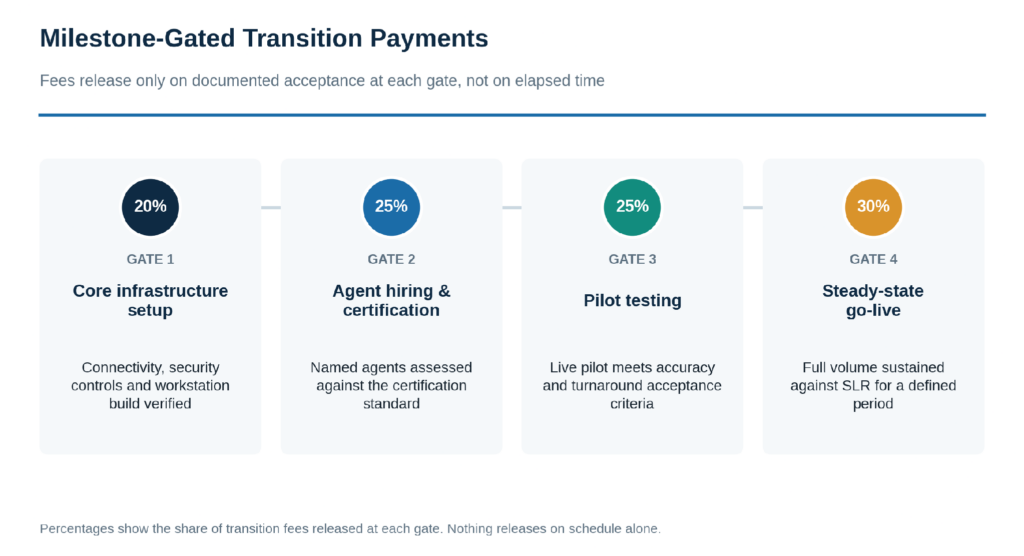
Figure 4. Milestone-gated transition payments, with fees released only on documented acceptance at each gate.
Transition is where budgets break, because it is the phase with the most activity and the least measurement. Gate reviews fix that by making payment contingent on a demonstrated state: infrastructure verified, named agents certified, pilot meeting acceptance criteria, full volume sustained against the SLR. A provider confident in its mobilization plan will accept gating readily, and reluctance to accept it is itself a finding.
Change Control Is What Protects the Fixed Price
Scope creep is not a discipline problem; it is the predictable result of an agreement that has no mechanism for pricing variation. A formal change control board with a documented rate card converts each variation into a small, quick decision instead of a quarterly renegotiation, and it preserves the integrity of whichever pricing model sits underneath.
What Does Restructured Risk Allocation Deliver in Practice?
A US healthcare technology firm running a 31% budget overrun under an uncapped T&M contract moved to a hybrid FTE model with 12% of monthly billing at risk. Total operating cost fell 29% within six months, claims accuracy rose from 91.2% to 99.6%, and turnaround dropped 44%.
Client Challenge
The firm was carrying a 31% budget overrun alongside declining processing accuracy under an uncapped time-and-materials agreement. The three causes compounded: scope creep with no change-control mechanism, ambiguous KPIs that made underperformance arguable, and unmanaged staffing scaling that grew the invoice without a corresponding governance conversation. Audit compliance exposure followed the accuracy decline.
Vendor Selection Process
PITON-Global ran an operational diagnostic and executed a targeted match across its network of more than 100 vetted Philippine providers, selecting a Manila-based financial operations specialist with HIPAA compliance certification and revenue cycle management depth. Compliance certification was a threshold criterion rather than a scored attribute, given the audit exposure already present.
Solution Implemented
The agreement was restructured into a hybrid FTE model with an at-risk pool. Baseline pricing was fixed per qualified agent, with 12% of monthly billing placed at risk against strict accuracy and turnaround SLRs, and an FX neutral corridor and quarterly earn-back provisions written into the master services agreement.
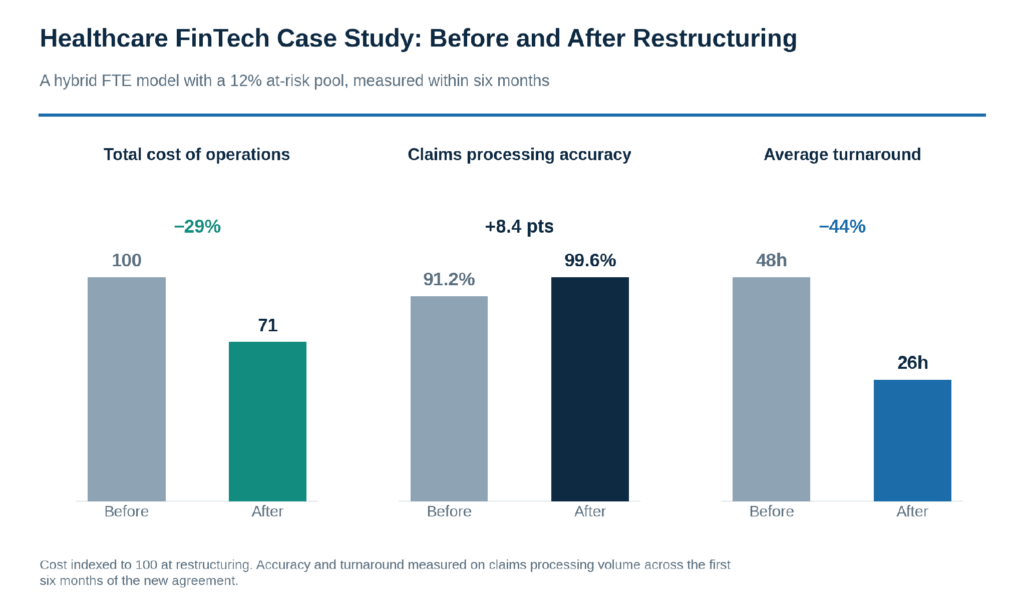
Figure 5. Operating cost, processing accuracy, and turnaround time before and after restructuring.
Outcomes and Lessons
Total operating cost fell 29% within six months, claims processing accuracy rose from 91.2% to 99.6% — eliminating backlog penalties — and average processing time dropped from 48 hours to 26. The mechanism worth noting is that cost and quality moved together rather than against each other: the accuracy gain removed rework, and rework was a substantial share of the volume the previous T&M contract had been billing for. Aligning baseline cost protection with performance-linked upside removes scope-creep friction and gives the vendor a direct reason to invest in talent quality and automation.
Why Do Enterprises Partner with PITON-Global to Mitigate Outsourcing Risk?
PITON-Global is a BPO advisory and management consultancy headquartered in Manila that guides executive teams through provider selection, contract negotiation, and governance architecture, drawing on a curated network of more than 100 audited Philippine providers.
Who Is PITON-Global?
PITON-Global advises enterprise buyers across provider selection, commercial structuring, and governance design. Its relevance to risk allocation is specific: judging whether a proposed model is workable requires knowing what delivery costs in a given hub, which providers can operate an at-risk structure, and which have the margin headroom to absorb the credits they are agreeing to. In a market of more than 1,000 providers, none of that is visible from a proposal.
How Does PITON-Global Differ from Traditional Outsourcing Brokers?
Traditional brokers operate on transactional finder fees, which shapes both the recommendation set and the point at which involvement ends — typically at introduction, before the pricing model, SLR framework, or liability structure is drafted. PITON-Global acts as a strategic partner instead: independent evaluation, recommendations that may include providers with no commercial relationship to the firm, and continued engagement through negotiation and governance architecture.
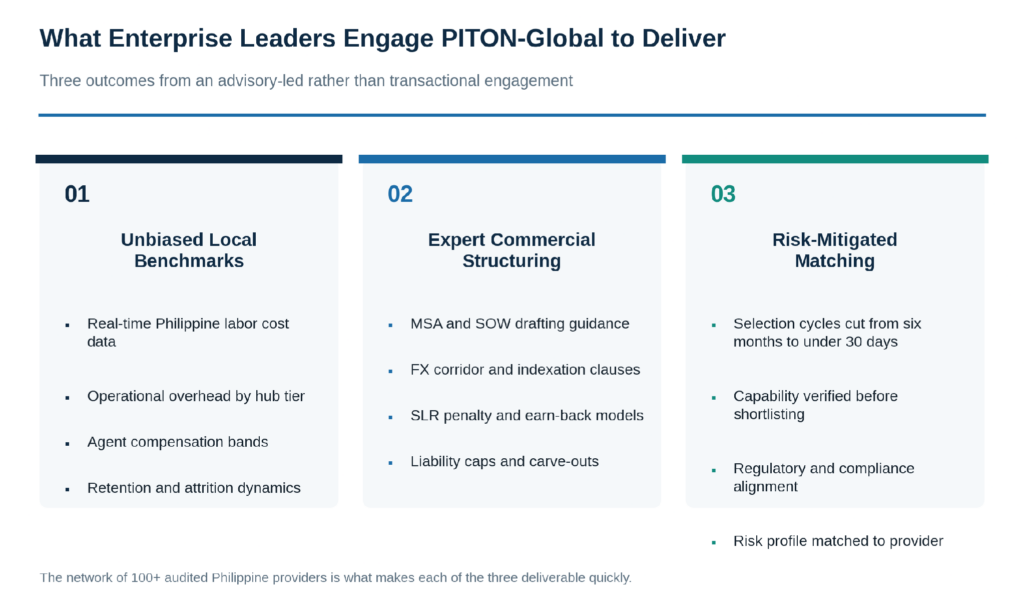
Figure 6. The three outcomes enterprise leaders engage PITON-Global to deliver.
How Does PITON-Global’s Network of 100+ Vetted Philippine BPO Providers Benefit Organizations?
The network comprises thoroughly audited contact centre and back-office providers, matched to buyers on technical requirements, regulatory framework, and risk profile rather than on availability. For risk allocation work that matters because the shortlist arrives already filtered for providers capable of operating the commercial structure being proposed, including compliance certifications the programme requires.
How Does PITON-Global’s Advisory-Led Vendor Matching Process Work?
An operational diagnostic establishes requirements, volumes, compliance obligations, and risk tolerance; the vetted network is filtered against them; candidates are assessed on delivery capability, certification, and financial headroom; and the buyer is supported through MSA and SOW structuring, FX clauses, SLR penalty and earn-back design, and the governance cadence that follows. Selection cycles compress from around six months to under 30 days.
Why Do Organizations Use PITON-Global?
- Unbiased local market benchmarks. Real-time data on Philippine labor costs, operational overhead, agent compensation, and retention dynamics.
- Expert commercial structuring. Guidance on MSAs, SOWs, FX risk clauses, liability caps, and SLR penalty and earn-back models.
- Risk-mitigated vendor matching. Selection cycles cut from six months to under 30 days without shortening the diligence itself.
- Alignment to regulatory framework. Providers matched to the certifications and compliance posture the programme actually requires.
- Governance architecture. Support through the design of the review cadence that keeps the allocation working after signature.
Frequently Asked Questions
What is a standard limitation of liability cap in BPO agreements?
General liability is typically capped at 12 to 24 months of total base fees paid preceding the claim. Uncapped liability is reserved for breach of confidentiality, data privacy violations under regimes such as GDPR or HIPAA, IP infringement, gross negligence, and willful misconduct.
How are transition and implementation risks financially allocated?
Through milestone-based pricing tied to operational acceptance criteria at defined gate reviews. Payments release only on successful completion of each stage — core infrastructure setup, agent certification, pilot testing, and steady-state go-live — rather than against an elapsed schedule.
What is the standard percentage allocated to at-risk SLR penalties?
At-risk pools generally run between 10% and 15% of monthly billings across all combined SLRs. Above 15% the structure increases vendor insolvency risk and tends to produce the staffing cuts that cause further failure; below 5% it fails to drive meaningful operational behavior.
How should continuous process improvements and AI automation savings be split?
Through a gainshare productivity clause. Savings generated by vendor-led process improvement or automation are commonly split evenly — half returned to the buyer as fee reductions, half retained by the vendor as expanded margin for a defined period of 12 to 24 months — which gives the provider a genuine reason to fund the investment.
How do buyers enforce legal jurisdiction and IP protection in Philippine contracts?
Designate a governing law, often Delaware, New York, or English law for international agreements, paired with binding international arbitration such as SIAC. Reinforce enforcement locally through individual employee NDAs, hardware-level data loss prevention, and ISO 27001-certified facilities, since practical protection depends on controls at the delivery floor as much as on the choice of forum.