
Healthcare payers and providers achieve the greatest operational improvements by outsourcing Revenue Cycle Management (RCM), clinical utilization review, and medical coding to the Philippines. Migrating these data-intensive, highly regulated functions routinely cuts operating costs 40%–60% while pushing first-pass clean-claim rates past 95% and accelerating cash flow.
Key Takeaways
- Primary drivers: Revenue Cycle Management and clinical utilization management deliver the largest operational and financial gains.
- Efficiency gains: well-executed migrations lift first-pass clean-claim rates above 95% and sharply reduce days in accounts receivable.
- Cost reduction: structural labor arbitrage across specialized Philippine healthcare talent cuts administrative overhead by 40%–60%.
- Compliance built in: mature providers operate under HIPAA, HITRUST, and SOC 2 Type II frameworks, reinforced by the Data Privacy Act of 2012.
- Scalability: the country’s deep healthcare-BPO infrastructure enables rapid, compliant scaling of back-office capacity.
Which Specific Healthcare Administrative Roles Drive the Highest ROI?
The highest returns come from complex, rule-based functions where accuracy directly affects cash flow and compliance: RCM and medical coding, clinical utilization review and case management, denial management, and accounts-receivable follow-up. These functions combine high volume, steep regulatory complexity, and a direct line to revenue.
Not all back-office work yields identical returns when offshored. Generic, low-complexity tasks save labor cost but move few performance metrics. The functions below concentrate specialized clinical and coding expertise on the processes where errors are most expensive — and where disciplined offshore teams compound savings with measurable quality gains.
Revenue Cycle Management & Medical Coding
The complexity of ICD-10/11 coding and constantly evolving payer guidelines creates persistent bottlenecks for domestic teams. Philippine providers draw on large pools of certified medical coders — credentialed through AAPC or AHIMA — and billing specialists who concentrate exclusively on charge capture, claim submission, and denial management. That focus consistently compresses billing cycles and lifts clean-claim rates.
Clinical Utilization Review & Case Management
A fast-growing segment deploys Philippine registered nurses trained in US clinical guidelines such as InterQual and MCG. These RNs handle pre-authorizations, concurrent reviews, and clinical documentation improvement, shifting a high-cost clinical-administrative burden off domestic nursing staff and freeing them to focus entirely on direct patient care.
The table below summarizes where the operational improvements concentrate, pairing the typical cost reduction for each function with the headline performance metric it moves.
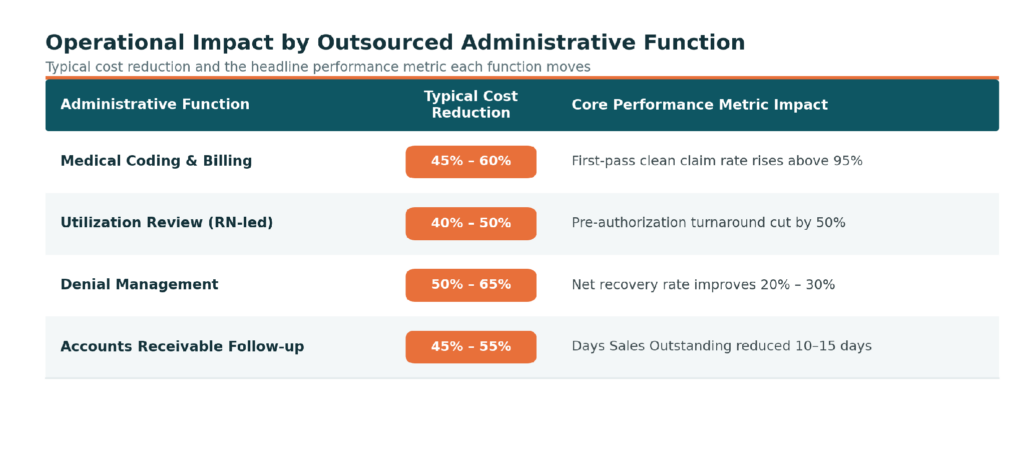
Plotted as ranges, the depth of structural savings is clearest in denial management and coding, where specialized expertise has the most room to recover revenue and prevent rework.

How Do Philippine Healthcare BPOs Balance Cost Reduction With Strict Compliance?
Leading Philippine providers treat compliance as core infrastructure, not an add-on. They operate under HIPAA, HITRUST, and SOC 2 Type II frameworks, and the country’s Data Privacy Act of 2012 aligns local law with global standards — keeping protected health information secure throughout the administrative lifecycle.
A common executive reservation about offshore operations is the perceived risk to data security and regulatory compliance. The Philippine BPO sector has answered that directly by institutionalizing compliance frameworks built specifically for the demands of global healthcare. The strongest teams function less like external processors and more like an embedded extension of the client’s own compliance department.
True operational excellence in healthcare offshoring isn’t merely about labor arbitrage; it’s about process compliance and clinical accuracy. The highest-performing teams in Manila aren’t just processors — they operate as seamless extensions of a hospital’s or payer’s compliance department, rigorously adhering to HIPAA, HITRUST, and SOC 2 Type II frameworks.
— John Maczynski, CEO of PITON-Global
Beyond contractual frameworks, the Data Privacy Act of 2012 imposes strict legal penalties for mishandling personal data, reinforcing the operational controls that providers already maintain. Together, this legal and operational foundation keeps patient health information secure across the entire billing and administrative chain.
What Results Did a Multi-State U.S. Hospital Group Achieve?
A multi-state hospital network cut its denial rate from 14% to 4.2% and compressed DSO from 58 to 41 days within seven months, saving $3.2 million annually. The turnaround came from a specialized Manila RCM team, secure workflow migration, and a root-cause feedback loop with domestic clinicians.
The Client Challenge
A multi-state provider network faced escalating operating costs and a denial rate that peaked at 14%. Its in-house billing team was overwhelmed by shifting regulatory guidelines, pushing Days Sales Outstanding to 58 days and straining operational cash flow.
Vendor Selection and Solution
Through an analytical advisory matching process that weighed capability, security certifications, and talent access, the group selected a specialized mid-sized Manila healthcare BPO from PITON-Global’s vetted network of more than 100 providers. The partner deployed 45 certified coders and denial-management specialists, migrated charge capture and claims tracking into a secure audited environment, and built a continuous feedback loop with domestic clinical staff to fix root-cause documentation errors.
Quantifiable Business Outcomes
Over seven months, denials and collections improved in tandem as clean-claim discipline took hold.
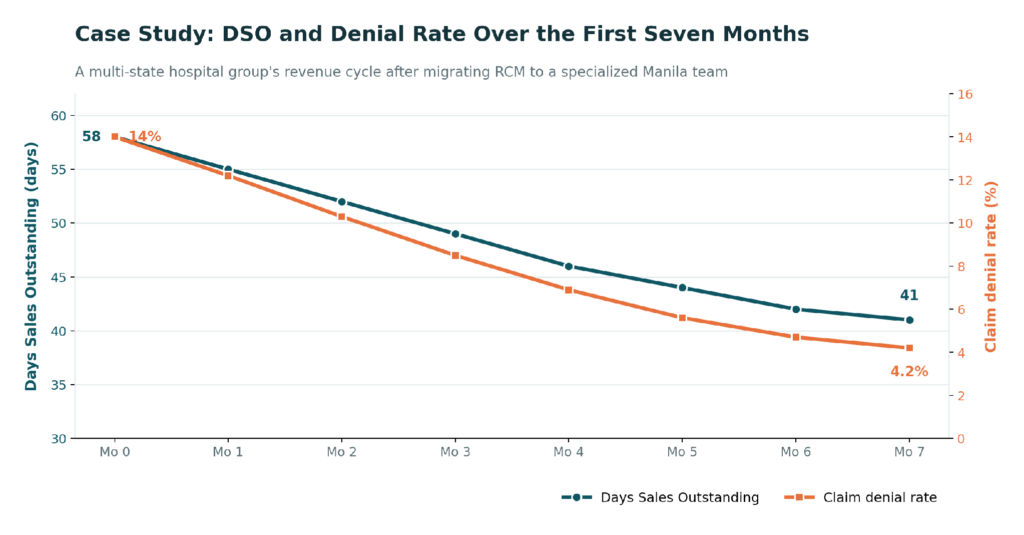
The denial rate fell from 14% to 4.2%, DSO compressed from 58 to 41 days, and the network saved $3.2 million annually in administrative overhead — cash that could be redirected toward clinical priorities.
Lessons Learned
Success hinged on choosing a provider with deep, specialized healthcare experience rather than a generic customer-service BPO, and on establishing clear communication protocols from the outset so documentation fixes flowed back to the source.
How Can Organizations Mitigate the Risks of Administrative Migration?
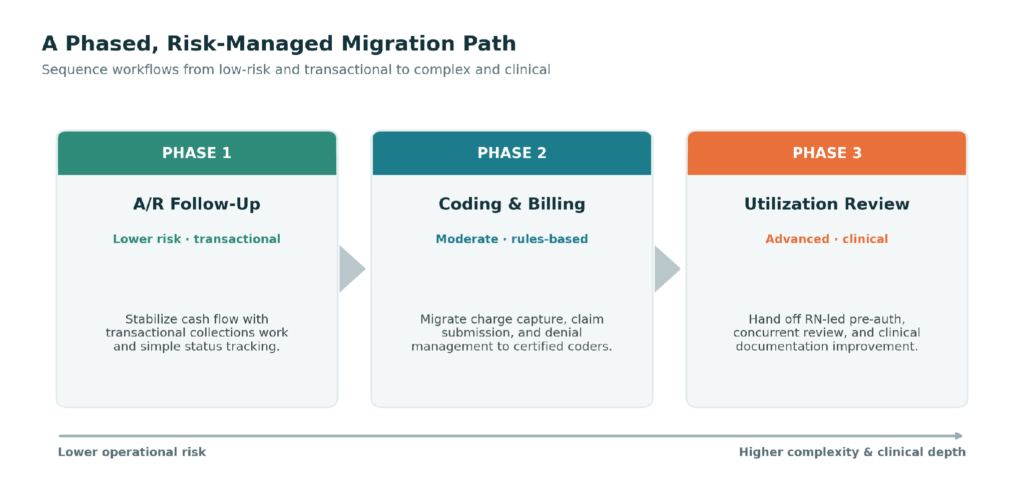
Organizations insulate themselves by running a structured selection framework: assess clinical depth over language proficiency, verify redundant infrastructure and business-continuity plans, and phase the migration — starting with transactional A/R follow-up before advancing to complex clinical utilization reviews.
Moving sensitive healthcare workflows offshore carries real operational risk — communication gaps, cultural misalignment, and technical friction during implementation. A disciplined framework converts those risks from surprises into managed variables.
- Assess clinical depth: evaluate vendors on actual clinical knowledge and coding accuracy, not merely general English proficiency.
- Verify redundant infrastructure: confirm business-continuity plans with redundant power, backup connectivity, and secure, isolated data terminals.
- Phase the implementation: begin with lower-risk transactional tasks like A/R follow-up before transitioning utilization review and other complex workflows.
Visualized as a sequence, the migration path moves deliberately from low-risk, transactional work toward complex, clinical functions — letting governance and quality mature at each stage.
How Does PITON-Global Accelerate Operational Excellence?
PITON-Global is an advisory-led outsourcing consultancy that matches healthcare organizations with the right provider from a curated network of 100+ vetted Philippine BPOs. By analyzing each organization’s regulatory, technical, and operational needs, it removes guesswork from vendor selection, mitigates transition risk, and accelerates time-to-value.
Navigating a landscape of more than 1,000 Philippine service providers is daunting for enterprise buyers, and a wrong choice is costly. PITON-Global streamlines that journey as a specialized, advisory-led consultancy rather than a transactional broker that simply passes along leads.
Drawing on deep industry expertise, the firm matches healthcare organizations to the ideal partner from its highly curated network of more than 100 vetted call-center and back-office providers. By analyzing a provider’s specific regulatory, technical, and operational requirements, PITON-Global removes the guesswork from selection — significantly reducing transition risk and shortening time-to-value.
What Do Healthcare Buyers Most Often Ask About Outsourcing to the Philippines?
The most frequent questions cover coder certifications, time-zone coverage, onboarding timelines, EHR/EMR access, and staff turnover. The concise answers below address each before a deeper engagement begins.
What certification levels do Philippine medical coders hold?
Philippine coders routinely carry globally recognized credentials, predominantly AAPC (CPC, COC) and AHIMA (CCS, CCA), ensuring full alignment with standard medical-coding guidelines.
How do Philippine BPOs handle time-zone differences for real-time support?
The industry runs 24/7. Healthcare teams work dedicated night shifts aligned to US daytime hours, staying in sync with domestic systems, payers, and patients.
What is the average onboarding time for a specialized team?
A standard deployment runs 4 to 8 weeks, covering secure network setup, training on proprietary software, and establishing quality-control baselines.
Can teams work directly in our existing EHR/EMR systems?
Yes. Teams access systems such as Epic, Cerner, or eClinicalWorks through secure encrypted Citrix environments or VPNs, keeping data contained within the client’s domestic servers.
How does turnover compare to domestic healthcare systems?
Specialized healthcare-BPO roles command premium compensation and clear career paths, producing notably lower turnover than typical domestic administrative departments.