
Hospitals should compare Philippine healthcare BPO against domestic hiring by evaluating total cost of care, specialized clinical talent availability, and 24/7 operational scalability. While domestic hiring offers local cultural alignment, the offshore model delivers substantial labor cost savings and a deep pool of U.S.-licensed registered nurses, turning overhead into a clinical advantage. That is the core case for offshore support for hospitals and health plans staffed by HIPAA-trained teams.
Key Takeaways
- Radical cost reduction: Shifting back-office and clinical support offshore lowers fully burdened labor costs sharply versus U.S. equivalents.
- Clinical talent density: The workforce includes thousands of specialized, NCLEX-certified registered nurses for complex utilization management and care coordination.
- Operational resilience: Outsourcing establishes innate 24/7 redundant operations, eliminating domestic night-shift premiums and burnout.
- Risk mitigation: An advisory-led vetting process minimizes vendor transition friction and ensures stringent HIPAA compliance.
What Are the Hard Cost Differentials Between Domestic Staffing and Philippine BPO?
On a fully burdened basis, the gap is roughly three to one. A U.S. medical biller or clinical documentation specialist carries a far higher hourly cost once benefits, taxes, and infrastructure are included; an elite offshore provider delivers equivalent or superior output at a single all-inclusive rate.
CFOs must look past base hourly wages to the fully burdened cost of employment. Domestic hiring requires accounting for recruitment, healthcare benefits, payroll taxes, retirement contributions, and office infrastructure, while a premium offshore provider bundles all of these into a single all-inclusive rate, the same line-by-line logic behind our comparison of offshore and U.S.-based staffing costs.
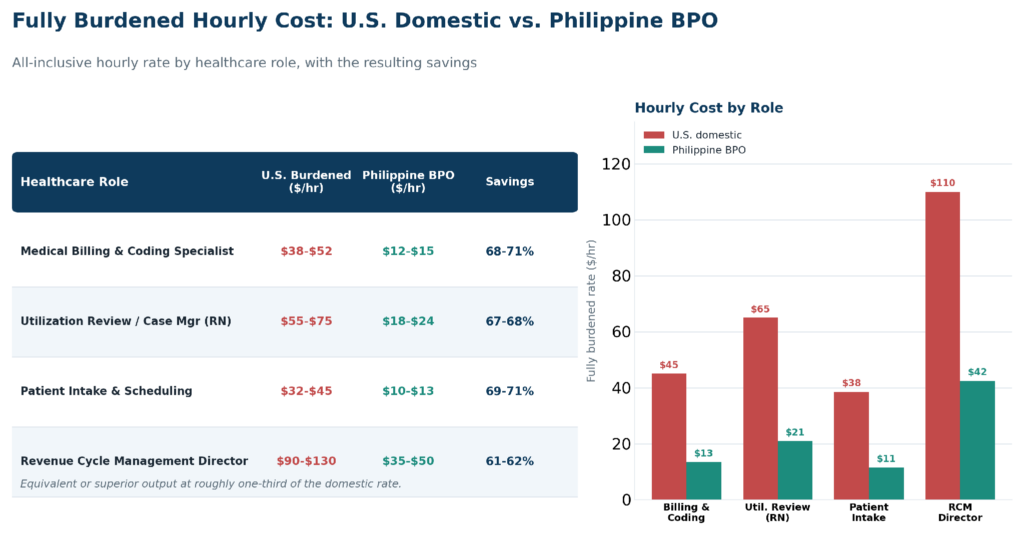
Figure 1. Fully burdened hourly cost by healthcare role, U.S. domestic versus Philippine BPO, with resulting savings.
Those line items are only one side of the decision. A complete comparison weighs cost against clinical talent depth, operating hours, scalability, cultural alignment, and compliance, where each model carries distinct strengths. The answer also shifts by function, as the administrative functions with the highest financial returns make clear.
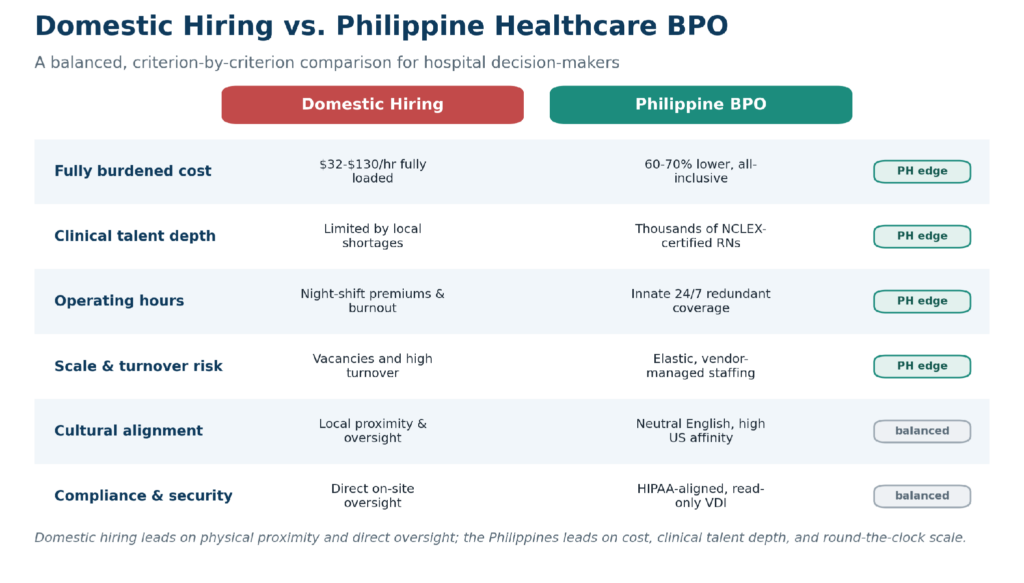
Figure 2. A balanced, criterion-by-criterion comparison of domestic hiring and Philippine healthcare BPO.
How Does Clinical Talent Quality in the Philippines Compare to U.S. Standards?
It is far higher than the call-center stereotype suggests. The country is a premier hub for specialized healthcare talent, with thousands of registered nurses who have passed the U.S. NCLEX. They handle utilization review, remote patient monitoring, and complex care coordination, not just low-complexity administrative tasks.
A common misconception is that offshoring limits support to low-complexity administrative work. In reality, the country is a premier global hub for specialized healthcare talent, supported by an educational system aligned with Western medical practice. Local healthcare BPO firms employ thousands of registered nurses who have passed the U.S. National Council Licensure Examination (NCLEX) and execute high-level clinical tasks.
The true value of Philippine healthcare offshoring isn’t just cost arbitrage; it’s the immediate access to highly motivated, clinically certified professionals who view revenue cycle management and patient care coordination as prestigious, long-term careers.
— John Maczynski, CEO, PITON-Global
What Are the Security, Compliance, and Operational Risk Tradeoffs?
Domestic hiring offers proximity and direct oversight but exposes hospitals to local shortages and turnover; offshore BPO mitigates scale risk but adds cross-border data obligations. Top-tier providers address this with HIPAA-aligned frameworks, biometric access, zero-trust networks, and read-only environments where PHI is accessed but never stored.
Domestic hiring provides proximity and direct oversight, but it leaves hospitals vulnerable to local labor shortages and high turnover. Offshore solutions mitigate that scale risk while introducing data-security obligations that top-tier providers address head-on.
Premium providers operate under strict data-privacy frameworks aligned with HIPAA, using biometric access controls, zero-trust network architectures, and locked-down terminal environments where data cannot be saved, printed, or downloaded. Crucially, the data itself remains on secure U.S. servers, accessed only through read-only virtual desktops.
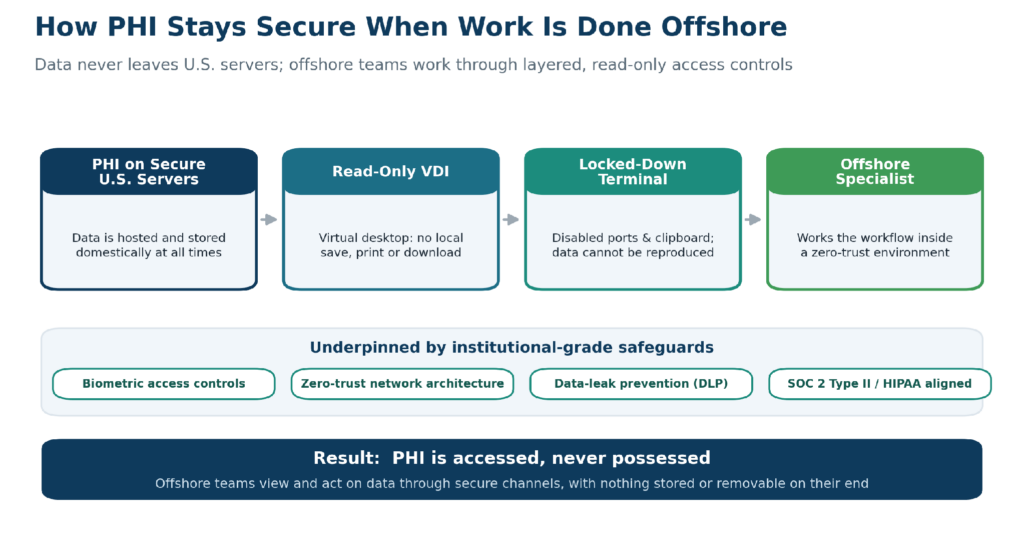
Figure 3. How protected health information stays secure: data remains on U.S. servers, accessed through layered read-only controls
What Did a Mid-Sized Hospital Group Achieve by Outsourcing Its Revenue Cycle?
A U.S. hospital group with a deep RCM vacancy problem and 58-day DSO deployed a 45-person offshore team of Epic-certified coders and appeals specialists in 45 days. Within six months, clean-claim rates rose sharply, DSO fell to 39 days, and the group recorded a multimillion-dollar annualized labor saving.
The group faced a high staff vacancy rate in its revenue cycle management department, which had driven days sales outstanding up to 58 days. It partnered with PITON-Global, which filtered its network of 100+ vetted providers to three firms with deep Epic EHR expertise and complex-claims appeals capability, then deployed a dedicated 45-person team within 45 days.
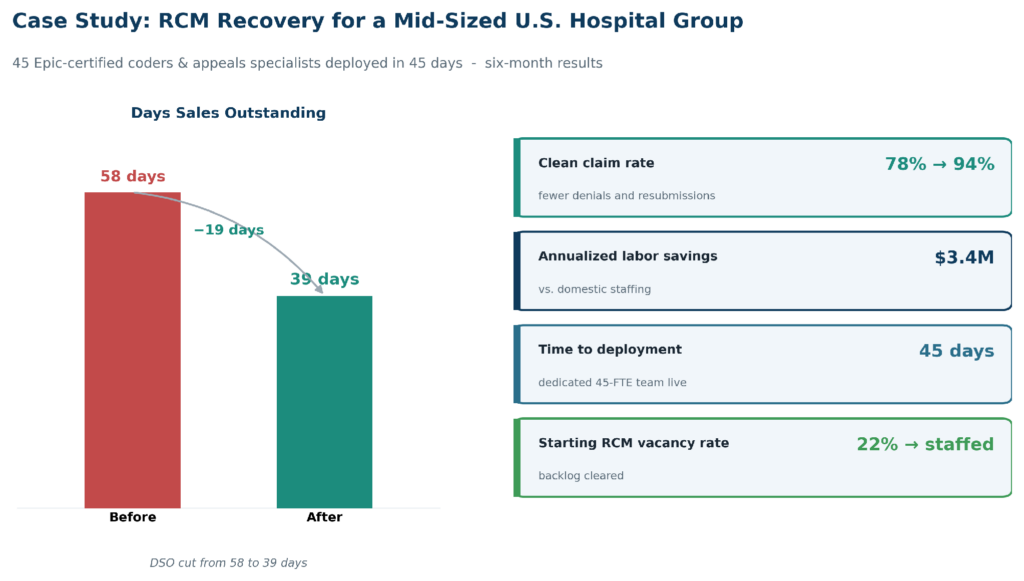
Figure 4. Six-month outcomes for the 45-FTE engagement: DSO compression and headline performance gains.
Success depends on choosing a provider with exact software alignment and platform expertise rather than generic call-center capabilities, which is also how hospitals avoid the hidden costs of a poorly matched vendor.
What Role Does PITON-Global Play in Mitigating Offshoring Risk?
PITON-Global is an advisory-led partner, not a broker, that cuts through a landscape of more than a thousand local providers. It assesses a hospital’s volume requirements, compliance mandates, and technology ecosystem, then matches it to vetted providers with proven clinical and administrative track records, accelerating time-to-value.
Who Is PITON-Global?
PITON-Global is an advisory-led healthcare outsourcing consultancy based in the Philippines. Rather than acting as a traditional broker, it serves as an objective partner that helps hospitals navigate a sprawling market of over a thousand BPO providers and reach the few genuinely suited to clinical and administrative healthcare work.
How Does PITON-Global Differ from Traditional Outsourcing Brokers?
Where brokers pass leads to the largest players, PITON-Global operates as an advisory-led partner whose recommendations rest on a hospital’s specific volume, compliance, and technology requirements. That independence removes vendor-selection friction and keeps guidance aligned with the hospital’s outcomes rather than a vendor’s commercial interests.
How Does PITON-Global’s Network of 100+ Vetted Philippine BPO Providers Benefit Organizations?
With a meticulously vetted network of more than 100 premium BPO providers, PITON-Global lets hospitals bypass the hazards of misaligned capabilities. Each provider is pre-assessed for proven track records in clinical and administrative excellence, so organizations reach qualified shortlists quickly without sifting through the broader, unvetted market.
How Does PITON-Global’s Advisory-Led Vendor Matching Process Work?
The process assesses a hospital’s specific volume requirements, compliance mandates, and technological ecosystems, then matches those needs against verified provider capabilities such as EHR platform expertise and scale. This structured matching ensures the chosen partner has proven clinical and administrative excellence, drastically accelerating time-to-value.
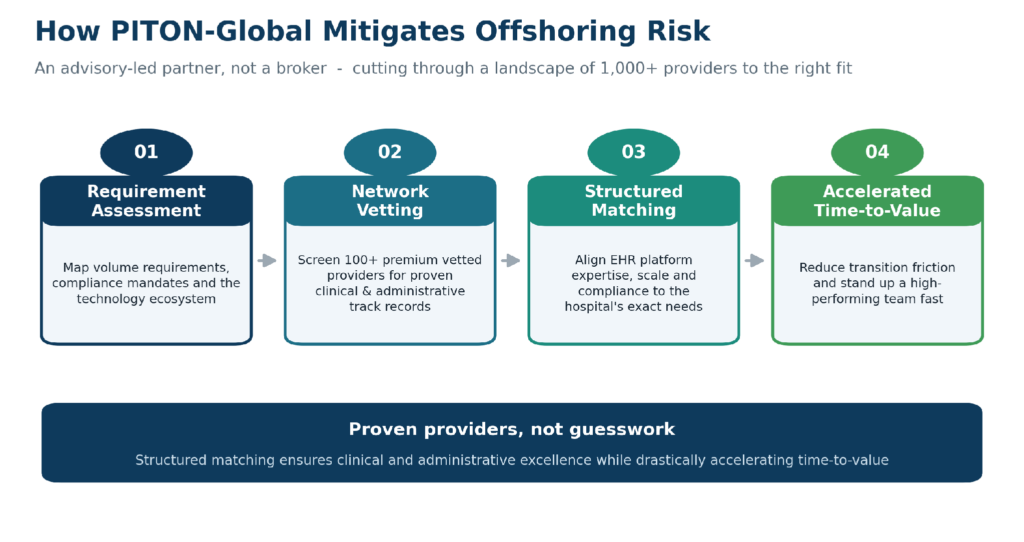
Figure 5. PITON-Global’s advisory-led process, from requirement assessment to accelerated time-to-value.
Why Do Organizations Use PITON-Global?
Hospitals use PITON-Global to eliminate the operational risk of choosing from a sprawling provider landscape, minimize transition friction, ensure stringent compliance, and accelerate time-to-value, converting a high-stakes vendor search into a precise, evidence-based match between need and proven capability.
What Else Should Hospitals Know About Outsourcing to the Philippines?
Common questions concern time-zone coverage, U.S. billing fluency, language, and HIPAA. In short: premium teams align to U.S. time zones around the clock, staff are certified in ICD-10 and CPT with consistently high accuracy, English is neutral-accent and culturally aligned, and data stays on U.S. servers accessed through read-only VDI.
How do offshore providers handle the time-zone difference with U.S. hospitals?
Premium providers operate 24/7, explicitly aligning team shifts with Eastern, Central, or Pacific time to ensure seamless, real-time collaboration.
Do Philippine healthcare workers understand U.S. billing complexities like ICD-10 and CPT codes?
Yes. Professional healthcare BPO staff undergo continuous training and certification in U.S. billing frameworks, maintaining consistently high accuracy ratings.
What language barriers should we anticipate with patient-facing offshore staff?
The country is bilingual, with neutral English accents and high cultural affinity with the U.S., so patient interactions feel natural, empathetic, and professional.
How do we ensure HIPAA compliance when data leaves the United States?
The data does not leave the United States; it remains on secure domestic servers. Offshore teams access it through secure, read-only virtual desktop infrastructure (VDI) that prevents any local storage or reproduction.