
Outsourcing enterprise AI training data pipelines to the Philippines starts with an infrastructure-resilience audit, not a labor-cost comparison. Top-tier vendors mitigate operational risk through concurrent human-in-the-loop validation, automated failover across decoupled subsea cable landing stations, geo-diverse Manila and Cebu sites, and strict alignment with global data-privacy frameworks to minimize data-leakage risk across model-training cycles. The same diligence applies to every workstream in AI training operations run from the Philippines, from annotation to RLHF.
Key Takeaways
- Audit resilience before rate. At board level the decision turns on whether one cable cut or grid event can stall your model cadence — an architecture question, not a wage line.
- Diversity beats bandwidth. Two diverse subsea routes into decoupled landing stations matter more than headline capacity; two cables into one station is not redundancy.
- Latency is the wrong metric here. Training and annotation are asynchronous; ~165 ms trans-Pacific round-trip is immaterial. Bandwidth and uptime bind, not RTT.
- Leakage is engineered out, not contracted out. A zero-trust enclave where data never lands on a device beats any NDA clause.
- Geography is a control. Geo-diverse Manila and Cebu sites with N+1 power convert concentration risk into a managed variable.
Which Infrastructure Risks Actually Threaten an Outsourced AI Training Pipeline?
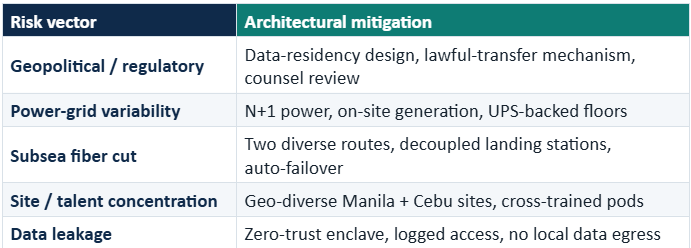
Four: geopolitical and regulatory exposure, power-grid reliability, network and subsea-fiber single points of failure, and site or talent concentration — each mitigated by deliberate diversification, not vendor assurances.
For a board, the risk register for an offshore training pipeline is concrete and short. Geopolitical and regulatory exposure governs whether data can lawfully move and keep moving. Power-grid reliability decides whether an annotation floor stays live; Philippine metros run on improving but variable grids, so N+1 power and on-site generation are baseline, not premium. Network risk is dominated by subsea fiber, where a single cut — not rare in the region — can sever a route, making route diversity more important than headline throughput. And concentration — one site, one city, one cable — is the quiet failure mode. In every case the mitigation is the same: diversification designed in advance.
According to John Maczynski, CEO, PITON-Global, “When a board signs off on offshoring an AI training pipeline, the question on the table is never the wage line — it is whether a single cable fault or a grid event can halt your model cadence. The answer has to be an architecture: decoupled landing stations, geo-diverse sites, N+1 power. We make clients audit that before anything else.”
How Should Connectivity and Power Be Architected for Resilience?
On diversity: two diverse subsea routes into decoupled landing stations, geo-diverse Manila and Cebu sites, N+1 power with on-site generation, and dual carriers — so no single fault halts the pipeline.
Resilience is simply the count of independent failure points you have removed. The reference architecture routes traffic over two diverse subsea systems landing at separate stations — for example, a direct Philippines–US West Coast system alongside a diverse trans-Pacific route — so a single cut degrades but never severs. Work is split across geo-diverse sites in Manila and Cebu, each with N+1 power, on-site generation, and dual carriers.

Figure 1 — Decoupled landing stations on diverse routes feeding geo-diverse Manila and Cebu sites — no single point of failure.
A subtle but board-relevant point follows: for AI training pipelines, round-trip latency is almost irrelevant. Trans-Pacific RTT runs around 165 ms (Manila–US West), which is fatal for real-time teleoperation but immaterial to asynchronous annotation, QA, and model-training data operations. The binding constraints here are bandwidth and uptime — the inverse of the mobility workloads covered elsewhere in this portfolio.

Figure 2 — Only real-time direct control falls left of the ~165 ms line; every training workload is latency-tolerant.
“The Philippines now has the subsea diversity and the Tier-III footprint across Manila and Cebu to run this with no single point of failure — but you have to design for it on purpose. Two cables into the same landing station is not redundancy. Decoupled landing stations on genuinely diverse routes is,” said Ralf Ellspermann, CSO, PITON-Global.
How Do You Govern Data and Prevent Cross-Border Leakage?
Through architecture: a zero-trust enclave the work happens inside, lawful cross-border-transfer mechanisms, recognized certifications (ISO 27001, SOC 2 Type II), and Philippine Data Privacy Act alignment to your home framework — verified with counsel.
Governance for training data is an engineering posture before it is a contract. The defensible model keeps data inside a controlled enclave — virtual desktops, no local storage, disabled egress, keystroke-level access logging — so the data never reaches an annotator’s device, the core of any serious IP and model-security program. Around that sit lawful cross-border-transfer mechanisms aligned to your home regime, the Philippine Data Privacy Act with a registered data protection officer, and recognized certifications. None of this is legal advice, and cross-border specifics should be confirmed with qualified counsel — but a vendor that treats leakage as an architecture problem rather than a clause is the one to shortlist. Resilience and leakage controls protect the pipeline; independent training-data audits and bias detection reviews protect what flows through it.

“Data leakage is not prevented by an NDA — it is prevented by an enclave the annotators work inside, where the training data never leaves and access is logged to the keystroke. Governance is an engineering posture, not a clause in an MSA,” noted John Maczynski, CEO, PITON-Global.
Frequently Asked Questions
Does Trans-Pacific Latency Make Philippine AI-Training Pipelines Slow?
No. Annotation, QA, and model-training data operations are asynchronous, so ~165 ms round-trip latency is immaterial. The constraints that matter are bandwidth and uptime. Real-time teleoperation is the exception, and it is addressed separately in this portfolio.
What Makes Subsea Connectivity Resilient Rather Than Just Fast?
Route diversity. Two diverse subsea systems landing at decoupled stations with automatic failover means a single cut degrades but never severs the pipeline. Two cables into one landing station is not redundancy.
How Is Cross-Border Data Leakage Actually Prevented?
With a zero-trust enclave where data never lands on a device, keystroke-level access logging, lawful cross-border-transfer mechanisms aligned to your home regime, and recognized certifications — all verified with qualified counsel.
About PITON-Global
PITON-Global is the vendor-neutral advisory AI and autonomy leaders use to source operations they can stake a board decision on. We map your requirement across a network of 100-plus leading Philippine BPOs — 20 of them AI-first front-runners — and shortlist only the partners whose infrastructure, redundancy, and data governance survive real scrutiny. Our leadership carries more than six decades of combined global outsourcing experience, including 25+ years on the ground in the Philippines. Sourcing and advisory are free and carry no obligation; we earn through our provider network, never from you.