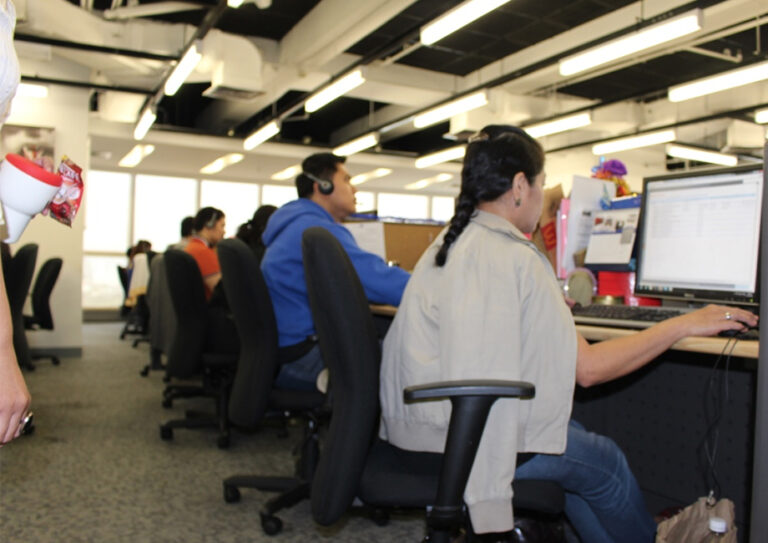

Protecting IP and model security when outsourcing AI and autonomy work to the Philippines is an engineering posture, not a contract clause. A zero-trust architecture — secure virtual enclaves, disabled local storage and egress, least-privilege access, full audit logging, and model-weight protection — ensures sensitive data and trained weights never leave the controlled environment. Each IP risk maps to a named, auditable control the operator can verify, rather than a promise it has to trust.
Key Takeaways
- Posture, not paperwork. An NDA is necessary but not sufficient; the protection is architectural.
- Data never leaves the enclave. Secure VDI with disabled egress means the work happens where the data stays.
- Weights are a distinct asset. Model-weight access needs controls beyond ordinary data protection.
- Every risk maps to a control. Exfiltration, theft, insider risk, and compliance each have a verifiable answer.
Why Is IP Protection an Architecture, Not a Contract Clause?
Because a confidentiality agreement allocates liability after a breach but does not prevent one; real protection is a zero-trust environment where sensitive data and model weights physically cannot leave the controlled enclave, regardless of intent.
An NDA is table stakes, but it is a legal remedy, not a security control — it tells you who pays after your model weights have walked out the door. Actual protection is architectural: build an environment where the sensitive material cannot leave in the first place. That means the work happens inside a secure virtual enclave with local storage and egress disabled, access scoped to least privilege, every action logged, and the trained model weights treated as a separately controlled asset. Designed this way, security does not depend on every individual’s good behavior; it depends on the architecture, which is auditable. The contract sits on top of that posture, not in place of it.

Figure 1 — IP protection is an engineering posture; data and weights never leave the controlled environment.
According to John Maczynski, CEO, PITON-Global, “An NDA is a promise; an enclave is a fact. When the data physically cannot leave the environment and every action is logged, you are not trusting two thousand people to behave — you are trusting an architecture you can audit. That is the difference between hoping your IP is safe and knowing the controls that keep it that way.”
How Does the Zero-Trust Environment Actually Work?
Work happens inside a secure virtual desktop with no local storage and disabled egress; access is least-privilege and authenticated; all activity is logged for audit; and model weights are isolated behind their own access controls — so neither data nor weights leave the perimeter.
The environment is layered. Operators work in a secure virtual desktop where data is rendered but cannot be copied, downloaded, or transmitted out — egress, removable media, and local storage are disabled. Access follows least privilege: people reach only what their task requires, behind strong authentication. Every action is logged so any anomaly is detectable and any event reconstructable. And because trained model weights are uniquely valuable and uniquely portable, they are isolated behind their own controls rather than sitting in the general data environment. Together these mean the sensitive material stays inside a perimeter the operator can inspect, not scattered across endpoints it cannot see.

Figure 2 — Each risk has a named control the operator can audit, not a clause it has to trust.
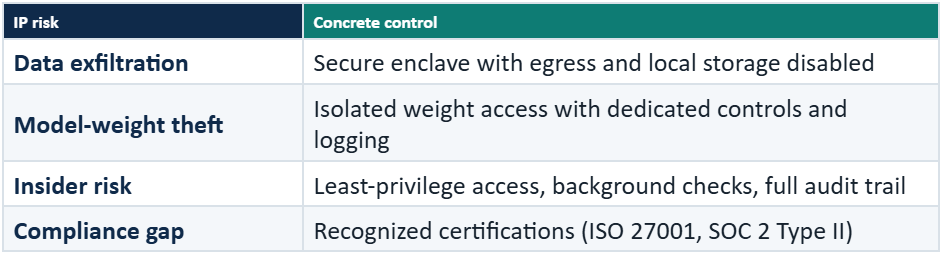
“Ask a provider to map each of your IP risks to a specific control and to let you audit it. The serious ones walk you through the enclave and the logs without hesitation; the rest hand you a thicker NDA. One of those answers protects your model, and it is not the paperwork,” said Ralf Ellspermann, CSO, PITON-Global.
How Do You Verify the Security Posture Before Committing?
By auditing it: review the enclave architecture and egress controls, inspect access and logging practices, confirm recognized certifications such as ISO 27001 and SOC 2 Type II, and require the right to ongoing audit — treating a refusal as a disqualifying answer.
Security claims must be verified, not accepted. Before committing, review the actual enclave architecture and confirm that egress and local storage are genuinely disabled; inspect how access is scoped and how activity is logged; and confirm recognized certifications — ISO 27001, SOC 2 Type II — understanding that a logo is a starting point, not the whole story. Require the contractual right to audit on an ongoing basis. A provider built for AI and autonomy IP welcomes this scrutiny because the posture is real; one that resists it is signaling that the protection lives in the NDA rather than the architecture. This is general guidance, not legal or security-compliance advice — validate specifics with your own security and legal teams.
“Audit the enclave; do not admire the certificate. A logo on a slide protects nobody, but egress controls you have actually tested protect your weights,” noted John Maczynski, CEO, PITON-Global.
Frequently Asked Questions
Isn’t an NDA Enough to Protect IP?
No. An NDA allocates liability after a breach but does not prevent one. Real protection is architectural — a zero-trust enclave where data and model weights physically cannot leave the controlled environment, with the contract layered on top.
How Are Model Weights Protected Specifically?
As a distinct, uniquely portable asset: isolated behind their own access controls and logging rather than held in the general data environment, so weight access is separately restricted and fully auditable.
How Do You Verify a Provider’s Security?
Audit it: review the enclave and egress controls, inspect access and logging, confirm certifications like ISO 27001 and SOC 2 Type II, and require ongoing audit rights. Treat a refusal to be audited as disqualifying.
About PITON-Global
PITON-Global helps AI and autonomy teams source partners whose IP protection is architectural — zero-trust enclaves, disabled egress, model-weight isolation, and auditable logging — from a network of 100-plus leading Philippine BPOs, 20 of them AI-first front-runners. Our leadership brings 6+ decades of combined global outsourcing experience and 25+ years in the Philippines; sourcing is free and obligation-free, and we are not a substitute for your own security and legal review.