
Back
Where Should You Locate Your Philippine Call Center: Manila, Cebu & Beyond?

By Ralf Ellspermann / 4 June 2026
 Authored by Ralf Ellspermann, CSO of PITON-Global, & 25-Year Philippine BPO Veteran | Executive | Verified by John Maczynski, CEO of PITON-Global, and Former Global EVP of the World's Largest BPO Provider on June 4, 2026

Choose the hub by trading talent depth against cost and resilience. Metro Manila (Tier 1) has the deepest talent and capacity but a 10–20% cost premium; Cebu, Davao, and Clark (Tier 2) offer strong talent at lower cost and growing scale; and emerging hubs like Iloilo and Bacolod offer the best cost and retention but limited capacity. With roughly 54% of the sector’s growth now driven by provincial hubs, hub selection is a budget and resilience decision, not a cosmetic one.
Key Takeaways
- Hub choice is a budget input. Metro Manila runs 10–20% above provincial cities — at scale, that delta can mean hundreds of thousands of dollars a year.
- Three tiers, three trade-offs. Tier 1 (Manila) for depth and capacity; Tier 2 (Cebu, Davao, Clark) for balance; emerging hubs for cost and retention.
- The growth is provincial. Roughly 54% of the sector’s growth is now driven by next-wave hubs outside Metro Manila.
- Talent depth falls as cost falls. Moving outward from Manila lowers cost and attrition but reduces the pool for large or specialized programs.
- Multi-hub builds resilience. Splitting across cities adds redundancy against local disruption — a continuity decision, not just a cost one.
What Are the Main Philippine Call Center Hubs?
Three tiers: Metro Manila (Tier 1, deepest talent and capacity), Cebu/Davao/Clark (Tier 2, strong talent at lower cost), and emerging hubs like Iloilo and Bacolod (best cost and retention, limited capacity).
Philippine call center capacity organizes into three tiers. Metro Manila is Tier 1: the deepest talent pool and the most capacity, the default for large or specialized programs, but carrying a cost premium. Cebu, Davao, and Clark form Tier 2: strong talent, lower cost, and growing scale, increasingly the sweet spot for balanced programs. And a band of emerging hubs — Iloilo, Bacolod, and other next-wave cities — offers the best cost and often the best retention, at the price of more limited capacity for very large or highly specialized teams.

Figure 1 — Three tiers of hub, each with a distinct talent-cost-capacity profile.
This map is shifting. Roughly 54% of the sector’s growth is now driven by provincial and next-wave hubs as providers and the government push capacity beyond Metro Manila — which means the Tier 2 and emerging options are deeper and more viable each year, not static.
How Much Does Location Change the Cost?
Materially: Metro Manila runs about 10–20% above provincial hubs, so a mid-sized program based in Cebu or Davao instead of Manila can save hundreds of thousands of dollars a year.
Hub selection is one of the larger cost levers available, and it is often overlooked. Metro Manila rates run roughly 10–20% higher than provincial cities like Cebu and Davao. At team scale that compounds quickly: a 50-agent program based in a Tier 2 hub rather than Manila can save on the order of several hundred thousand dollars a year in payroll — without sacrificing English fluency or US-hours coverage. The trade-off is talent depth and capacity: the further from Manila, the lower the cost and often the better the retention, but the shallower the pool for very large or specialized programs.
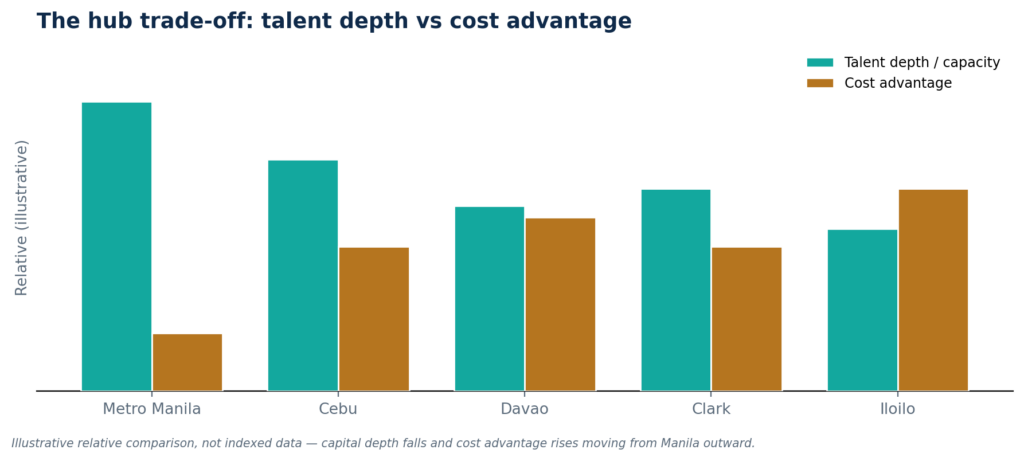
Figure 2 — Illustrative trade-off: talent depth falls and cost advantage rises moving from Manila outward.
“Clients fixate on the hourly rate and skip the hub conversation, which is backwards — the hub often moves the budget more than the negotiation does. The same quality of agent can cost fifteen percent less an hour in Cebu than in Manila. For a large program, that one decision is worth more than anything you’ll win at the contract table.” John Maczynski — CEO, PITON-Global; former Global EVP of the world’s largest BPO provider
How Do You Choose the Right Hub for Your Program?
Match the hub to your program’s size, specialization, and continuity needs — Manila for scale and niche skills, Tier 2 for balance, emerging hubs for cost and retention, and multiple hubs for resilience.
The right hub follows from the program, not the other way around. A large or highly specialized program — say, complex technical or healthcare support at volume — usually needs Metro Manila’s depth. A balanced customer-service or sales program often runs best in a Tier 2 hub, capturing most of the talent at meaningfully lower cost. A cost-sensitive program that values retention may do best in an emerging hub, accepting capacity limits. And any program where continuity is critical should consider splitting across two hubs for redundancy against local disruption. The point is to treat location as a deliberate input alongside engagement model and partner — not a detail the vendor decides for you.
| Program Profile | Best-Fit Hub Strategy |
| Large or specialized | Metro Manila (Tier 1) for depth and capacity. |
| Balanced CX / sales | Cebu, Davao, or Clark (Tier 2) for cost-quality balance. |
| Cost-sensitive | Emerging hubs (Iloilo, Bacolod) for best rate and retention. |
| Continuity-critical | Two hubs for redundancy against local disruption. |
| Rapid scale-up | Manila or established Tier 2 with deep, ready talent. |
| Niche skills | Wherever the specific talent pool is deepest. |
“The provincial hubs are where the most interesting growth is happening — strong English, lower attrition, real loyalty, and costs below Manila. For the right program, a city like Iloilo or Davao isn’t a compromise; it’s the better choice. The skill is matching the program to the hub, and that’s exactly the local knowledge most overseas buyers don’t have.” Ralf Ellspermann — CSO, PITON-Global; 25-year Philippine BPO veteran
Frequently Asked Questions
What Are the Main Call Center Locations in the Philippines?
Metro Manila (Tier 1: deepest talent and capacity), Cebu, Davao, and Clark (Tier 2: strong talent at lower cost), and emerging hubs like Iloilo and Bacolod (best cost and retention, more limited capacity).
Is Metro Manila More Expensive Than Other Hubs?
Yes — roughly 10–20% higher than provincial cities like Cebu and Davao. At scale, basing a program in a Tier 2 hub instead can save hundreds of thousands of dollars a year without losing English fluency or US-hours coverage.
Which Philippine Call Center Hub Should I Choose?
Match it to your program: Manila for large or specialized work, Tier 2 (Cebu/Davao/Clark) for balanced programs, emerging hubs for cost and retention, and two hubs for business-continuity resilience.
Are Provincial Philippine Hubs Viable for Serious Programs?
Increasingly yes — roughly 54% of sector growth is now driven by provincial and next-wave hubs, which offer strong English, lower attrition, and lower cost, with capacity deepening each year.
Related in This Series
Why Are Call Centers in the Philippines the Global CX Standard — and Is AI Changing That?
The full service taxonomy, voice to omnichannel.
What Call Center Services Can You Outsource to the Philippines?
The full service taxonomy, voice to omnichannel.
How Does Call Center Outsourcing to the Philippines Work?
Engagement models: managed, dedicated, hybrid, BOT, GCC.
What Does It Cost to Run a Call Center in the Philippines?
The TCO cost-stack and 2026 benchmarks.
Why Is Call Center Pricing Moving From Per-Hour to Outcome-Based?
How the commercial model is changing in the AI era.
How Do Philippine Call Centers Deliver CX Quality?
The metrics that govern quality, and the voice edge.
Is AI Replacing Call Centers in the Philippines?
The AI-human division of labor, in depth.
How Do You Choose the Right Call Center Partner?
The vendor scorecard and the quality-tier gap.
About PITON-Global
PITON-Global is a vendor-neutral outsourcing advisory with 25+ years in the Philippine market and on-the-ground knowledge of every major hub. We help you match your program to the right city — and the right provider in it — balancing cost, talent depth, and resilience, free of charge and with no obligation.
Achieve sustainable growth with world-class BPO solutions!
PITON-Global connects you with industry-leading outsourcing providers to enhance customer experience, lower costs, and drive business success.
Get Your Top 1% Vendor List
Author
Ralf Ellspermann is a multi-awarded outsourcing executive with 25+ years of call center and BPO leadership in the Philippines, helping 500+ high-growth and mid-market companies scale call center and customer experience operations across financial services, fintech, insurance, healthcare, technology, travel, utilities, and social media.
A globally recognized industry authority - and a contributor to The Times of India, CustomerThink, and The AI Journal - he advises organizations on building compliant, high-performance offshore contact center operations that deliver measurable cost savings and sustained competitive advantage.
Known for his execution-first approach, Ralf bridges strategy and operations to turn call center and business process outsourcing into a true growth engine. His work consistently drives faster market entry, lower risk, and long-term operational resilience for global brands.
EXECUTIVE GOVERNANCE & ACCURACY STANDARDS
Authored by:

Ralf Ellspermann
Founder & CSO of PITON-Global,
25-Year Philippine BPO Veteran,
Multi-awarded Executive
Specializing in strategic sourcing and excellence in Manila
View Full Bio
Verified by:

John Maczynski
CEO of PITON-Global, and former Global EVP of the World’s largest BPO provider | 40 Years Experience
Ensuring global compliance and enterprise-grade service standards
View Full Bio
Last Peer Review: June 4, 2026
This service framework is audited quarterly to meet shifting global outsourcing regulations and COPC standards.