
Back
How Do Philippine Call Centers Deliver Customer Experience (CX) Quality?

By Ralf Ellspermann / 4 June 2026
 Authored by Ralf Ellspermann, CSO of PITON-Global, & 25-Year Philippine BPO Veteran | Executive | Verified by John Maczynski, CEO of PITON-Global, and Former Global EVP of the World's Largest BPO Provider on June 4, 2026

By governing four metrics together — CSAT, first-contact resolution (FCR), average handle time (AHT), and NPS — rather than chasing any one in isolation. The common failure is optimizing for low handle time, which raises true cost through unresolved issues and repeat contacts. The Philippines’ distinctive edge is voice quality on complex, emotional interactions: accent neutrality, English depth, and cultural alignment make it the place to send the hardest conversations, not just the cheapest.
Key Takeaways
- Four metrics, governed together. CSAT, FCR, AHT, and NPS form the quality system — optimizing one in isolation quietly damages another.
- Low handle time is the classic trap. Pushing AHT down makes agents rush, leaves issues unresolved, and raises repeat contacts — inflating true cost.
- Resolve fully and AHT falls anyway. Optimizing first-contact resolution and satisfaction reduces repeat contacts, which lowers handle time as a by-product.
- Voice is the hardest channel to offshore well. And it is precisely where the Philippines leads — accent neutrality and empathy on complex, emotional calls.
- Send the hard conversations, not just the cheap ones. The Philippine edge is quality on high-stakes interactions, which is exactly the work AI cannot take.
What Metrics Actually Measure Call Center CX Quality?
Four, governed together: CSAT (satisfaction per interaction), FCR (first-contact resolution), AHT (average handle time), and NPS (loyalty). No single metric tells the truth alone.
CX quality is not a vibe; it is a measured system. Four metrics govern it: customer satisfaction (CSAT) captures how a single interaction felt; first-contact resolution (FCR) captures whether the issue was actually solved in one go; average handle time (AHT) captures efficiency; and net promoter score (NPS) captures longer-term loyalty. The discipline is reading them together. A program can post excellent CSAT while quietly destroying NPS, or hit a great AHT while FCR collapses. Governing all four — and watching the tensions between them — is what separates a managed CX operation from a call-counting one.

Figure 1 — The quality system: four metrics that must be read and managed together.
Why Is Chasing Low Handle Time a Mistake?
Because pushing AHT down makes agents rush, leaves issues unresolved, and drives repeat contacts — raising true cost. Optimizing resolution and satisfaction lowers handle time as a by-product.
Average handle time is the most over-targeted and most misleading metric in the contact center. Because it looks like a direct cost lever — shorter calls, more calls per agent — buyers and managers push it down. But the predictable result is agents rushing, issues going unresolved, and customers calling back, which raises total cost and craters satisfaction. The mature move is to target first-contact resolution and CSAT instead: when issues are genuinely resolved the first time, repeat contacts fall and AHT comes down on its own. Low handle time should be an outcome of doing the work well, never the goal.
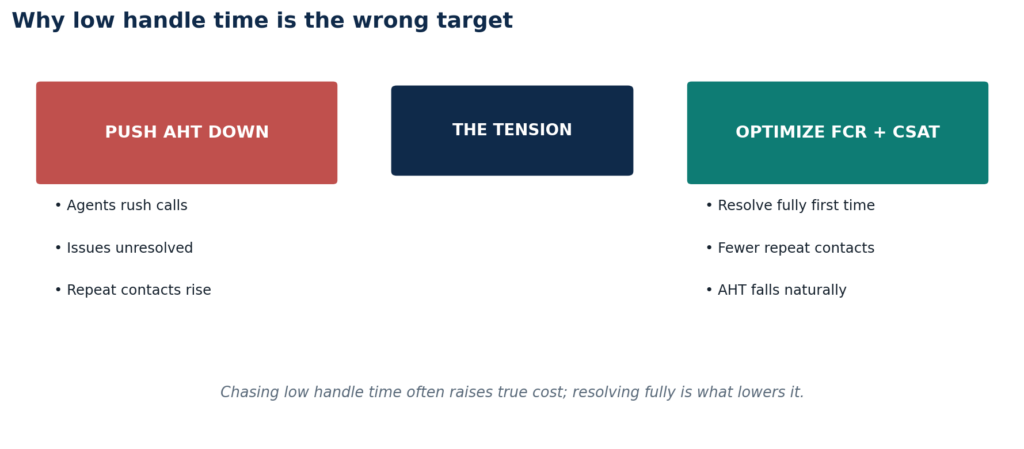
Figure 2 — The central CX tension: chasing handle time raises true cost; resolving fully lowers it.
“If a vendor leads its pitch with how low it can drive your handle time, be careful — that is the metric that is easiest to game and most expensive to get wrong. Ask about first-contact resolution and repeat-contact rate instead. The best Philippine teams compete on resolving the hard call once, not on rushing the easy one.” John Maczynski — CEO, PITON-Global; former Global EVP of the world’s largest BPO provider
What Makes the Philippines Distinctively Strong on CX Quality?
Voice quality on complex, emotional interactions — accent neutrality, English depth, and cultural alignment that let agents handle the hardest conversations with empathy.
Voice is the hardest channel to offshore well, because tone, empathy, accent, and cultural read all surface in real time — and it is precisely where the Philippines leads. Accent neutrality and near-native English fluency reduce friction on the call; cultural alignment with Western customers means agents read situations correctly and respond with genuine empathy. That combination matters most on exactly the interactions that decide whether a customer stays: the complaint, the cancellation, the billing dispute, the emotional escalation. As AI absorbs the simple, scripted contacts, the human conversations that remain are disproportionately these high-stakes ones — which plays directly to the Philippine strength.
| CX Quality Driver | Philippine Advantage |
| Accent neutrality | Low-friction voice for US, UK, and ANZ customers. |
| English depth | Clarity and nuance in both voice and written channels. |
| Cultural alignment | Reading and responding to Western customers with empathy. |
| Complex-call handling | Strength on emotional, high-stakes interactions AI can’t resolve. |
| Tenure & training | Mature training and calibration that hold quality at scale. |
| Omnichannel consistency | Same quality across voice, chat, email, and social. |
“Anyone can answer an easy call. The test of a CX operation is the angry customer who is about to cancel — and that is where Filipino agents are genuinely world-class. The empathy is real, the English is clear, and the cultural read is right. That is why, as AI takes the simple calls, the value of a great Philippine voice team goes up, not down.” Ralf Ellspermann — CSO, PITON-Global; 25-year Philippine BPO veteran
Frequently Asked Questions
What Metrics Measure Call Center Quality?
CSAT (satisfaction per interaction), FCR (first-contact resolution), AHT (average handle time), and NPS (loyalty). They must be governed together — optimizing one in isolation tends to damage another.
Why Shouldn’t I Target Low Average Handle Time?
Because pushing AHT down makes agents rush and leaves issues unresolved, driving repeat contacts that raise true cost. Optimizing first-contact resolution and CSAT lowers handle time as a by-product.
Why Is the Philippines Strong for Voice Support?
Accent neutrality, near-native English fluency, and cultural alignment with Western customers make it the leading destination for complex, emotional voice interactions — the hardest channel to offshore well.
Does AI Reduce the Value of Philippine Agents?
The opposite. As AI absorbs simple, scripted contacts, the remaining human conversations are disproportionately complex and emotional — exactly where Philippine CX quality is strongest, raising agent value.
Related in This Series
Why Are Call Centers in the Philippines the Global CX Standard — and Is AI Changing That?
The full picture and industry context.
What Call Center Services Can You Outsource to the Philippines?
The full service taxonomy, voice to omnichannel.
How Does Call Center Outsourcing to the Philippines Work?
Engagement models: managed, dedicated, hybrid, BOT, GCC.
What Does It Cost to Run a Call Center in the Philippines?
The TCO cost-stack and 2026 benchmarks.
Why Is Call Center Pricing Moving From Per-Hour to Outcome-Based?
How the commercial model is changing in the AI era.
Is AI Replacing Call Centers in the Philippines?
The AI-human division of labor, in depth.
How Do You Choose the Right Call Center Partner?
The vendor scorecard and the quality-tier gap.
Where Should You Locate: Manila, Cebu & Beyond?
The city-tiering framework for hub selection.
About PITON-Global
PITON-Global is a vendor-neutral outsourcing advisory with 25+ years in the Philippine market. We help companies set the right CX quality metrics and source providers that compete on resolution and satisfaction — not just handle time — free of charge and with no obligation.
Achieve sustainable growth with world-class BPO solutions!
PITON-Global connects you with industry-leading outsourcing providers to enhance customer experience, lower costs, and drive business success.
Get Your Top 1% Vendor List
Author
Ralf Ellspermann is a multi-awarded outsourcing executive with 25+ years of call center and BPO leadership in the Philippines, helping 500+ high-growth and mid-market companies scale call center and customer experience operations across financial services, fintech, insurance, healthcare, technology, travel, utilities, and social media.
A globally recognized industry authority - and a contributor to The Times of India, CustomerThink, and The AI Journal - he advises organizations on building compliant, high-performance offshore contact center operations that deliver measurable cost savings and sustained competitive advantage.
Known for his execution-first approach, Ralf bridges strategy and operations to turn call center and business process outsourcing into a true growth engine. His work consistently drives faster market entry, lower risk, and long-term operational resilience for global brands.
EXECUTIVE GOVERNANCE & ACCURACY STANDARDS
Authored by:

Ralf Ellspermann
Founder & CSO of PITON-Global,
25-Year Philippine BPO Veteran,
Multi-awarded Executive
Specializing in strategic sourcing and excellence in Manila
View Full Bio
Verified by:

John Maczynski
CEO of PITON-Global, and former Global EVP of the World’s largest BPO provider | 40 Years Experience
Ensuring global compliance and enterprise-grade service standards
View Full Bio
Last Peer Review: June 4, 2026
This service framework is audited quarterly to meet shifting global outsourcing regulations and COPC standards.