

Because AI breaks the per-hour model. Pricing has evolved from per-hour to per-seat, per-call, and now toward per-outcome and AI-blended value-based models. The reason is structural: once AI deflects 25–40% of tier-1 volume, paying per agent-hour means funding handle time that AI has removed and misaligning incentives. Outcome-based pricing — paying for resolved tickets or results — lets the buyer benefit from AI efficiency and rewards the provider for outcomes, not hours.
Key Takeaways
- Pricing is on a five-rung ladder. Per-hour → per-seat → per-call → per-outcome/per-resolution → AI-blended/value-based — moving from paying for inputs to paying for results.
- AI breaks the hourly model. When AI deflects 25–40% of volume, per-hour billing makes you pay for handle time AI removed — and misaligns incentives.
- Outcome-based realigns incentives. Paying per resolution rewards the provider for solving problems efficiently, and passes AI’s efficiency gains to the buyer.
- Per-hour isn’t dead — it’s narrowing. It still fits unpredictable or low-volume work, but it is the wrong default for high-volume, AI-augmented programs.
- Match the model to the work. The right pricing basis depends on volume predictability, measurability of outcomes, and how much AI is in the workflow.
How Has Call Center Pricing Evolved?
Along a ladder from per-hour to per-seat, per-call, per-outcome/per-resolution, and now AI-blended value-based pricing — progressively shifting from paying for inputs to paying for results.
Call center commercial models have climbed a clear ladder. Per-hour — paying for agent time — is the legacy default and still the most common, but it puts all the volume risk on the buyer. Per-seat or per-FTE pays for staffed capacity: more predictable, but still input-based. Per-call or per-contact ties cost to interactions handled — volume-linked, but not value-linked. Per-outcome or per-resolution pays for results, such as resolved tickets, shifting efficiency risk to the provider. And the newest rung, AI-blended or value-based pricing, charges for value delivered as AI absorbs the underlying volume. The direction of travel is unmistakable: from paying for time to paying for outcomes.

Figure 1 — Five rungs from input-based to outcome-based pricing — and the risk shift at each step.
Why Does AI Break the Per-Hour Pricing Model?
Because AI deflects 25–40% of tier-1 volume, so per-hour billing makes you pay for handle time AI has eliminated — and rewards the provider for staffing hours rather than solving problems.
The per-hour model assumes a stable link between hours staffed and value delivered. AI severs that link. When automation deflects 25–40% of tier-1 volume, an hourly contract has you paying for agent time that the work no longer requires — and worse, it gives the provider no incentive to deploy AI at all, since fewer hours means less revenue. The incentives invert: under per-hour, efficiency hurts the provider; under outcome-based, efficiency helps both sides. That misalignment is why thoughtful buyers are moving off pure hourly pricing for AI-augmented work.
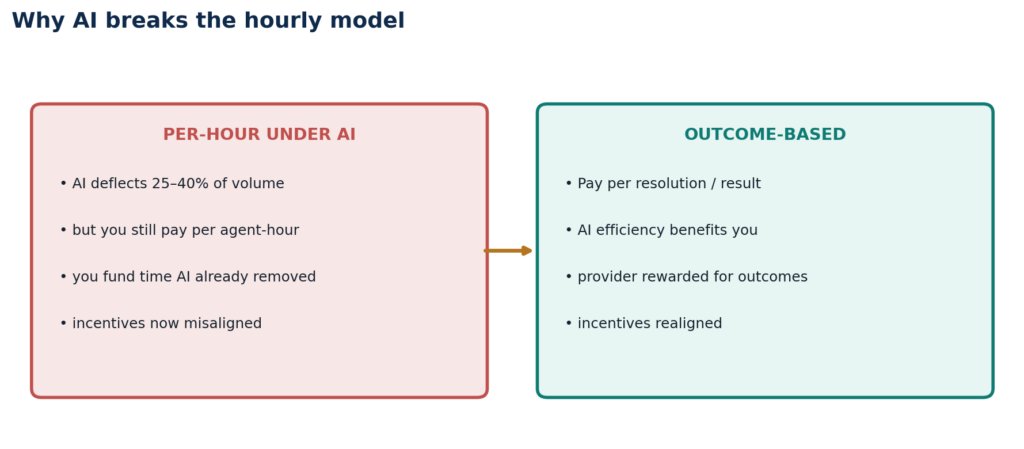
Figure 2 — Under AI, per-hour misaligns incentives; outcome-based realigns them.
“The hourly model was built for a world where more hours meant more work done. AI ended that world. If you pay per hour while your provider automates a third of the volume, you are literally paying for work that isn’t happening — and you have just paid your provider to not give you the savings. Outcome pricing fixes the incentive: they win when your customers’ problems get solved, not when the clock runs.” John Maczynski — CEO, PITON-Global; former Global EVP of the world’s largest BPO provider
What Does Outcome-Based Pricing Actually Look Like — and What Are Its Risks?
You pay per resolved ticket, successful outcome, or value metric rather than per hour — which aligns incentives but requires clear, agreed definitions of an “outcome” and clean measurement.
In an outcome-based model you pay for results — a resolved ticket, a completed sale, a retained customer — not for the hours or seats behind them. Done well, it aligns everyone: the provider is rewarded for resolving issues efficiently, AI efficiency flows to the buyer as lower cost per outcome, and the relationship optimizes for customer success rather than time-on-phone. The risks are real and manageable: you must define “resolution” precisely (to avoid premature closes that game the metric), measure it cleanly, and account for cases where outcomes depend partly on factors outside the provider’s control. This is why outcome models are often introduced gradually — blended with a base — rather than as an overnight switch.
| Pricing Model | Best When… | Watch-Out |
| Per-hour | Volume is low or unpredictable | Pays for AI-removed time |
| Per-seat / FTE | You want predictable capacity | Still input, not outcome |
| Per-call | Volume is the cost driver | Rewards volume, not value |
| Per-resolution | Outcomes are measurable | Define “resolved” tightly |
| AI-blended / value | AI is heavy in the workflow | Needs mature measurement |
Should You Abandon Per-Hour Pricing Entirely?
No — per-hour still fits unpredictable or low-volume work; the point is to stop defaulting to it for high-volume, AI-augmented programs where outcome-based models fit better.
This is an evolution, not an extinction. Per-hour pricing remains sensible for genuinely unpredictable work, low or spiky volumes, and early-stage programs where outcomes are hard to define. The mistake is treating it as the automatic default for every engagement, including high-volume, AI-augmented programs where it now actively works against you. The mature approach is to match the pricing basis to the work: how predictable is the volume, how measurable is the outcome, and how much AI sits in the workflow? Increasingly the answer points up the ladder — toward per-resolution and value-based models — and the providers who embrace that are signaling confidence in their own efficiency.
“When a provider resists any conversation about outcome-based pricing, ask yourself why. The ones confident in their quality and their AI are happy to be paid for results — it is their advantage. The ones clinging to pure hourly billing are often protecting an inefficiency they would rather you kept funding. The pricing model a provider prefers tells you a lot about the provider.” Ralf Ellspermann — CSO, PITON-Global; 25-year Philippine BPO veteran
Frequently Asked Questions
What Are the Main Call Center Pricing Models?
Per-hour (pay for agent time), per-seat/per-FTE (pay for capacity), per-call (pay per interaction), per-outcome/per-resolution (pay for results), and AI-blended/value-based (pay for value as AI handles volume).
Why Is Per-Hour Pricing a Problem in the AI Era?
Because AI deflects 25–40% of tier-1 volume, so per-hour billing makes you pay for handle time AI removed, and gives the provider no incentive to automate — efficiency reduces their revenue. The incentives are misaligned.
What Is Outcome-Based Call Center Pricing?
Paying per resolved ticket, successful outcome, or value metric rather than per hour. It aligns incentives and passes AI efficiency to the buyer, but requires precise definitions of an “outcome” and clean measurement.
Should I Stop Using Per-Hour Pricing?
Not entirely — it still fits unpredictable or low-volume work. The point is to stop defaulting to it for high-volume, AI-augmented programs, where per-resolution or value-based models align incentives better.
Related in This Series
Why Are Call Centers in the Philippines the Global CX Standard — and Is AI Changing That?
The full picture and industry context.
What Call Center Services Can You Outsource to the Philippines?
The full service taxonomy, voice to omnichannel.
How Does Call Center Outsourcing to the Philippines Work?
Engagement models: managed, dedicated, hybrid, BOT, GCC.
What Does It Cost to Run a Call Center in the Philippines?
The TCO cost-stack and 2026 benchmarks.
How Do Philippine Call Centers Deliver CX Quality?
The metrics that govern quality, and the voice edge.
Is AI Replacing Call Centers in the Philippines?
The AI-human division of labor, in depth.
How Do You Choose the Right Call Center Partner?
The vendor scorecard and the quality-tier gap.
Where Should You Locate: Manila, Cebu & Beyond?
The city-tiering framework for hub selection
About PITON-Global
PITON-Global is a vendor-neutral outsourcing advisory with 25+ years in the Philippine market. We help companies choose the right pricing model for AI-era CX — from per-hour to outcome-based — and source providers willing to be paid for results, free of charge and with no obligation.