
Back
Is AI Replacing Call Centers in the Philippines?

By Ralf Ellspermann / 4 June 2026
 Authored by Ralf Ellspermann, CSO of PITON-Global, & 25-Year Philippine BPO Veteran | Executive | Verified by John Maczynski, CEO of PITON-Global, and Former Global EVP of the World's Largest BPO Provider on June 4, 2026

No — AI is reshaping the work, not replacing the industry. The model is deflect-augment-escalate: AI resolves 25–40% of routine tier-1 volume, assists agents on the rest, and escalates the complex and emotional calls to humans. Raw call volume falls, but the remaining work is higher-value and the industry keeps growing. The real divide in 2026 is not human vs AI — it is between providers that have built genuine AI capability and those still selling it before they can deliver it.
Key Takeaways
- AI reshapes, it doesn’t replace. The Philippine industry grew to ~$40B and ~1.9M workers in 2025 even as AI adoption accelerated — the displacement thesis is not in the data.
- The model is deflect-augment-escalate. AI handles routine tier-1, augments agents on the rest, and escalates complex and emotional calls to humans.
- Volume down, value up. AI deflects 25–40% of tier-1 volume, but the remaining calls are harder and worth more — lifting agent value even as raw volume falls.
- New roles are emerging. Agents increasingly supervise and orchestrate AI systems — an “AI pilot” layer that didn’t exist a few years ago.
- The real risk is the capability gap. Leading providers deliver real AI-augmented CX; others oversell capabilities they’re still learning to build. Vetting matters more than ever.
Is AI Actually Replacing Call Centers in the Philippines?
No — the industry grew in revenue and headcount through 2025 even as AI adoption accelerated. AI is changing the mix of work, not eliminating the industry.
The displacement narrative is intuitive and wrong. If AI were replacing Philippine call centers, you would see revenue and headcount falling; instead both grew in 2025 — to about $40B and 1.9M workers — with the sector expanding at roughly twice the global rate and targeting $59B and 2.5M workers by 2028. AI is unquestionably changing the work: it is automating routine contacts at scale. But automation of tasks is not elimination of the industry, and the numbers show an industry absorbing AI and continuing to grow.
“Every decade someone declares the call center dead — IVR was going to kill it, offshoring was going to kill it, chatbots were going to kill it, now agentic AI. Forty years in, the industry is bigger than ever. Technology keeps taking the routine work, and the humans keep moving up to the harder work. AI is the most powerful version of that pattern yet, but it is the same pattern.” John Maczynski — CEO, PITON-Global; former Global EVP of the world’s largest BPO provider
How Do AI and Human Agents Actually Divide the Work?
Through a deflect-augment-escalate model: AI resolves routine tier-1, assists agents on mid-complexity work, and escalates complex, emotional, high-judgment calls to humans.
The operating model that has emerged is a clean three-way division. AI deflects routine tier-1 contacts — status checks, simple how-tos, password resets — resolving them without a human. AI augments the human on everything else: real-time suggestions, instant knowledge retrieval, automatic call summaries and after-call work. And the human escalation tier owns the calls that need empathy, judgment, and accountability — the complaints, the complex troubleshooting, the emotional escalations. The human is not removed; the human is moved up to the work that matters most.
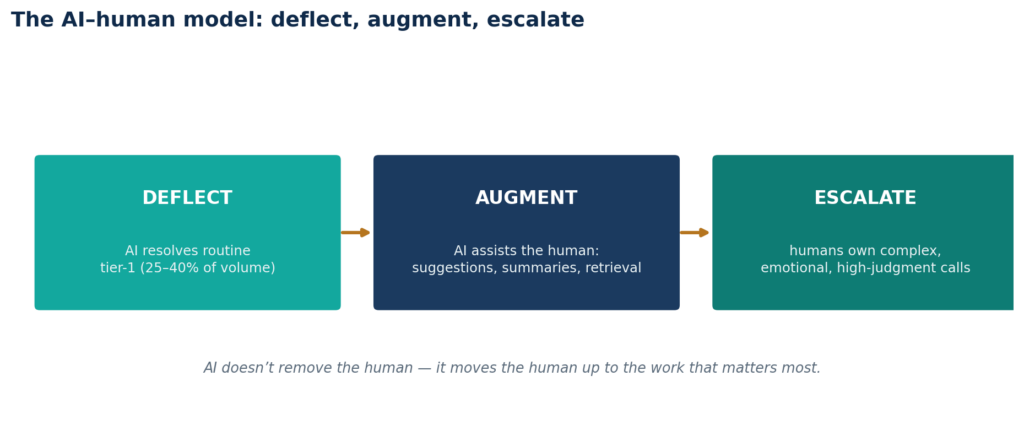
Figure 1 — AI deflects, augments, and escalates — concentrating human effort on the highest-value interactions.
If AI Deflects 25–40% of Calls, Why Is the Industry Still Growing?
Because volume down is not value down: the remaining calls are harder and worth more, agents take on AI-orchestration roles, and new demand keeps arriving faster than automation removes it.
AI is deflecting an estimated 25–40% of tier-1 volume at leading providers — a real and large number. The reason the industry grows anyway is that the work that remains is concentrated at the high-value end. The simple calls leave; the complex, emotional, high-judgment calls stay, which raises the value (and the rate) of each remaining human interaction. Meanwhile agents move into new AI-adjacent roles — supervising, correcting, and orchestrating the automated systems. The result is fewer routine calls but more valuable work per agent, and an industry that keeps expanding.

Figure 2 — AI removes routine volume while the human tier shifts to complex, higher-value work.
“The mistake is reading a drop in call volume as a drop in value. We see the opposite with clients: AI clears the noise, and suddenly the human team is spending its time only on the calls that actually move retention and revenue. The seat count may shift, but the value of the operation goes up. That is augmentation, not replacement.” Ralf Ellspermann — CSO, PITON-Global; 25-year Philippine BPO veteran
What Is the Real Risk an AI-Era Call Center Buyer Should Worry About?
Not displacement — the capability gap between providers who have built genuine AI-augmented operations and those overselling capabilities they cannot yet deliver.
The genuine 2026 risk is choosing the wrong partner, not whether to use AI at all. A real fault line has opened in the industry: leading providers have built proprietary, working AI-augmented stacks and deliver measurable efficiency gains, while others — still early on a multi-year AI maturity curve — are selling capabilities they are only beginning to build. For a buyer, this makes diligence on actual, demonstrated AI capability essential: ask to see live deployments, real deflection and quality data, and how the human-AI handoff actually works — not a deck of promised features. The right partner uses AI to make a strong human team better; the wrong one uses AI as a sales story.
Frequently Asked Questions
Is AI Replacing Call Center Jobs in the Philippines?
No. The industry grew in revenue and headcount through 2025 despite accelerating AI adoption. AI is automating routine tasks and shifting agents to higher-value, complex work and AI-orchestration roles, not eliminating the industry.
How Much Call Volume Does AI Handle?
At leading providers, AI is deflecting an estimated 25–40% of routine tier-1 volume. The remaining human calls are more complex and higher-value, which raises agent value even as raw volume falls.
What Is the Deflect-Augment-Escalate Model?
AI deflects routine tier-1 contacts, augments agents on mid-complexity work with suggestions and summaries, and escalates complex, emotional, high-judgment calls to humans — concentrating human effort where it matters most.
What Should I Check When a Provider Claims AI Capability?
Demand evidence: live deployments, real deflection and quality data, and a clear account of the human-AI handoff. The 2026 risk is providers overselling AI capabilities they are still learning to build.
Related in This Series
Why Are Call Centers in the Philippines the Global CX Standard — and Is AI Changing That?
The full picture and industry context.
What Call Center Services Can You Outsource to the Philippines?
The full service taxonomy, voice to omnichannel.
How Does Call Center Outsourcing to the Philippines Work?
Engagement models: managed, dedicated, hybrid, BOT, GCC.
What Does It Cost to Run a Call Center in the Philippines?
The TCO cost-stack and 2026 benchmarks.
Why Is Call Center Pricing Moving From Per-Hour to Outcome-Based?
How the commercial model is changing in the AI era.
How Do Philippine Call Centers Deliver CX Quality?
The metrics that govern quality, and the voice edge.
How Do You Choose the Right Call Center Partner?
The vendor scorecard and the quality-tier gap.
Where Should You Locate: Manila, Cebu & Beyond?
The city-tiering framework for hub selection.
About PITON-Global
PITON-Global is a vendor-neutral outsourcing advisory with 25+ years in the Philippine market. We help companies separate real AI-augmented CX capability from sales stories, and source providers whose AI genuinely makes a strong human team better — free of charge and with no obligation.
Achieve sustainable growth with world-class BPO solutions!
PITON-Global connects you with industry-leading outsourcing providers to enhance customer experience, lower costs, and drive business success.
Get Your Top 1% Vendor List
Author
Ralf Ellspermann is a multi-awarded outsourcing executive with 25+ years of call center and BPO leadership in the Philippines, helping 500+ high-growth and mid-market companies scale call center and customer experience operations across financial services, fintech, insurance, healthcare, technology, travel, utilities, and social media.
A globally recognized industry authority - and a contributor to The Times of India, CustomerThink, and The AI Journal - he advises organizations on building compliant, high-performance offshore contact center operations that deliver measurable cost savings and sustained competitive advantage.
Known for his execution-first approach, Ralf bridges strategy and operations to turn call center and business process outsourcing into a true growth engine. His work consistently drives faster market entry, lower risk, and long-term operational resilience for global brands.
EXECUTIVE GOVERNANCE & ACCURACY STANDARDS
Authored by:

Ralf Ellspermann
Founder & CSO of PITON-Global,
25-Year Philippine BPO Veteran,
Multi-awarded Executive
Specializing in strategic sourcing and excellence in Manila
View Full Bio
Verified by:

John Maczynski
CEO of PITON-Global, and former Global EVP of the World’s largest BPO provider | 40 Years Experience
Ensuring global compliance and enterprise-grade service standards
View Full Bio
Last Peer Review: June 4, 2026
This service framework is audited quarterly to meet shifting global outsourcing regulations and COPC standards.