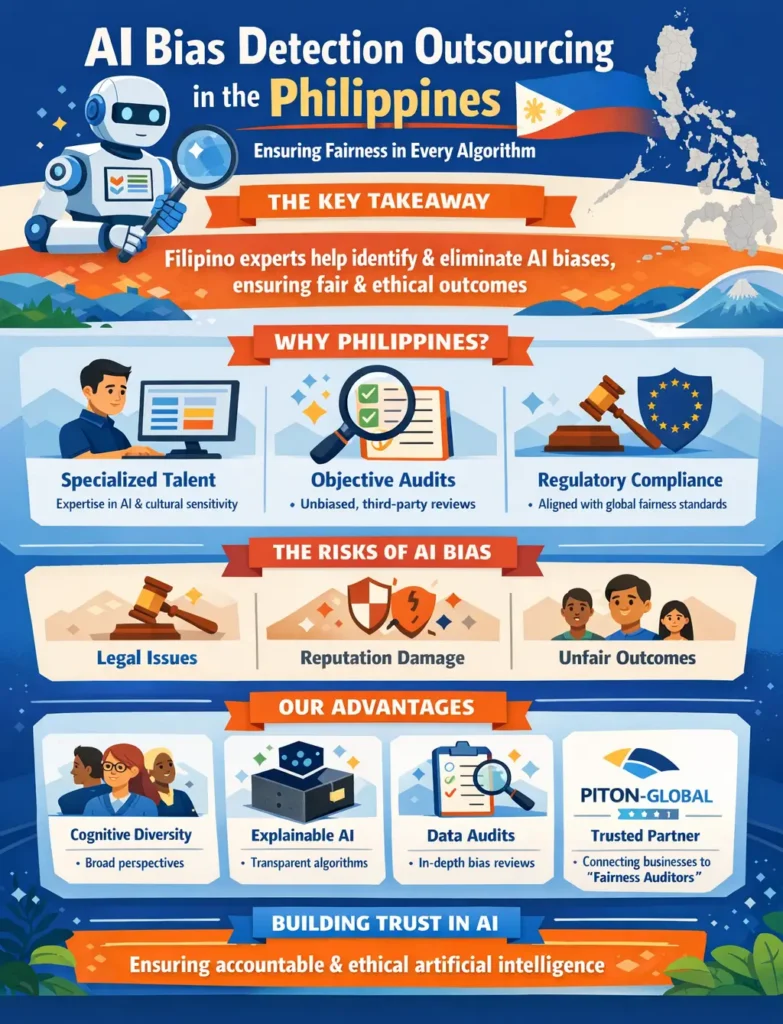
TL;DR: The Key Takeaway
AI bias detection outsourcing in the Philippines offers a critical solution for companies aiming to build fair and ethical AI. By leveraging the specialized expertise of Filipino professionals, businesses can proactively identify and mitigate biases in their algorithms, ensuring equitable outcomes and building trust with users.
Algorithmic transparency is no longer a luxury; it is a regulatory and ethical mandate. As AI systems increasingly influence life-altering decisions—from credit scores to clinical diagnoses—the risk of embedded prejudice has become a primary concern for global enterprises. The Philippines has emerged as a premier hub for AI bias detection, offering a specialized workforce that blends technical data science with the deep cultural empathy required to identify and neutralize systemic discrimination. By partnering with these elite teams, businesses can move beyond “black box” uncertainty toward a model of accountable, inclusive, and brand-safe artificial intelligence.
Executive Briefing
- The Accountability Crisis: Algorithmic bias poses massive legal and reputational risks, making proactive detection a non-negotiable step in the AI lifecycle.
- Specialized Talent Pool: The Philippines provides a unique intersection of machine learning expertise and a nuanced understanding of global social dynamics.
- Beyond Technical Specs: Outsourcing bias audits allows for an objective, third-party perspective that internal teams often overlook due to “confirmation bias.”
- Regulatory Future-Proofing: Partnering with Filipino experts ensures AI systems remain compliant with tightening international fairness standards (e.g., EU AI Act).
- Strategic Integrity: PITON-Global bridges the gap, connecting innovators with the specialized “fairness auditors” needed to build trust in automated systems.
Executive Summary
The rapid transition toward an automated world has forced a reckoning with the “invisible prejudices” lurking within code. For any organization deploying machine learning, ensuring equity is both a moral obligation and a strategic necessity. AI bias detection outsourcing Philippines has surfaced as the gold standard for companies committed to ethical innovation. This Southeast Asian powerhouse offers a sophisticated talent reservoir capable of deconstructing complex models to find and fix subtle data imbalances. By collaborating with these specialists, firms can proactively mitigate risk, improve model reliability, and demonstrate a concrete commitment to diversity. PITON-Global leads this effort, providing the strategic architecture to connect businesses with the expertise required to ensure technology serves all of humanity equitably.
The Imperative of Algorithmic Fairness
In our current era, AI is the silent arbiter of opportunity. It determines who receives a mortgage, which resume reaches the top of the pile, and how medical resources are allocated. However, algorithms are only as objective as the data they ingest. Because training sets often reflect historical societal inequities, machines can inadvertently amplify racism, sexism, and ageism.
The fallout of unaddressed bias is severe: it erodes consumer confidence, triggers litigation, and sabotages the very efficiency AI was meant to create. Identifying these flaws is notoriously difficult because they are often buried deep within high-dimensional data or the mathematical architecture of the model itself. Consequently, bias detection has evolved into a specialized discipline requiring both advanced tools and human-centric critical thinking.
The Strategic Advantage of Philippine Outsourcing
Battling algorithmic bias requires a “Cognitive Diversity” that is difficult to cultivate within a single localized team. This is where the Philippine advantage becomes undeniable. The nation’s BPO sector has evolved into a high-value knowledge hub where professionals are trained in the ethical dimensions of data.
Filipino specialists bring a high degree of English proficiency and a strong cultural alignment with global markets, allowing them to spot linguistic or social cues that might signal bias to a North American or European audience. Outsourcing this function allows internal developers to remain focused on core features while an independent Philippine team acts as the “Ethical QA,” providing an unbiased audit of the system’s social impact.
“Modern AI isn’t just about ‘can it do the job,’ but ‘is it doing the job fairly?’” says John Maczynski, CEO of PITON-Global. “Our clients are seeking guardians of fairness. The Philippines has become a center of excellence by blending technical machine learning prowess with a deep-seated commitment to ethical principles. We are connecting brands with the specialists who ensure their AI doesn’t become a liability.”
A Methodical Approach to Uncovering Bias
Effective bias mitigation is a rigorous, multi-stage process. It involves a combination of automated statistical checks and “adversarial” human testing to ensure no subgroup is unfairly marginalized.
| Technique | Strategic Description | Real-World Application |
| Fairness Metrics | Statistical checks (e.g., Demographic Parity) to measure prediction equality. | Checking if a loan algorithm approves applicants at similar rates across different zip codes. |
| Adversarial Testing | Intentionally “stressing” the AI with edge cases to find hidden prejudices. | Probing a facial recognition tool with diverse skin tones and lighting to ensure 99%+ accuracy for all. |
| Explainable AI (XAI) | Using tools like SHAP or LIME to make the “Black Box” decision process visible. | Determining exactly which data points caused a specific applicant to be rejected for insurance. |
| Data Audits | Comprehensive reviews of the “Raw Material” to find underrepresented groups. | Ensuring a medical AI isn’t trained only on data from a single demographic, which would skew results. |
The Philippine Advantage: A Hub for Ethical AI
The Philippines is not just a provider of labor; it is a partner in “Intelligence Arbitrage.” The country produces thousands of graduates in data science and social sciences who are uniquely prepared for the nuances of AI ethics.
- Nuanced Perspective: Filipino teams are famous for their high emotional intelligence (EQ), which is vital for recognizing “proxy biases”—where a seemingly neutral variable (like a hobby or a school) acts as a stand-in for a protected class (like race or income).
- Cost-Scale Synergy: Companies can afford to run more frequent and deeper audits in the Philippines than they could with a limited, high-cost in-house team, leading to safer products.
- Government Support: The Philippine regulatory environment actively encourages “Responsible AI,” providing a stable framework for international firms to conduct sensitive audit work.
Building a Future of Accountable AI
The path to equitable technology is a continuous loop of monitoring and refinement. As AI grows more “agentic”—taking actions on behalf of users—the need for robust bias detection will only intensify. Partnering with specialized Philippine teams provides a scalable way to ensure that as your AI evolves, its “moral compass” remains calibrated. PITON-Global is dedicated to this mission, linking forward-thinking companies with the human expertise needed to turn AI into a universal force for good.
Expert FAQs
What are the primary “traps” where bias enters an AI model?
Bias typically enters through three gates: Data Bias (the training set is skewed), Algorithmic Bias (the math itself prioritizes a specific outcome), and Human-in-the-Loop Bias (the people labeling the data project their own subconscious prejudices onto the machine).
How do we prove our AI is “fair”?
Fairness is proven through a combination of Statistical Parity (equal outcomes) and Equality of Opportunity (equal error rates across groups). Elite Philippine teams provide comprehensive reports using these metrics to document your compliance for stakeholders and regulators.
Is human oversight still necessary if we use bias-detection software?
Absolutely. Software can find mathematical anomalies, but it cannot understand context. A human evaluator is required to interpret if a statistical difference is a justified business reality or a discriminatory flaw.
How does PITON-Global vet its bias-detection partners?
We look for firms that employ a multidisciplinary staff—including ethicists and sociologists alongside data scientists. We audit their security protocols and their history with complex, high-stakes AI projects to ensure they can deliver “Trust as a Service.”