

Maximizing edge-case accuracy in ML training outsourcing to the Philippines is a data-engineering problem, not a labeling-volume one. Specialized teams time-align asynchronous LiDAR, radar, and camera streams, label fused scenes in 3D, and drive bounding-box error toward the pixel level through consensus QA and gold-set auditing — which cuts training epochs and GPU spend rather than just producing more labels. It is the quality question at the heart of how AI companies set up offshore training-data teams.
Key Takeaways
- Fusion, not annotation. The hard part is reconciling asynchronous LiDAR, radar, and camera into one temporally consistent 3D scene — generalist labelers can’t do it.
- Pixel-level tolerance is the spec. Edge-case accuracy lives in the last few pixels of a cuboid; the QA system, not the labeler, guarantees it.
- Bad labels burn GPUs. Noisy training data forces more epochs and more data to hit target accuracy — label error is a compute-cost lever.
- Consensus beats throughput. Multi-pass consensus and gold sets, with measured inter-annotator agreement, are what make labels trustworthy.
- Engineer the team, don’t rent seats. A standing pod that learns your ontology and failure modes compounds in accuracy; a rotating crowd does not.
Why Does Multi-Modal Sensor-Fusion Labeling Demand Specialized Teams?
Because the work is reconciling asynchronous LiDAR, radar, and camera streams into a single temporally consistent 3D scene — a data-engineering task requiring domain knowledge of perception, not generalist box-drawing.
A perception stack does not see one image; it sees several sensor streams arriving at different rates and resolutions, and a label is only useful if it is consistent across all of them through time. That means time-aligning a LiDAR point cloud, radar returns, and camera frames, then labeling the fused scene in 3D so a cuboid tracks the same object frame to frame. Doing this well requires labelers who understand sensor characteristics, occlusion, and why a given edge case is hard — a standing, trained pod, not a rotating crowd paid per box. This is the work that rewards a deep, domain-literate workforce, which is the Philippine talent base’s real advantage on this task and a large part of why leading AI companies already run support there.

Figure 1 — Asynchronous streams are time-aligned, fused, labeled in 3D, then consensus-checked to an audited ground truth.
According to John Maczynski, CEO, PITON-Global, “People still buy sensor-fusion labeling as if it were image tagging, and it is not even the same discipline. You are reconstructing a scene across three sensors through time. The teams that get this right are the ones that have lived inside one operator’s ontology long enough to know why a partially occluded cyclist at dusk is the label that actually matters.”
How Do You Drive Bounding-Box Error Toward the Pixel Level?
Through the QA system, not the individual labeler: gold-set auditing, multi-pass consensus, measured inter-annotator agreement, and an explicit error budget enforced per object class.
Pixel-level accuracy is a property of the process, not of any one annotator. The defensible method runs labels through gold sets (known-answer scenes that calibrate every labeler), multi-pass consensus on hard frames, and continuously measured inter-annotator agreement, all against an explicit error budget that differs by object class — a misplaced cuboid edge on a distant vehicle costs less than a missed pedestrian. The output that matters is not throughput but a defect rate the operator can trust enough to train on. This is why a serious partner reports agreement statistics and class-level error, not just labels delivered, the same measured discipline behind human verification of generative AI output.

“We do not promise zero errors — anyone who does is selling something. We promise a measured, class-weighted defect rate and the agreement statistics behind it, because that is the number an ML team can actually plan a training run around,” said Ralf Ellspermann, CSO, PITON-Global.
How Does Label Quality Translate Into Fewer Training Epochs and Lower Compute Cost?
Directly: noisy labels force a model to train longer and on more data to reach a target accuracy, so each point of label error inflates GPU spend — making pixel-level accuracy a compute-cost lever, not a quality nicety.
The argument that lands with a VP of Autonomy is economic. Label noise propagates into the loss surface: a model trained on inconsistent ground truth needs more epochs, more data, and more tuning to reach the same accuracy, and sometimes plateaus below it. That extra training is real GPU spend and real calendar time. Tightening label accuracy therefore shows up not on the annotation invoice but on the compute bill and the release schedule — which is the line a good outsourcing case is made on. The right partner is measured on downstream model efficiency, not labels-per-hour.
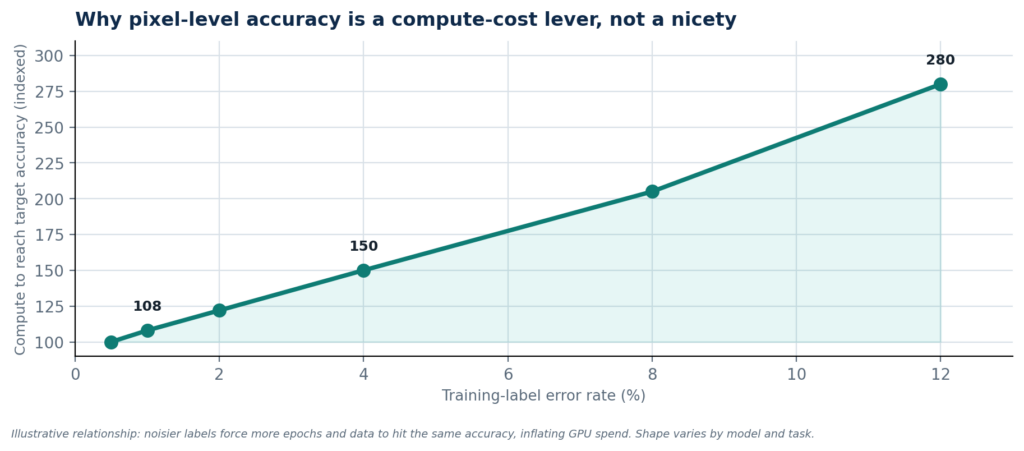
Figure 2 — Illustrative: noisier labels force more epochs and data for the same accuracy, inflating GPU spend.
“The board conversation changes the moment you stop counting cents per label and start counting GPU-hours per accuracy point. A cleaner dataset is the cheapest compute optimization most teams never make, and it is the one you can buy without touching your model architecture,” noted John Maczynski, CEO, PITON-Global.
Frequently Asked Questions
Can Generalist Data Labelers Handle Sensor-Fusion Work?
No. Reconciling asynchronous LiDAR, radar, and camera into a temporally consistent 3D scene requires perception domain knowledge and a standing, trained pod. Generalist per-box labeling produces inconsistent ground truth that degrades model accuracy. The same holds for other specialist modalities, such as the speech and sound labeling behind voice models.
How Is Labeling Accuracy Actually Measured?
By gold-set calibration, multi-pass consensus on hard frames, and reported inter-annotator agreement against a class-level error budget — with tighter tolerance where safety impact is highest. A serious partner reports these statistics, not just label counts.
Why Frame Label Accuracy as a Compute Cost?
Because noisy labels force a model to train longer and on more data to reach target accuracy, inflating GPU spend and slipping release dates. Tightening accuracy shows up on the compute bill, which is where the outsourcing case is strongest.
About PITON-Global
PITON-Global helps AI and autonomy teams find the rare data-engineering pods that label sensor fusion to a standard a model can actually train on. From a network of 100-plus leading Philippine BPOs — including 20 AI-first front-runners — we shortlist only partners measured on model accuracy and compute efficiency, never labels-per-hour. Behind that sits a leadership team with more than six decades of combined global outsourcing experience and 25+ years in the Philippine market. Our matching service is free and obligation-free, funded by our provider network rather than by you.