
Outsourcing GenAI prompt and output moderation to the Philippines means defending a public-facing generative platform against coordinated prompt attacks, deepfakes, and copyright infringement — through a daily operational cadence of updating prompt-filter blacklists, auditing synthetic outputs, and manually reviewing high-risk media variations. Guardrails decay without maintenance, so the deliverable is a standing team running that cadence continuously, not a one-time safety filter. It is one of the standing services AI companies source from Filipino evaluation and safety teams for model builders, next to annotation and RLHF.
Key Takeaways
- The surface shifts daily. Prompt attacks, deepfakes, and infringement evolve constantly; static guardrails decay fast.
- Cadence is the product. Daily blacklist updates, output audits, and media review keep guardrails current.
- Both ends need moderation. Filter malicious prompts at input and audit unsafe or infringing content at output.
- Humans handle the novel. New attack patterns and edge-case media need human review automation can’t yet catch.
What Is the GenAI Output-Safety Attack Surface?
Four shifting fronts: coordinated prompt attacks and jailbreaks, deepfakes and synthetic-identity abuse, copyright infringement and memorized output, and unsafe regenerated media variations — a surface that changes daily as users probe the model.
A public generative platform faces an adversarial population testing its limits in real time. The surface spans coordinated prompt attacks and jailbreaks aimed at eliciting prohibited output; deepfakes and synthetic-identity or likeness abuse; copyright infringement, including memorized or near-verbatim reproduction; and a long tail of unsafe media variations users generate by reworking prompts. Unlike a fixed policy problem, this surface moves — new jailbreaks and evasion techniques appear continuously — so defending it is an operations discipline, not a one-time configuration. That ongoing, adversarial nature is what makes it a standing team’s job, distinct from the one-off pre-launch stress-testing of AI systems.
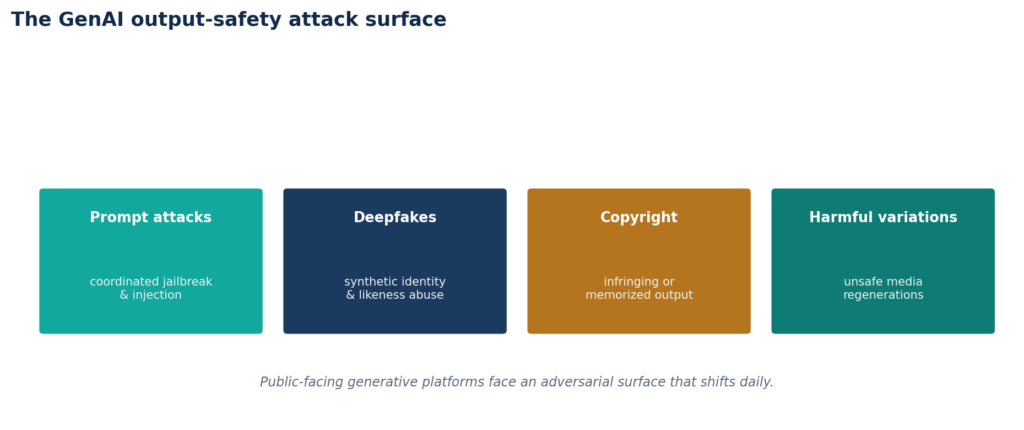
Figure 1 — Public-facing generative platforms face an adversarial surface that shifts daily.
According to John Maczynski, CEO, PITON-Global, “A generative platform’s guardrails are not a wall you build once — they are a garden you weed every day. The jailbreak that failed yesterday has three new variants this morning. Without a team maintaining the filters daily, your safety posture quietly rots while your traffic grows.”
What Is the Daily Operational Cadence That Keeps Guardrails Current?
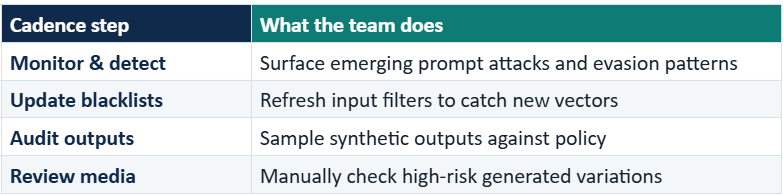
A repeating loop: monitor and detect emerging attacks, update prompt-filter blacklists, audit synthetic outputs against policy, and manually review high-risk media variations — run continuously, because guardrails decay the moment maintenance stops.
The work is a cadence, not a project. Each day a standing team monitors for emerging prompt attacks and evasion patterns, updates the input blacklists and filters that catch them, audits a sample of synthetic outputs against policy, applying the same human judgment that benchmarks generative output, to catch what slipped through, and manually reviews the high-risk media variations automated systems flag or miss. The loop then repeats, feeding what it learns back into the filters. This is precisely the kind of disciplined, repeating, judgment-laden operation that outsources well to a trained Philippine team — and precisely the kind that fails when treated as a one-time safety filter shipped with the model.

Figure 2 — A standing team runs this loop continuously; guardrails decay without daily maintenance.
“Input filtering and output auditing are two different muscles, and you need both. Catch the malicious prompt where you can, but assume some get through and audit what the model actually produced. The teams that only guard the front door are always surprised by what comes out the back,” said Ralf Ellspermann, CSO, PITON-Global.
Why Outsource This Cadence Rather Than Rely on the Model’s Built-In Safety?
Because built-in safety is a static baseline that adversaries route around within days; sustaining protection needs continuous human-run maintenance and review at scale — a standing operation a trained partner runs more reliably and affordably than an in-house team can staff around the clock.
A model’s built-in guardrails are a starting point, not a finished defense — determined users find new jailbreaks and unsafe regenerations faster than any single release can anticipate. Sustaining safety therefore requires the daily cadence above, run continuously and at the scale of live traffic, which is hard and expensive to staff in-house around the clock. A trained partner runs it as a standing discipline with follow-the-sun coverage at lower cost, while the platform retains ownership of its policies and the final word on enforcement. The model gives you the baseline; the operation keeps it from decaying.
“Budget for the maintenance, not just the launch. A safety filter is a perishable good: staff the team that refreshes it daily or watch it decay while your traffic grows,” noted John Maczynski, CEO, PITON-Global.
Frequently Asked Questions
What Does GenAI Prompt and Output Moderation Cover?
Both ends: filtering coordinated prompt attacks and jailbreaks at input, and auditing synthetic outputs for unsafe content, deepfakes, and copyright infringement at output — across an attack surface that shifts daily. Fairness is a related but separate track, covered by dedicated algorithmic bias reviews.
Why Is a Daily Cadence Necessary?
Because guardrails decay: new jailbreaks and evasion patterns appear continuously, so blacklists, output audits, and media review must be refreshed daily. A static safety filter shipped with the model is outdated within days.
Isn’t the Model’s Built-In Safety Enough?
No. Built-in safety is a static baseline adversaries route around quickly. Sustaining protection needs continuous human-run maintenance at the scale of live traffic, which a trained partner runs more reliably and affordably than around-the-clock in-house staffing.
About PITON-Global
PITON-Global helps generative-AI platforms source the standing teams that run prompt- and output-moderation as a daily discipline — from a network of 100-plus leading Philippine BPOs, 20 of them AI-first front-runners. Our leadership carries 6+ decades of combined global outsourcing experience and 25+ years in the Philippines, and our sourcing is free and obligation-free, funded by the provider network rather than by you.