

TL;DR: The Key Takeaway
Generative AI evaluation outsourcing in the Philippines provides the essential human cognitive layer to validate and benchmark machine-generated content, ensuring models are not just creative, but also accurate, safe, and aligned with human values. This strategic outsourcing of judgment is the new frontier in AI development, and one of the human-review services AI model builders outsource most often.
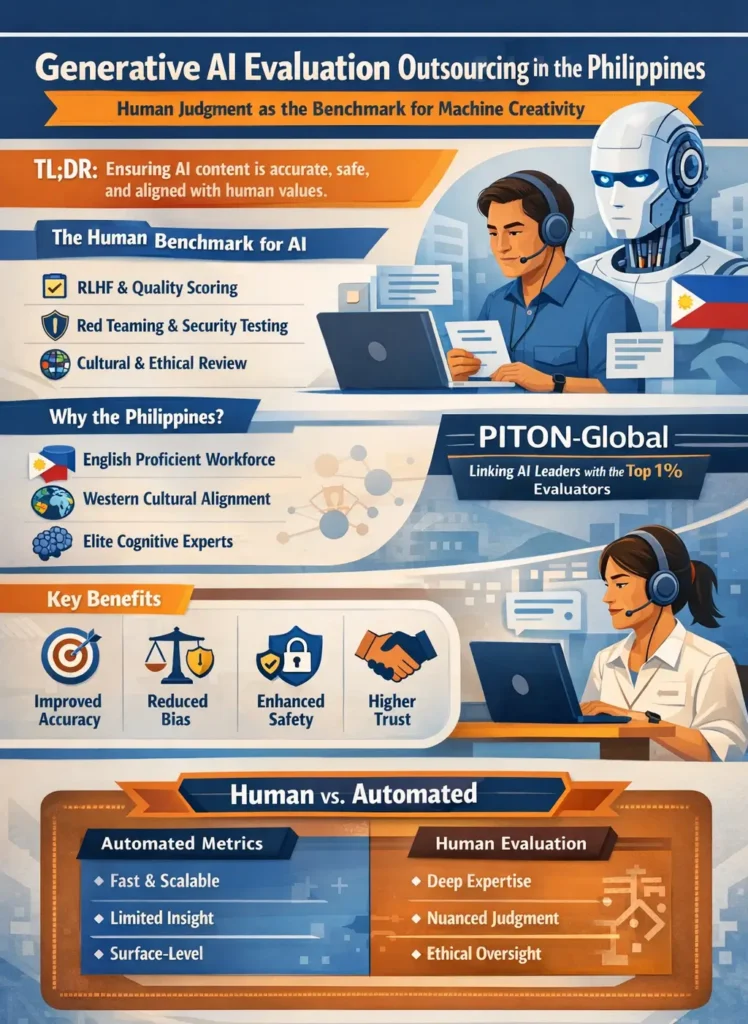
The evaluation of generative AI in the Philippines has evolved into a critical governance layer for large language models (LLMs). By utilizing a sophisticated workforce to perform RLHF, red teaming, and quality scoring, AI developers can move beyond inadequate automated metrics. This human-centric approach ensures that model outputs are not only fluent but also safe, factually grounded, and culturally resonant, establishing a definitive “human benchmark” for machine-generated content.
- Metric Limitations: Statistical scores like BLEU cannot detect hallucinations or assess nuanced creative tone.
- Strategic Hub: The Philippines offers a unique combination of high-level English proficiency and Western cultural alignment.
- Performance Impact: Expert evaluation directly correlates with higher user trust and reduced model bias.
- Adversarial Rigor: Filipino “red teams” proactively identify security flaws and “jailbreak” risks before public release.
- Elite Connectivity: PITON-Global links AI pioneers with rigorously vetted cognitive evaluators in the Southeast Asian corridor.
The Human Imperative in an Age of Machine Creativity
Despite the startling fluency of modern generative systems, a persistent gap remains: algorithms lack the innate ability to judge the quality of their own creation. Early validation relied on statistical benchmarks like ROUGE, which measure similarity to a reference text. While efficient, these metrics fail to capture the essentials of high-stakes AI: logic, helpfulness, and safety. A high statistical score does not guarantee that a chatbot’s advice is empathetic or that its code is structurally secure.
This creates an “evaluation imperative.” Even the most massive models, trained on trillions of parameters, require a human grounding in common sense and lived experience. Human evaluators introduce necessary “cognitive friction”—a process of rigorous, subjective judgment that prevents models from drifting into inaccuracy or harmful bias. By using human intuition as the ultimate arbiter, developers ensure their systems are not just powerful, but genuinely reliable and aligned with human values.
Why the Philippines Leads in Judging Machine Output
The necessity for high-fidelity human oversight has turned the Philippines into the epicenter of the cognitive services market. This leadership is built on a specific synergy of talent and infrastructure. With a highly literate workforce deeply immersed in global communication nuances, the nation provides a level of contextual depth that automated systems—and other outsourcing destinations—struggle to match.
This intellectual capital is supported by a mature BPO framework that has spent decades serving the world’s most rigorous tech firms. This ecosystem ensures that complex evaluation projects are managed with operational precision, robust data security, and total scalability. For global AI labs, the Philippines offers a stable, high-performance environment where human judgment can be scaled to meet the demands of rapid model deployment, whether the team sits in the capital or in one of the regional hubs weighed in our Manila, Cebu and Clark site comparison.
“We are witnessing a fundamental shift in the BPO sector: the primary value has moved from the transaction to the judgment. Our partners aren’t seeking script-followers; they need experts who can scrutinize a multi-billion dollar model and decide if it is safe for public consumption. This is the pinnacle of cognitive labor, and the Philippines is setting the global standard.” — John Maczynski, CEO, PITON-Global
The Spectrum of AI Assessment Work
Generative AI assessment is not a uniform task. It ranges from simple preference rankings to high-stakes adversarial testing. PITON-Global categorizes these services into four tiers to match specific project needs with the appropriate level of Filipino expertise; the top tiers overlap with the pre-deployment benchmarking of AI models before launch.
Cognitive Demand and Task Classification
| Evaluation Tier | Primary Goal | Cognitive Demand | Example Task |
| Tier 1: Preference | Train reward models via binary choice. | Low-Medium | A/B testing chatbot tone for helpfulness. |
| Tier 2: Quality Scoring | Measure output against detailed rubrics. | Medium | Rating articles for factual density and style. |
| Tier 3: Red Teaming | Search for vulnerabilities and biases. | High | Attempting to “jailbreak” a model’s safety filters. |
| Tier 4: Expert | Domain-specific assessment (Legal/Medical). | Very High | Reviewing AI-generated case summaries for legal precision. |
From RLHF to Agentic Governance: Defining the Future
The services defining the current market have moved far beyond simple data tagging. Reinforcement Learning from Human Feedback (RLHF) is now the industry standard for fine-tuning models like ChatGPT. In this loop, Filipino evaluators create the “reward models” that teach an AI how to be helpful and harmless.
Furthermore, “Red Teaming” has become a mandatory pre-launch phase, where teams act as ethical hackers to expose a model’s potential for misuse. As AI transitions into autonomous “agents” capable of real-world action, a new discipline of Agentic Governance is emerging. This involves human-led oversight to ensure that autonomous agents act ethically and remain within their intended operational boundaries. These services represent the shift from simple annotation to sophisticated AI stewardship.
Human vs. Automated Evaluation: A Strategic Comparison
While AI-assisted evaluation is growing, human judgment remains the “gold standard” for nuance and safety. Leading labs now utilize a hybrid strategy: automated tools for rapid, large-scale screening, and human specialists for final validation and ethical sign-off. Whether those specialists sit in-house or with a partner is the question our build-or-outsource guide for AI teams works through.
| Criterion | Automated Metrics | Human Evaluation |
| Scalability | Near-Infinite | High (via Philippine BPO) |
| Cost | Low | Medium |
| Nuance & Context | Minimal | Exceptional |
| Bias/Harm Detection | Superficial | Deep & Critical |
| Gold Standard | No | Yes |
The ROI of Human-Centered Review
Investing in elite human evaluation is a strategic move to protect brand equity and accelerate market entry. First, it results in superior model performance; human feedback is the most effective way to eliminate “hallucinations” and refine stylistic alignment. This leads to higher user retention and faster adoption.
Second, rigorous evaluation serves as the ultimate risk mitigation tool. By identifying biases and security flaws before they reach the public, companies avoid the catastrophic reputational damage of a model failure. In a 2026 regulatory environment, this level of oversight is no longer optional—it is a business requirement. By leveraging the Philippine ecosystem, AI developers can cycle through these validation phases faster, bringing safer, more intelligent models to market ahead of the competition.
Expert FAQs
Q1: How does AI evaluation differ from traditional data annotation?
Annotation is descriptive (e.g., “This is a cat”). Evaluation is qualitative and critical (e.g., “Is this AI-generated legal advice accurate and ethically sound?”). Evaluation requires a much higher degree of critical thinking and subjective reasoning.
Q2: How is consistency maintained across thousands of evaluators?
Quality is ensured through granular rubrics and continuous “calibration” sessions. Filipino teams undergo rigorous training where their judgments are compared against gold-standard benchmarks to ensure that subjective ratings remain objective and consistent at scale.
Q3: Can human evaluators pass their own biases to the AI?
It is a risk that must be managed. The solution is diversity. By recruiting a broad cross-section of the highly educated Philippine workforce, we ensure a wide range of perspectives, preventing any single demographic bias from being baked into the model.
Q4: What is the next step for this industry?
The focus is moving toward Agentic Governance. As AI begins to execute tasks autonomously, the human role will shift toward monitoring these “agents” to ensure their real-world actions remain safe and beneficial.