

On this page
- Key Takeaways
- Which Core Functions Yield the Most Immediate Bottom-Line Impact?
- Why Do Back-Office Functions Deliver Compounding Returns, Not Just Linear Savings?
- How Do Tailored Mid-Market Operators Prevent Early Value Erosion?
- What Does a High-Return Transformation Look Like in Practice?
- What Is PITON-Global and How Does It Guide Provider Selection?
- Frequently Asked Questions
The highest returns come from structured, analytical back-office functions — Finance & Accounting and Healthcare Revenue Cycle Management — plus specialized Technical Support. While front-office CX delivers rapid scale, these analytical workstreams provide deep, compounding cost reductions, permanent process optimization, and long-term margin expansion; the per-agent cost of each function is modeled live on our pricing page.
Key Takeaways
- Back-office yields lead. Structured analytical functions like F&A and legal support yield the deepest reductions in fully burdened OpEx.
- Specialized domains arbitrage fastest. Healthcare RCM and technical helpdesks expand margins quickly, drawing on the deep local pool of nursing and engineering graduates.
- Cross the scale threshold. Returns multiply once programs pass 15–20 FTEs, spreading fixed management, security, and oversight overhead.
- Add the automation multiplier. Top-tier returns increasingly come from local teams running advanced software automation, not wage differentials alone.
- Contain attrition friction. Specialized mid-market vendors keep program attrition low, protecting early ROI from training and recruitment drag.
Which Core Functions Yield the Most Immediate Bottom-Line Impact?
Back-office and highly technical roles generate the highest net returns. Deep local availability of CPAs and registered nurses lets enterprises run compliance-heavy, data-intensive workflows at a fraction of Western cost — eliminating domestic recruiting premiums, benefits overhead, and payroll taxes that strain the balance sheet.
While voice-based CX remains the largest employment sector in the Philippine BPO landscape, corporate fiscal data shows that back-office and highly technical roles deliver the highest net financial returns. The structural driver is the deep local availability of certified professionals — CPAs, registered nurses — operating under global delivery models at a fraction of Western capital expense, provided the buyer also evaluates labor cost stability among candidate providers, since wage volatility erodes the return.
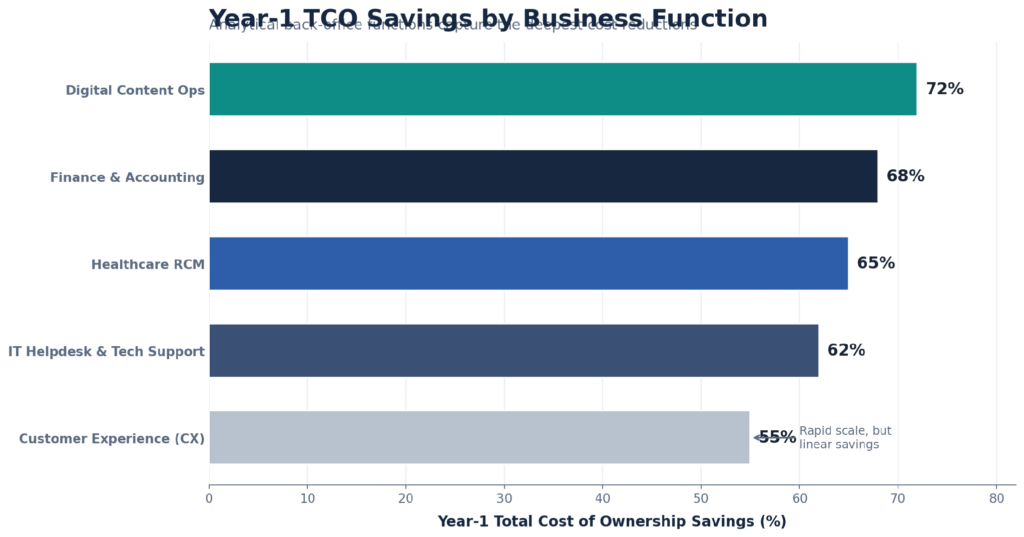
Figure 1. Year-1 total cost of ownership savings by business function.
Functions requiring rigid compliance pipelines, strict transaction cycles, and intensive data processing adapt most efficiently to offshoring — and each pairs a distinct cost profile with a primary performance metric, which is also what should drive the choice between FTE-, transaction- and outcome-based pricing.
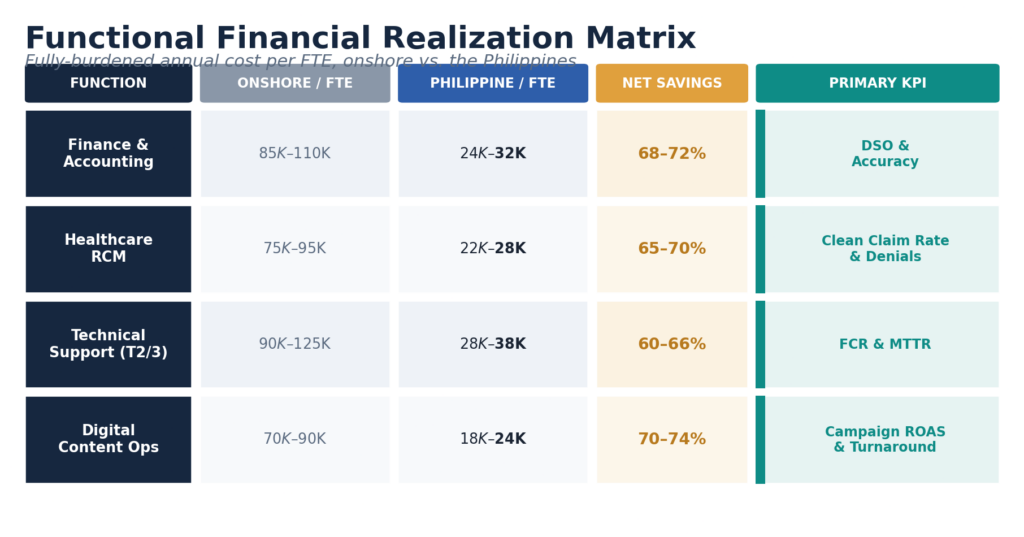
Figure 2. Fully-burdened cost per FTE, net savings, and primary KPI by function.
Finance & Accounting
Accounts payable and receivable, general ledger, and reconciliation work maps cleanly to offshore delivery, cutting fully-burdened cost sharply while improving Days Sales Outstanding and accuracy.
Healthcare Revenue Cycle Management
Medical coding, billing, and denial management draw on the large pool of licensed local professionals, delivering deep savings alongside higher clean-claim rates and stronger denial recovery.
Technical Support (Tier 2/3)
Infrastructure and sysadmin support tap engineering graduates for substantial savings, improving first-contact resolution and mean time to resolution on complex issues.
Why Do Back-Office Functions Deliver Compounding Returns, Not Just Linear Savings?
Front-office CX delivers immediate, linear savings on headcount, but the gains flatten. Analytical back-office operations compound: as teams optimize end-to-end workflows, lower error rates, and shorten transaction cycles, value keeps accruing well beyond the initial labor arbitrage — which is why they drive superior long-term margin expansion.
Voice-based customer service delivers fast, linear cost savings by shifting headcount. Analytical back-office operations behave differently: because degree-holding professionals continuously improve accuracy and cycle times, the return accelerates over time rather than plateauing.

Figure 3. Linear front-office savings versus compounding back-office returns over two years.
How Do Tailored Mid-Market Operators Prevent Early Value Erosion?
They deploy agile, dedicated operational pods that embed domain experts directly into the client’s existing workflows. By absorbing operational logic quickly, specialized mid-market providers compress the transition from a standard six months to under 90 days — accelerating positive cash flow and avoiding the compounding errors that erode early returns.
A primary risk in complex transformation is process degradation during transition. Large, generic providers often deploy rigid legacy training manuals that ignore an enterprise’s customized software environment and subtle workflow dependencies, extending onboarding and eroding early returns through compounding errors.
Mid-market Philippine providers counter this with dedicated pods that embed domain experts into existing workflows, absorbing operational logic fast. That specialization compresses the transition cycle to under 90 days, accelerating the path to positive cash flow, and it keeps turnover below the attrition rates common among BPO companies in the country.
“True optimization does not come from finding the lowest cost per hour; it comes from maximizing output per hour. When you transition complex functions like accounting or revenue cycle management to specialized mid-market teams in the Philippines, you aren’t just saving on labor. You are inserting highly motivated, degree-holding professionals into your processes who consistently improve accuracy and reduce transaction cycle times.”
— John Maczynski, CEO, PITON-Global
What Does a High-Return Transformation Look Like in Practice?
It restores liquidity fast. A multi-state healthcare group battling a high denial rate and billing backlog deployed a dedicated 30-FTE Philippine RCM team — cutting denials to a fraction of the prior rate within 120 days, reducing Days Sales Outstanding by 14 days, and delivering substantial annualized structural savings.
A multi-state healthcare provider group faced severe cash-flow constraints from an escalating billing backlog, high domestic turnover, and a high claim denial rate. Using an advisory-led model, it bypassed mass-market brokers and screened niche Manila operators with verifiable US healthcare compliance credentials, active HIPAA certifications, and specialized medical-coding practices.
The enterprise deployed a secure 30-FTE team to manage the end-to-end billing cycle, system-wide data clearing, and complex denial management — following a disciplined value-acceleration lifecycle.

Figure 4. The value acceleration lifecycle that compresses transition to under 90 days.

Figure 5. Denial-rate, liquidity, and cost outcomes of the deployment.
Lesson Learned
Isolating highly analytical, non-voice workflows and placing them with targeted providers avoids communication bottlenecks, ensures compliance, and protects critical financial metrics.
What Is PITON-Global and How Does It Guide Provider Selection?
PITON-Global is an elite, advisory-led outsourcing consultancy that removes execution risk and vetting delay from vendor selection. Acting as a strategic partner rather than a lead broker, it maps each enterprise’s software, regulatory, and scaling needs to a continuously audited network of 100+ specialized providers.
Who Is PITON-Global?
PITON-Global is a premium, advisory-led outsourcing consultancy that functions as a strategic partner to enterprise buyers, procurement executives, and corporate leadership, maintaining an exclusive, continuously audited network of more than 100 specialized providers across the Philippines.
How Does PITON-Global Differ From Traditional Outsourcing Brokers?
Rather than operating as a volume-driven lead broker, PITON-Global acts as a neutral strategic advisor. It aligns buyers with the right-fit provider instead of the highest bidder, removing the conflict of interest and hidden costs of mismatched partnerships.
How Does Its Network of 100+ Vetted Philippine BPO Providers Benefit Organizations?
The exclusive, continuously audited network of 100+ specialized call-center and back-office providers lets enterprises reach vetted, high-performing partners matched to their exact needs — minimizing procurement risk and time to a best-fit match.
How Does Its Advisory-Led Vendor Matching Process Work?
Through a diagnostic matching methodology, PITON-Global maps an enterprise’s software infrastructure, regulatory constraints, and long-term scaling targets directly to vetted providers — minimizing procurement risk and positioning organizations to capture maximum returns from day one.
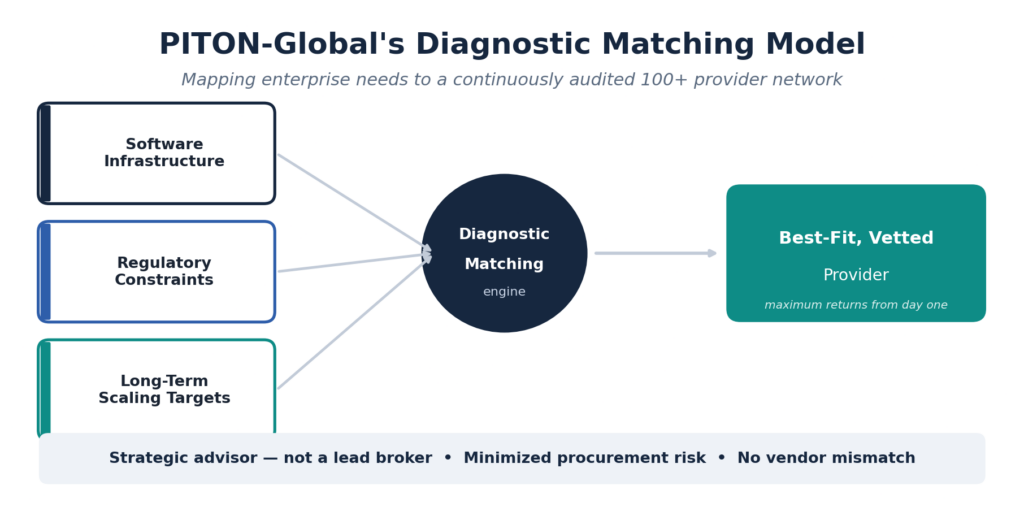
Figure 6. The diagnostic matching model, from enterprise needs to a best-fit provider.
Why Do Organizations Use PITON-Global?
Executive teams use PITON-Global to remove execution risk, eliminate the hidden costs of vendor mismatch, and shorten procurement — ensuring they partner with providers capable of capturing maximum operational returns from day one.
Frequently Asked Questions
Why does the Philippines excel in finance and accounting functions?
The country produces thousands of accounting graduates annually, aligns university curricula with IFRS and US GAAP, and maintains a strong institutional focus on corporate fiscal compliance.
What infrastructure secures sensitive financial workflows offshore?
Top-tier providers deploy isolated networks with multi-factor authentication, endpoint detection and response, data-loss-prevention protocols, and compliance architectures aligned with SOC 2 Type II.
How do voice roles compare to back-office analytics on long-term fiscal return?
Voice-based service delivers immediate, linear headcount savings, while analytical back-office operations drive higher compounding returns by optimizing end-to-end workflows and lowering error rates.
What pitfalls most often delay or damage outsourcing ROI?
The common failures are poorly defined processes, weak documentation, picking a vendor purely on low hourly rates, and inadequate management support during the first 90-day transition.
What scale justifies an offshore back-office program?
Benefits appear with teams as small as 5 FTEs, but peak efficiency and maximum return on overhead typically unlock when scaling to 15 or more dedicated positions.
How should data-security infrastructure be evaluated during selection?
Audit providers for native SOC 2 Type II compliance, ISO/IEC 27001 certification, and robust endpoint security protocols to eliminate financial exposure to data breaches.