

On this page
- Key Takeaways
- What Key Factors Drive Labor Cost Fluctuations in the Philippine BPO Sector?
- How Does Agent Attrition Impact Long-Term BPO Pricing Predictability?
- How Do Tier-1 and Secondary Delivery Locations Compare on Price Stability?
- What Financial Frameworks Safeguard Enterprise Contracts Against Inflation?
- What Does Financial Stabilization Through Vendor Alignment Look Like in Practice?
- What Role Does PITON-Global Play in Vetting a Vendor’s Financial Footing?
- Frequently Asked Questions
Evaluating labor cost stability among Philippine BPO companies requires analyzing fully loaded wage structures, regional talent saturation, agent attrition drag, and contractually enforced inflation hedges. The fully loaded rate is the unit of analysis, and what the loaded hourly rate actually contains — wage, statutory additions, overhead, margin — is where stability is either built in or missing. Enterprises must judge a provider’s ability to stay wage-competitive without passing unhedged overhead to the client, selecting delivery hubs with sustainable talent pipelines and structuring contracts with CPI indexation, open-book cost models, and currency corridors.
Key Takeaways
- Fully loaded rate vs. base wage gap: Top-line base salary quotes obscure a substantial layer of statutory additions, including mandatory night shift differentials, 13th-month pay, and Pag-IBIG, SSS, and PhilHealth employer contributions.
- The hidden financial drag of attrition: High annual agent turnover creates invisible per-seat costs every year in continuous recruitment, nested training, and degraded First Contact Resolution.
- Geographic arbitrage and wage inflation: Metro Manila carries a markedly higher labor inflation rate because of vendor density, whereas Tier-2 and Tier-3 hubs such as Cebu, Clark, Iloilo, and Bacolod offer flatter wage escalation profiles.
- Contractual and AI-driven controls: Indexing annual adjustments to the Philippine CPI and establishing FX currency corridors prevents unbudgeted seat-rate escalations, while real-time agent-assist tools lift transaction capacity to offset mandatory wage increases.
What Key Factors Drive Labor Cost Fluctuations in the Philippine BPO Sector?
Labor costs move with three forces: macro-economic and regulatory factors such as Regional Wage Board adjustments, the Consumer Price Index, and increases in SSS, PhilHealth, and Pag-IBIG contributions; statutory mandates including the night differential and 13th-month pay; and local market dynamics—attrition cycles, skill premiums, and the spread between Metro Manila and regional hubs. Together they lift base rates substantially.
Evaluating long-term BPO pricing predictability requires analyzing macro-economic regulations, statutory mandates, and hyper-localized wage competition across the Philippine archipelago. Labor cost trajectories are governed by regional economic conditions rather than national averages: the Regional Tripartite Wages and Productivity Boards (RTWPB) set localized minimum wage floors, so escalation differs between the National Capital Region and provincial hubs. The structural map below organizes the drivers a buyer must model.
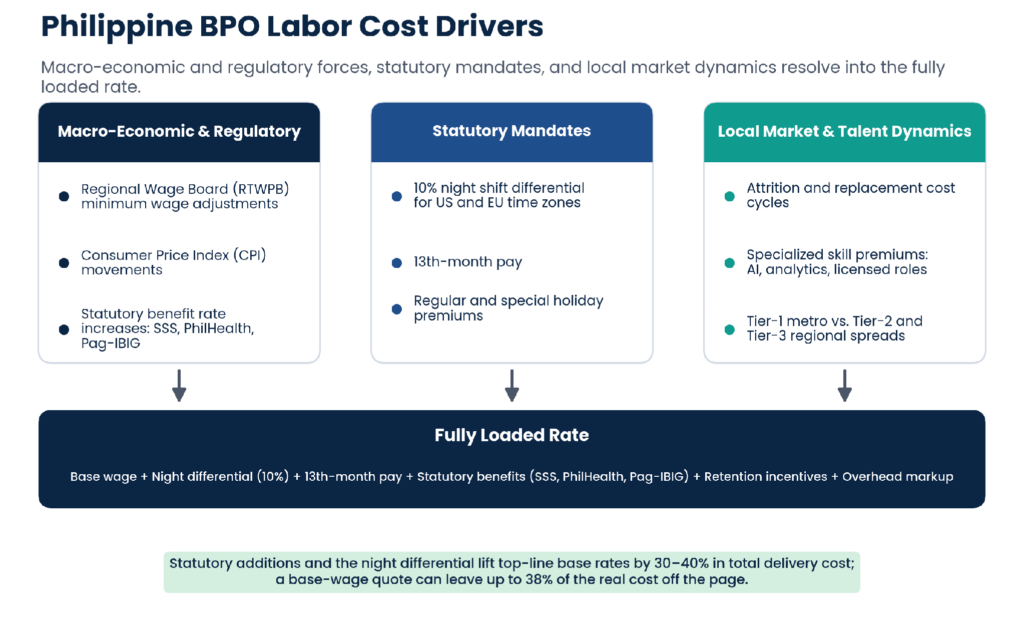
Figure 1. Structural map of Philippine BPO labor cost drivers—macro-economic and regulatory factors, statutory mandates, and local market dynamics—resolving into the fully loaded rate.
Enterprise buyers must evaluate the complete fully loaded labor equation: base wage, plus the night differential, plus 13th-month pay, plus statutory benefits (SSS, PhilHealth, Pag-IBIG), plus retention incentives, plus overhead markup. Employer contributions to SSS, Pag-IBIG, and PhilHealth undergo periodic statutory rate increases, and when they are combined with mandatory night differential pay for shifts serving North American and European time zones, top-line base rates rise materially in total delivery cost. A quote that shows only the base wage has left a large share of the real cost off the page.
How Does Agent Attrition Impact Long-Term BPO Pricing Predictability?
Agent turnover is the primary hidden driver of BPO budget variance. Once annual turnover runs high, indirect costs—recruitment spend on every replacement hire, new hires operating well below full efficiency for eight weeks, one trainer per 12 agents in nesting, and salary-compressing retention bonuses—degrade quality and margins. A low rate with high turnover routinely costs more over 36 months than a higher rate with turnover held low.
When a delivery center operates with high annual turnover, hidden indirect operational costs degrade program quality and erode financial margins. None of them appears on the rate card; all of them appear in the buyer’s results. The table below itemizes the four components and their long-term financial consequence.
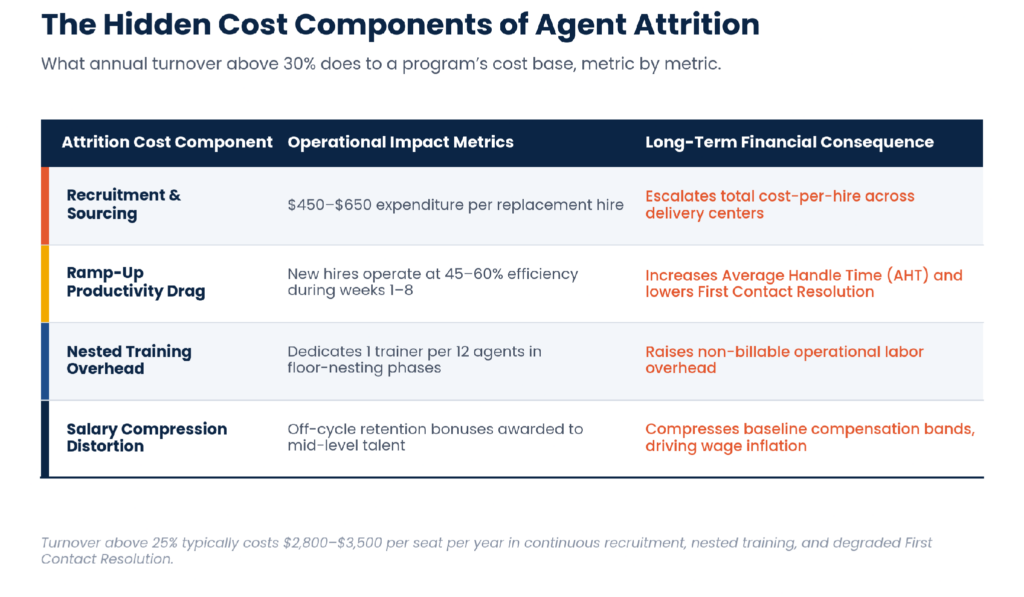
Figure 2. The four cost components of agent attrition, their operational impact metrics, and their long-term financial consequences.
The arithmetic is unforgiving. A vendor quoting a low initial hourly rate with a high annual turnover rate routinely proves more expensive over a 36-month period than a provider quoting a higher rate with turnover held low, once recruitment, ramp-up drag, quality degradation, and the emergency rate increases that follow wage compression are added, as the chart below illustrates.
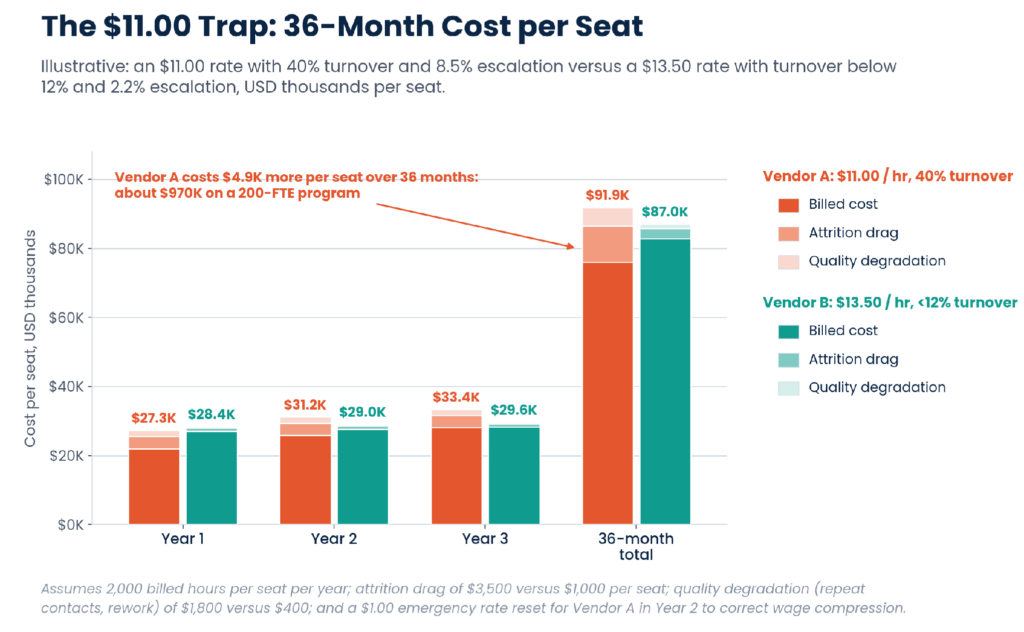
Figure 3. Illustrative 36-month cost per seat: a low rate with high turnover versus a higher rate with low turnover, including attrition drag and rate escalation.
Too many enterprise buyers treat labor costs as a static accounting entry rather than a dynamic operational variable. If your provider relies on systemic wage compression to keep initial seat rates low, you will pay for it through operational churn, degraded service quality, and emergency rate increases down the road. True cost stability is achieved when a vendor invests in retention architectures that keep experienced talent at the desk.
— John Maczynski, CEO, PITON-Global
How Do Tier-1 and Secondary Delivery Locations Compare on Price Stability?
Metro Manila offers the deepest specialized talent but the least stable cost, with vendor density driving poaching and the fastest annual wage escalation. Primary regional centers such as Cebu City and Clark combine moderate attrition with real estate well below NCR, and next-wave cities such as Iloilo, Bacolod, Davao, and Dumaguete pair the lowest turnover with the slowest annual wage growth.
Geographic distribution across the Philippine delivery ecosystem creates distinct labor cost and stability profiles, and the same regional logic applies to technical teams, as our 2026 blueprint for engineering outsourcing shows. Compounded over a three-year contract, the difference between Metro Manila’s escalation rate and a next-wave city’s is worth more than most rate-card negotiations, as the chart below shows.
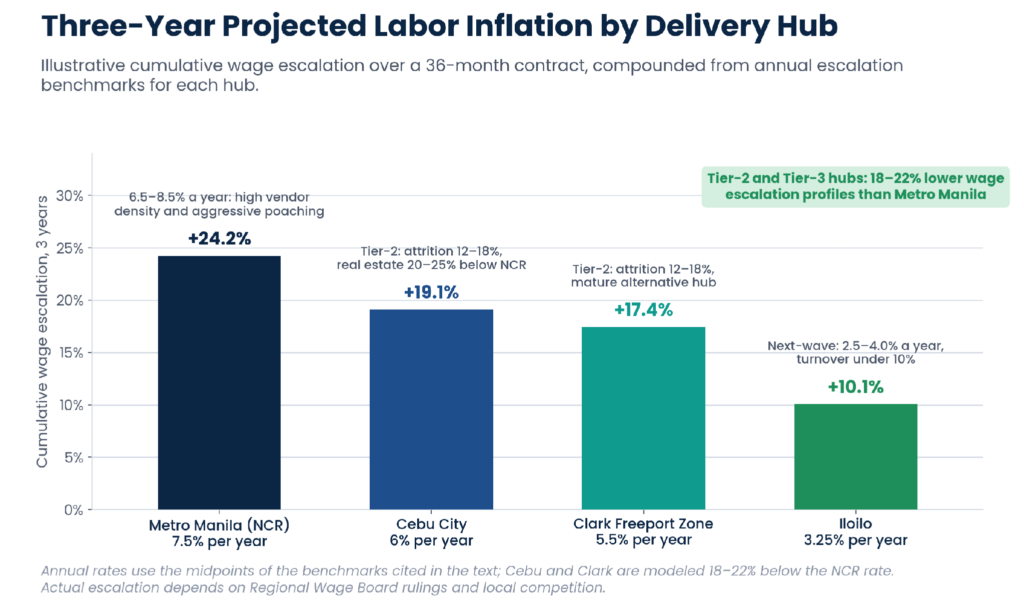
Figure 4. Three-year projected labor inflation across Metro Manila, Cebu City, Clark, and Iloilo (illustrative, compounded from annual escalation benchmarks).
Metro Manila (NCR)
Makati, BGC, Ortigas, and Quezon City offer the highest concentration of technical and specialized back-office talent. However, high vendor density drives aggressive poaching, resulting in the fastest annual wage escalation in the country and a labor inflation rate well above the national profile.
Primary Regional Centers (Cebu City, Clark Freeport Zone)
Mature alternative hubs featuring lower attrition rates and real estate overheads well below NCR levels, maintaining a balance between talent availability and price stability. For most 50–200 FTE customer experience and back-office programs, they are the stability sweet spot.
Next-Wave Digital Cities (Iloilo, Bacolod, Davao, Dumaguete)
Tertiary markets featuring highly loyal labor pools with the lowest turnover of any tier. Lower local living costs translate to slow, predictable annual wage growth, with Tier-2 and Tier-3 hubs together offering markedly flatter wage escalation profiles than Metro Manila.
What Financial Frameworks Safeguard Enterprise Contracts Against Inflation?
Four contractual controls protect against inflation: CPI-indexed rate adjustments capped at the Philippine Statistics Authority’s official CPI; symmetrical currency corridors in which the vendor absorbs movements inside the band and shares those outside it; open-book cost-plus auditing that separates statutory wage changes from discretionary markups; and gainsharing that lets AI-driven productivity offsets cushion statutory increases.
Enterprise procurement teams must implement dynamic contractual controls that account for baseline economic shifts while preventing arbitrary vendor margin expansion. The four mechanisms below work as a system: each one closes a gap the others leave open.
CPI-Indexed Rate Adjustments
Cap annual contract rate increases at the official Philippine Consumer Price Index published by the Philippine Statistics Authority, establishing an objective ceiling. A vendor whose costs genuinely rise faster than CPI must show why in the open-book review rather than simply invoicing it.
Symmetrical Currency Corridors
Establish a narrow USD/PHP or EUR/PHP exchange-rate band. Fluctuations within the corridor are absorbed by the vendor; movements outside the band trigger shared rate adjustments. Symmetry matters: when the peso weakens the buyer should benefit as readily as the vendor does when it strengthens.
Open-Book Cost-Plus Auditing
Require full transparency into base wages, statutory benefits, and facilities overhead to isolate legitimate statutory wage adjustments from discretionary vendor markups. Open-book terms also expose the wage compression that precedes emergency rate increases before it becomes the buyer’s problem.
Gainsharing and Productivity Offsets
Tie contract terms to automation and efficiency milestones. When vendor AI tools improve agent transaction speed—real-time agent-assist typically adds meaningful capacity—the resulting labor savings cushion against statutory wage increases rather than accruing solely to the provider. The framework below shows how the four controls combine in an annual review.
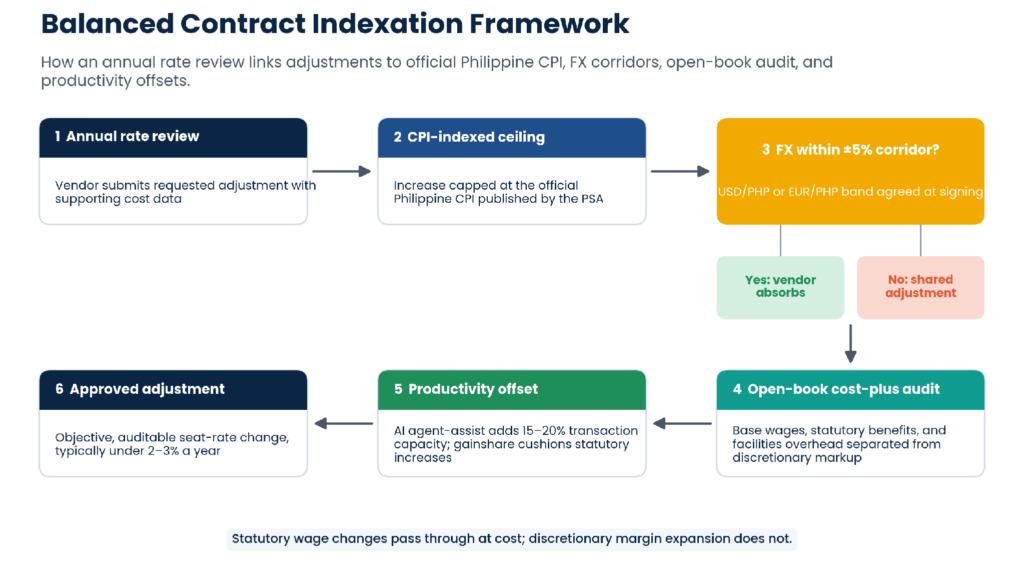
Figure 5. A balanced contract indexation framework linking annual rate adjustments to official Philippine CPI, FX corridors, open-book audit, and productivity offsets.
What Does Financial Stabilization Through Vendor Alignment Look Like in Practice?
Financial stabilization comes from vendor alignment, not rate negotiation. A Tier-1 North American financial services firm moved a 200-FTE Metro Manila program with runaway turnover and steep annual price increases to a specialized Cebu provider under a CPI-indexed open-book agreement, cutting turnover to a fraction of its prior level within eight months, saving a substantial sum annually, and holding adjustments to a small fraction of the previous escalation.
Client Challenge
A Tier-1 North American financial services firm faced steep annual contract price increases across a 200-FTE customer support program in Metro Manila, driven by uncurbed agent turnover that kept the program in permanent ramp and pushed the provider into repeated wage catch-up.
Vendor Selection
PITON-Global conducted an operational audit across its network of more than 100 Philippine BPO providers, isolating talent retention metrics, fully loaded cost structures, and delivery locations. The audit identified a specialized mid-market provider operating in Cebu City with a documented retention architecture.
Solution Implemented
The client transitioned the 200-FTE program to the Cebu delivery center under a transparent, CPI-indexed open-book agreement with a currency corridor. The provider deployed a skills-based career progression model and hybrid workspace options designed to keep experienced agents at the desk — the engagement levers our guide to building motivated contact-center teams sets out.
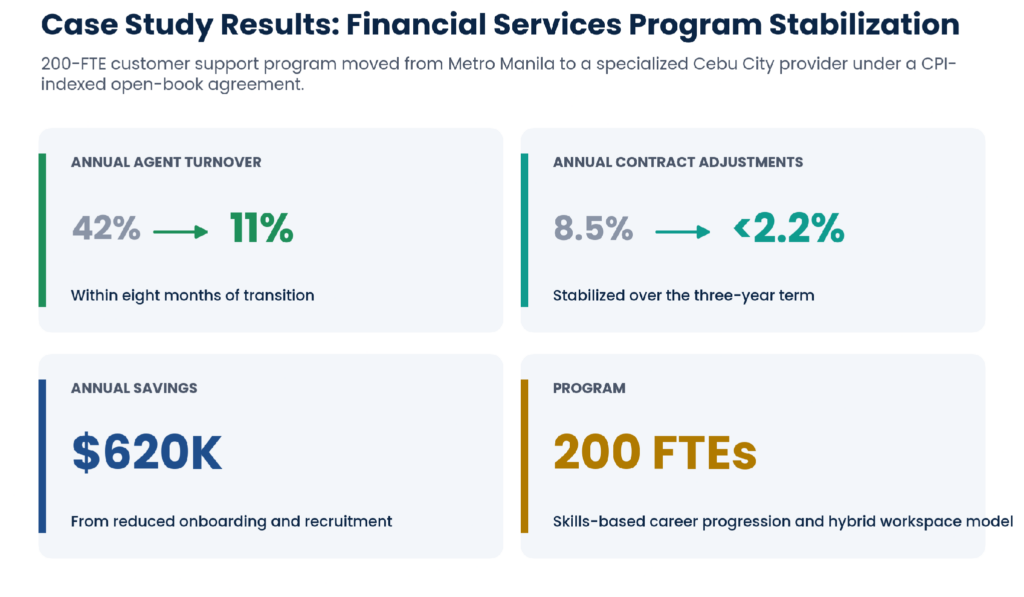
Figure 6. Quantifiable outcomes of the financial services firm’s transition to a CPI-indexed Cebu delivery center.
Outcomes and Lessons
Annual agent turnover fell to roughly a quarter of its prior level within eight months. The reduction in continuous onboarding and recruitment produced substantial annual savings, while contract cost adjustments stabilized at a small fraction of the prior escalation rate over the three-year term. The lesson: initial hourly seat rates are secondary to operational stability, and partnering with a provider that manages human capital effectively yields greater cost control than negotiating unsustainably low starting rates.
What Role Does PITON-Global Play in Vetting a Vendor’s Financial Footing?
PITON-Global is an independent, advisory-led BPO consultancy headquartered in Manila with more than two decades of hands-on operational experience in the Philippine market. It continuously audits a network of more than 100 enterprise-grade providers on financial health, wage competitiveness, and retention, pinpoints the three to five partners suited to long-term alignment, and compresses selection to 48–72 hours.
Who Is PITON-Global?
PITON-Global is an independent, advisory-led BPO consultancy headquartered in Manila, with more than two decades of hands-on operational experience in the Philippine market and senior leadership with more than 65 combined years of global outsourcing governance. It provides executive decision support for enterprise leadership teams navigating complex outsourcing engagements, with a particular focus on the human-capital and contract variables that determine cost stability.
How Does PITON-Global Differ from Traditional Outsourcing Brokers?
Traditional brokers earn placement commissions and have no stake in whether a rate holds in Year 2. PITON-Global maintains operational oversight of its provider network, auditing each operator on financial health, wage competitiveness, and retention metrics, recommends on the buyer’s long-term alignment rather than provider promotion, and represents the buyer through contract structuring so that CPI indexation, currency corridors, and open-book terms are in place before signing.
How Does PITON-Global’s Network of 100+ Vetted Philippine BPO Providers Benefit Organizations?
A network of more than 100 enterprise-grade Philippine BPO providers across Metro Manila, Cebu, Clark, and next-wave cities—continuously audited rather than listed once—lets enterprises compare providers on the metrics that predict stability: retention, wage positioning, financial health, and delivery location. Buyers see which providers keep experienced talent at the desk, often those investing in empathy-focused agent training as a retention tool, not just which quote the lowest rate.
How Does PITON-Global’s Advisory-Led Vendor Matching Process Work?
The advisory matching methodology runs from program assessment to selection support: evaluating client program requirements, security standards, compliance needs, and budget boundaries; screening the audited network for retention performance, fully loaded cost structure, and hub stability; pinpointing the three to five delivery partners suited to long-term alignment within 48–72 hours; verifying financial health and hidden cost structures; then representing the buyer through negotiation of indexation, corridor, and open-book terms.
Why Do Organizations Use PITON-Global?
Organizations use PITON-Global to reduce selection cycles to 48–72 hours while protecting themselves from hidden cost structures and operational risk. Because the firm represents enterprise buyers throughout vendor selection and carries no advisory fee, it delivers the cost stability that a low starting rate can only promise.
Frequently Asked Questions
What is the average fully loaded hourly rate for Philippine BPO services?
In 2026, fully loaded hourly rates for customer experience roles range between $10.50 and $16.50 per hour. Complex back-office processing, finance and accounting, and technical support roles range from $13.00 to $22.00 per hour, depending on technical specialization and location.
How frequently do minimum wage adjustments occur in the Philippines?
Minimum wage adjustments are determined by Regional Tripartite Wages and Productivity Boards (RTWPB) and typically occur once every 12 to 18 months in response to regional economic shifts and consumer price changes.
How do currency fluctuations impact USD-denominated BPO contracts?
When the Philippine peso depreciates against the U.S. dollar, vendors experience local margin relief; when the peso strengthens, vendor operating costs rise. Incorporating currency corridor clauses with symmetrical bands distributes FX volatility risk equitably.
Why do mid-market Philippine BPO providers often deliver greater price stability than mega-vendors?
Mid-market providers of 200–2,000 seats typically maintain lower administrative overhead and treat a 50–200 FTE account as core business. The result is direct executive oversight, customized retention strategies, and stable, transparent pricing models.
How do AI-assisted agent tools help stabilize BPO operational costs?
Integrating real-time AI copilots, automated call summarization, and predictive knowledge bases increases agent transaction capacity materially. This throughput gain offsets mandatory statutory wage inflation without increasing total seat count.