

On this page
- Key Takeaways
- What Are the Fundamental Operational Differences Between Dedicated and Shared BPO Models?
- How Do Cost Structures and TCO Compare Across Both Delivery Models?
- Which Model Best Fits Your Compliance, Security, and Quality Standards?
- What Does Restructuring Support with a Blended Model Look Like in Practice?
- Who Is PITON-Global and How Does Its Advisory Neutralize Outsourcing Risk?
- Frequently Asked Questions
Businesses should compare dedicated and shared-team models on volume predictability, workflow complexity, and management control alongside Total Cost of Ownership. Dedicated models offer superior security, process alignment, and lower hourly unit costs for high-volume operations, while shared models maximize cost efficiency for low-volume or variable workflows billed per ticket or per flex hour. Where the team sits is a separate question, covered in how outsourcing locations stack up.
Key Takeaways
- Dedicated Teams: Deliver maximum brand alignment, security compliance, and direct management control at the lowest fully loaded hourly rates for stable volume.
- Shared-Team Models: Eliminate unbilled seat burn for low-volume or sporadic workflows by billing purely on per-transaction or shared-hour metrics.
- Cost-per-resolution metrics: Reveal true financial efficiency, proving that cheaper shared-seat rates become expensive if handle times double or quality drops.
- Compliance and data segregation: Risks are significantly higher in shared environments, making dedicated FTEs mandatory for regulated industries such as healthcare and BFSI.
What Are the Fundamental Operational Differences Between Dedicated and Shared BPO Models?
Dedicated models assign exclusively allocated full-time staff at a fixed monthly cost per seat, handle high-complexity workflows under client-directed SOPs and QA, and isolate data on dedicated physical or virtual workstations. Shared models pool cross-trained agents across multiple clients, bill per ticket, per call, or per shared hour, suit standardized transactional work, and rely on vendor-managed queues with system-level partitioning.
Selecting between dedicated and shared-team structures is a different decision from the nearshore-versus-offshore location debate, and it requires understanding how vendor resources are allocated, governed, and billed in Philippine BPO operations. The table below compares the two models on the six operational metrics that matter most in a sourcing decision.
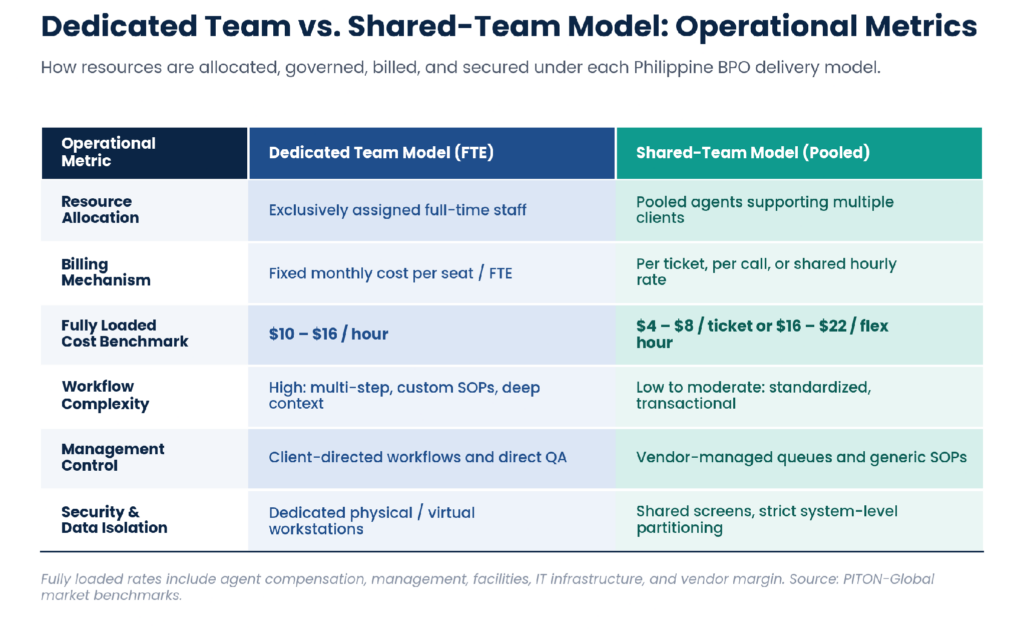
Figure 1. Operational metrics for the Dedicated Team (FTE) model versus the Shared-Team (pooled) model.
The difference is easiest to see as a resource map. In a dedicated model, a pod of agents lives inside one brand’s ecosystem—its systems, its SOPs, its quality program. In a shared model, cross-trained agents draw tasks from a centralized queue fed by several clients at once, as the diagram below shows.
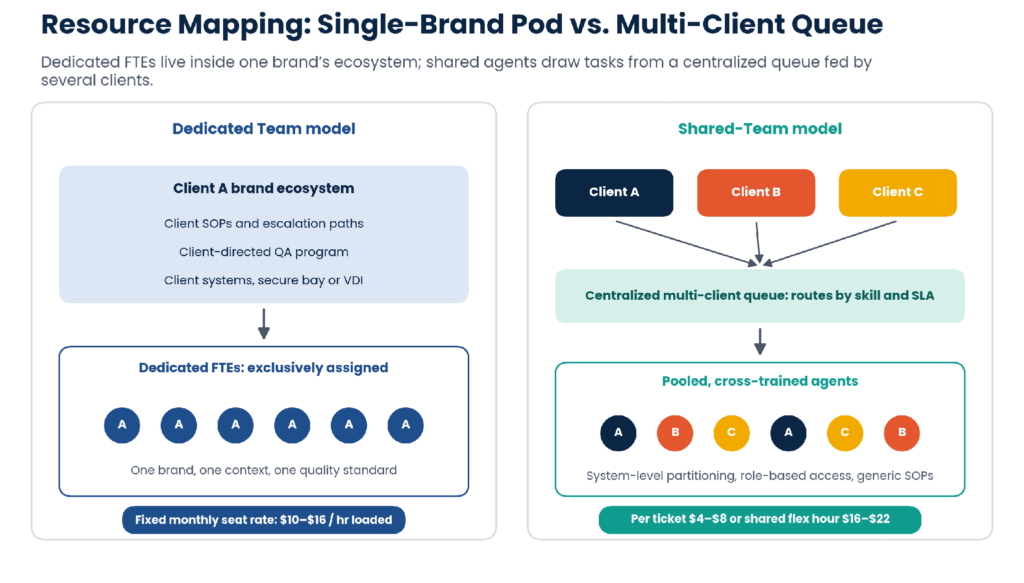
Figure 2. Resource mapping: dedicated FTEs assigned to a single brand ecosystem versus shared agents routing tasks from a centralized multi-client queue.
How Do Cost Structures and TCO Compare Across Both Delivery Models?
Total cost of ownership depends on capacity utilization and overhead, not headline rates. Dedicated TCO adds client-side management overhead and unbilled capacity burn to direct labor, and pays off above 160 hours per month per seat. Shared TCO adds quality control, rework, and queue management to a per-ticket rate that runs noticeably higher per contact but carries zero idle-time expense.
Evaluating total cost of ownership requires analyzing capacity utilization and operational overhead rather than headline bill rates. Each model has a cost the invoice never shows: the dedicated seat that sits idle in a trough, and the shared ticket that has to be reworked or escalated. The same unbundling discipline applies when you normalize competing vendor proposals line by line.
Dedicated Teams: Low Unit Economics with Unbilled Seat Exposure
Dedicated models lock in direct labor, management overhead, facilities, and technology at a fixed monthly cost per FTE. They deliver optimal economies of scale for volumes exceeding 160 hours per month per seat, and invoice amounts remain constant, which simplifies operational budgeting. The exposure is utilization risk: the buyer absorbs the financial burden of low queue volume, idle agent time, and seasonal dips.
Shared Teams: Transactional Flexibility with Variable Unit Costs
Shared models aggregate multiple client volumes across a centralized team of cross-trained agents. Buyers pay exclusively for active handling time, resolved tickets, or inbound contacts, which makes the model ideal for unpredictable spikes without paying for permanent bench strength. The trade-off is premium unit cost: on a per-minute or per-contact basis, handling costs run materially higher than dedicated agent equivalents. The chart below shows where the two cost curves cross.
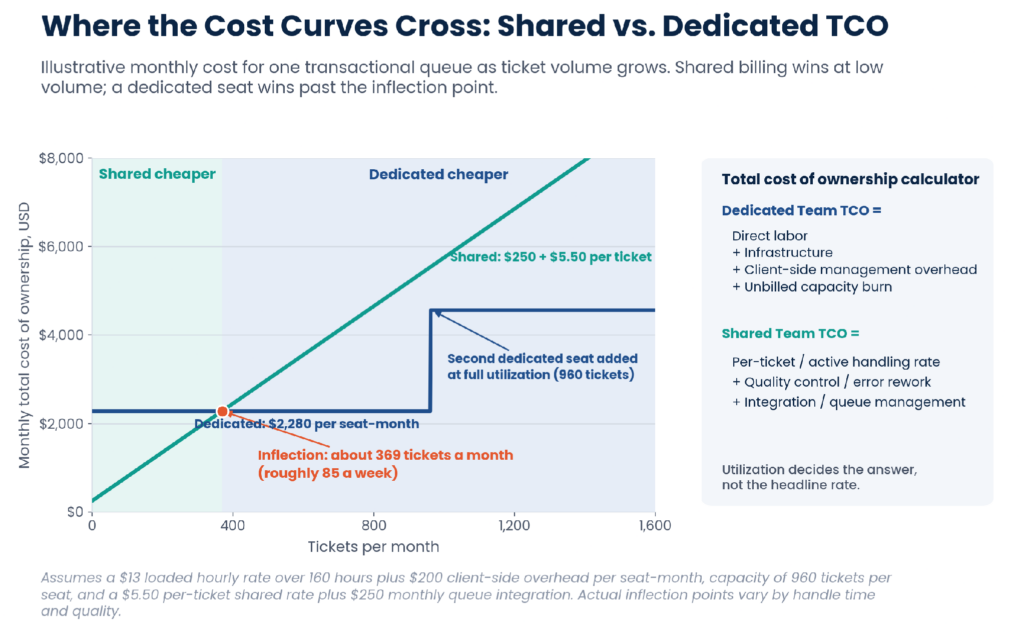
Figure 3. Illustrative monthly TCO curves: shared teams are cheaper at low ticket volumes until an inflection point where a dedicated FTE becomes more cost-effective.
Which Model Best Fits Your Compliance, Security, and Quality Standards?
Regulated and high-touch work belongs in dedicated teams. Dedicated agents operate in isolated bays or secure VDI environments that satisfy PCI DSS and HIPAA, absorb brand voice and escalation nuance, and show lower attrition in secondary hubs such as Cebu, Iloilo, and Clark. Shared teams handle multi-tenant data under role-based access controls, rely on standardized scripts, and run higher attrition.
Data security, regulatory compliance, and brand representation dictate engagement suitability. Three factors decide the question before cost enters the discussion.
Information Security and PCI DSS/HIPAA
Dedicated teams operate in isolated bays or secure virtual desktop environments with zero clean-desk ambiguity, which is why dedicated FTEs are effectively mandatory for regulated industries such as healthcare and BFSI. Shared teams handle multi-tenant data, requiring strict role-based access controls and partitioned software environments—robust for standard data, but harder to evidence to an auditor.
Brand Voice and Contextual Nuance
Dedicated agents absorb company culture, product nuances, and specialized escalation pathways. Shared agents rely on standardized scripts and knowledge bases, which limits their ability to resolve complex, unstructured customer problems and shows up in customer effort scores. Cultural fit with North American customers matters in both models, a theme explored in our look at the Philippines and India as call-center rivals.
Quality Assurance and Attrition
Dedicated teams in secondary Philippine hubs such as Cebu, Iloilo, and Clark report markedly lower attrition than shared-pool environments, driving higher long-term process retention. The decision flowchart below turns these factors, plus volume and budget, into a structured choice.
The biggest mistake procurement teams make is putting complex, high-touch workflows into a shared-agent environment to save on initial setup costs. If an agent shifts between three different brand scripts in an hour, brand context collapses, handle times spike, and customer churn eradicates your arbitrage.
— John Maczynski, CEO, PITON-Global
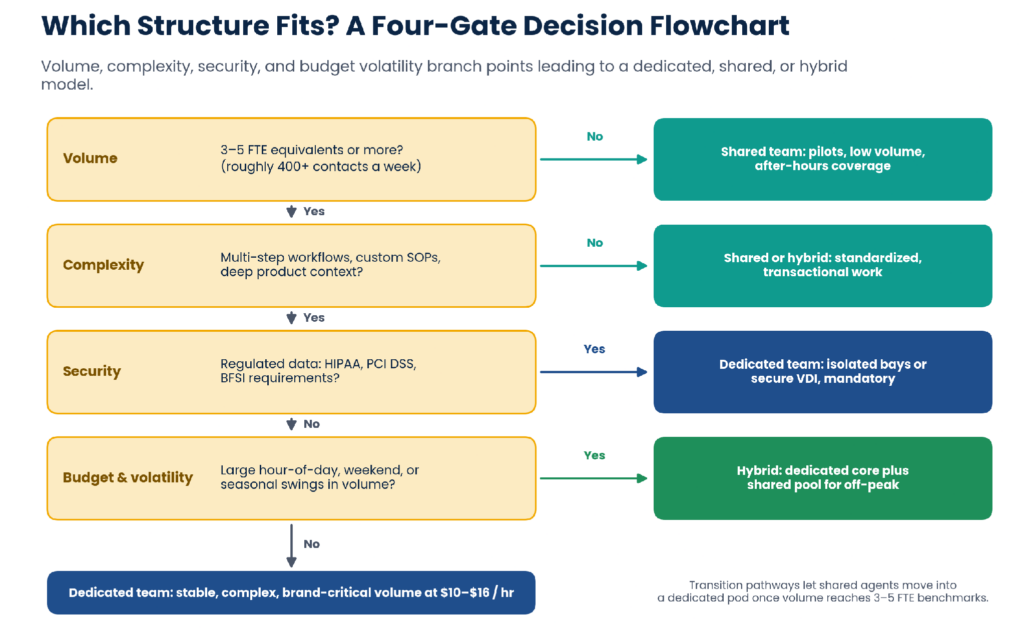
Figure 4. Decision flowchart: volume, complexity, security, and budget branch points leading to a dedicated, shared, or hybrid structure.
What Does Restructuring Support with a Blended Model Look Like in Practice?
Restructuring with a blended model matches each workload to the right structure. A fast-growing B2B SaaS platform replaced a shared-team agreement with 12 dedicated FTEs for complex weekday tier-2 queries backed by a shared managed pool for off-hours and weekend tier-1 coverage, cutting handling costs materially versus a fully dedicated 24/7 setup and lifting tier-2 first contact resolution substantially.
Client Challenge
A B2B SaaS platform experienced rapid growth but struggled with volatile ticket patterns—heavy weekday tier-1 support combined with minimal weekend volume. Its initial shared-team BPO agreement caused elevated customer effort scores because generic agent responses could not resolve complex product issues.
Vendor Selection
Working with PITON-Global, the client evaluated mid-market providers in Metro Manila and Cebu. PITON-Global structured an RFP targeting operators with specialized technical support pools and hybrid model infrastructure, so that both halves of the workload could be served by one accountable provider.
Solution Implemented
PITON-Global designed a hybrid staffing model featuring 12 dedicated FTEs for complex weekday tier-2 technical queries, backed by a shared managed pool for off-hours and weekend tier-1 queue coverage, with SLAs set separately for each ticket priority.
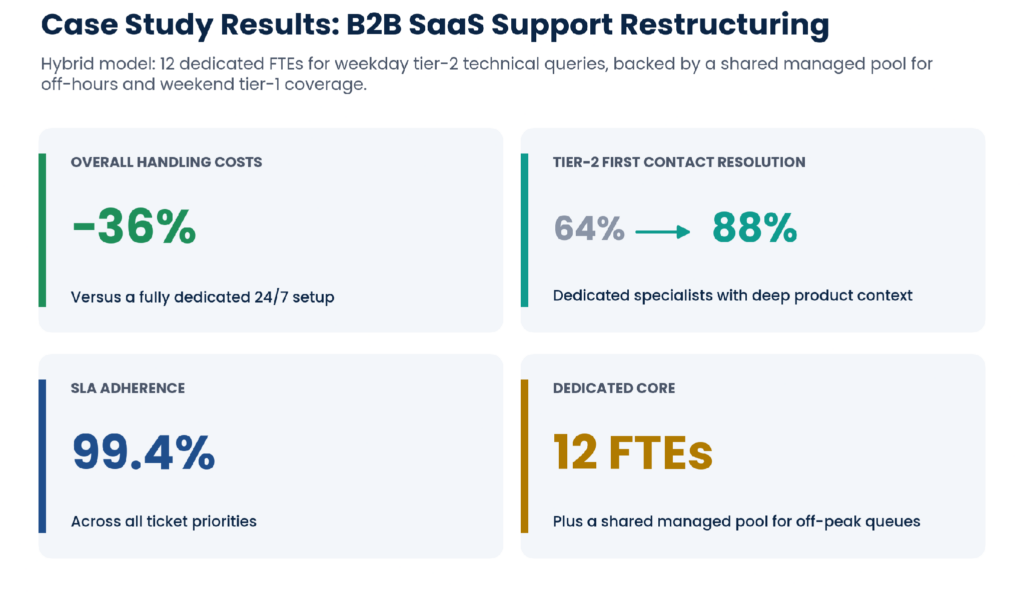
Figure 5. Quantifiable outcomes of the SaaS platform’s hybrid dedicated-and-shared support model.
Outcomes and Lessons
Overall handling costs fell sharply compared with a fully dedicated 24/7 setup. First Contact Resolution for tier-2 issues rose substantially, and the program held SLA adherence high across all ticket priorities. The lesson: blending dedicated expertise for core processes with shared pools for off-peak coverage balances cost management with service quality.
Who Is PITON-Global and How Does Its Advisory Neutralize Outsourcing Risk?
PITON-Global is an independent BPO advisory and vendor-matching consultancy based in Manila, led by executive operators with over 65 years of global outsourcing governance. Operating as a vendor-neutral advisor, it filters more than 1,000 Philippine BPOs down to the strongest operators for each client’s industry and scale, and negotiates dedicated, shared, or hybrid pricing structures at zero cost to buyers.
Who Is PITON-Global?
PITON-Global is an independent BPO advisory and vendor-matching consultancy based in Manila, Philippines, led by executive operators with more than 65 years of combined global outsourcing governance. It helps enterprise buyers evaluate, select, and negotiate with Philippine service providers, starting with the question this article addresses: which delivery model the workload actually needs.
How Does PITON-Global Differ from Traditional Outsourcing Brokers?
Traditional outsourcing brokers push the structure and the provider that pay them. PITON-Global operates as a vendor-neutral advisor: it evaluates client requirements against verified delivery benchmarks, security certifications such as SOC 2 Type II and ISO 27001, attrition rates, and actual client performance data, recommends on the buyer’s outcomes rather than provider promotion, and stays engaged through contract governance.
How Does PITON-Global’s Network of 100+ Vetted Philippine BPO Providers Benefit Organizations?
PITON-Global filters more than 1,000 Philippine BPOs to match clients with the top tier of operators tailored to their industry and scale. Because the network is already segmented by capability—dedicated pods with secure bays for regulated work, shared pools with disciplined partitioning for transactional volume, and providers with the infrastructure to run both—buyers see only operators that can execute the recommended model.
How Does PITON-Global’s Advisory-Led Vendor Matching Process Work?
The process runs from operational audit to contract governance: auditing call volumes, ticket complexity, SOP maturity, and security requirements; recommending the dedicated, shared, or hybrid model the workload needs; data-driven matchmaking against verified benchmarks and certifications; then negotiating the pricing structure with model transition pathways and no hidden operational charges.
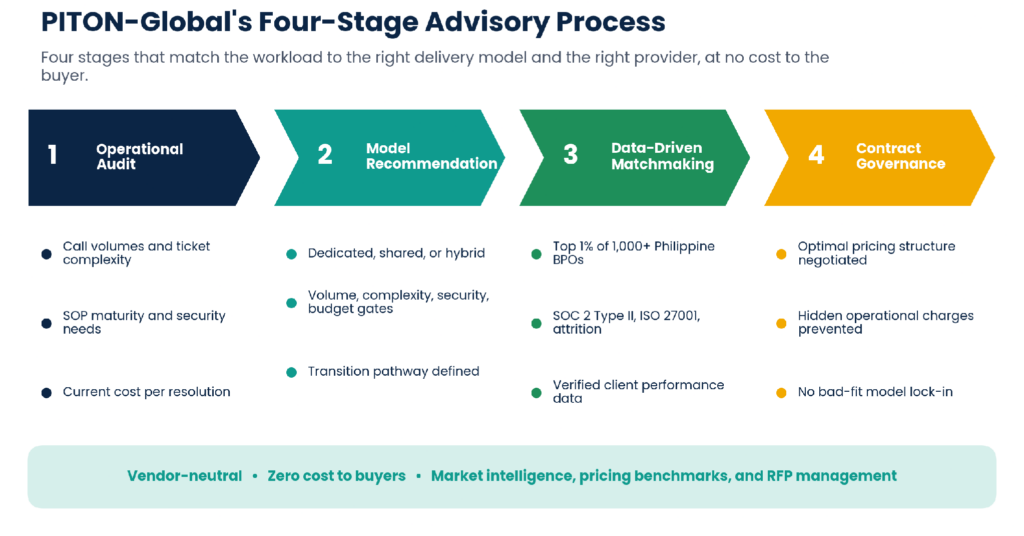
Figure 6. PITON-Global’s four-stage advisory process, from operational audit to contract governance.
Why Do Organizations Use PITON-Global?
Organizations use PITON-Global for market intelligence, pricing benchmarks, and RFP management delivered at no cost to the buyer, and for contract governance that prevents hidden operational charges and bad-fit model lock-in. The result is a delivery model that fits the workload and a provider that can run it.
Frequently Asked Questions
What is the average fully loaded hourly rate for dedicated BPO agents in the Philippines?
Fully loaded rates for dedicated customer support and back-office agents in the Philippines sit well below onshore equivalents, with the exact figure set by role, site, and volume. Specialized technical, financial, or engineering roles price higher, and quoted rates are inclusive of direct salaries, management, facilities, IT infrastructure, and vendor margin.
When is a shared-team model the correct operational choice?
A shared-team model is ideal for early-stage pilots, low-volume processes of under 100 contacts per week, simple transactional tasks, or after-hours coverage where dedicated seats would sit idle for long periods.
Can we transition from a shared model to a dedicated team as volume grows?
Yes. Most well-structured Philippine BPO contracts include model transition pathways, allowing organizations to migrate high-performing shared agents into a dedicated pod once volume reaches 3 to 5 full-time equivalent benchmarks.
How do BPOs protect data security in a shared-team environment?
Reputable BPOs enforce system-level data partitioning, strict role-based access controls, disabled peripheral hardware, clean-desk physical enforcement, and encrypted VDI sessions to prevent cross-client data exposure.
How does PITON-Global ensure we select the right delivery model?
PITON-Global conducts an operational audit of your call volumes, ticket complexity, SOP maturity, and security requirements to recommend the optimal engagement model, then matches you with vetted Philippine providers specialized in that structure.