

On this page
- Key Takeaways
- How Do You Normalize Commercial Rate Cards Across Competing Proposals?
- What Operational Metrics Best Reveal Vendor Execution Capability?
- How Should Statutory Labor and Compliance Obligations Be Audited?
- What Does a Complete Evaluation Sequence Look Like End to End?
- What Does a Rigorous Proposal Comparison Deliver in Practice?
- Why Do Enterprise Buyers Rely on PITON-Global to Reduce Outsourcing Risk?
- Frequently Asked Questions
Enterprises must compare competing BPO proposals in the Philippines by evaluating normalized fully loaded cost structures, verifying production-level operational metrics, auditing statutory labor compliance, and testing technological integration capabilities. Evaluating unbundled rate cards alongside SLA-linked penalty-and-reward mechanisms ensures financial alignment while mitigating delivery risk. The same discipline applies one level up, when comparing offshore and nearshore destinations before any bid is invited.
Key Takeaways
- Normalize commercial structures. Convert flat-rate proposals into unbundled cost-plus models to isolate base wages, statutory benefits, infrastructure overhead, and provider margin.
- Audit production metrics, not sales metrics. Separate marketing claims from account-level operational data: frontline attrition, handle times, shrinkage, and first contact resolution.
- Verify Philippine statutory compliance. Confirm pricing funds mandatory DOLE obligations including 13th-month pay, PhilHealth, SSS, Pag-IBIG, and the night shift differential.
- Evaluate tech stack integration. Assess whether the CCaaS platform, security architecture, and AI tooling integrate with internal systems without hidden licensing fees.
- Stress-test SLA remediation terms. Demand a clear credit-and-earn-back framework that protects budget while driving continuous operational recovery.
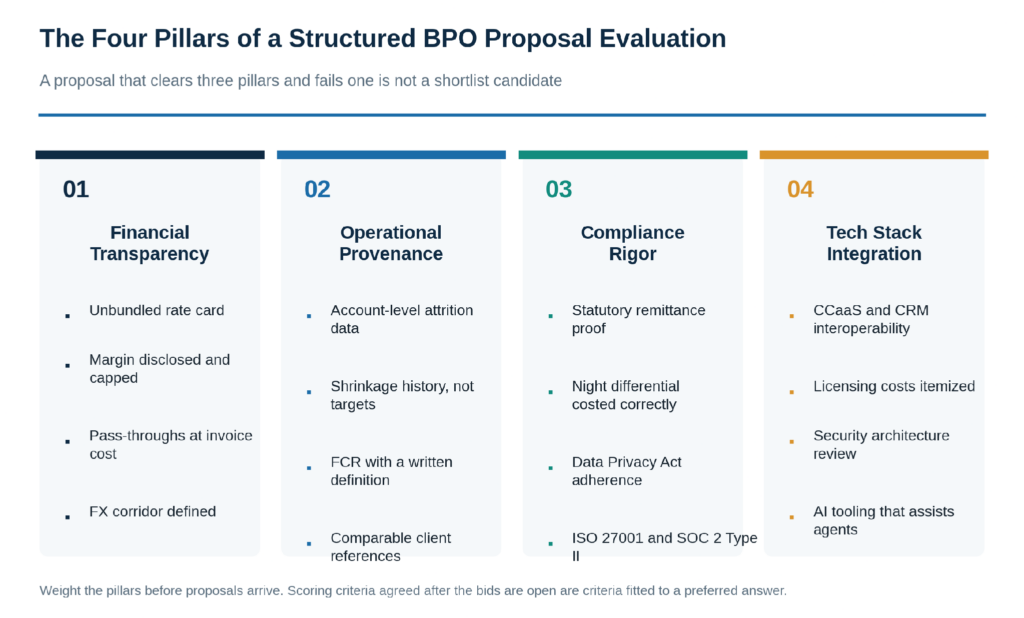
Figure 1. The four pillars of a structured BPO proposal evaluation, with the specific evidence each pillar requires.
How Do You Normalize Commercial Rate Cards Across Competing Proposals?
Restate every bid into a single commercial matrix that isolates base agent compensation, statutory contributions, technology and overhead, provider margin, and FX treatment. Until proposals sit on one fully loaded, productive-hour basis, the spread between them reflects differing assumptions rather than differing cost.
Comparing proposals on headline hourly rate produces misleading financial projections. One Philippine vendor may propose a flat hourly rate well above a rival’s bid. Without unbundling, procurement cannot tell whether the lower bid represents genuine operational efficiency, a leaner overhead structure, or wage compression that will surface as attrition in month seven. All three produce the same number on a summary sheet.
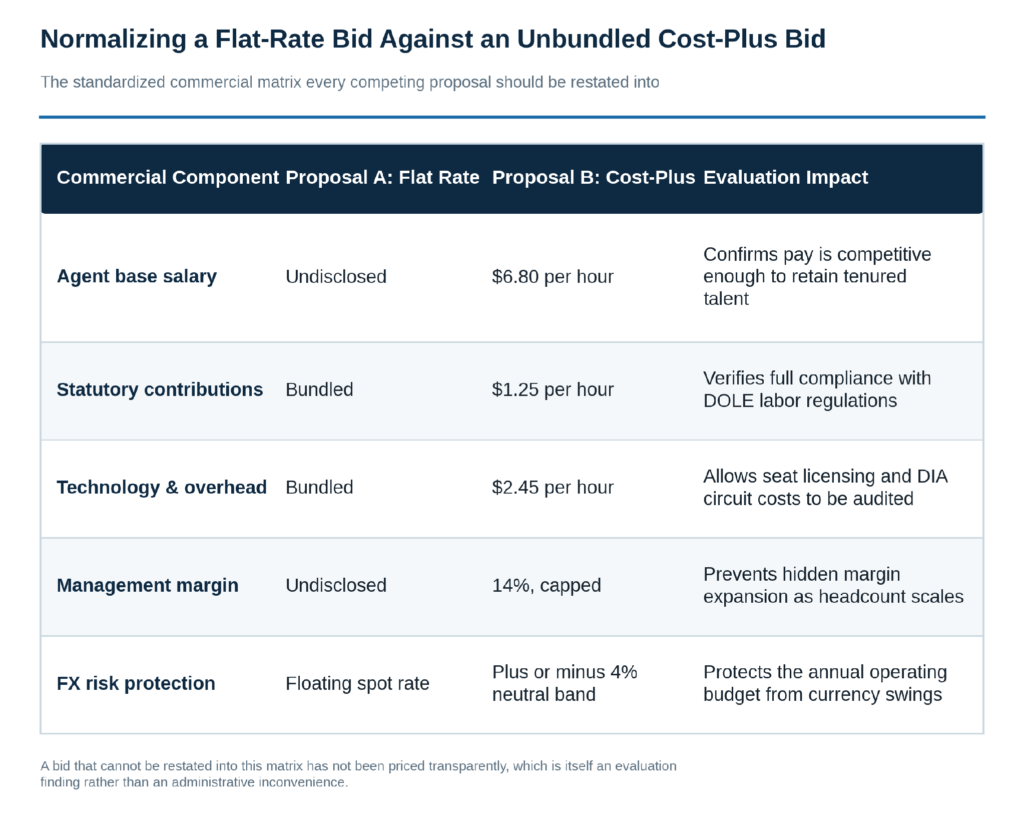
Figure 2. The standardized commercial matrix used to restate a flat-rate bid alongside an unbundled cost-plus bid.
Fix the Unit Before Comparing the Numbers
Normalization starts with the billing unit. A rate quoted on paid hours includes breaks, training, coaching, and paid leave; the same rate quoted on productive hours does not. With typical shrinkage levels, identical underlying cost can appear far apart depending only on that choice. Build one comparison sheet stating, for each bidder: the billing unit, assumed shrinkage, monthly paid hours per FTE, whether training and coaching hours are billable, and the assumed span of control.
Expect the Ranking to Change
The practical value of normalization is that it reorders the field. Bids that omit night differential funding or assume a thinner supervisory ratio move up once those costs are added back; bids that bundled licenses their competitors excluded can move down. A procurement team that skips this step is not choosing the cheapest provider — it is choosing the provider that left the most out of its proposal.
What Operational Metrics Best Reveal Vendor Execution Capability?
Account-level production data, not pitch-deck averages. Request 90-day and 12-month voluntary attrition for comparable accounts, historical planned and unplanned shrinkage, first contact resolution with its written definition, and handle time paired with repeat-contact rate. High-performing Philippine centers keep total shrinkage low and can document it.
Sales decks display ideal scenarios by design, often leaning on country-level strengths such as language and culture rather than account data. Evaluating a proposal means inspecting what the provider actually delivers on accounts that resemble yours in channel mix, complexity, and coverage hours. Request the data under NDA during evaluation rather than after award; a provider unwilling to share account-level figures at the point of maximum competitive pressure will not become more transparent once contracted.
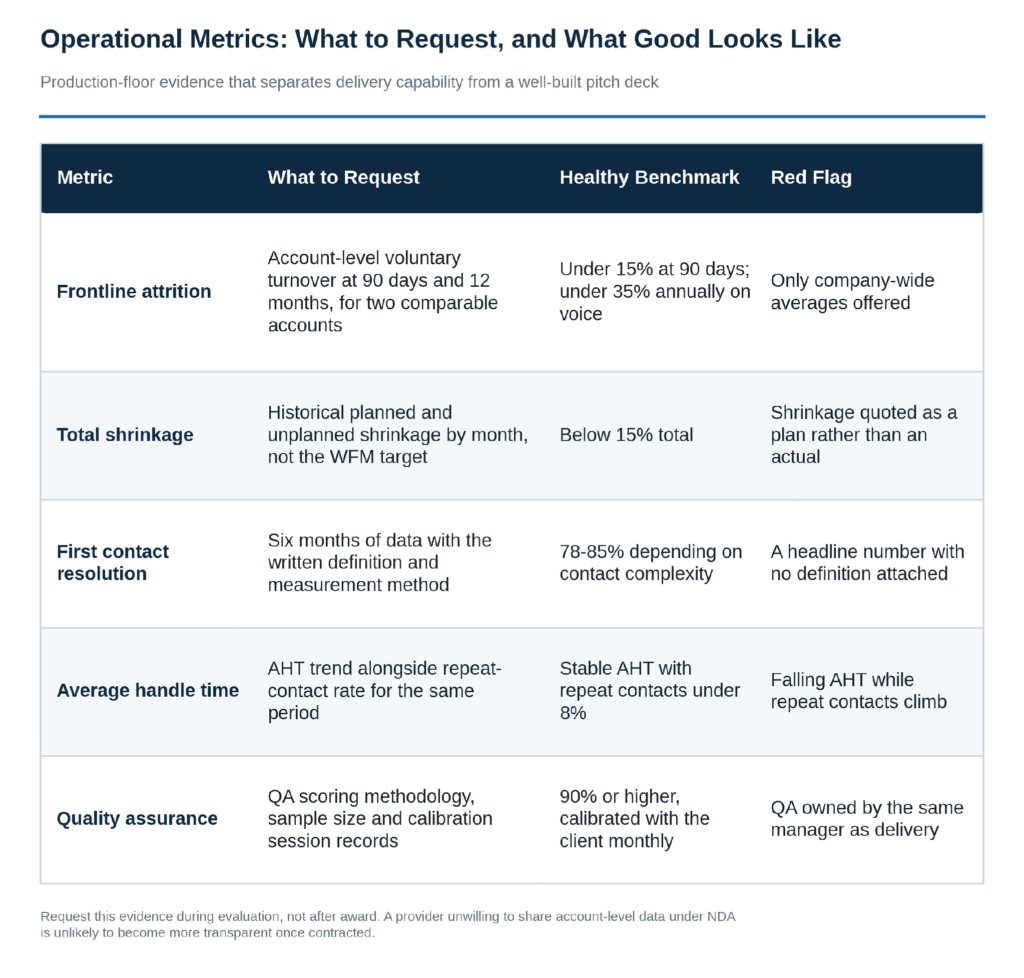
Figure 3. Operational metrics to request during evaluation, the healthy benchmark for each, and the red flag that should stop the shortlist.
Frontline Attrition
Examine both 90-day and 12-month voluntary turnover. Early attrition exposes recruitment and onboarding quality; annual attrition exposes compensation and career pathing. A vendor with a low hourly rate and high annual turnover will transfer significant hidden replacement and retraining cost back to the buyer, arriving as service inconsistency rather than as an invoice line.
Agentic AI and Workflow Integration
Evaluate how the vendor layers automation with human specialists rather than how much headcount it claims to replace. The useful question is what happens to the residual queue: as routine contacts are automated, the human workload becomes harder and more judgement-intensive, so per-interaction rates built on a pre-automation contact mix will understate the cost of what remains. Ask to see containment rate alongside post-containment escalation and CSAT.
Shrinkage and Attendance Standards
Review historical planned and unplanned shrinkage rather than the workforce management target. Low, stable total shrinkage indicates disciplined scheduling and steady attendance; high figures, or a provider that cannot separate planned from unplanned, signal that the billed headcount and the productive headcount are not the same number.
Comparing BPO proposals purely on hourly rates is the single fastest way to derail an outsourcing initiative. True cost optimization happens when you normalize the rate card, inspect production floor metrics, and ensure frontline talent is compensated well enough to stick around for the long haul.
— John Maczynski, CEO, PITON-Global
How Should Statutory Labor and Compliance Obligations Be Audited?
Reconcile proposed base rates against regional prevailing wages, require proof of quarterly statutory remittances for existing operations before signature, and verify data protection posture under the Philippine Data Privacy Act alongside ISO 27001 and SOC 2 Type II evidence.
The Philippine BPO sector operates under labor rules enforced by the Department of Labor and Employment: SSS, PhilHealth, and Pag-IBIG contributions, 13th-month pay mandated under Presidential Decree 851, and a mandatory night shift differential for work between 10:00 p.m. and 6:00 a.m. Lowball proposals frequently reach their price by underfunding or omitting these obligations, which transfers legal, operational, and reputational exposure to the buyer.
Direct Wage Reconciliation
Confirm that proposed base rates meet or exceed regional prevailing wages for the specific skill set in Manila, Cebu, or Clark. Wage floors are set regionally and move on their own cycle — Metro Manila’s non-agricultural daily minimum rose to ₱755 on 25 July 2026 and reaches ₱780 in January 2027 — so a rate that clears the floor today may not clear it in the second contract year. Ask each bidder how statutory increases will be handled and whether they flow through at documented cost.
Statutory Contribution Proof
Require government remittance schedules for existing operations before contract execution, not attestations. Attestation confirms the vendor understands its obligations; receipts confirm it meets them. Make quarterly verification an ongoing audit right rather than a one-time procurement check.
Data Security and Privacy
Verify compliance with the Philippine Data Privacy Act of 2012, ISO 27001 certification, and a current SOC 2 Type II report where sensitive customer data is handled. Read the SOC 2 exceptions rather than the cover page, and confirm the scope covers the specific site and service that will run your program.
What Does a Complete Evaluation Sequence Look Like End to End?
Five stages across three to six weeks: lock the scope, the billing unit, and the dedicated or shared delivery model before bids are invited, normalize every proposal onto one basis, verify production metrics for comparable accounts, review compliance and security evidence, then complete reference calls, site validation, and integration testing before selection.
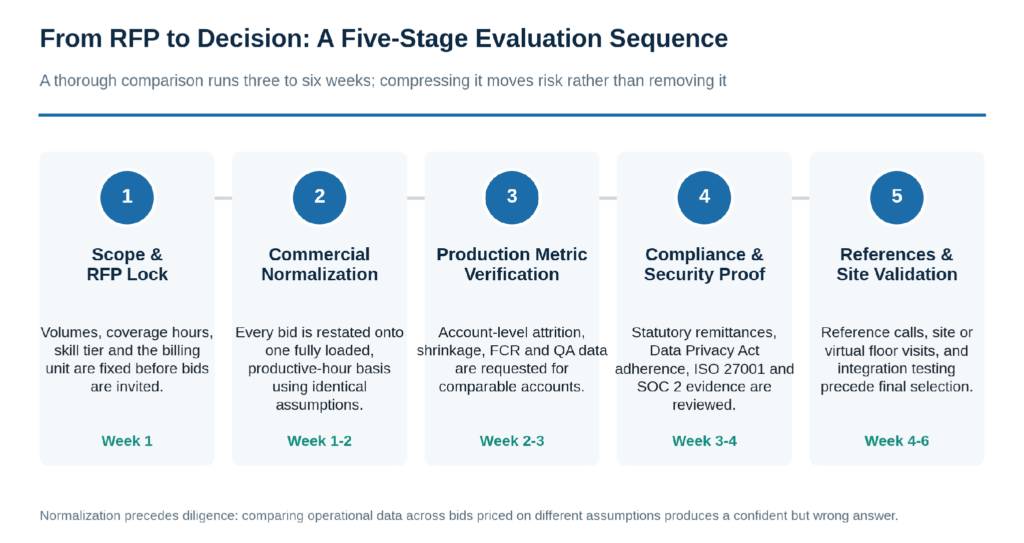
Figure 4. The five-stage evaluation sequence from RFP lock to final selection, with indicative timing.
Sequence matters as much as content. Normalization has to precede operational diligence, because comparing attrition and shrinkage data across bids priced on different assumptions produces a confident but wrong conclusion — the provider with the best-looking metrics may simply be the one that scoped a lighter workload. Equally, the scoring weights should be agreed before bids are opened. Criteria set afterwards tend to be criteria fitted to a preferred answer.
What Does a Rigorous Proposal Comparison Deliver in Practice?
A US FinTech migrating 80 support and fraud prevention seats received five bids spread widely on hourly rate. Normalization showed the lowest bid was the third most expensive once omitted statutory funding was added back. The selected provider delivered meaningful savings, strong retention, and a clear CSAT gain.
Client Challenge
A fast-growing US FinTech platform needed to migrate 80 customer support and fraud prevention seats to the Philippines. Five competing proposals arrived with hourly rates spread far apart on ostensibly the same scope, which made it impossible to tell whether the variance reflected delivery quality, compliance posture, or simply what each bidder had chosen to include.
Audit and Vendor Selection
PITON-Global normalized all five proposals onto a single fully loaded basis. The audit found that the lowest bidder reached its headline rate by misclassifying night shift differentials and underfunding mandatory benefits — an approach that would have produced turnover exposure within the first year and left the client carrying compliance risk it had not priced. Candidates were then evaluated across a network of more than 100 vetted Philippine providers to identify partners already operating under fully unbundled, compliant models.
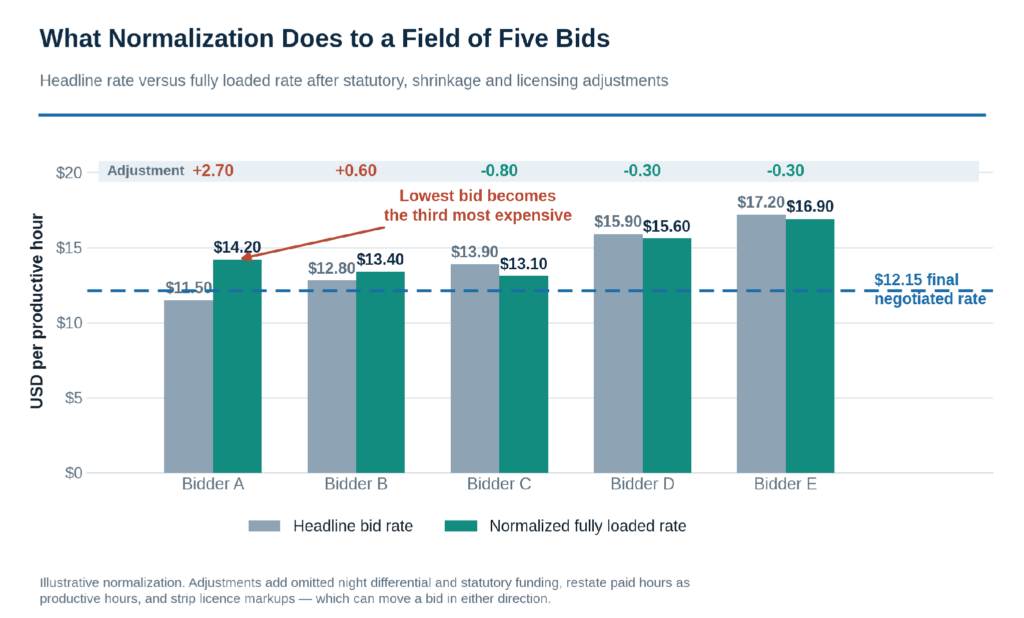
Figure 5. What normalization does to a field of five bids: the headline ranking and the fully loaded ranking are not the same order.
Solution Implemented
The client selected an enterprise-grade Manila provider on an unbundled cost-plus model: direct agent base pay, statutory benefits billed as a net pass-through, a separate technology fee, and a capped management margin, each quoted as its own hourly line. Every pass-through item was named individually and billed against original invoices.
Quantifiable Business Outcomes
- Clear overall savings against original US operating costs, achieved without reducing the direct wage allocation.
- High annual agent retention across the first twelve months of steady-state delivery.
- A marked CSAT gain within 90 days of launch, sustained through the first year.
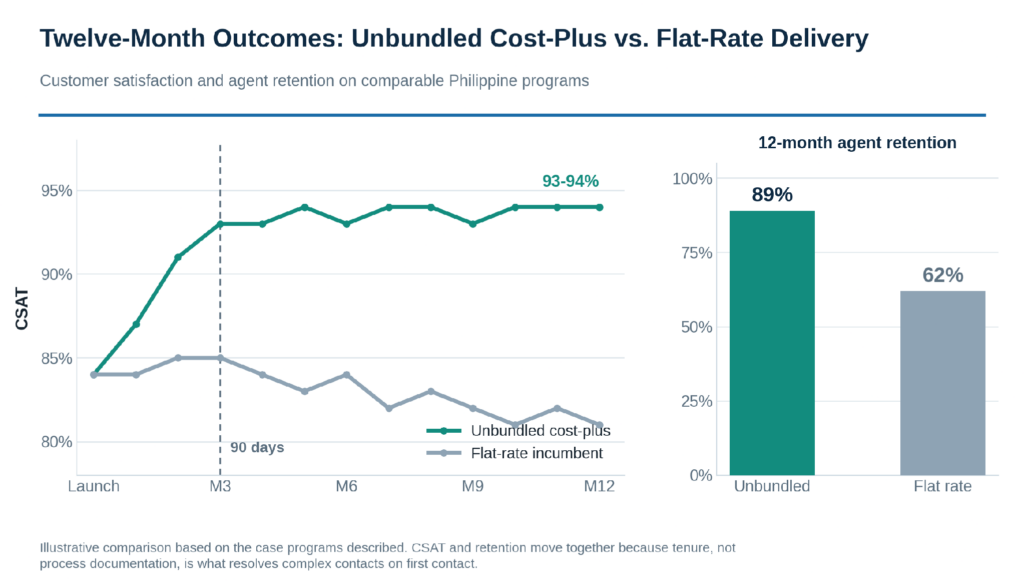
Figure 6. Twelve-month customer satisfaction and agent retention outcomes on unbundled cost-plus versus flat-rate delivery.
Lessons Learned
The two results are connected rather than coincidental. Retention and satisfaction move together because tenure, not process documentation, is what resolves complex contacts on first attempt. A thorough unbundled evaluation prevents unexpected operational cost and protects service quality at the same time, because the same opacity that hides a margin also hides an underfunded wage line.
Why Do Enterprise Buyers Rely on PITON-Global to Reduce Outsourcing Risk?
PITON-Global is a BPO advisory and sourcing consultancy that helps executive teams navigate provider selection in the Philippines. Operating as an independent partner rather than a transactional broker, it guides buyers through proposal normalization, technical diligence, and commercial structuring.
Who Is PITON-Global?
PITON-Global advises enterprise buyers on Philippine outsourcing across provider selection, proposal evaluation, and commercial structuring. Its relevance to a competitive bid process is specific: normalizing proposals correctly requires knowing what site overhead actually costs in Manila versus Clark, what wage bands the local market supports for a given skill tier, and which providers have the financial structure to accept a capped margin. In a market of more than 1,000 contact centers and back-office operations, none of that is visible from a rate card. Buyers still weighing the country itself can start with how the Philippines and India compare for call-center work.
How Does PITON-Global Differ from Traditional Outsourcing Brokers?
A commission-driven broker earns most when a particular provider is selected, which narrows the recommendation set to whichever partners pay best and ends the relationship at introduction — before the bids are even compared. An advisory-led model is organized around the buyer’s outcome: independent evaluation, objective recommendations that may include providers with no commercial relationship to the advisor, and continued involvement through diligence, negotiation, and transition. In proposal work the distinction is concrete, since an intermediary paid on placement has no incentive to report that every shortlisted bid is priced above market.
How Does PITON-Global’s Network of 100+ Vetted Philippine BPO Providers Benefit Organizations?
The network spans enterprise-grade providers across voice, back-office processing, IT services, and AI-assisted operations in Manila, Cebu, Clark, and Davao. Because candidates are pre-assessed for capacity, certifications, financial stability, and attrition performance — and screened for willingness to price transparently — buyers begin from a shortlist of providers that could realistically deliver the program rather than a field of bidders that responded to a tender. Qualification compresses from months to weeks.
How Does PITON-Global’s Advisory-Led Vendor Matching Process Work?
Matching runs from requirement definition to selection support. Volumes, channel mix, skill tier, coverage hours, and compliance obligations are documented; the vetted network is filtered for specialization, location tier, and right-sized capacity; competing proposals are restated onto one fully loaded basis so each line can be tested against market corridors; shortlisted providers are validated on security posture, continuity planning, attrition history, and SLA record; and the buyer is supported through reference calls, negotiation, and the construction of audit rights and governance cadence. Risk reduction is built into each stage rather than addressed at signature.
Why Do Organizations Use PITON-Global?
- Reduced outsourcing risk. Independent diligence on delivery capability, statutory compliance, and attrition history surfaces problems while there is still leverage to act.
- Eliminated proposal ambiguity. Normalization removes the assumption differences that make competing bids look further apart than they are.
- Improved provider fit. Matching on domain expertise and program size keeps the account strategic revenue for the provider rather than a rounding error.
- Accelerated vendor selection. A pre-qualified shortlist compresses a discovery cycle that typically runs for months into weeks.
- Better long-term outcomes. Commercial structuring and governance design continue past signature, where evaluation decisions are actually tested.
Frequently Asked Questions
What is the most common hidden cost in Philippine BPO proposals?
The most frequent are recurring replacement training fees for routine turnover, software seat licensing markups, telecom and usage overage charges, and unhedged foreign exchange variance surcharges. None is a surprise to the provider; each is left out for competitive reasons and retrofitted once switching costs are high.
How do unbundled cost-plus models benefit enterprise buyers?
Unbundled pricing gives complete visibility into wage distribution, statutory benefit funding, technology cost, and vendor profit, which prevents artificial margin expansion as the program scales. It also makes each line individually benchmarkable, so a renegotiation becomes an evidence-based conversation rather than a haggle over a single blended number.
Should companies require vendors to sign SLA-linked penalty frameworks?
Yes. Negotiate service credits worth a small share of monthly fees for critical SLA breaches, alongside earn-back mechanisms that let a vendor recover withheld fees through sustained recovery. Without earn-backs, a provider that has already lost the quarter’s credits has no financial reason to invest in fixing the problem.
What exchange rate protections should be included in a Philippine BPO contract?
A dual-currency corridor — commonly a narrow neutral band either side of the reference rate — where minor fluctuations are absorbed by the vendor and larger swings trigger shared adjustment. Name the reference rate and use a 90-day trailing average so neither party can time a request, and make the band symmetrical in both directions.
How long does a thorough proposal evaluation process take?
Three to six weeks for a complete comparison covering financial normalization, operational audits, compliance verification, reference checks, and technology integration testing. Compressing the timeline does not remove the work; it moves it into the first operating quarter, where it costs more to resolve.