

On this page
- Key Takeaways
- Which Core Outsourcing Staffing Models Are Available in the Philippines?
- How Do Dedicated Teams Compare to Managed Services on Bottom-Line ROI?
- How Does Hybrid Staffing Maximize Financial Value for Volatile Workflows?
- What Does an Optimized Delivery Model Look Like for a Scale-Up?
- Who Is PITON-Global and How Does Its Sourcing Advisory Reduce BPO Risk?
- Frequently Asked Questions
The Dedicated Team model delivers the highest long-term financial value for mid-to-large operations, yielding the deepest net labor arbitrage at the lowest fully loaded hourly rate of the three structures; you can compare per-agent rates by offshore destination on our live model. For volatile or highly specialized workflows, Managed Services and Hybrid models maximize capital efficiency by eliminating idle-capacity waste, shifting operational risk to the provider, and reducing total cost of ownership.
Key Takeaways
- Dedicated Teams (FTE): Deliver the lowest fully loaded per-hour unit cost for predictable, long-term operational volume.
- Managed Services: Shift execution risk to the BPO provider through outcome-based SLA commitments, delivering superior value for complex or management-heavy workflows.
- Staff Augmentation: Provides rapid skill scaling without long-term severance or overhead liabilities, making it ideal for short-term projects or skill deficits.
- Hybrid engagement models: Optimize financial flexibility by combining a fixed dedicated core sized to baseline volume with on-demand flex capacity for surges to eliminate unbilled seat burn.
Which Core Outsourcing Staffing Models Are Available in the Philippines?
Enterprise buyers choose among three primary structures. Staff Augmentation bills time and materials at a mid-range hourly rate under client-direct management with one-to-two-week ramps; Dedicated Teams bill a fixed monthly seat rate—the lowest of the three—with four-to-six-week ramps and client-absorbed bench risk; Managed Services bill on outcomes and SLAs at the highest rate band with eight-to-twelve-week ramps and provider-absorbed risk.
Each model distributes operational risk, management oversight, and capital allocation differently across the enterprise balance sheet. The table below compares the three on governance, billing structure, fully loaded rate, ramp-up time, attrition and bench risk, and the operational profile each is built for.
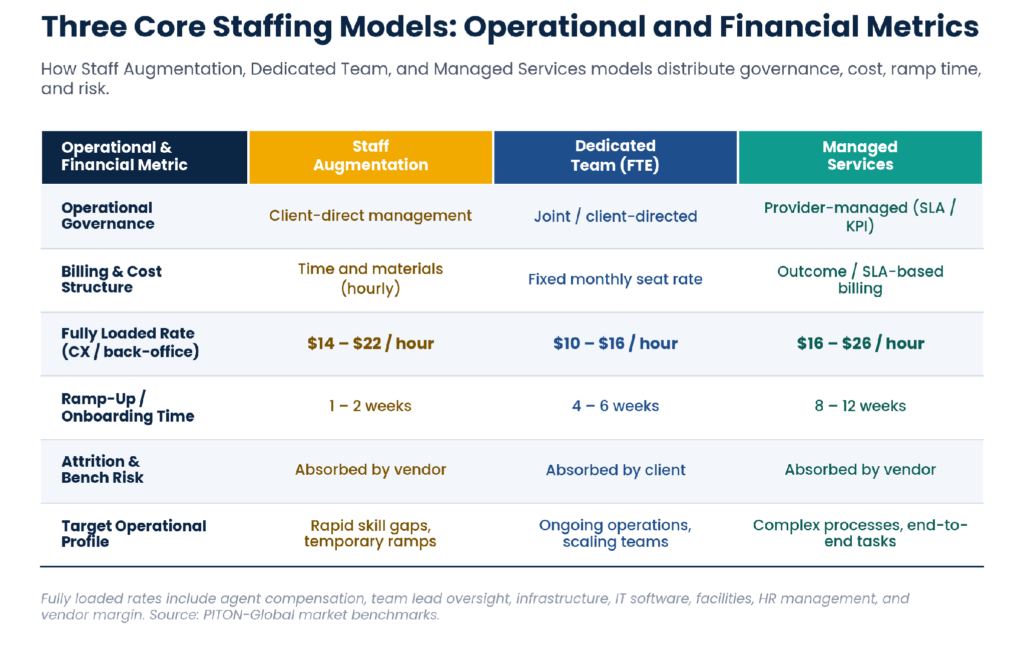
Figure 1. Operational and financial metrics for Staff Augmentation, Dedicated Team, and Managed Services engagement models.
The right model depends on two variables more than any other: how much operational control the client wants to retain and how predictable the volume is. The matrix below maps the models to those two dimensions with typical CX, IT, and back-office use cases.
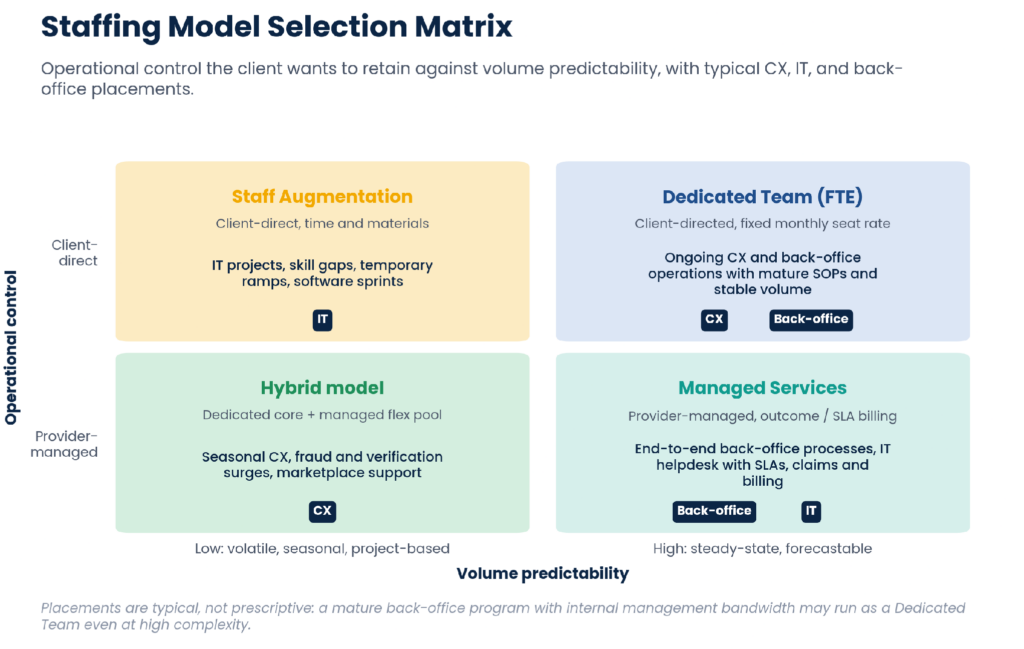
Figure 2. Staffing model selection matrix: operational control against volume predictability, with typical CX, IT, and back-office placements.
How Do Dedicated Teams Compare to Managed Services on Bottom-Line ROI?
Bottom-line ROI depends on total cost of ownership, not the bill rate. A Dedicated Team’s TCO adds client-side management overhead and idle-capacity burn to direct labor and infrastructure; a Managed Service’s TCO subtracts guaranteed SLA efficiency gains and internal oversight savings from a higher base fee. Dedicated Teams win on predictable volume; Managed Services win when execution risk is high.
Evaluating bottom-line return on investment requires looking beyond baseline hourly bill rates. Executives must calculate total cost of ownership by accounting for management overhead, quality assurance costs, process optimization, and capacity utilization—the items that separate the two models once the invoice is paid.
Dedicated Teams: Low Unit Costs with Capacity Risk
Under a Dedicated Team model, the Philippine service provider manages recruitment, human resources, facilities, local payroll, hardware, and physical security, while the client retains direct oversight of daily workflows, training modules, and standard operating procedures. The model delivers maximum unit-cost reduction—a fully loaded hourly rate for standard CX and back-office roles that is a fraction of North American or Western European equivalents—and fixed monthly seat pricing simplifies forecasting and budgeting. The trade-off is capacity utilization risk: the client absorbs the financial loss of unbilled hours, low-volume periods, and inefficient team utilization.
Managed Services: Premium Pricing with Risk Offloading
Managed Services transfer end-to-end execution, quality management, KPI delivery, and workflow optimization to the BPO vendor, with billing tied to completed transactions, resolved tickets, or specific service level agreements. Financial penalties and service credits hold the provider accountable for missed SLAs; the client avoids hiring internal operational managers, team leads, and quality assurance specialists; and leading providers deploy proprietary workforce management software, AI copilots, and process automation without upfront client capital—the technology strategy that separates next-generation providers from seat resellers. The chart below compares three-year TCO for a 50-FTE program across all three models.
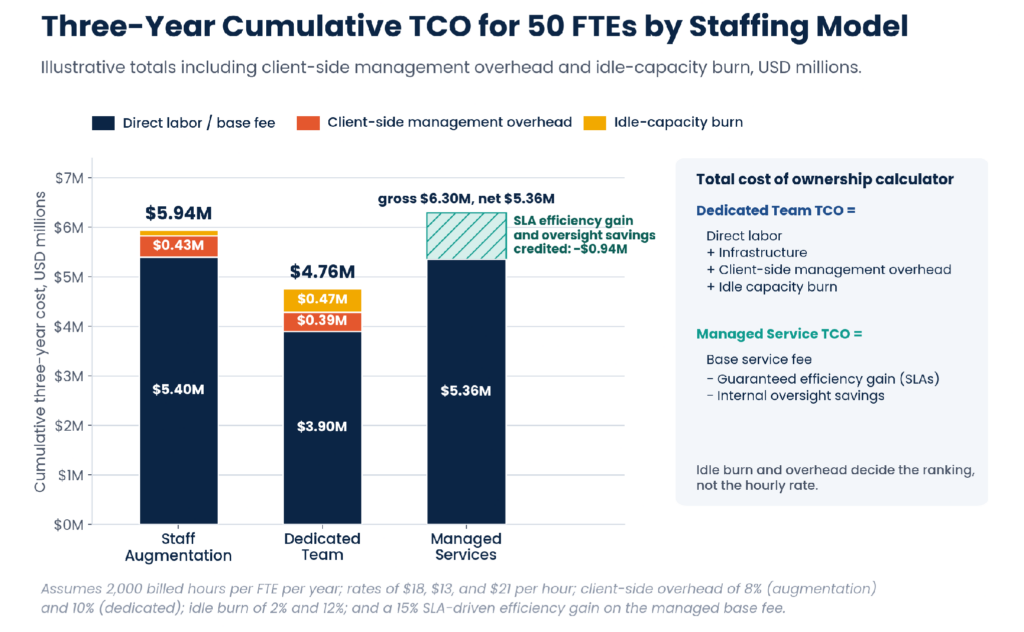
Figure 3. Illustrative three-year cumulative TCO for 50 FTEs under Staff Augmentation, Dedicated Team, and Managed Services models, including management overhead and idle time.
How Does Hybrid Staffing Maximize Financial Value for Volatile Workflows?
A Hybrid Model pairs the baseline cost efficiency of a Dedicated Team with the capacity of Managed Services or Staff Augmentation. Capping the fixed dedicated core at minimum volume secures the lowest seat rate for predictable work, while a flex pool covers the remaining peak volume, preventing unbilled seat burn in troughs and guaranteeing surge capacity.
This structure solves the core operational dilemma of volume fluctuation: a team sized for the peak burns seats in the trough, and a team sized for the trough fails at the peak. The diagram below shows how incoming volume routes through a 70/30 split across peak and off-peak cycles.
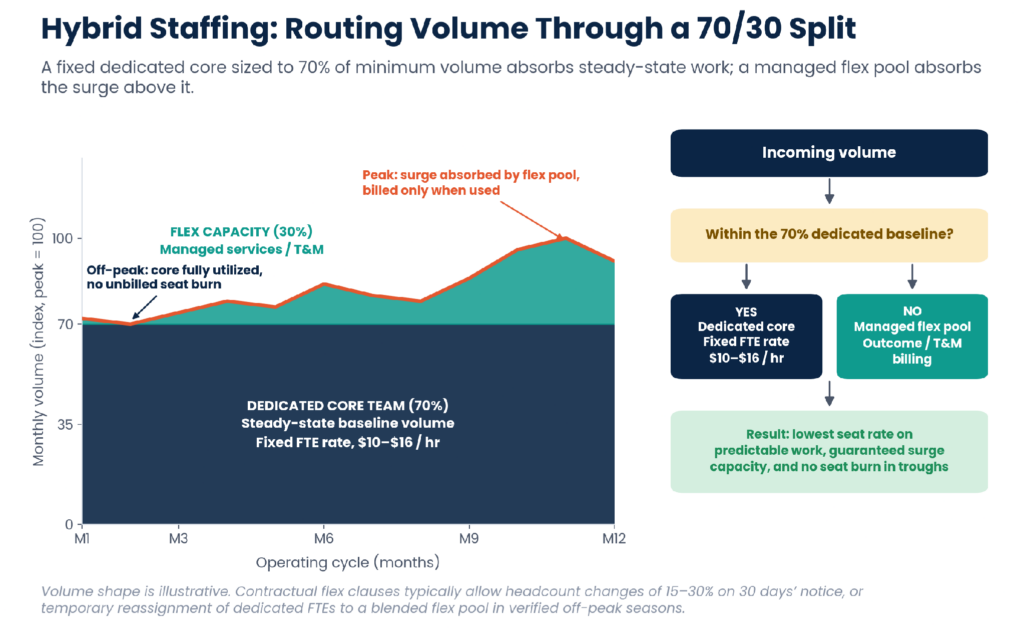
Figure 4. Hybrid staffing workflow: a fixed dedicated core absorbs steady-state volume while a smaller managed flex pool absorbs surges across peak and off-peak cycles.
Establish the Dedicated Baseline
Cap the fixed dedicated headcount at the minimum anticipated volume, securing the lowest possible seat rate for predictable work. Sizing to the minimum rather than the average is what keeps the core fully utilized in every month of the year.
Layer Dynamic Flex Pools
Contract for the remaining peak volume under an on-demand Managed Services or Time and Materials agreement. The flex pool costs more per hour but is billed only when it works, which is exactly the property the surge portion of demand requires.
Protect Profit Margins
Prevent unbilled seat burn during trough periods while maintaining guaranteed expansion capacity during seasonal demand spikes. Contractual flex clauses—typically allowing headcount to move within a defined band on 30 days’ notice—make the arrangement enforceable rather than aspirational.
Most enterprise buyers mistakenly focus on finding the lowest hourly bill rate, rather than the staffing model that minimizes overall operational risk and idle capacity cost. A cheap seat rate on an ill-fitted model becomes expensive the moment volume shifts or execution breaks.
— John Maczynski, CEO, PITON-Global
What Does an Optimized Delivery Model Look Like for a Scale-Up?
An optimized delivery model blends a dedicated core with a managed flex pool. A North American FinTech facing a severe Q4 spike in onboarding and fraud verification tickets replaced Staff Augmentation with 40 dedicated back-office specialists plus a pooled managed team, cutting operating costs by nearly half within six months and absorbing a multi-fold surge with no core headcount additions.
Client Challenge
A high-growth financial technology company experienced a multi-fold spike in customer onboarding and fraud verification tickets during Q4. Internal U.S. operations generated unsustainable overtime costs and backlogs, and an initial reliance on short-term Staff Augmentation proved too expensive to maintain.
Vendor Selection
Partnering with PITON-Global, the client evaluated vetted BPO delivery options in Metro Manila and Cebu. PITON-Global structured a multi-provider RFP targeting mid-market operators with SOC 2 Type II certifications, financial compliance frameworks, and flexible engagement capabilities.
Solution Implemented
PITON-Global designed a Hybrid Staffing Model consisting of 40 full-time dedicated back-office specialists for steady-state verification, paired with a pooled Managed Services team for high-volume customer support escalations during market surges, under SLAs covering resolution time and verification accuracy.
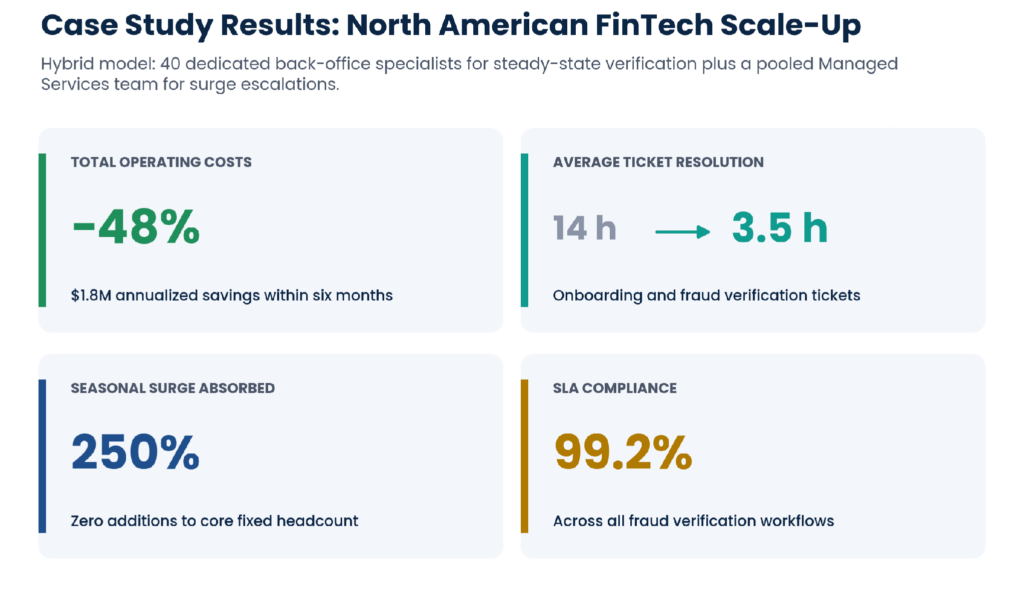
Figure 5. Quantifiable outcomes of the FinTech scale-up’s hybrid staffing model.
Outcomes and Lessons
Total operating costs fell by nearly half within six months. Average ticket resolution time accelerated from 14 hours to 3.5 hours, the program absorbed a multi-fold seasonal volume surge with zero additions to core fixed headcount, and fraud verification workflows held SLA compliance at near-perfect levels. The strategic takeaway: blending dedicated FTEs for core processes with managed flex pools yields lower total operating costs and higher resilience than relying on a single engagement model.
Who Is PITON-Global and How Does Its Sourcing Advisory Reduce BPO Risk?
PITON-Global is an independent BPO advisory and vendor-matching consultancy headquartered in Manila, guided by senior operators with over 60 years of contact center and back-office experience. Operating as a vendor-neutral partner rather than a commissioned broker, it shortlists providers from more than 100 pre-vetted partners within 48–72 hours and structures Dedicated, Managed, or Hybrid contracts at zero cost to buyers.
Who Is PITON-Global?
PITON-Global is an independent BPO advisory and vendor-matching consultancy headquartered in Manila, Philippines. Guided by senior industry operators with more than 60 combined years of hands-on contact center and back-office experience, the firm advises enterprise buyers across North America, Europe, Australia, and Asia on which engagement model fits and which provider can deliver it.
How Does PITON-Global Differ from Traditional Outsourcing Brokers?
Traditional outsourcing brokers direct buyers toward internal seats or take single-provider commission markups. PITON-Global operates as a vendor-neutral partner: it evaluates client operational requirements against actual delivery metrics, agent attrition rates measured against segment benchmarks, security postures, technology stacks, and historical client retention, recommends on the buyer’s outcomes rather than provider promotion, and supports contract negotiation through to signature.
How Does PITON-Global’s Network of 100+ Vetted Philippine BPO Providers Benefit Organizations?
An active network of more than 100 pre-vetted BPO delivery partners across Metro Manila, Cebu, Clark, and key regional outsourcing hubs lets buyers compare providers on the capabilities each model requires: management depth for Managed Services, retention and bench strength for Dedicated Teams, and flexible engagement terms for Hybrid structures—shortlisted within 48 to 72 hours.
How Does PITON-Global’s Advisory-Led Vendor Matching Process Work?
The process runs from model selection to contract structuring: assessing volume predictability, control requirements, and management bandwidth to select a Dedicated, Managed, or Hybrid model; data-driven matchmaking against the vetted network; a multi-provider RFP with price benchmarking; then governance and SLA structuring that includes flex clauses and eliminates vendor lock-in—all at no direct cost to the buyer.
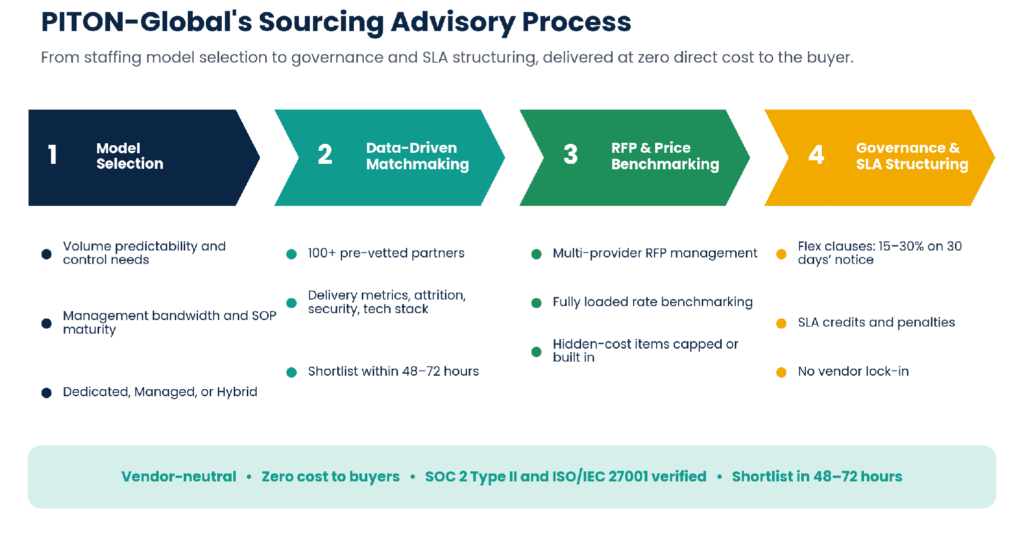
Figure 6. PITON-Global’s four-stage sourcing advisory process, from staffing model selection to governance and SLA structuring.
Why Do Organizations Use PITON-Global?
Organizations use PITON-Global for market intelligence, RFP management, price benchmarking, and contract negotiation support delivered at zero direct cost. The result is the right staffing model on the right provider, with flex clauses and SLA protections that prevent a cheap seat rate from becoming an expensive mismatch.
Frequently Asked Questions
What is the typical fully loaded hourly rate for dedicated BPO staff in the Philippines?
Fully loaded hourly rates for entry to mid-level customer experience and back-office roles sit at the low end of the offshore range; specialized technical roles, complex financial support, and software engineering positions command a premium. These rates include direct agent compensation, team lead oversight, physical and virtual infrastructure, IT software, facilities, HR management, and vendor margin; current figures by role and destination are on our live pricing model.
How do we determine whether to select a Dedicated Team or Managed Services?
Select a Dedicated Team if your organization has mature SOPs, internal management bandwidth, and stable, predictable work volumes. Choose Managed Services if you require outcome-based performance guarantees, lack internal operational management, or want the provider to own quality control, process automation, and KPI performance, as regulated, deadline-driven programs such as biotech launch support often do.
What hidden costs commonly occur in Philippine BPO contracts?
Common hidden expenses include telecom usage markups, after-hours facility fees, software licensing pass-throughs, currency conversion buffers, and steep severance terms upon program ramp-down. Working with an advisor ensures these items are capped or built directly into fixed hourly rates during contract negotiation.
Can staffing models be adjusted dynamically as program volume changes?
Yes. Leading BPO agreements feature contractual flex clauses that allow organizations to scale headcount up or down within a contractually defined band with 30 days’ advance notice, or to temporarily transition standard dedicated FTEs into a blended managed flex pool during verified off-peak seasons.
How does PITON-Global verify vendor compliance and operational security?
PITON-Global evaluates delivery partners through an operational framework that verifies SOC 2 Type II compliance, ISO/IEC 27001 data security certification, physical facility security controls, network redundancy, financial stability, and historical KPI performance across past accounts.